Passengers

Passengers

Posted on December 21, 2016 at 8:47 pm
Copyright Columbia Pictures 2016

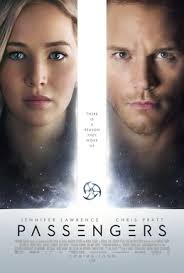
“Passengers” is beautiful to look at, a pretty story about pretty people in a pretty (outer space) setting, but it cannot overcome the ick factor of its premise.

Everyone’s favorite boy we wish lived next door, Chris Pratt, plays a likeable ordinary guy who works with his hands named Jim Preston, one of 5000 passengers and 250 crew in a spaceship on a hundred-year journey to a hospitable colonized planet. Like the spaceship in “Wall-E,” it is set up with every luxury, from sushi restaurant to a genial robot bartender (Michael Sheen). The people on board are in suspended animation for a hundred years, to be awakened four months before arrival, to enjoy the ship’s amenities and prepare for their new home. The ship is gorgeous, though I am not sure how practical it is.

But somehow Jim awakens 90 years early and there is no way to return to his hibernation. He is alone on the spaceship and his plan to emigrate to the new planet is not going to happen. Instead of being a pioneer in a fresh, optimistic new world, he is doomed to spend the rest of his days stranded, sure to die before anyone else on the ship is awake. The ship’s help kiosks briskly inform him that malfunction of the hibernation units is impossible, a reminder of the Titanic’s “unsinkable” hubris. He tries to send a message to the home base on earth, only to learn that it will be more than 30 years before he can get an answer.

So, he basically turns the spaceship into a man cave, living in dirty sweats, growing a beard, drinking, and playing one on no one basketball and one on avatar dance video game. Finally, almost mad with loneliness, he starts looking at the files of the 4999 people still sleeping on the ship, and finds himself captivated with one of them, a journalist from New York with the fantasy name Aurora Lane (Jennifer Lawrence). After many discussions with the robot bartender, he can no longer help himself. He knows it is wrong, but he wakes her up, and he lets her think it was due to the same malfunction that woke him.

Decades ago, movies used to have scenes where the guy grabbed the girl and she beat her fists helplessly against his chest, crying, “I hate you!” until he forced her into a passionate kiss, after which she melted into his arms. These were mostly romantic comedies, but we saw some of this and worse in drama, too. Remember Rhett carrying Scarlett up the stairs in “Gone With the Wind,” and 30 years later, Laura falling for her rapist, Luke, on “General Hospital.” (Also see: Zeus and Europa, the Sabine women, the silent classics “The Sheik” and “Son of the Sheik”) But that just doesn’t work any more.

Aurora is entirely a fantasy figure. Even her nudity is highly sexualized, where his is not. By taking away any shred of agency or consent the script sets up an insurmountable obstacle to any kind of relationship for Jim and Aurora, which it makes the fatal mistake of treating as surmountable. There’s the getting-to-know-you part, and then she she-learns-the-truth part and then the not-talking-to-him part, and then the work-together-or-everyone-dies part, but nothing can really support the idea of the romance it tries to persuade us is happening.

Parents should know that this film includes extended sci-fi action and peril, sad death with characters injured and a sad death, some disturbing images, issues of predatory behavior and consent, brief strong language, alcohol, sexual references and situations, and nudity.

Family discussion: Why did Aurora make that choice at the end of the film? What would you do if you were left alone?

If you like this, try: “Gravity” and “The Martian”
Related Tags:


Romance Science-Fiction
Why Him?

Why Him?

Posted on December 20, 2016 at 10:20 pm

Copyright 20th Century Fox

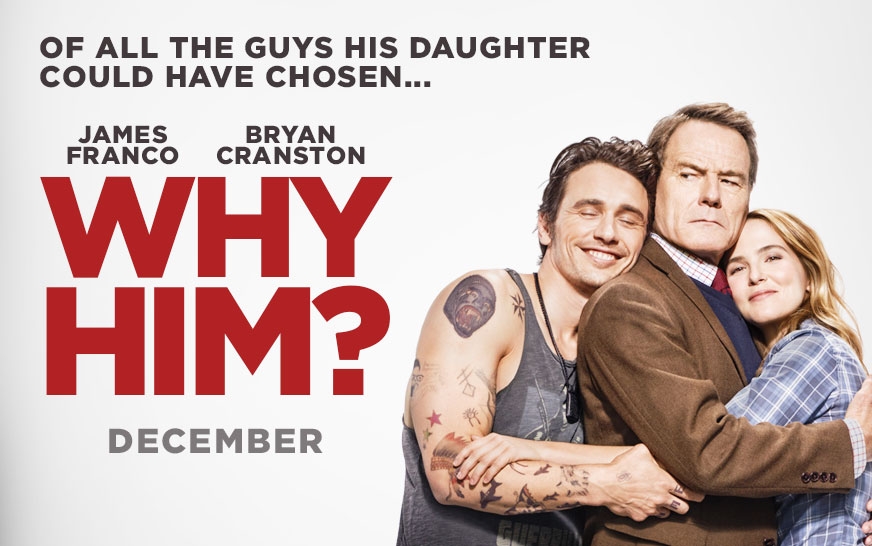
If you go to see “Why Him?” you will ask yourself, “Why Me?”

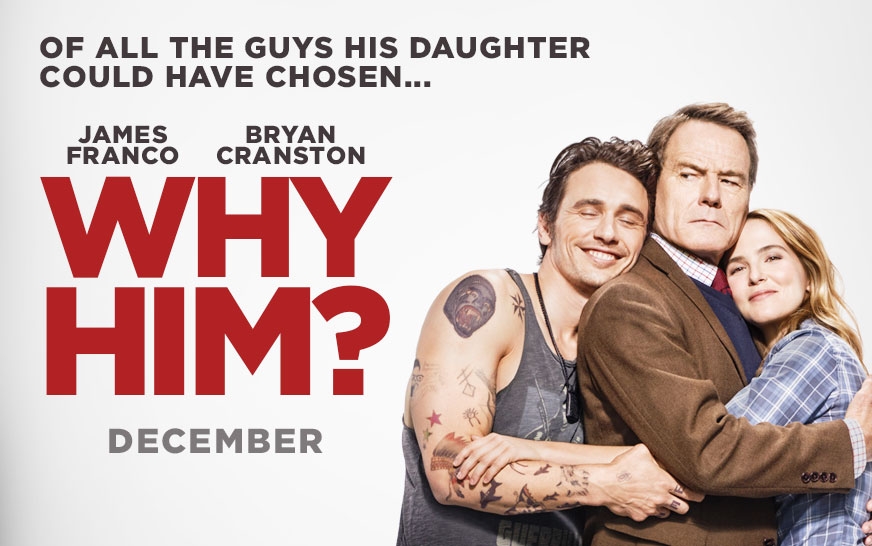
Some of the people behind “Meet the Parents” had the idea of basically making the same movie all over again. Of course they made it all over again twice with the sequels, but hey, this time let’s try a twist! How about if the dad is the normal one and it is the prospective son-in-law who is outrageous! And maybe if we have extended scenes of Bryan Cranston and Megan Mullally sitting on toilets, and enjoying it, and the cast getting drenched in moose urine, no one will notice that it is not actually funny. Believe me, I noticed. Over and over and over again.

Cranston plays Ned Fleming, a nice guy who loves his family. We first see him celebrating his birthday with his wife Barb (Mullally), teenage son Scotty (Griffin Gluck), and the employees of his printing business, who are like family, too. Ned’s daughter Stephanie (Zoey Deutch of “Everybody Wants Some!!”) Skypes in from her dorm room at Stanford. Her boyfriend, not realizing anyone can see her, comes into her room and takes his clothes off, thus letting Ned know, in front of all his friends, that she has a boyfriend with whom she has sex. So we’re in that skeezy category of films going back to “Take Her She’s Mine” and “The Impossible Years,” in which daddies are obsessed with their daughters’ sex lives.

It turns out that Stephanie’s beau is a daddy’s nightmare. Not only are they having sex, but Laird (James Franco)’s youth, sexuality, and wealth (he is a tech zillionaire) makes Ned feel emasculated and he hates not being Stephanie’s number one guy anymore. This come just as Ned has not told anyone that his business is doing poorly

The family goes to California to spend Christmas with Stephanie, and everything they learn about Laird just makes Ned feel more anguished. But have no feel — at some point following the moose urine and Japanese toilet jokes, there will be hugs all around.

Franco commits fully to the man-child Laird, and his charm and movie star smile makes up for some of the most appalling elements of the storyline and even gives us a hint of what Stephanie might see in him. Keegan-Michael Key adds some spark as Laird’s concierge/best friend, and there are a couple of clever lines. But disgusting and outrageous does not equal funny, no matter how much moose urine you pour onto it.

Parents should know that this film includes extremely crude and explicit humor including sexual references and situations and bathroom jokes, very strong and crude language, drinking, drugs, comic peril and violence.

Family discussion: How does your family treat the people who date its members? How were Laird and Ned alike?

If you like this, try: “Meet the Parents”

Related Tags:


Comedy
Sing

Sing

Posted on December 20, 2016 at 8:44 pm

B-
Lowest Recommended Age: Kindergarten - 3rd Grade
MPAA Rating: Rated PG for some rude humor and mild peril.
Profanity: Mild schoolyard language
Alcohol/ Drugs: None
Violence/ Scariness: Some peril, criminal activity, fire
Diversity Issues: Humor about disability
Date Released to Theaters: December 20, 2016
Date Released to DVD: March 20, 2017
Amazon.com ASIN: B01LTI0P1U
Copyright 2016 Illumination

“Sing” is an often-adorable, often-puzzlingly off-kilter animated film about animal singers putting on a show despite many obstacles, for the love of music and performing. What’s best about the film is simple — seeing a wild assortment of animal characters sing an even wilder assortment of songs, everything from Lady Gaga to Frank Sinatra to Taylor Swift to Christopher Cross. It works every time, with a nifty score from Joby Talbot tying it all together. The story around it, though, keeps getting derailed.

The concept harks back to the musicals of the 1930’s — the old “let’s put on a show.” Koala Buster Moon (Matthew McConaughey) is a failing impresario who is about to lose his theater. He has a devoted assistant with an unfortunate habit of losing her glass eye. Even more unfortunate, the movie seems to think we will find that hilarious.

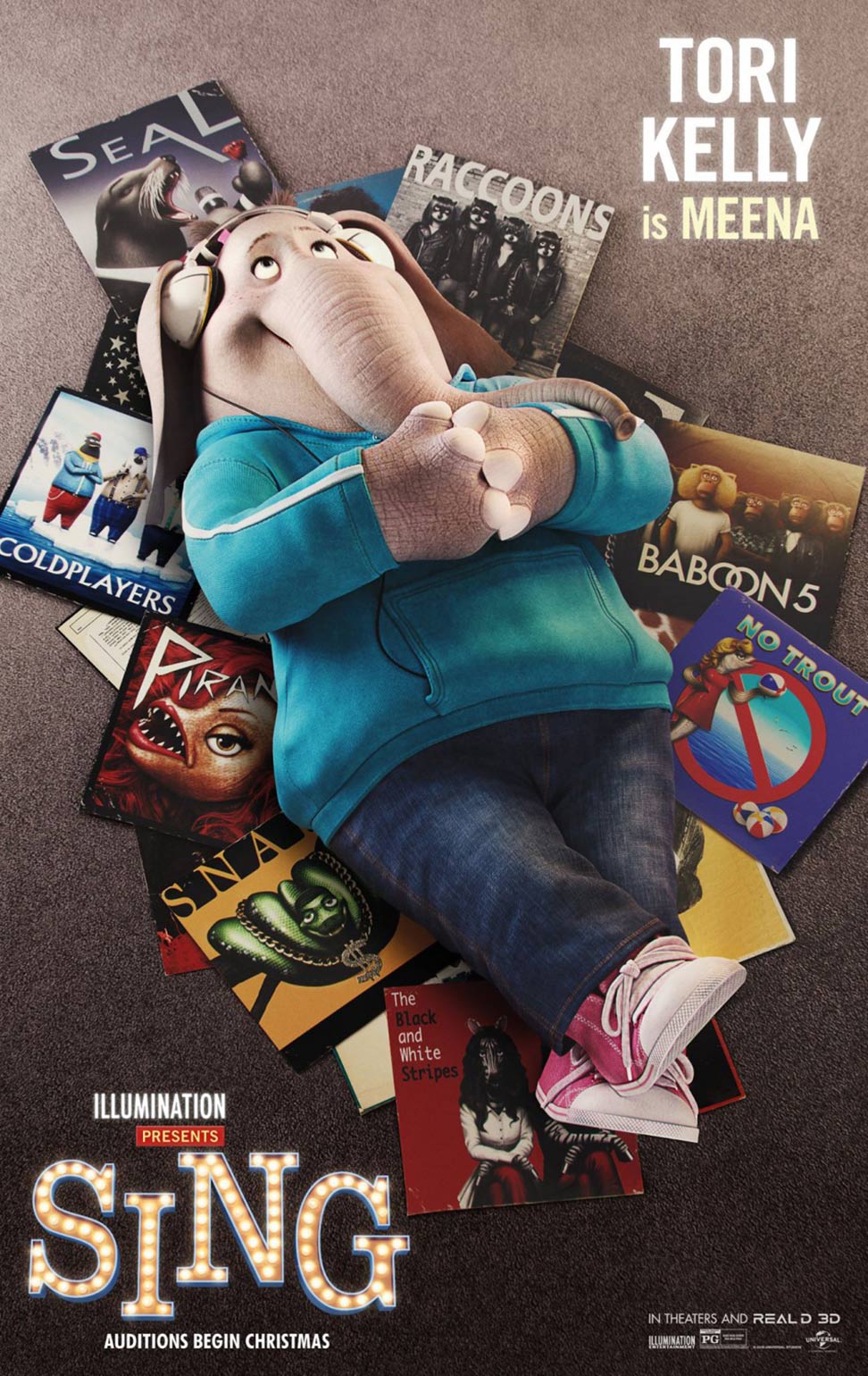
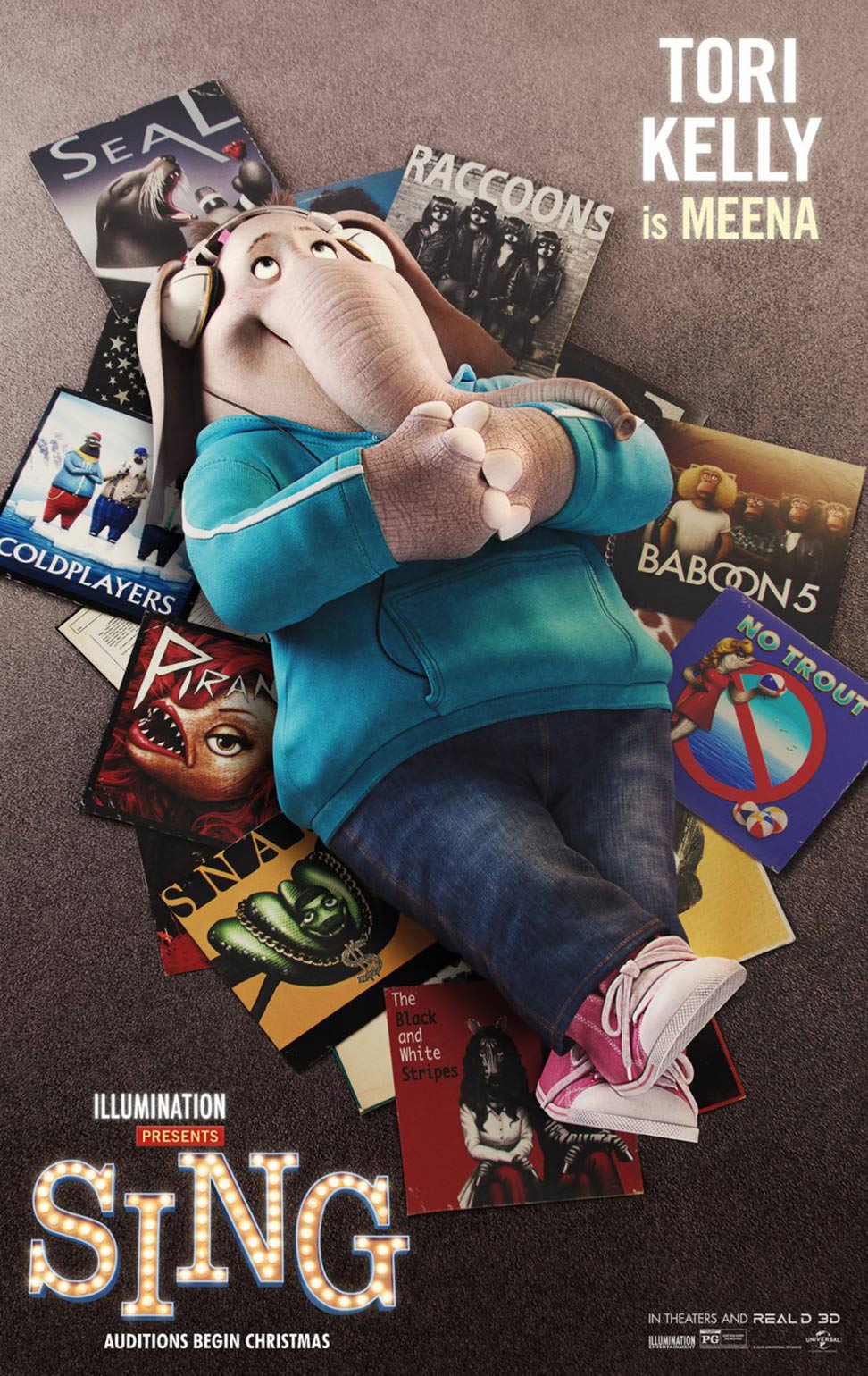
How about a singing competition! Great idea! Small problem — due to a mistake, the prize money has been vastly inflated and the invitations to participate widely distributed. Oh, well, on to the auditions! Hopefuls include a cynical mouse (Seth MacFarlane) who croons saloon songs, Ash, a punky hedgehog (Scarlett Johansson), a harried pig with dozens of children to care for (Reese Witherspoon), a strange pig named Gunter (Nick Kroll), Johnny, a teenage gorilla in a leather jacket and with a Cockney accent, (Taron Egerton), and Meena, a shy teenage elephant (real-life “American Idol” contestant Tori Kelly).

The singing is a delight and I was genuinely sorry that so many of the performances were just snippets. The same goes for the all-star cast, many of whom have just one or two lines. It never takes advantage of the animal setting and instead relies on overplotted backstories of the participants that are mostly a distraction, with one exception the Rube Goldberg contraption the mother pig creates to care for her children and oblivious husband while she is out singing. Johnny’s father leads a robbery gang, and they expect Johnny to act as lookout and getaway driver just when he needs to be at the theater. Ash has a boyfriend who does not realize how special she is. And Meena is just too shy to perform. The robbery sequence and subsequent visit to Johnny’s father in jail, a serious and scary fire, some predatory loan sharks, and that glass eye “humor” are all especially poor choices for a movie positioned for families with young children.

Parents should know that this film includes some slapstick humor, including a character whose false eye keeps popping out, criminal behavior involving a parent and teenage child, parent in prison, scary fire, business problems.

Family discussion: If you were going to perform, what song would you pick and why? What made Meena so shy and what helped her?

If you like this, try: “Zootopia” and “Despicable Me”

Related Tags:


Animation DVD/Blu-Ray Pick of the Week Musical
La La Land

La La Land

Posted on December 15, 2016 at 5:52 pm

A
Lowest Recommended Age: Middle School
MPAA Rating: Rated PG-13 for some language
Profanity: Some strong language
Alcohol/ Drugs: Social drinking
Violence/ Scariness: None
Diversity Issues: None
Date Released to Theaters: December 9, 2016
Date Released to DVD: April 24, 2017
Amazon.com ASIN: B01LTI1WAI

lalalandThe nickname for the California town whose literal translation is “City of Angels” comes from its initials: LA for Los Angeles. But “La La Land” also refers to the culture of its most notable industry, whether the reference is to the magic of its images of pretty people doing pretty things or to the instability of the various deals, relationships, and people behind them. The title of this exquisite film from writer/director Damien Chazelle refers to all of that and to the “la la” of music as well. Its bravura, breathtaking opening scene introduces us to the world of the story, with one of LA’s defining experiences — being stuck in traffic on a sunny day — transforming into a stunning, joyous, candy-colored musical number, with the camera swooping along as a part of the choreography in, apparently, one long shot.

Among the Angelenos on the 105 Freeway are barrista and aspiring actress Mia (Best Actress Oscar winner Emma Stone), rehearsing some dialog for an upcoming audition, and Sebastian (Ryan Gosling), a jazz musician with retro taste, as we can see from his watch, ring, and car. He honks the horn. She flips him the finger. They go their separate ways and we follow her to work at a coffee shop on a movie studio lot, near the window where Humphrey Bogart and Ingrid Bergman looked out as the Germans marched into Paris in “Casablanca.” The magic of movies — both the way they move and inspire us and the gulf between illusion and reality — shimmer throughout the film.

Mia and Sebastian bump into each other (once literally) a few more times, as we see each of them struggle. He wants to own a jazz club, but his business partner has betrayed him and he has had to take a job playing bland Christmas tunes in a restaurant for a demanding boss (played by J.K. Simmons, who won an Oscar for Chazelle’s first film, “Whiplash”). He can’t help himself, and seques into jazz, just as Mia wanders in and hears him. She is transfixed. He is fired.

They meet up again when he is playing another demeaning gig — an 80’s cover band performing at a party. And then, after another party, he chivalrously walks her to her car, and they begin to like each other — so much that they swing into a cheeky song and dance about how much they don’t. The song is “A Lovely Night,” and in the classic tradition of Fred Astaire and Ginger Rogers tunes like “A Fine Romance.” The lyrics may suggest they have no interest in each other, but we and they know from the way their dance seems so effortless, that it is very much the contrary.

The story moves through the seasons (though of course the weather never changes) and soon Mia and Sebastian are happily living together and encouraging each other. But he feels pressure to take a job with an old friend (John Legend) that means good money but constant travel. And good intentions and true affection are sometimes not enough.

Chazelle’s deep and spacious romanticism includes the city and its dreamers and music and movies and love itself. There are dozens of sure-handed, thoughtful touches, from the imperfect perfection of the singing and dancing, which lends an intimate, accessible quality, to the telling glimpses of life in Hollywood — the brief glimpse of a big star or a scene being filmed, the humiliation of auditions, the people who get halfway through a pastry and then demand their money back because it is not gluten-free, the endless wait for the valet parking after a party, the way Mia’s clothes go from bright primary colors to patterns, subdued hues, and then black and white. The songs, with music by Justin Hurwitz and lyrics by Benj Pasek and Justin Paul are captivating and evocative. Sebastian walks along the pier, whistling and then singing about whether he dares to hope. Mia and her roommates wear bright, primary-colored dresses and sing about going out to a party. And in one gorgeous number, the exhilaration of love is made literal as the couple dance up into the stars of the Griffith Observatory.

There are tributes/references to classic films like “Singin’ in the Rain,” “Rebel Without a Cause,” and “The Umbrellas of Cherbourg,” but this movie is not derivative. The storyline is deceptively simple, but the specificity of the detail, depth of understanding, and beautiful performances create true movie magic. “La La Land” is narratively ambitious and emotionally resonant, with a final ten minutes that are pure, wistful poetry. Chazelle and Hurwitz understand that some feelings are just so big they have to be sung and danced. And this movie made me so happy I wanted to create a musical number of my own. But I settled for watching this more two more times instead.

Parents should know that this film includes brief strong language and some emotional confrontations.

Family discussion: What did Mia and Sebastian learn from each other? How did their support for each other’s dreams change their careers? How did the music help tell the story?

If you like this, try: “Singin’ in the Rain” and “The Umbrellas of Cherbourg” — both inspirations for this film

Related Tags:


DVD/Blu-Ray Pick of the Week Musical Romance
Collateral Beauty

Collateral Beauty

Posted on December 14, 2016 at 4:41 pm

Copyright 2016 Warner Brothers

With typical understated euphemism, the military calls the damage inflicted on non-target sites and civilians “collateral damage.” Screenwriter Allan Loeb calls his new film a fable and he asks us to consider the possibility of “collateral beauty,” beauty that is revealed only when our pain forces us to pay attention. Emily asked in Thornton Wilder’s Our Town, “Does anyone ever realize life while they live it…every, every minute?” The State Manager answers, “No. Saints and poets maybe…they do some.” This movie would add, “And those who are grieving.”

Howard (Will Smith) is confident, charming, and successful when we first see him, asking his partners and the employees of his advertising agency, “What is your Why?” He is not asking them to participate in a discussion of existential metaphysics and man’s search for meaning. He was asking them to think about how to describe their client’s products to answer the potential customers’ Why questions. Death, Time, Life, according to Howard, are what we grapple with. “We long for love, we wish for more time, we fear death.” Products that help people feel that they have some control over mortality and intimacy are the ones that will sell.

But three years later, Howard has suffered the most shattering loss of all, the death of a child. He sits in his office creating elaborate domino structures and then watching them fall. He’s “the domino champion of crazytown” and the jobs of everyone in the company are at stake.

Howard no longer even speaks to his friends and colleagues, Whit (Edward Norton), Claire (Kate Winslet), and Simon (Michael Pena) and he no longer meets with clients. The business is in trouble. They have one hope — a sale of the company. But Howard will not discuss it, and he controls the majority of the stock.

Desperate, Whit, Claire, and Simon hire a detective (Ann Dowd) to help them build a case that Howard is not mentally stable enough to control his voting shares. She tells them Howard has been writing letters to express his pain. He has written to Death, to Love, and to Time. And so Whit, Claire, and Simon hire three actors to play the roles of Death (Helen Mirren), Love (Keira Knightley), and Time (Jacob Latimore), to answer Howard’s letters. Best case scenario, they make it possible for him to move forward by engaging directly with his questions about life and pain and loss and meaning. Worst case scenario, they document his mental instability so they can override his ability to block the deal.

White, Claire, and Simon each have their own problems, it turns out, and the actors provide some gentle guidance on that as well. And Howard is provoked into responding. Each encounter makes it possible for him to take another step toward re-engaging with the world, including attending a grief support group for parents whose children have died.

I was touched by the film’s willingness to do what it asks Howard to do — to confront death, love, and time and ask what it all means and why it hurts so much. Its heartfelt sincerity and lovely performances beguiled me into its world. It is worth seeing for Mirren’s exquisitely witty turn alone. She is clearly having a great time playing the part of a Capital R Theatrical Capital-A Actress. Norton is also excellent, especially in scenes between Whit and his tween daughter who is furious at him for cheating on her mother. Naomie Harris as the leader of the support group has a sweet gravity that is as important to bringing some grounding to Howard as his conversations with the embodiment of abstract concepts. And Smith brings all of his full-out charisma to the role of a man who cannot figure out how to go on when he has lost everything that matters because his view of the world has been shattered into sub-atomic particles and nothing makes sense. Howard has become a man who spends days adjusting the precise placement of elaborate domino structures and then knocks them down and leaves the room without watching the way they knock each other down.

The raw elements of Smith’s acting anchor the more fanciful and symbolic elements of the story, tenderly told, with a conclusion of warmth, healing, and perhaps some connection to a fourth spirit, hope.

Parents should know that this film includes themes of loss and devastating grief, including death of children, and a few swear words.

Family discussion: If you wrote letters to Time, Death, and Love, what would you say? What other concepts would you write to? What is collateral beauty, and does it take a profound loss to be able to see it?

If you like this, try; “Our Town,” “Truly, Madly, Deeply” and “The Pursuit of Happyness”

Related Tags:


Not specified
THE MOVIE MOM® is a registered trademark of Nell Minow. Use of the mark without express consent from Nell Minow constitutes trademark infringement and unfair competition in violation of federal and state laws. All material © Nell Minow 1995-2026, all rights reserved, and no use or republication is permitted without explicit permission. This site hosts Nell Minow’s Movie Mom® archive, with material that originally appeared on Yahoo! Movies, Beliefnet, and other sources. Much of her new material can be found at Rogerebert.com, Huffington Post, and WheretoWatch. Her books include The Movie Mom’s Guide to Family Movies and 101 Must-See Movie Moments, and she can be heard each week on radio stations across the country.

Website Designed by Max LaZebnik