The Edge of Seventeen

The Edge of Seventeen

Posted on November 17, 2016 at 5:42 pm

Copyright 2016 STX
Copyright 2016 STX
A psychiatrist once told me that just as an infant can have fevers that would be lethal in an adult, a teenager can have symptoms that would be evidence of psychosis at any other stage of life. Mood swings, the feeling that everyone is looking at you, disordered thinking, bizarre appearance: you might be having some sort of breakdown, or you just might be an adolescent. Stories about that intensely traumatic age connect to those of us who have been through it and those who are in the midst of it with a visceral sense of recognition, and, if we’re lucky, a bittersweet humor.

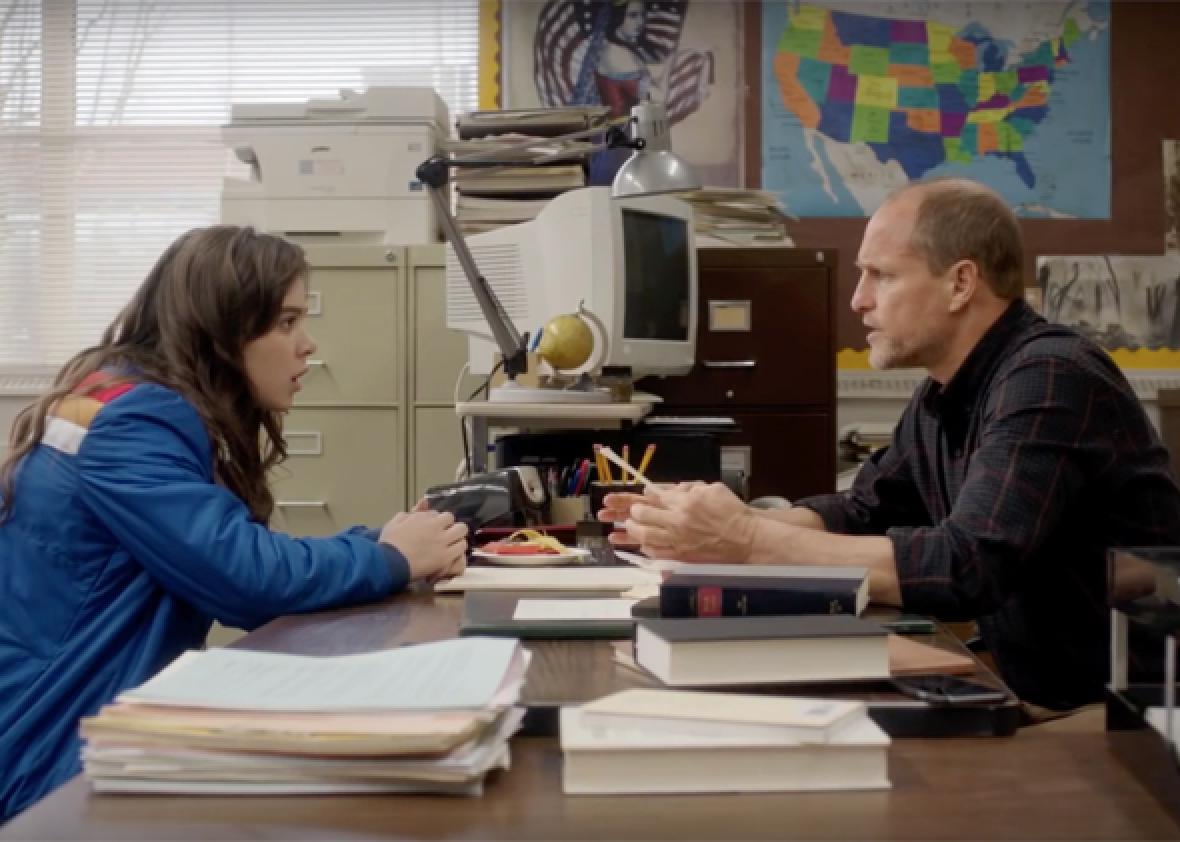
“Edge of Seventeen,” written and directed by Kelly Fremon Craig, captures the intensity and chaos and drama drama drama of this age. Hailee Steinfeld plays Nadine, who, like many 17-year-olds, is certain that she is the only person on earth who truly understands what it is to suffer. She actually has experienced a terrible loss, the death of her father, which has left her remaining family fragile. Her older brother Darian (Blake Jenner of “Everybody Wants Some!!”) compensates by being perfect in every disgusting way possible, from Nadine’s perspective. He is handsome, talented, athletic, and popular. That leaves nothing left for her but to be awkward and miserable.

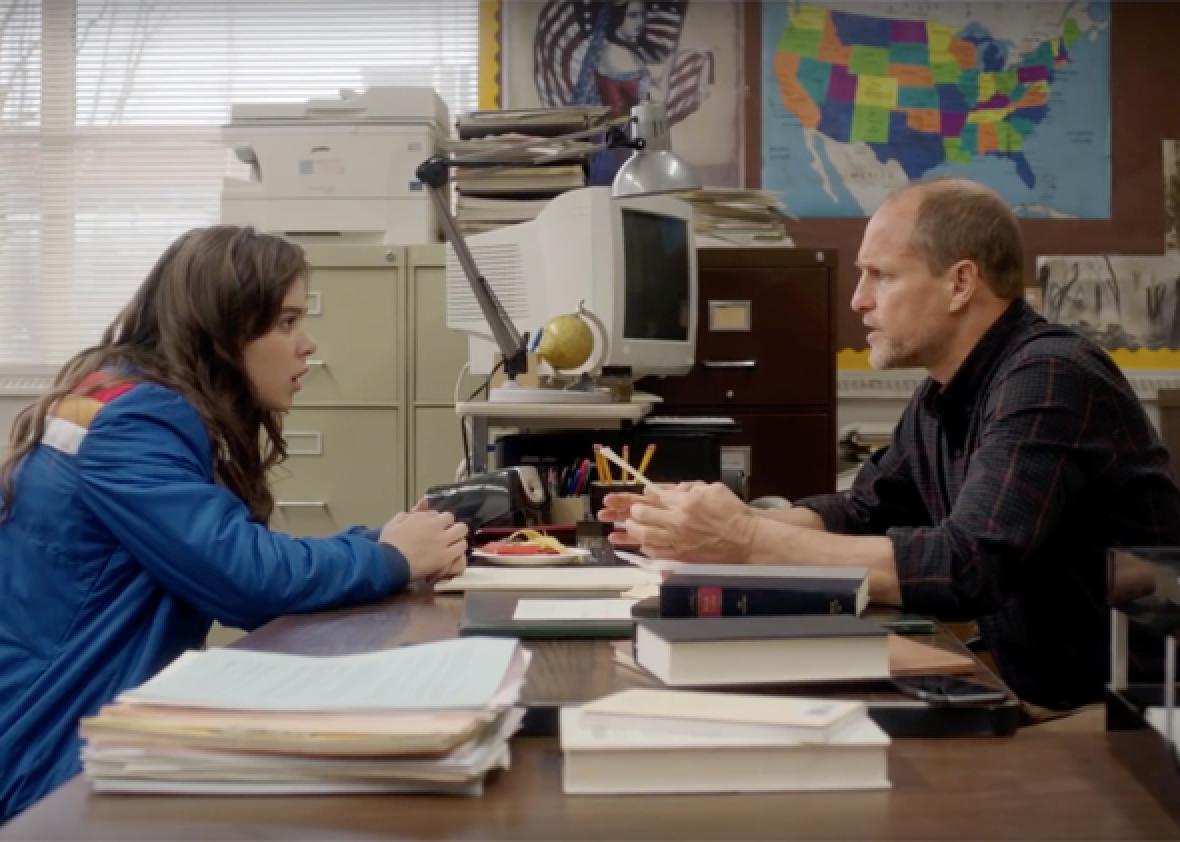
The only thing good in her life, she thinks, is her endlessly supportive and understanding BFF Krista (Haley Lu Richardson), who sympathizes with Nadine about the misery of having no father, a perfect brother, and a crush on an unattainable boy who works at Petland in the mall (Alexander Calvert as Nick). She also has a teacher named Mr. Bruner, played with perfectly dry, understated wit by Woody Harrelson, who knows teenagers well enough to understand that the best way to reassure Nadine is not to try to comfort her. When she trounces into the classroom where he is eating lunch alone to tell him she has to kill herself, he responds by noting mildly that in fact she has just interrupted his own creation of a suicide note. “As some of you know, I have 32 fleeting minutes of happiness per school day during lunch which has been eaten up again and again by the same especially badly dressed student and I finally thought, you know what, I would rather have the dark, empty nothingness.” She thinks she wants everyone to be as fraught as she is. He knows how to strike just the right balance of detachment and sympathy.

So when she tries to cancel a sexually explicit invitation to Nick but accidentally sends it instead, Mr. Bruner is there to take a look and point out that she should be more careful about run-on sentences. The reason she is talking to him about it instead of Krista is that Krista, the single good thing in her life, has committed the ultimate betrayal. She and Darien are in a relationship. Nadine is in such a severe state of collapse that she does not notice that there is a smart, handsome, very nice boy interested in her (Hayden Szeto in a star-making performance as Erwin).

The film itself has that same perceptive sympathy for the agonies of adulthood, allowing us to laugh at Nadine only because we know she’ll be fine — she’s going to grow up and make this movie.

Parents should know that this movie has very explicit and crude language, sexual references, and non-explicit sexual situations, a car accident with a sad (offscreen) death of a parent), and teen drinking.

Family discussion: How did Nadine, Darien, and their mother express their grief differently? Is it easier being the perfect one? What do you do to feel better?

If you like this, try: “Rocket Science,” “Thumbsucker,” and “The Duff”

Related Tags:


Comedy Coming of age Drama Romance School Stories about Teens
Arrival

Arrival

Posted on November 10, 2016 at 5:26 pm

B+
Lowest Recommended Age: Middle School
MPAA Rating: Rated PG-13 for brief strong language
Profanity: Brief strong language
Alcohol/ Drugs: Some drinking
Violence/ Scariness: Very sad death of a child, peril
Diversity Issues: Diverse characters
Date Released to Theaters: November 11, 2016
Date Released to DVD: February 13, 2017
Amazon.com ASIN: B01LTHYE0O

Copyright 2016 Paramount
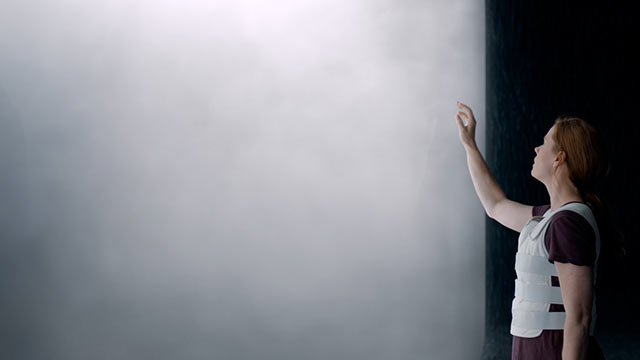
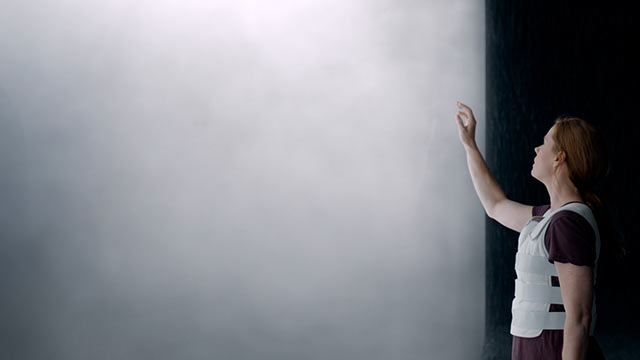
It’s called “Arrival.” Not “Attack” or “War of the Worlds.” In this thought-provoking, conceptually ambitious film, the creatures from another world just…arrive. At twelve points around the globe, huge, monolithic spacecraft that look like flying saucers turned sideways are suddenly just there. What do you do? How do you determine the intentions and capacities for harm from a species of creature with whom you do not have the most fundamental experiences and assumptions in common? Do they even have a language we are capable of understanding? Do they have the capacity to speak or write? Do we have the capacity to understand? Is this “ET” or “Battlefield Earth?” Or maybe that “Twilight Zone” episode where the book the aliens bring titled To Serve Man turns out to be a cookbook?

And how can we tell? This is not one of those sci-fi movies where the aliens get some TV signals and teach themselves English by watching game shows and sitcoms. So, the US military seeks out a linguist (Amy Adams as Dr. Louise Banks) because before we can decide what our response will be, we have to try to find a way to figure out how to communicate with them. “Language is the foundation of civilization,” she says to another expert being transported to the alien ship with her. “No,” he tells her. “It is science.” He is a physicist (Jeremy Renner as Dr. Ian Donnelly). If you think that both sets of skills will be necessary, that they will find a way to communicate, and find some connection with one another as well, you are right, but it will still surprise you all the way to the end.

Director Denis Villeneuve is not afraid to take on big issues and complex questions. And, as always in movies about aliens, it is more about who we are than who they are. Positioning us against creatures who are completely unknown requires us to think more deeply about our assumptions and capabilities.

Louise figures out a way to begin to communicate with the floating squid-like creatures. But is the word they are conveying “tool” or “weapon?” And will humans around the world be able to find a way to work together or will one country undermine our efforts to communicate by attacking the alien ships? We may be better at communicating with other species than our own.

The details really matter here and production designer Patrice Vermette fills the screen with thoughtful, illuminating touches from the Brancusi-like sculptural curves of the spacecraft to the calligraphy-like symbols created by the aliens. Striking images inspire awe and wonder in us as they do the characters. And the Chomsky-esque notions that language shapes our thinking even more than our thinking shapes language is conveyed in the film’s own structure as well as its dialog. Ultimately, it is a reminder of the power of communication, with movies themselves as one of humanity’s best examples.

Parents should know that this movie’s theme includes worldwide threats, with some peril, very sad illness and death of a child, divorce, and some strong language.

Family discussion: Which is the foundation of civilization, language or science? Or is it something else? What would you ask the aliens?

If you like this, try: “Close Encounters of the Third Kind” and “2001: A Space Odyssey”

Related Tags:


Drama DVD/Blu-Ray Pick of the Week Science-Fiction
Almost Christmas

Almost Christmas

Posted on November 10, 2016 at 5:24 pm

Copyright Universal 2016

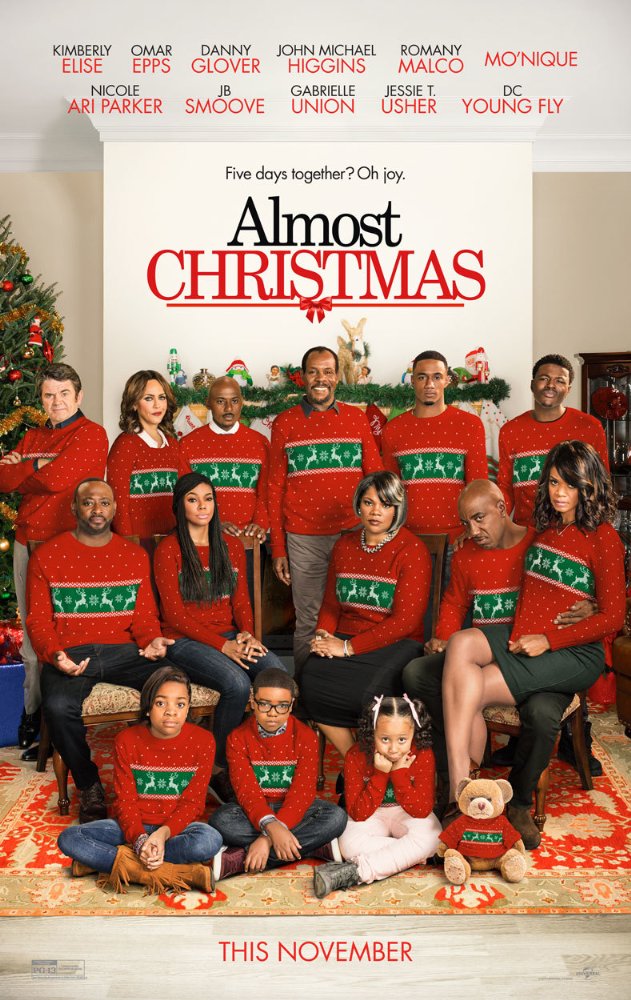
In “Almost Christmas,” Danny Glover plays Walter, a recent widower who spends a lot of time in the kitchen, trying over and over again to replicate his late wife’s legendary sweet potato pie. What he wants to replicate, of course, is the time when his family was all together, as shown in a heart-tugging, gracefully edited opening credit sequence, with the years melting into each other from 1971 to 2015. A young couple embraces on a mattress on the floor and, as it happens in life, an eye blink later they have three children, and then, as a bit of a late surprise, a fourth. The children are all adults now, coming home for the first Christmas since their mother died, and Walter wants it to be a time of reconnection. For that, he needs the sweet potato pie and it has to be just like hers.

Writer/director David Talbert (“Baggage Claim”) is trying for his own version of a sweet potato pie with this film, mixing in the standard ingredients for a Christmas family gathering comedy/drama movie. So, there are adult siblings with ongoing conflicts, a dad who is spending too much time on work, precocious kids (in this case, happily uploading every element of family dysfunction on social media), church, a guest star (though why you would put Gladys Knight in a film and not let her sing is beyond me), family traditions, a kitchen disaster, secrets to be revealed, a rekindled romance, a busted marriage, high maintenance in-laws, and, of course Christmas meaning and reconciliation magic and a lot of food. In other words, other than running into Gladys Knight, it is pretty much what goes on around the world at Christmas.

Talbert’s sweet potato pie of a movie has the right ingredients, and if they are not always combined just right, it still makes for a treat, with an exceptional cast and enough laughs to keep us going until the exact right moment for some tears.

Walter’s older son is Christian (Romany Malco), a husband and father of two who is running for Congress (none of this storyline makes any sense as Christmas is at least 11 months before the next election and the issue he gets caught up in is municipal, not federal, but okay). Malco is terrific in an unusually understated role. The look on his face as Walter asks him to speak at the homeless shelter his mother was devoted to shows endless tenderness and loss. His wife (an underused Nicole Ari Parker) is mostly there to remind him that he should not take time away from the family for his campaign. The youngest of Walter’s children is Evan (Jessie T. Usher), a college football player being scouted for the NFL draft, hiding an addiction to painkillers.

Their two sisters are Rachel (co-producer Gabrielle Union), a fiercely independent single mom and law student, and Cheryl (Kimberly Elise), a dentist married to a know-it-all former basketball player (J.B. Smoove), who is still a player, if you know what I mean.

Walter’s outspoken sister-in-law, a backup singer named May (Mo’Nique) arrives to wear a wild assortment of wigs and prepare an even wilder assortment of exotic foods that no one will touch. Rachel’s high school friend (Omar Epps) would like to renew their acquaintance. And Jasmine (Keri Hilson), Christian’s campaign manager (John Michael Higgins) and Evan’s friend (D.C. Young Fly) show up for various complications.

Like Walter’s pie, it’s not quite as good as the real thing. It would fit it well with Hallmark’s line-up of non-stop Christmas movies from Halloween through New Year’s Day. But there’s a reason those movies are so popular. They remind us of our own chaotic but still memorable holidays and our own difficult but still wonderful families.

Parents should know that this film includes some sexual references and a non-explicit situation, prescription drug abuse, sad offscreen death of a parent, offscreen car crash with injuries, gun, and some strong and explicit language.

Family discussion: What is your family’s favorite recipe? Why was it hard for the sisters to get along?

If you like this, try: “This Christmas”

Related Tags:


Comedy Drama Family Issues Holidays
Loving

Loving

Posted on November 10, 2016 at 5:21 pm

A-
Lowest Recommended Age: Middle School
MPAA Rating: Rated PG-13 for thematic elements
Profanity: Racist epithets
Alcohol/ Drugs: Some alchohol
Violence/ Scariness: Racism, some shoving, child hurt in accident
Diversity Issues: A theme of the movie
Date Released to Theaters: November 11, 2016
Date Released to DVD: February 6, 2017
Amazon.com ASIN: B01LTHZK2U

Copyright 2016  Focus
Copyright 2016 Focus
We don’t have to see how they met. We don’t have to see how he worked up the courage to ask her out or their first misunderstanding, or watch her try on different outfits before their big date. “Loving,” written and directed by Jeff Nichols (“Midnight Special,” “Mud”) brings us into the story of Richard and Mildred Loving (Joel Edgerton and Oscar nominee Ruth Negga) as they have a very short, very simple, but very meaningful conversation. She pauses, and we can see on her face that she does not know how he will react and is perhaps afraid to hope. Finally, she says it: “I’m pregnant.”

There is a pause, only a few seconds but it feels much longer. Finally he says only, “That’s great.” But it is clear that he is overjoyed that their love has created a child and he is fully committed to her. And it is clear, too, that they are not fully aware of the ramifications of having a child when the mother is black, the father is white, and the Commonwealth of Virginia, which shut down its entire school system just four years earlier in response to the Supreme Court’s Brown v. Board of Education decision, prohibits marriage or cohabitation between people of different races specifically because it does not want mixed-race children to be born.

Washington D.C. allows inter-racial marriage, so they are married there in 1958, and return home.  One night the sheriff crashes into their home as they are sleeping in their bed, their marriage license on the wall, and arrests them.  The judge suspends their sentence only if they will agree to leave the state and never return together.

They live with family in Washington, and raise three children.  But Mildred wants to go home. Nichols conveys the Edenic quality of the countryside they love. The Civil Rights movement has begun, so she writes to Attorney General Robert Kennedy to ask for his help.  He puts her in touch with the American Civil Liberties Union, a nonprofit that protects Constitutional rights. Two idealistic, if inexperienced, young lawyers (Nick Kroll and Jon Bass) want to take their case to the Supreme Court, which can invalidate all 16 state miscegenation laws.

Nichols keeps the legal stuff at the edges of the story. His focus is on the Lovings and their community, and the film is brimming with small, beautifully realized, evocative details. A dinner scene shows how completely Richard is accepted as a part of Mildred’s family. But we also see a frank conversation where a black man tells Richard that they may be alike, but Richard can “fix” his problem with the bigoted law by leaving Mildred while there is nothing they can do to “fix” theirs.

Richard’s mother, a midwife, only needs a few words to let Richard know that she did not give the police any information about where the Lovings were (and to let him know she was not entirely happy about the marriage, though she treats Mildred with kindness). We see a baleful glance from a defeated white competitor in a car race that could indicate the source of the complaint to the sheriff.

We see Richard’s careful, capable hands stirring mortar and laying concrete blocks and Mildred caring for the children and sitting at the kitchen table to write to the Attorney General. And, in a re-creation of the famous photo in LIFE Magazine by Grey Villet (a nice cameo by Nichols regular Michael Shannon), we see their quiet pleasure in each other as they laugh at the “Andy Griffith Show” episode about Aunt Bee’s pickles. He may need a lawyer to tell the nine old men on the Supreme Court he loves his wife. We see it in every frame.

Parents should know that this film depicts historic racism with some offensive epithets. The movie also includes a childbirth scene and an (off-screen) accident involving a child.

Family discussion: If you could take a case to the Supreme Court, what would it be?  What do we learn about the Lovings from seeing them with their families?

If you like this, try: the documentary “The Loving Story

Related Tags:


Based on a true story Drama DVD/Blu-Ray Pick of the Week Features & Top 10s Race and Diversity Romance
Doctor Strange

Doctor Strange

Posted on November 3, 2016 at 5:42 pm

B+
Lowest Recommended Age: Middle School
MPAA Rating: Rated PG-13 for sci-fi violence and action throughout, and an intense crash sequence
Profanity: Some strong language
Alcohol/ Drugs: None
Violence/ Scariness: Prolonged fantasy/superhero peril and violence, serious car accident, characters injured and killed, some disturbing images
Diversity Issues: Diverse characters (Asian male character in the comics portrayed by a white actress)
Date Released to Theaters: November 4, 2016

Doctor_Strange_posterIf they ever give a Best Supporting Prop Oscar, it should go to Doctor Strange’s Cape of Levitation, the most endearing magical implement/sidekick since Sorceror Mickey’s brooms in “Fantasia.” And if they ever give out a Best Superhero Movie Producer and Sustainer of the MCU, the lifetime achievement version should go to Kevin Feige, who has once again figured out just the right balance between consistency and distinctiveness, between action and wit, and, perhaps the most difficult hurdle, between magic and superpowers. “Doctor Strange” has a superb cast, a witty script, and some knockout special effects.

Doctor (not Dr.) Strange is a brilliant neurosurgeon. He is also arrogant and obsessed with work with a biting, acerbic wit. If this sounds a bit Tony Stark-ish, you’re on the right track.

He is severely injured in a car accident.  (Distracted driving, kids, wait to send that text or review that CAT scan image until you have safely parked the car.)  His hands are shattered, with nerve damage and tremors, which will end his career as a surgeon.  The man who prided himself on being able to diagnose and cure the most hopeless cases cannot find a way to heal himself.

And then the man of rationality and science, with nothing more to lose, has to try something new. He hears of a man who found a miraculous cure in Nepal, so, despite his skepticism about “alternative” medicine, he goes there only to find that what is involved is an entirely “alternative” way of thinking about the world, the universe, and, perhaps most difficult, himself.

His sensei is known as The Ancient One (the white female Tilda Swinton as a character portrayed as an Asian male in the comics), an ageless and endlessly wise and powerful teacher who shows Strange that the reality he believes he understands and can control is one of many.  The Avengers protect the material world from threats, but The Ancient One and her accolytes protect us from magical threats. Is it indelicate to point out that the most severe threats are all coming from former students, a la Darth Vader and Kylo Ren, and Professor X’s former students, so maybe the best course is for The Ancient One to shut down the school entirely?  And follow her own advice that if you silence your ego your power will rise?

Oh, who cares. This is when we start to get the very cool special effects, with “Inception”-style planes folding over each other and M.C. Escher-style chases.  And you gotta love a neuro-surgeon turned wizard who throws down references to Bob Seger and Beyoncé and, in the big, big moment, finds a solution that is as clever as it is magical.

NOTE: Stay through the credits for TWO extra scenes, one at the very end.

Parents should know that this film includes intense fantasy and superhero action, peril, and violence, car accident, disturbing and graphic images, characters injured and killed, and brief strong language.

Family discussion: Why does Strange insist on being called “Doctor?” Why does The Ancient One first turn him down?

If you like this, try: the Steve Ditko-era comics, “Inception,” Cumberbatch’s “Sherlock” series, and the “Avengers” films

Related Tags:


Comic book/Comic Strip/Graphic Novel Fantasy Movies -- format Scene After the Credits Superhero
THE MOVIE MOM® is a registered trademark of Nell Minow. Use of the mark without express consent from Nell Minow constitutes trademark infringement and unfair competition in violation of federal and state laws. All material © Nell Minow 1995-2026, all rights reserved, and no use or republication is permitted without explicit permission. This site hosts Nell Minow’s Movie Mom® archive, with material that originally appeared on Yahoo! Movies, Beliefnet, and other sources. Much of her new material can be found at Rogerebert.com, Huffington Post, and WheretoWatch. Her books include The Movie Mom’s Guide to Family Movies and 101 Must-See Movie Moments, and she can be heard each week on radio stations across the country.

Website Designed by Max LaZebnik