Hacksaw Ridge

Hacksaw Ridge

Posted on November 3, 2016 at 5:39 pm

Copyright 2016 Warner Brothers

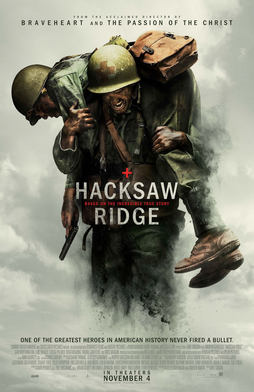
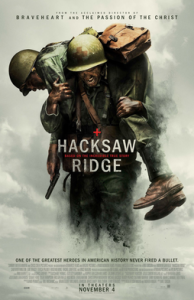
Desmond Doss (Andrew Garfield) called himself a “conscientious supporter.”  He wanted to support the troops fighting in WWII; he just would not touch a gun. And so, after brutal bullying and assaults and a court-martial, he was permitted to “go into battle without a gun.” And so, as a part of the “Liberty Battalion” of Army’s 77th Infantry Division, he went into one of the most dangerous battles of the war, with no weapons, just a Bible and some syringes with morphine.

Mel Gibson‘s first film as a director in a decade combines themes he returns to again and again: personal courage in the face of overwhelming odds, sacrifice for others, inspiration, faith, and very graphic, agonizing mortification of the flesh. The first half of the film introduces us to Doss, growing up in Lynchburg, Virginia with an abusive, alcoholic father (Hugo Weaving), falling for a pretty nurse (Teresa Palmer), and wanting to help the war effort without killing anyone.

Then there is an extended section covering basic training, with a tough but not humorless sergeant played by one of the few Americans in the cast, Vince Vaughn. It sweetly and sometimes amusingly harks back to the classic WWII films, with assorted characters from very different parts of the country are thrown together and a tough sergeant who whips them into shape with insults and threats, but everyone knows it is really for their own good, to teach them what they need to know to survive. There is no category for a regular army guy who says he cannot even touch a gun. They do everything they can to get him to change his mind or leave the military, but he will not give up. He’s a guy who will walk an extra two miles because he likes the woods. He knows who he is and what he believes.

And then, he is in battle. And again, he will not give up. “Just let me get one more, Lord,” is his prayer as over and over, 75 times, he heads back into enemy fire to pick up wounded men — including two Japanese soldiers — and carefully lower each one over a sheer cliff with an improvised pulley.

The scenes in battle are as harrowing as any ever put on screen. We are in the midst of utter carnage and chaos. Gibson knows how to create a visceral experience to make us understand just how extraordinary the rescue mission was. In an interview, he once said that he hates war, but loves warriors. Both are evident in this stirring tribute to a true hero.

Parents should know that this film includes extremely graphic and disturbing wartime violence with grisly images of wounded and dead soldiers, bullying and a brutal beating, domestic violence, and a car accident. Characters use some mild language.

Family discussion: How does the sergeant prepare the soldiers for war? How does he promote teamwork? What should the military do with “conscientious supporters?”

If you like this, try: “We Were Soldiers” and “Sergeant York”

Related Tags:


Not specified
Trolls

Trolls

Posted on November 3, 2016 at 5:26 pm

Copyright 2016 Dreamworks

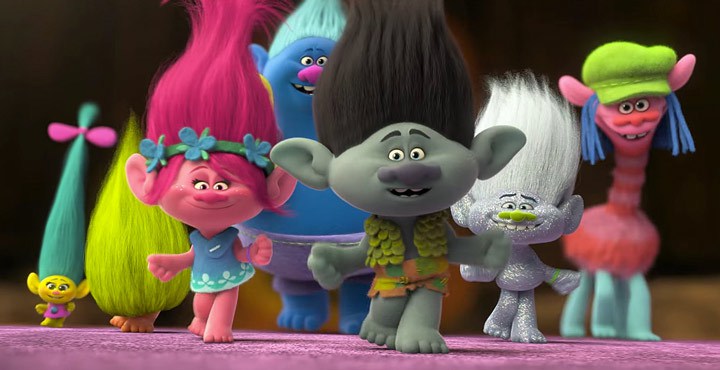
“Trolls” is pure delight, lots of jokes, great music, and a surprisingly wise take on the elusive quest for happiness. Plus, it has that Justin Timberlake song that’s like pure sunshine.

It is tricky to make self-consciously adorable characters happy without being sugary, but it works because they understand the difference between happiness based on generosity, honesty, and courage and pleasure, based on sensation.

The characters are inspired by the so-ugly-they’re-cute troll dolls with the colorful poufs of hair invented by Danish sculptor Thomas Dam (DreamWorks has now bought the company, making the film something of an infomercial for the toys). The trolls all about sunshine, parties, singing, dancing, cupcakes, glitter, scrapbooks, and scrapbooks frosted with glitter. They have fitbit-style wrist bands reminding them every half hour that it is hugging time. The trolls are led by benevolent King Peppy (Jeffrey Tambor), who saved the trolls from the monstrous Bergens twenty years before, and his irrepressibly cheery daughter Princess Poppy (Anna Kendrick).

The Bergens are as naturally unhappy as the trolls are happy. The only way the Bergens have ever found to feel happy is to eat the trolls. Once a year, they would raid the troll tree and gobble down as many as they could. King Peppy led them to a secret place where the Bergens could not find them, courageously risking his own life to make sure there was “no troll left behind.”

Poppy decides to have a party to celebrate 20 happy and peaceful years since the trolls escaped from the Bergens. Branch (Justin Timberlake), the one pessimistic troll, warns her that a loud celebration might attract the attention of the Bergens, but Poppy insists. Branch is right — the Bergen chef (Christine Baranski) has been searching for the trolls for 20 years, and the party fireworks lead her to their new home. She captures some of the trolls and Poppy, mindful of her father’s example, goes off to rescue them.  Branch, who had predicted the Bergen threat and spent all his time creating a shelter while the other trolls were hugging and singing, had planned to wait out the invasion alone. But Poppy invites the other trolls to hide out there, and Branch agrees to go with her.

And so there is a journey and (literally) colorful characters along the way and once in Bergen-land, where the rescue effort is complicated but ultimately aided by the trolls friendship with a Bergen scullery-maid with a crush on the young king. Her name is Bridget (Zooey Deschanel) and she agrees to help the trolls if they will help her get the attention of the king.  There’s a makeover that is half mice in “Cinderella” and half Cyrano de Bergerac. I worried that the film was buying into old-school notions that a girl has to be made over to attract and please a man, but the film is clear that Bridget that she may get a confidence boost from the makeover but she needs to be honest with her crush about who and what she is.  And it was very good to see the movie’s honest engagement with the idea of happiness.  Even with daunting and scary challenges, a positive attitude can inspire you and those around you. Even the saddest loss does not mean that you lose happiness forever.  And the greatest happiness comes from being close to those we love.  Hugs and music and dancing always help, too.

Parents should know that this film includes fantasy/action peril. Some trolls are eaten by the Bergens, with one especially sad loss of a character’s grandmother.

Family discussion: What do the trolls know about happiness that the Bergens don’t?  What is the difference between pleasure and happiness? What is the hardest part of trying to be happy?

If you like this, try: “Megamind” and “Despicable Me”

Related Tags:


3D Animation Fantasy For the Whole Family Musical

New Life

Posted on October 27, 2016 at 5:40 pm

B-
Lowest Recommended Age: Middle School
Profanity: None
Alcohol/ Drugs: Drinking and drunkenness, drinking to deal with grief and stress
Violence/ Scariness: Very sad deaths
Diversity Issues: None
Date Released to Theaters: October 28, 2016


“New Life” is a bland but sweet, touching story about an attractive couple, kind-hearted, good people who are very much in love, and learn that happily ever after does not always mean what you think.

Ben and Ava meet as children. As they get older (played by Jonathan Patrick Moore and co-screenwriter Erin Bethea), their friendship is tested, and then deepens. They face frustrations and challenges, both external and internal, as they try to pursue their careers but keep their relationship precious. Ava’s best friend becomes pregnant but the father is not in her life. Ava wants to become pregnant but it does not happen right away.

Moore and Bethea have a charming chemistry that makes up for the corniness of the “Love Story”-ish screenplay.

Parents should know that this movie includes some very sad losses, including illness, and accidents.

Family discussion: Was Ben right about his professional obligations? What is the best way to comfort someone who is grieving?

If you like this, try: “The Redemption of Henry Myers”

Related Tags:


Movies -- format
Moonlight

Moonlight

Posted on October 27, 2016 at 5:33 pm

A-
Lowest Recommended Age: Mature High Schooler
MPAA Rating: NR (some sexuality, drug use, brief violence, and language throughout)
Profanity: Very strong language
Alcohol/ Drugs: Drugs and drug dealing, alcohol, smoking
Violence/ Scariness: Bullies, beating, disturbing images, sad offscreen death
Diversity Issues: A theme of the movie, homophobia
Date Released to Theaters: October 28, 2016
Date Released to DVD: February 27, 2017
Amazon.com ASIN: B01LTHZVM4
Copyright 2016 Plan B Entertainment

In the 2017 Oscar winner for Best Picture, a man tells a young boy a story, and, as with many stories adults tell children, especially in movies, it is a story with a purpose. Juan (Mahershala Ali) tells the boy derisively known as “Little” (Alex Hibbert) that when he was young, a woman saw him at night and told him that the silvery moonlight made his dark skin looked blue. She said he should be called Blue from then on. But, he tells Little, he wasn’t. “At some point you gotta decide for yourself who you gonna be. Can’t let nobody make that decision for you.”

In “Moonlight,” a film of a delicate, shimmering beauty that measures up to the title, the boy will struggle to make that decision for himself. Three chapters, as a child, a teenager and a young man, played by three different actors, are labeled with three different names that he is called: the taunting nickname Little, his birth certificate name Chiron (played by Ashton Sanders), and the nickname given to him by someone who had a profound impact on him, Black (played by Trevante Rhodes). Who will he decide to be?

The story begins in the Liberty City neighborhood of Miami. Little runs from bullies and hides out in a crack house, where he is discovered by Juan, a kind-hearted drug dealer. Little won’t talk, so Juan takes him home, where his warmhearted significant other, Teresa (singer Janelle Monae) gives little some food and lets him stay the night. The next day, Juan brings Little back to his mother, Paula (Naomie Harris), a nurse who loves Little but leaves him alone much of the time. “He can take care of hisself. He good like that.”

In the second section, he is a skinny teenager all but abandoned by his mother, who has become addicted to drugs, and bullied at school. He still does not talk much, but he has one friend, Kevin (Jharrel Jerome), who calls him Black. Chiron cannot even acknowledge to himself that he wants more from Kevin, but one night on the beach, they share a piercingly sweet moment of tenderness that will indirectly lead to an act of violence.

When we see him again, he is a man, with an armor of muscle and gold teeth grillz, still almost silent, still almost isolated. But a call from Kevin inspires a journey.

The film is based on a play called “In Moonlight Black Boys Look Blue” by McArthur awardee Tarell Alvin McCraney, who worked with director Barry Jenkins (the lovely romance “Medicine for Melancholy”) on adapting it for the screen. Both McCraney and Jenkins, like Little, had mothers who struggled with addiction, and Jenkins grew up on the Liberty City setting of the film.

The small miracle of the movie is the way it subverts the expectations the audience has based on news reports and many, many other movies. Every character is authentically complex. The graceful, poetic score by composer Nicholas Britell gives the story epic scope and heartbreaking intimacy.

We see Juan’s kindness and wisdom as he holds Little gently in the ocean, teaching him to swim and, more important, giving him an idea of what a man can be. We hear his thoughtful answer when Little asks him what “faggot” means. And yet, when Paula wants drugs, Juan supplies them, even knowing what it will do to Little. The confident, capable Kevin casually mentions time in prison as though it was an inevitable rite of passage. Little/Chiron/Black is physically transformed from chapter to chapter. We are continually challenged and confounded, yet held close to the heart of the story by its romantic lyricism and, most of all, the spacious humanity of its love for its characters.

Parents should know that this film includes very mature material: bullying, brutality, drug dealing and drug abuse, very strong language including homophobic slurs, sexual references and explicit sexual situations.

Family discussion: Why does the main character have a different name in each chapter? What do you think happened to Juan?

If you like this, try: “Medicine for Melancholy”

Related Tags:


Based on a play Drama DVD/Blu-Ray Pick of the Week GLBTQ and Diversity Race and Diversity
Inferno

Inferno

Posted on October 27, 2016 at 5:10 pm

Copyright Sony 2016
Copyright Sony 2016

Dashing, globe-trotting symbology professor Robert Langdon (Tom Hanks) doesn’t work any harder at trying to prevent a global pandemic than Hanks and director Ron Howard work at trying to make the Dan Brown book into a movie. You can guess how Langdon’s effort works out. I’m here to tell you that the movie does not. Not even close.

Langdon wakes up, disoriented and with a gash on his head. As far as he remembers, he is still at Harvard but somehow he sees Florence out the window. He has no recollection of the past few days and the doctor (Felicity Jones) explains that he has temporary retrograde amnesia. Her name is Sienna.  Conveniently, she speaks English — she is English — and several other languages, and even more conveniently she is a fan of his work because she “likes puzzles.”  She attended one of his lectures when she was nine years old and has read all of his books with such devotion that she even mentions there is one she didn’t like much.

When an assassin dressed as a police officer starts shooting at them, Sienna grabs Robert and brings him, still in his hospital gown, to her apartment. Pretty soon, they are both on the trail of a puzzle that leads to an impending release of a virus that while wipe out 80 percent of humanity, put in place by a crazed zillionaire who had some very strong feelings about the problems of over-population, and who fell to his death in the prologue, but not before warning darkly that “Humanity is the disease; Inferno is the cure.”

Robert, still groggy, has to figure out how to stop release of the virus. But the clues are simply that that puzzling or interesting.  Unlike The Da Vinci Code, where Brown put together a clever and intricate series of clues based on authentic history and art, this one is little more than chase scenes in iconic locations, alternating with yawn-inducing scenes people barking kill orders into headsets and staring intently into monitors.

We also get drearily Delphic pronouncements like “the truth can be glimpsed only through the eyes of death” and somber almost-adages like “the greatest sins in human history have been committed in the name of love,” squinting at Renaissance frescos, a mysterious group with the PAC-like name The Command Risk Consortium (“We are not the government; we get things done”), a stolen death mask of “Inferno” poet Dante Alighieri, and an absurd pause for a chat about missed chances and regret. Irrfan Khan provides an all-too-brief bright spot, and I would happily see an entire movie about his crisp and unflappable character. As for the rest, one action scene is underwater, but the rest of it drags so much it feels like it might be, too.

Parents should know that this film includes fantasy/action style violence with grotesque and disturbing images, theme of global pandemic, chases and extended peril with characters injured and killed, suicide, betrayal, some strong and crude language, and a sexual situation.

Family discussion: Who is doing the most to address the problems of over-population? Why is Dante especially appropriate for this story?

If you like this, try: “The Da Vinci Code”

Related Tags:


Action/Adventure Based on a book Series/Sequel
THE MOVIE MOM® is a registered trademark of Nell Minow. Use of the mark without express consent from Nell Minow constitutes trademark infringement and unfair competition in violation of federal and state laws. All material © Nell Minow 1995-2026, all rights reserved, and no use or republication is permitted without explicit permission. This site hosts Nell Minow’s Movie Mom® archive, with material that originally appeared on Yahoo! Movies, Beliefnet, and other sources. Much of her new material can be found at Rogerebert.com, Huffington Post, and WheretoWatch. Her books include The Movie Mom’s Guide to Family Movies and 101 Must-See Movie Moments, and she can be heard each week on radio stations across the country.

Website Designed by Max LaZebnik