Pitch Perfect 2

Pitch Perfect 2

Posted on May 14, 2015 at 5:48 pm

B+
Lowest Recommended Age: High School
MPAA Rating: Rated PG-13 for innuendo and language
Profanity: Some strong and crude language
Alcohol/ Drugs: Drinking
Violence/ Scariness: Comic peril and violence, no one hurt
Diversity Issues: Diverse characters
Date Released to Theaters: May 15, 2015
Date Released to DVD: September 21, 2015
Amazon.com ASIN: B00NYC3SG4
Copyright 2015 Universal

“Pitch Perfect 2” is — bear with me — the musical comedy variation on the “Furious 7” recipe for success.  The sequel jettisons any pretense of seriousness of purpose, structural logic, or psychological authenticity, joyfully tosses off any pretense of taking itself, its heartwarmingly diverse characters, or its storyline seriously.  And both, unexpectedly but utterly deservedly, will make you teary-eyed.  Substitute exquisitely harmonized snippets of popular songs for cars flying out of planes, and it’s basically the same movie.  And there’s nothing wrong with that.  “Pitch Perfect 2” is even more fun than the first.

Beca (Anna Kendrick) was just starting college in the first film, about her reluctant agreement to join the all-girl acapella group called The Barden Bellas, led by Aubrey (Anna Camp) and her loyal lieutenant Chloe (Brittany Snow).  Now Aubrey has graduated but Chloe is still there, deliberately flunking so she will not have to leave the now-three-time national champion Bellas.  Beca is a senior, hoping she can take on a dream internship with a musical producer (Keegan-Michael Key, the “angry Obama”) without disrupting the group.

But the group has been disrupted.  The Bellas performed at the President’s birthday celebration (footage of the Obamas is inserted to make it look like they were really there), with Fat Amy (Rebel Wilson) coming in like a wrecking ball on a trapeze.  It was a triumph until it became a disaster when Fat Amy’s skin-tight jumpsuit split open and she wasn’t wearing underwear.

The Bellas are banned from collegiate competition, and are not even allowed to conduct auditions. Too bad for those hoping for a reprise of one of the first film’s most entertaining scenes, but there is simply no time. We hardly get a chance to hear Barden’s male acapella group, the Treblemakers, either. This is all about the Bellas fighting their way back with the only option left to them — an international competition, up against the world champions, Germany’s Das Sound Machine, a group so terrifyingly huge and technically perfect it is a kind of acapella Triumph of the Will.

But we’re not here for the plot; we’re here for the music, and there is a ton of it, all so good and so varied that it is frustrating to get it in such short snippets. Songs made popular by the Andrews Sisters, Hansen, Taylor Swift, En Vogue, Mika, Montell Jordan, and Carrie Underwood zip by, most hilariously in a sing-off that tops the original’s. Categories include “Songs About Butts” (one character points out that’s pretty much everything on the radio) and “I Dated John Mayer.” Hilariously, one of the competing acapella groups is the Green Bay Packers. And Snoop Dogg shows up to sing a Christmas song.

There is one new addition to the Bellas, though, “True Grit’s” Hailee Steinfeld as Emily, an eager but shy freshman whose mom (Katey Sagal) was a Bella, so she’s a legacy. She also writes songs.

Will the Bellas get their mojo back? Will Beca impress her boss? Will Aubrey show up for a pep talk? Will there be some delicious silliness along the way? Will Emily’s new songs be game-changers when the long-standing tradition is covers only? How about some romance (a bit) and some comedy (a lot)?  But what’s the deal with the false eyelashes on everyone?  Did Elizabeth Banks bring on her Effie Trinket makeup team?  Fat Amy’s no/yes from Fat Amy when Bumper (Adam Devine of “Modern Family”) says he wants to have sex with her is ooky and just plain off.

But first time director Banks, who co-produced the first film and the sequel, and returns, this time as both commentator on acapella competitions and as head of the organization, manages a very large cast and an even larger set list.  She keeps the tone light and breezy, balancing the outrageous (hate mail from Supreme Court Justice Sonia Sotomayor?) with the touching.  A call-back to the first film’s breakout hit “Cups,” is simply lovely.  If some elements of what we can barely dignify by terming a storyline are pat and predictable, the song choices are not. From the very first moment, with an a capella rendition of the Universal” logo music, we are in mash-up heaven. It is worth the price of admission to hear “MmmBop” acapella, and then, icing on the cake and cherry on the sundae, we get some Kris Kross “Jump” action as well. Acca-heaven.

Parents should know that this film includes some crude sexual and bodily function humor, some strong language, and comic violence (no one hurt). There is a joke that seems to imply that a woman’s “no” to an invitation to have sex is not to be taken seriously, but it later turns out that this is part of a consensual relationship.

Family discussion: What makes you special?  What makes your friends and family special? How do you find your voice to express who you are?

If you like this, try: the first “Pitch Perfect” and the television show “The Sing-Off”

Related Tags:


Based on a book Comedy DVD/Blu-Ray Pick of the Week Musical Scene After the Credits Series/Sequel
Noble

Noble

Posted on May 7, 2015 at 5:57 pm

B
Lowest Recommended Age: Middle School
MPAA Rating: Rated PG-13 for mature thematic material, including some violent and sexual situations
Profanity: Some strong language
Alcohol/ Drugs: Drinking, smoking
Violence/ Scariness: Gang rape, child abuse and child homelessness, war scenes
Diversity Issues: A theme of the movie
Date Released to Theaters: May 8, 2015

Christina Noble is an Irish woman known as “Mama Tina” to thousands of Vietnamese children and their families. Her own childhood was one of poverty, abandonment, loss, and hardship, but her resilience and determination led her to give children half a world away the help she never had herself. This film tells her improbable story and conveys her endless charm, her engaging spirit, and the extraordinary difference that one person can make in the world.

Noble is played by three different actresses to show us her life as a child, a teenager and young mother, and as a woman in her 40’s, her children grown, who follows a dream to go to Vietnam and help the homeless children of Vietnam. We first see her skipping school at age 10 to sing Doris Day songs in a bar (played by Gloria Cramer Curtis), and running from the truant officer. Her mother dies and her father all but abandons the children who are eventually split up. Christina ends up at a convent school. As a teenager, she is played by the radiant Sarah Greene (“Penny Dreadful”), and undergoes a second cruel abandonment by her father, a gang rape, a pregnancy, and then is forced to give up her child through the same kind of forced adoption program documented in “Philomena.” She finally falls in love, gets married, and has more children, but her husband is cruel and abusive.

The story moves back and forth in time to give us a greater understanding of Christina’s courage and of her faith in God, in her purpose, and in her ability to make something better out of what she has. Irish star and stand-up comedian Deirdre O’Kane (“Moone Boy”) gives a smashing performance as the grown-up Christina, fearless and always frank, whether confronting a child molester, getting a smile from a dour desk clerk, asking for money from every corporate representative trying to do business in Vietnam or challenging God to do a better job or at least get out of her way and let her get on with it. And her indomitable spirit and merry heart make this remarkable story vivid, true, and touching.

Parents should know that this film includes themes of deprivation and abuse, including the loss of a parent, abandonment, gang rape, child molestation, child homelessness, and a character being forced to give up her child. There is some strong language, drinking, and smoking.

Family discussion: Why was helping the homeless and orphaned children of Vietnam so important to Christina Noble? What made it possible for her to survive the loss, abandonment, and abuse of her early years? How can you learn to be more resilient?

If you like this, try: Noble’s book, Bridge Across My Sorrows, and another real-life-inspired story, “Mary and Martha”
Related Tags:


Based on a true story Movies -- format
Bravetown

Bravetown

Posted on May 7, 2015 at 5:41 pm

C-
Lowest Recommended Age: Mature High Schooler
MPAA Rating: Rated R for some language, drug use and brief sexuality
Profanity: Some strong language
Alcohol/ Drugs: Drinking, drugs, and drug overdose
Violence/ Scariness: Battle scenes, extended discussion of war dead
Diversity Issues: None
Date Released to Theaters: May 8, 2015
Copyright 2015 Lighting Entertainment

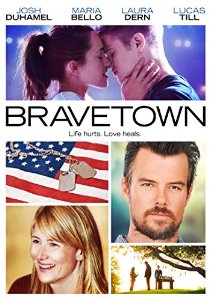
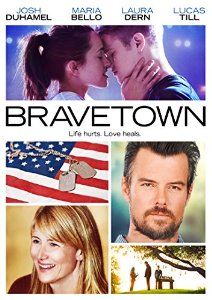
If only salutory intentions and one good performance could save a film so fundamentally wrongly conceived. “Bravetown” starts out as “Footloose,” veers into “Ordinary People,” and ends up as “Swing Kids,” with jaw-dropping shifts in tone and focus and total misreading of the import of its message.

It really is a shame, because it has a good heart and an important point to make about the devastation of small towns with very little opportunity but a lot of patriotic spirit, and the devastation when so many of the town’s young men go to war. And the always-welcome Josh Duhamel as always gives a performance of enormous heart and intelligence. He plays Alex, the small town’s psychiatric social worker assigned to Josh Harvest(!) (Lucas Till), a sulky teenager who has been sent to live with his father following an accidental drug overdose.

Josh barely knows his monosyllabic father (“That Thing You Do’s” Tom Everett Scott). And the log cabin in the small, depressed North Dakota town is the other side of the world from Josh’s life as a hot — and usually high — young DJ, living with a single mom (Maria Bello) who struggles with substance abuse. Josh’s entire life is music, having sex with his girlfriend, and watching “Platoon” while smoking weed. Until he takes one pill too many and finds himself in court one time too many. Thus, a one-way ticket to a town called Paragon, where the only place that seems to do any business is the recruiting office.

It follows the “Footloose” formula closely at first. The Chris Penn role of only local kid who will talk to him is played by Jae Head (“The Blind Side”). It’s a little weird that he looks about eight years younger than Josh and begins by talking about how pretty his sister is, how she just broke up with her boyfriend, and how she’s in a dance team that is terrible. It is a lot weirder when Josh decides to attend the school dance and the dance team gets up to perform and they are, in fact, terrible, and then, as soon as Josh gets behind the turntables and starts spinning, they magically snap into shape instantly develop a whole new perfectly synchronized routine.

I am not kidding. I mean, even in “Footloose” and “Flashdance” and all of that genre, we at least get to see them practice and slowly get better.

And then it gets really crazy.

Back to the “Footloose” template: The sister (Kherington Payne as Mary) is pretty but troubled and has a dead brother. Her ex-boyfriend likes to hit people and tells Josh to stay away from her. Mary takes Josh to her special place, in this case a tribute to the young men the town has lost to war.

And for the “Ordinary People” part: Alex is an offbeat but insightful therapist who gains the trust of the recalcitrant Josh by letting him spend their court-ordered time watching soccer and eating pizza. These are the only scenes in the film that have any warmth.

Alex, like everyone else in town, is hurting, too. So is Mary’s depressed mother, played by Laura Dern. She seems to be relegated these days to struggling mother roles but is always watchable in them.

Things go completely nuts when we get to the dance team competitions, with a couple of disturbingly clueless examples of cultural appropriation. The Indian (as in Asia, not America) dance number is insensitive, but even worse is the one that has the group dressed up in sweat suits and gold chains like one of those awful fraternity “ghetto” parties.

And then it gets really really crazy as the teenagers start telling the grown-ups what’s wrong and it affects them the way Josh’s magical DJ-ing affected the dance team. Instant cure! Followed by the most insanely mis-imagined — wait for it — dance number on film since the Swing Kids fought Hitler with some swell big band music.

Parents should know that this film has some strong language, an explicit sexual situation, drinking and drug use, some racial and cultural insensitivity, bullies and fighting, wartime battle scenes and discussion of casualties and fatalities.

Family discussion: Why did Alex watch soccer games with Josh? Can you think of a time when you wished you had shared more about yourself?

If you like this, try: the “Step Up” movies, “Footloose” and “Flashdance”

Related Tags:


Movies -- format Stories about Teens
The D Train

The D Train

Posted on May 7, 2015 at 5:34 pm

C
Lowest Recommended Age: Adult
MPAA Rating: Unrated
Profanity: Very strong and crude language
Alcohol/ Drugs: Drinking, smoking, drugs
Violence/ Scariness: Some peril
Diversity Issues: None
Date Released to Theaters: May 8, 2015

Copyright 2015 IFC Films
Comedies, especially dark ones, have a lot of freedom when it comes to narrative logic, but the emotional logic still has to ring true. No matter how crazy the storyline gets, the way the characters respond to it has to make sense, and that is where “The D Train” goes, well, off the rails.

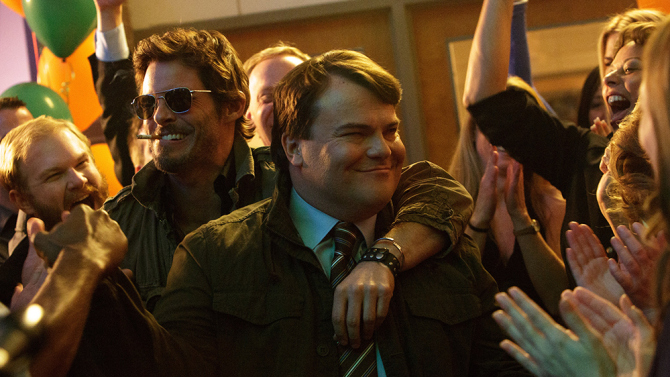
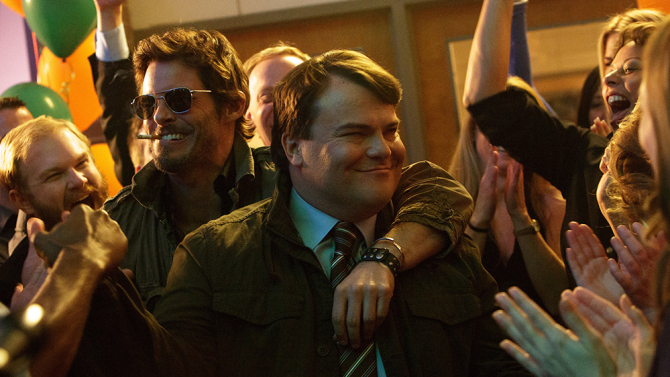
Jack Black plays Dan Landsman, who is helping to organize his high school’s 20th reunion. He keeps insisting he is the chairman of the planning committee, but none of the other members think he holds that title, even though he is the only one who knows the password to the reunion’s Facebook page. Dan organizes their meetings, rearranging the desks in the school library and setting up the phones to call the alumnae and encourage them to attend. He has a laminated sign with suction cups to stick on the door to make sure they are not disturbed. This reunion matters tremendously to him. He is married to a classmate (Kathryn Hahn) and seems stuck in high school, still hoping to find a way to be one of the popular kids and have a cool nickname.

Late one night, he sees a commercial for sunblock starring another classmate, Oliver Lawless (James Marsden). Dan decides that this means Oliver is a celebrity, and that if he can persuade him to attend the reunion, everyone else will want to come, too. So he lies to his tech-phobic boss (Jeffrey Tambor) to wrangle a business trip to LA, but makes it sound so promising that the boss insists on coming along.

In LA, Oliver is at first not even interested enough to be puzzled by Daniel’s attention. But then he begins to warm to Daniel’s enthusiastic approval. They have a couple of very debauched nights, especially the second one. What happens in LA does not stay in LA, and the fragility of Daniel’s most fundamental sense of himself is revealed. When Oliver does show up for the reunion, Daniel begins to unravel.

Marsden, always underestimated as an actor, is superb in this role, fully embracing the character’s darkness, narcissism, self-loathing, and vulnerability. But Black does not have enough to work with to make Daniel sympathetic enough for us to want him to succeed or evil enough for us to want him to fail.

Parents should know that this film has extremely strong and crude language and very explicit sexual references and situations, drinking, smoking, and drug use.

Family discussion: Why was the reunion so important to Daniel? Why was Daniel’s admiration (and his debauching) so important to Oliver?

If you like this, try: “Chuck and Buck”

Related Tags:


Comedy Movies -- format
Ride

Ride

Posted on May 7, 2015 at 5:05 pm

B+
Lowest Recommended Age: High School
MPAA Rating: Rated R for language and some drug use
Profanity: Some strong language
Alcohol/ Drugs: Drinking, drugs
Violence/ Scariness: Peril
Diversity Issues: None
Date Released to Theaters: May 8, 2015
Date Released to DVD: August 17, 2015
Amazon.com ASIN: B00Y250GE4
Copyright Sandbar Pictures 2015

A surf bum named Ian (Luke Wilson) is explaining the physics of the interaction between surfboard and wave: it’s an inanimate object in an ever-changing environment. One doesn’t move. One never stops moving in powerful and highly unpredictable ways. And that is also the story of the woman who is not quite listening to Ian’s explanation.

Oscar-winner Helen Hunt writes, directs, and stars in “Ride,” the story of Jackie, an overprotective Manhattan mother whose son, Angelo (Brenton Thwaites) flees for California to surf. Her plan was for him to start college just 85 steps away from the apartment that they share, constantly calling back and forth to each other rapid-fire as they work on their laptops. He feels claustrophobic and over-managed, so when he visits his father in California he decides to stay. Jackie finds out when she visits his dorm to make his room more homey.

She follows him out to California and when he does not want to talk to her, the only way she can think of to stay close to him is to learn to surf. And so we will see her lose or relinquish everything she thought was essential to who she was: her black Manhattan editor wardrobe, her constantly buzzing phone, her willingness to be perpetually available to handle crises at the office, her reluctance to meet her ex-husband’s new family, the intensity of her connection to her son, and the equal intensity of her refusal to rely on anyone but herself. She has been an inanimate object in an ever-changing environment. Can she adapt?

Hunt’s script is clever and warm-hearted. As with her previous film, Then She Found Me, loosely adapted from novel by Elinor Lipman, the film explores the challenge of being a loving and supportive mother to an adult or almost-adult child while being a person at the same time — and letting the child be a person, too.

After a short introduction, where we see her sitting on the other side of her then-preschool son’s bedroom door all night, tiptoeing out of the way so he won’t see her when he gets up to go to the bathroom, we see them just before he is supposed to start college. He repeatedly asks her for help with his story, but she is an experienced editor who has worked with nervous authors for many years and she knows better than to do the work for him. “It just has to be surprising and inevitable,” she tells him. And clearly, that is advice that Hunt the screenwriter has taken to heart as well.

She has a great sense for writing say-able dialog that sounds smart and believably witty while letting us know who the characters are through what they say and how they say it.

Parents should know that this film includes strong language, sexual references and situations, drinking, and drug use.

Family discussion: Did the end of this story feel both inevitable and surprising? What will happen next?

If you like this, try: “Then She Found Me”

Related Tags:


Drama DVD/Blu-Ray Pick of the Week Family Issues Romance
THE MOVIE MOM® is a registered trademark of Nell Minow. Use of the mark without express consent from Nell Minow constitutes trademark infringement and unfair competition in violation of federal and state laws. All material © Nell Minow 1995-2026, all rights reserved, and no use or republication is permitted without explicit permission. This site hosts Nell Minow’s Movie Mom® archive, with material that originally appeared on Yahoo! Movies, Beliefnet, and other sources. Much of her new material can be found at Rogerebert.com, Huffington Post, and WheretoWatch. Her books include The Movie Mom’s Guide to Family Movies and 101 Must-See Movie Moments, and she can be heard each week on radio stations across the country.

Website Designed by Max LaZebnik