I’ll See You in My Dreams

I’ll See You in My Dreams

Posted on May 21, 2015 at 5:55 pm

B+
Lowest Recommended Age: Mature High Schooler
MPAA Rating: Rated PG-13 for sexual material, drug use and brief strong language
Profanity: Strong language
Alcohol/ Drugs: Drinking, marijuana
Violence/ Scariness: Some mild peril, sad death
Diversity Issues: None
Date Released to Theaters: May 22, 2015
Copyright 2015 Bleeker Street

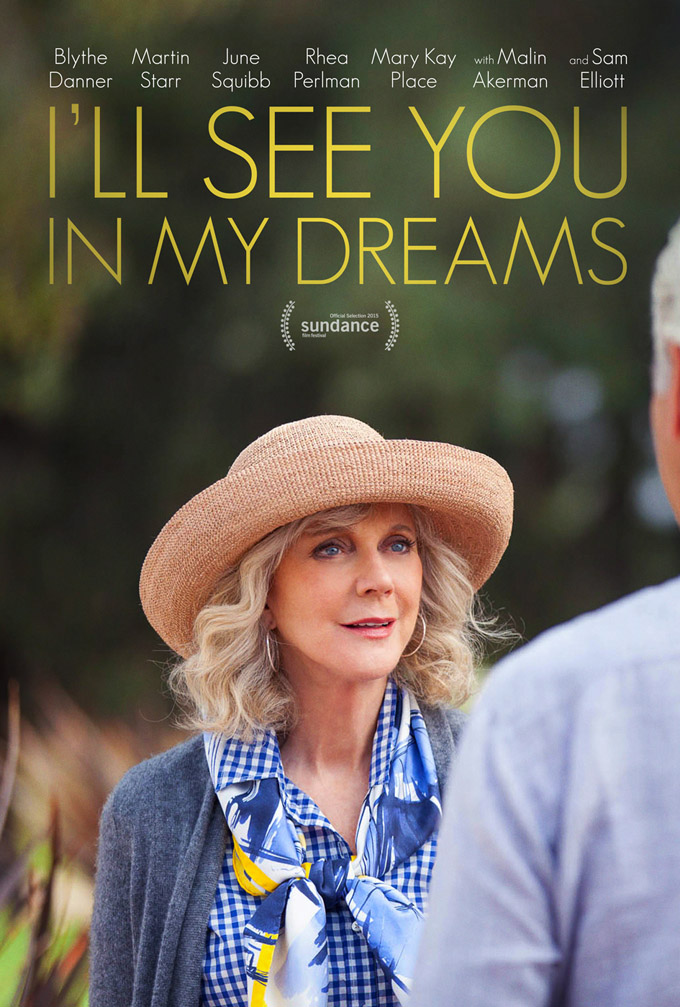
Blythe Danner gives a performance of exquisite sensitivity in “I’ll See You in My Dreams,” the story of a lonely widow. She plays Carol, a singer-turned teacher who retired 20 years ago after her husband died. Her friends in a nearby retirement community urge her to join them but she prefers to stay in her home, her primary companions her dog and her glass of white wine.

The movie begins by taking us through a day we surmise is just like hundreds of others. She plays cards with friends, she plays golf, she feeds the dog, she sips wine and watches television. She keeps busy and she is not unhappy. She has plans, and she has fun, but she does not have much of a sense of purpose. When a rat invades her home, it is unsettling. She asks her new pool cleaner for help.

His name is Lloyd (Martin Starr), and he is lost in a way that makes her feel able to talk to him.  Her feelings toward him are not maternal or romantic. But he is smart, and funny and self-deprecating and he was willing to help her with the rat.  And he is newly back in town and living with his parents, so he can use a friend, too.  When he tells her about going to do karaoke, she agrees to go with him.

A speed dating event with her friends is a hilarious disaster, but that may make an overture from a handsome stranger named Bill (Sam Elliott) seem more appealing.  Writer/director Brett Haley has a good sense for the way people who have no time for trivialities get to the point with each other, wasting little time on getting-to-know-you trivialities.  Carol’s conversations with Lloyd and Bill are direct without being intrusive, and especially without being judgmental.  When she is with her friends, there are easy exchanges that reflect the kind of connection based on the shared experience of being an older woman.  A scene where they all get high on one friend’s medical marijuana is completely charming.

It is almost beyond belief that this is Danner’s first romantic lead in a film.  She is breathtaking.  Haley wisely just leaves the camera on her beautiful face as she sits with her beloved dog while he slowly stops breathing in the vet’s office.  Her grief is devastating.  Her devotion is deeply moving.  Her performance of “Cry Me a River” in karaoke is also magnificent.  The incandescence she brings to the story of a woman who is still struggling for connection makes this one of the most touching performances of the year.

Parents should know that this movie has strong language, drinking and drugs, sexual references and situations, and a sad death.

Family discussion: What do we learn about Carol from the karaoke scenes? Why did she become friends with Lloyd? How is dating different for older people than for younger people?

If you like this, try: “The Best Exotic Marigold Hotel” and its sequel

Related Tags:


Drama Movies -- format Romance
American Sniper

American Sniper

Posted on May 18, 2015 at 8:00 am

B+
Lowest Recommended Age: Mature High Schooler
MPAA Rating: R for strong and disturbing war violence, and language throughout including some sexual references
Profanity: Very strong language
Alcohol/ Drugs: Drinking and drunkenness
Violence/ Scariness: Wartime violence including battles and snipers, characters injured and killed, disturbing images
Diversity Issues: A theme of the movie
Date Released to Theaters: January 16, 2015
Date Released to DVD: May 18, 2015
Amazon.com ASIN: B00RGZ915C
Copyright 2015 Warner Brothers

The highest-grossing movie of 2014 is also one of the most controversial. Director Clint Eastwood and producer-star Bradley Cooper have made a more subtle and nuanced film than either the people who loved it or the people who hated it give him credit for. Extremists on both sides found validation for their views, whether for or against the wars in Iraq and Afghanistan or for or against the actions of the military there. That may be the most significant proof of the evenhandedness of Eastwood, a man who made two separate films about Iwo Jima to tell the stories of both the Japanese and American military.

We see Chris Kyle as a young boy, hunting with his father (Ben Reed). We learn two key facts. First, even at that age, Kyle is a very good shot. Second, we hear his father explain that there are sheep, wolves, and sheepdogs, and he expects his boys to grow up to be protectors of sheep, not wolves or their victims.

Nevertheless, Chris grows up (now played by a bulked-up Cooper) without much direction until he decides to enlist. In the movie, it is a response to news reports about Americans being killed by terrorists, following time spent as a ranch hand and finding his girlfriend in bed with another man. In fact, Kyle had always planned to join the military and he does not mention the girlfriend in his book.

This is the kind of diversion from the truth that has caused some viewers to argue that the portrayal is slanted. Later on, as he becomes the deadliest sniper in US military history, the film again unnecessarily ramps up the drama as though Eastwood does not trust the audience to appreciate the intensity, moral quandaries, and psychological impact of war or the courage and skill required of the military. They really did not have to inflate the story of the bounty being put on his head or make it seem as though he was the only one.

The movie and Kyle’s book both begin with a real-life story of Kyle’s first day, where he shoots a woman with a grenade (in the movie, he shoots the child she hands it to as well). This parallels a later moment where he has to decide whether to shoot. Kyle says in both book and movie that he has no regrets. Whether the viewer concludes that is the reason or the result of combat is left to us.

Parents should know that this movie concerns the real-life experiences of a military sniper in combat, with many characters injured and killed and disturbing images. Characters use strong language and there are sexual references and situations and drinking and drunkenness.

Family discussion: Who are the sheep/wolves/sheepdogs in your life?

If you like this, try: “The Hurt Locker” and “The War Tapes”

Related Tags:


Based on a book Based on a true story DVD/Blu-Ray Pick of the Week Romance War
Mad Max: Fury Road

Mad Max: Fury Road

Posted on May 14, 2015 at 6:00 pm

B+
Lowest Recommended Age: Mature High Schooler
MPAA Rating: Rated R for intense sequences of violence throughout, and for disturbing images
Profanity: Some strong language
Alcohol/ Drugs: None
Violence/ Scariness: Constant, intense, and graphic violence, guns, explosions, crashes, some disturbing images
Diversity Issues: Diverse characters
Date Released to Theaters: May 15, 2015
Copyright Village Roadshow  Pictures 2015
Copyright Village Roadshow Pictures 2015

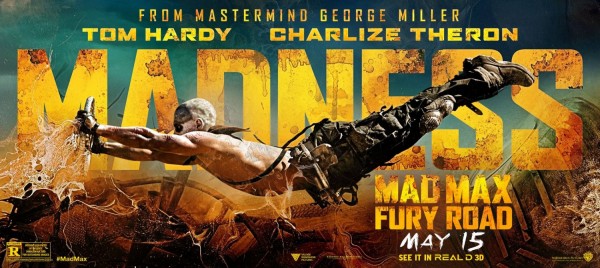
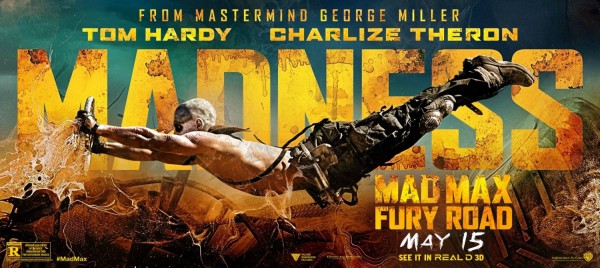
Mad Max (Tom Hardy, taking over from Mel Gibson) stamps on a two-headed lizard and then chews its head off. And that’s just in the first minute. That master of apocalyptic junkyard anarchy, George Miller, is back, bigger, wilder, madder than ever with this fourth of the Mad Max movies, all set in a post-apocalyptic desert dystopia of deprivation, chaos, rust, and brutality. In this world, all anyone has ever known is loss and despair. There is no hope, no thought of any possible way to learn or create. At one point, a character points to something completely unfamiliar to him, calling it “that thing.” It is a tree.

The first three films were about the fight for gasoline to fuel the vehicles pieced together from the wreckage. This one is about another, even more precious fluid: water. Other precious fluids come into the story as well, including blood and breast milk.

A brutal dictatorship has taken over, controlling access to all of that. All are the preserve of Immortan Joe (Hugh Keays-Byrne, with the right crazy eyes for the role), who lives literally above everyone else in a place known as The Citadel, maintaining control with his army of War Boys, all with shaved heads and powder-white skin and all convinced that their destiny is to die for Immortan Joe and be transported to paradise in Valhalla. Immortan Joe also maintains a harem of impossibly long-legged, lovely young woman. His chief lieutenant is Furiosa (Charlize Theron), a fearless woman with a mechanical arm, so much the central focus of the film that it should have been named for her. When Furiosa escapes with Immortan Joe’s women, including his pregnant “queen,” Joe and his peers come after them, in a convoy of tricked-up vehicles, all made to destroy. Everything is in shades of burnt-out umber except for the bright red suit of a guy shredding an electric guitar to keep everyone angry.

One of the War Boys is Nuz (Nicholas Hoult), who has brought along his “blood bag.” That would be Max, who was captured by Immortan Joe’s troops and kept alive only to serve as a blood donor. Nuz did not want to be left behind but had not yet finished getting his transfusion. So Max is manacled and attached to the front of Nuz’s car. Max ends up with Furiosa and the young women, who are seeing the “green place” where Furiosa was born.

Miller is a master of cinema, and his staging and cinematography on the action scenes are shot through with throbbing, raging, adrenalin that contrasts with the stoicism of Max and Furiosa. Miller has said that the Edge camera car is the most exciting technological innovation in his career. It allowed him (he operated it himself) to put the camera in the middle of the action. He does not like to use CGI, preferring “practical” (real) effects, and the grittiness is so palpable we feel we are inhaling dust.

Hardy is excellent, though, as with Bain, his face is masked for much of the film. Theron is more incendiary than the film’s mountainous fireballs, creating a character with a rich, complicated history in the way she fights, in the determined set of her brows, in the way she looks at the helpless young women, thinking about where she has been and what she has seen. The action makes our hearts beat harder, but Miller’s ability to create characters that transcend the crashes and explosions and themes that resonate all too sharply with contemporary conflicts, are what can make them beat more fiercely.

Parents should know that this film has non-stop apocalyptic action, peril, and violence with many characters injured and killed and several graphic and disturbing images, as well as some strong language, some nudity, and references to domestic abuse.

Family discussion: Why won’t Max tell Furiosa his name? Why did society become so savage? Why was one community different?

If you like this, try: the first three “Mad Max” movies and Welcome to Wherever You Are, A Documentary Celebrating the MAD MAX Mythology

Related Tags:


3D Action/Adventure Fantasy Movies -- format Series/Sequel Thriller
Pitch Perfect 2

Pitch Perfect 2

Posted on May 14, 2015 at 5:48 pm

B+
Lowest Recommended Age: High School
MPAA Rating: Rated PG-13 for innuendo and language
Profanity: Some strong and crude language
Alcohol/ Drugs: Drinking
Violence/ Scariness: Comic peril and violence, no one hurt
Diversity Issues: Diverse characters
Date Released to Theaters: May 15, 2015
Date Released to DVD: September 21, 2015
Amazon.com ASIN: B00NYC3SG4
Copyright 2015 Universal

“Pitch Perfect 2” is — bear with me — the musical comedy variation on the “Furious 7” recipe for success.  The sequel jettisons any pretense of seriousness of purpose, structural logic, or psychological authenticity, joyfully tosses off any pretense of taking itself, its heartwarmingly diverse characters, or its storyline seriously.  And both, unexpectedly but utterly deservedly, will make you teary-eyed.  Substitute exquisitely harmonized snippets of popular songs for cars flying out of planes, and it’s basically the same movie.  And there’s nothing wrong with that.  “Pitch Perfect 2” is even more fun than the first.

Beca (Anna Kendrick) was just starting college in the first film, about her reluctant agreement to join the all-girl acapella group called The Barden Bellas, led by Aubrey (Anna Camp) and her loyal lieutenant Chloe (Brittany Snow).  Now Aubrey has graduated but Chloe is still there, deliberately flunking so she will not have to leave the now-three-time national champion Bellas.  Beca is a senior, hoping she can take on a dream internship with a musical producer (Keegan-Michael Key, the “angry Obama”) without disrupting the group.

But the group has been disrupted.  The Bellas performed at the President’s birthday celebration (footage of the Obamas is inserted to make it look like they were really there), with Fat Amy (Rebel Wilson) coming in like a wrecking ball on a trapeze.  It was a triumph until it became a disaster when Fat Amy’s skin-tight jumpsuit split open and she wasn’t wearing underwear.

The Bellas are banned from collegiate competition, and are not even allowed to conduct auditions. Too bad for those hoping for a reprise of one of the first film’s most entertaining scenes, but there is simply no time. We hardly get a chance to hear Barden’s male acapella group, the Treblemakers, either. This is all about the Bellas fighting their way back with the only option left to them — an international competition, up against the world champions, Germany’s Das Sound Machine, a group so terrifyingly huge and technically perfect it is a kind of acapella Triumph of the Will.

But we’re not here for the plot; we’re here for the music, and there is a ton of it, all so good and so varied that it is frustrating to get it in such short snippets. Songs made popular by the Andrews Sisters, Hansen, Taylor Swift, En Vogue, Mika, Montell Jordan, and Carrie Underwood zip by, most hilariously in a sing-off that tops the original’s. Categories include “Songs About Butts” (one character points out that’s pretty much everything on the radio) and “I Dated John Mayer.” Hilariously, one of the competing acapella groups is the Green Bay Packers. And Snoop Dogg shows up to sing a Christmas song.

There is one new addition to the Bellas, though, “True Grit’s” Hailee Steinfeld as Emily, an eager but shy freshman whose mom (Katey Sagal) was a Bella, so she’s a legacy. She also writes songs.

Will the Bellas get their mojo back? Will Beca impress her boss? Will Aubrey show up for a pep talk? Will there be some delicious silliness along the way? Will Emily’s new songs be game-changers when the long-standing tradition is covers only? How about some romance (a bit) and some comedy (a lot)?  But what’s the deal with the false eyelashes on everyone?  Did Elizabeth Banks bring on her Effie Trinket makeup team?  Fat Amy’s no/yes from Fat Amy when Bumper (Adam Devine of “Modern Family”) says he wants to have sex with her is ooky and just plain off.

But first time director Banks, who co-produced the first film and the sequel, and returns, this time as both commentator on acapella competitions and as head of the organization, manages a very large cast and an even larger set list.  She keeps the tone light and breezy, balancing the outrageous (hate mail from Supreme Court Justice Sonia Sotomayor?) with the touching.  A call-back to the first film’s breakout hit “Cups,” is simply lovely.  If some elements of what we can barely dignify by terming a storyline are pat and predictable, the song choices are not. From the very first moment, with an a capella rendition of the Universal” logo music, we are in mash-up heaven. It is worth the price of admission to hear “MmmBop” acapella, and then, icing on the cake and cherry on the sundae, we get some Kris Kross “Jump” action as well. Acca-heaven.

Parents should know that this film includes some crude sexual and bodily function humor, some strong language, and comic violence (no one hurt). There is a joke that seems to imply that a woman’s “no” to an invitation to have sex is not to be taken seriously, but it later turns out that this is part of a consensual relationship.

Family discussion: What makes you special?  What makes your friends and family special? How do you find your voice to express who you are?

If you like this, try: the first “Pitch Perfect” and the television show “The Sing-Off”

Related Tags:


Based on a book Comedy DVD/Blu-Ray Pick of the Week Musical Scene After the Credits Series/Sequel
Noble

Noble

Posted on May 7, 2015 at 5:57 pm

B
Lowest Recommended Age: Middle School
MPAA Rating: Rated PG-13 for mature thematic material, including some violent and sexual situations
Profanity: Some strong language
Alcohol/ Drugs: Drinking, smoking
Violence/ Scariness: Gang rape, child abuse and child homelessness, war scenes
Diversity Issues: A theme of the movie
Date Released to Theaters: May 8, 2015

Christina Noble is an Irish woman known as “Mama Tina” to thousands of Vietnamese children and their families. Her own childhood was one of poverty, abandonment, loss, and hardship, but her resilience and determination led her to give children half a world away the help she never had herself. This film tells her improbable story and conveys her endless charm, her engaging spirit, and the extraordinary difference that one person can make in the world.

Noble is played by three different actresses to show us her life as a child, a teenager and young mother, and as a woman in her 40’s, her children grown, who follows a dream to go to Vietnam and help the homeless children of Vietnam. We first see her skipping school at age 10 to sing Doris Day songs in a bar (played by Gloria Cramer Curtis), and running from the truant officer. Her mother dies and her father all but abandons the children who are eventually split up. Christina ends up at a convent school. As a teenager, she is played by the radiant Sarah Greene (“Penny Dreadful”), and undergoes a second cruel abandonment by her father, a gang rape, a pregnancy, and then is forced to give up her child through the same kind of forced adoption program documented in “Philomena.” She finally falls in love, gets married, and has more children, but her husband is cruel and abusive.

The story moves back and forth in time to give us a greater understanding of Christina’s courage and of her faith in God, in her purpose, and in her ability to make something better out of what she has. Irish star and stand-up comedian Deirdre O’Kane (“Moone Boy”) gives a smashing performance as the grown-up Christina, fearless and always frank, whether confronting a child molester, getting a smile from a dour desk clerk, asking for money from every corporate representative trying to do business in Vietnam or challenging God to do a better job or at least get out of her way and let her get on with it. And her indomitable spirit and merry heart make this remarkable story vivid, true, and touching.

Parents should know that this film includes themes of deprivation and abuse, including the loss of a parent, abandonment, gang rape, child molestation, child homelessness, and a character being forced to give up her child. There is some strong language, drinking, and smoking.

Family discussion: Why was helping the homeless and orphaned children of Vietnam so important to Christina Noble? What made it possible for her to survive the loss, abandonment, and abuse of her early years? How can you learn to be more resilient?

If you like this, try: Noble’s book, Bridge Across My Sorrows, and another real-life-inspired story, “Mary and Martha”

Related Tags:


Based on a true story Movies -- format
THE MOVIE MOM® is a registered trademark of Nell Minow. Use of the mark without express consent from Nell Minow constitutes trademark infringement and unfair competition in violation of federal and state laws. All material © Nell Minow 1995-2026, all rights reserved, and no use or republication is permitted without explicit permission. This site hosts Nell Minow’s Movie Mom® archive, with material that originally appeared on Yahoo! Movies, Beliefnet, and other sources. Much of her new material can be found at Rogerebert.com, Huffington Post, and WheretoWatch. Her books include The Movie Mom’s Guide to Family Movies and 101 Must-See Movie Moments, and she can be heard each week on radio stations across the country.

Website Designed by Max LaZebnik