
The Maze Runner

Posted on September 18, 2014 at 5:59 pm

B
Lowest Recommended Age: High School
MPAA Rating: Rated PG-13 for thematic elements and intense sequences of sci-fi violence and action, including some disturbing images
Profanity: Some strong language
Alcohol/ Drugs: Underage drinking
Violence/ Scariness: Extended sci-fi action, peril and violence with many disturbing images, including monsters, dead bodies, apparent suicide, and wounds, many characters injured and killed
Diversity Issues: Diverse characters
Date Released to Theaters: September 19, 2014
Date Released to DVD: December 15, 2014
Amazon.com ASIN: B00OY7YPGK

maze runnerYes, it’s another dystopic YA trilogy (actually, there’s a fourth volume, a prequel), and yes, only a teenager with fabulous cheekbones can save the day. But “The Maze Runner” is not a lesser repeat. It is a worthy addition to the genre, an absorbing drama with surprising turns and even more surprising resonance to contemporary conflicts.

Our main character learns what is going on around him at the same time we do. He awakens with a gasp in an elevator cage hurtling to the surface. His memory is gone. He does not know who he is or where he is. When the elevator stops, he finds that he is in a wilderness, the entire population adolescent boys. They call it The Glade. For three years, one boy has arrived by that same elevator every month, along with some supplies in a box marked WCKD. We learn along with the boy, called “Greenie” by the others because he is new, that they have created a society with rules and assigned tasks. The Glade is surrounded by a massive maze that re-arranges itself every night. One group of boys, called Runners,” explore the maze every day to try to map its variations and figure out an escape path. They have to be out of the maze at night because horrible monsters called The Grievers come out. No one who was in the maze at night has ever survived. A “sting” from one of the monsters is toxic, causing madness. The other boys, led by Alby (Aml Ameen of “The Butler”), introduce the greenie to their world and tell him he will remember his name. “It’s the one thing they let us keep.” He does remember. His name is Thomas (Dylan O’Brien).

The boys understand the concept of parents but have no memory of ever having had any. Chuck (Blake Cooper), one of the youngest and most tender-hearted of the boys in The Glade, confides to Thomas that he has carved a little totem for the parents he cannot remember but hopes to be returned to some day.

Alby explains the rules to Thomas. Everyone must do his part. Never harm another Glader. “None of this works unless we have trust.” Never go beyond these walls. But those rules are based on the past. Thomas’ arrival signals some changes. Or did he create those changes? That is an issue that will be debated and then fought over.

“You’re not like the others,” someone says to Thomas. “You’re curious.” Thomas says that if they have not figured a way out in three years, it is time to try something new. Some of the others agree with him, especially after the elevator arrives with someone new — a girl — with a note that says she will be the last one.

A little bit “Lord of the Flies” (boys creating their own society, the struggle between animal instincts and human justice), a little bit “Hunger Games” (teenagers used as pawns by adults), it still manages to bring some imaginative and provocative themes and create distinctive characters. The maze itself is stunning. Production designer Marc Fisichella and the entire sound team have created a maze that is more than an obstacle course or a metaphor. The conflicts as the boys try to maintain some control in the midst of an environment that, like the maze, shifts and constricts are absorbing. The result is a film that you do not need to be a teenager or a YA fan to appreciate.

Parents should know that this film has sci-fi-style action, peril and violence, guns, knives, many young characters injured and killed, suicide, scary and disgusting monsters, some disturbing images, some strong language, and teen drinking.

Family discussion: Why do Thomas and Gally have different ideas about what to do? What was the maze supposed to test?

If you like this, try: the book series and other dystopian films like “The Hunger Games” and “Divergent”

Related Tags:


Based on a book DVD/Blu-Ray Pick of the Week Fantasy Stories about Teens

The Drop

Posted on September 11, 2014 at 6:00 pm

Author Dennis Lehane writes about a world of desperation, fear, and damaged people inflicting further damage. His novels have been filmed as “Mystic River” and “Gone Baby Gone.” And now his short story, “Animal Rescue,” has been turned into “The Drop,” about a “drop bar,” a dingy place with dingy regulars, a bitter former owner still resentful of the thugs who took it over, a soft-hearted bartender and the dog he rescues from a garbage can, and lots of cash, dropped at the bar by racketeers to be picked up by bigger, tougher, racketeers. You know what that means: colorful, highly euphemistic dialog said by top-notch actors doing their best to play hard, hard men. Very little is said in this world but a lot is understood.
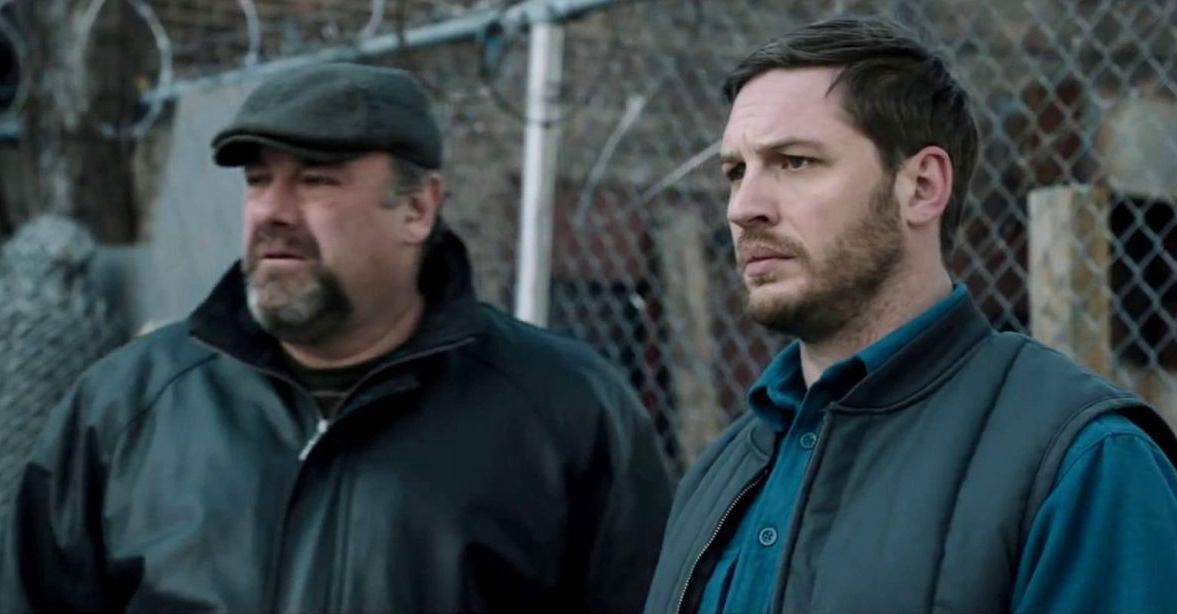

Fortunately, here that means we get James Gandolfini in a beautifully nuanced performance that makes us miss him even more sharply. He plays “Cousin Marv,” whose name is still on the bar, but no longer on the deed. Now he’s just the manager, and he quietly but meaningfully tells Bob (Tom Hardy), the bartender, to take down the Christmas decorations (“It’s December 27th!”) and stop running a tab for the flowsy barfly at the end of the counter. Oh, and no more rounds for the boys at the bar, even though they are observing the 10th anniversary of a friend’s death. We will learn later that there is more significance to the last two items than losing the revenue on a few drinks.

Copyright 2014 Fox Searchlight

On his way home, Bob hears a noise in a neighbor’s garbage can. It is a badly injured puppy. The wary neighbor is Nadia (Noomi Rapace), who insists on taking a picture of Bob’s driver’s license on her cell phone and sending it to four friends before she will even talk to him about the puppy. She helps him clean it up and reluctantly agrees to care for it for a couple of days so he can decide what to do. He adopts the puppy and names it Rocco. And she offers to care for the puppy while he is at work to make some extra money.

For a moment, things are looking up for the lonely Bob. But not for Cousin Marv’s or for Cousin Marv. Marv and Bob are held up at gunpoint by two guys in masks who may not be entirely unknown to them. The owners are tough Chechen gangsters who expect them to get the money back and who give them a glimpse of some guys they are in the middle of torturing just to make sure the message is received. And Cousin Marv’s is set to be the drop bar for the biggest betting night of the year, the Super Bowl. A cop (John Ortiz of “Silver Linings Playbook”) is nosing around. And there is pressure on Bob as well. A very unstable guy in the neighborhood, reputed to have killed a guy, says he is Rocco’s owner and he may have some feelings of ownership toward Nadia as well. Also, there is a body part formerly belonging to someone who was formerly alive, and it will need to be disposed of.

The storyline is all right, but what matters here is the mood, and that is excellent, with Gandolfini, as always, a master class in acting. There are so many layers to his performance, whether he is answering his sister’s question about dinner or refusing to look inside a bag that clearly cannot contain any good news. His expression in his very last scene of the film is particularly compelling.

Hardy’s quiet power is beautifully restrained. Ann Dowd as Marv’s wistful sister and Matthias Schoenaerts as Eric, Rocco’s volatile former owner are also very good. In some ways, Eric is the most revealing character in the story. Asked what he wants, he isn’t sure, except that he doesn’t want Bob to think he has anything over on him. People want money, of course, and power, and to be left alone. But what drives them really nuts is the fear that someone has more than they do and there’s nothing they can do about it.

Parents should know that this plot concerns various crimes and attempted crimes including extortion, robbery, torture, and murder, with many characters injured and killed, as well as some graphic and disturbing images, drinking, smoking, and constant strong language.

Family discussion: The original title of the story this film was based on is “Animal Rescue.” Would that have been more appropriate for the film? Why did Bob stay at the bar?

If you like this, try: “Killing Them Softly” and “Get Shorty,” both featuring James Gandolfini

Related Tags:


Based on a book Crime Drama Thriller

Dolphin Tale 2

Posted on September 11, 2014 at 5:59 pm

Copyright Warner Brothers 2014

The warmest, wisest, most pleasurable live-action family film of the year is “Dolphin Tale 2,” even better than the 2011 original. This really is that rare movie for the whole family.

The first film was inspired by the true story of Winter, a rescued dolphin who was able to thrive in Florida’s Clearwater Marine Aquarium after an innovative new prosthetic tail helped to protect her spine and allow her to swim. She has been an inspiration to millions of visitors in person and via webcam, especially to wounded veterans and other adults and children with disabilities. In the original, directed by Charles Martin Smith (Terry the Toad in “American Graffiti” and Farley Mowat in Never Cry Wolf, a sensitive loner named Sawyer (Nathan Gamble) bonds first with the wounded dolphin and then with the staff who care for the marine animals, especially aquarium head Clay (Harry Connick, Jr.) and his pretty daughter Hazel (Cozi Zuehlsdorff). Ashley Judd played Sawyer’s mother, Kris Kristofferson played Clay’s houseboat-dwelling dad, and Morgan Freeman played crusty Dr. McCarthy, who figures out how to make the prosthetic comfortable and stable.

Everyone returns for this follow-up, and this time Charles Martin Smith does triple duty as writer, director, and actor, appearing as a strict but not unsympathetic USDA official responsible for making sure the facility meets federal standards in caring for the animals.   He may refer to Winter at CMA1108, but he is trying to do what is best for her.

The kids have gone from middle school to high school. They are now experienced marine animal specialists, and spend most of their time at the aquarium, much of that in the water. We see how capable and knowledgeable they are when they assist in the rescue of an injured dolphin they name Mandy and a sea turtle ensnared in fishing line they dub Mavis. And we see how deeply they care for the animals when the veteran of their dolphin population, a 40-year-old deaf dolphin who is “paired” with Winter, dies suddenly. This is more than a sad loss. Dolphins are deeply social creatures. If Winter cannot or is not willing to be be paired with another dolphin, she will die.  The USDA inspector says that if they cannot find a friend for Winter in 30 days, she will have to be moved.

Mandy’s arrival seems providential. But then the best thing happens, which is also the worst thing. They are able to restore Mandy to health.  But that means that she can no longer remain in captivity, which is just for animals who can no longer take care of themselves.  The motto of the facility is three words: rescue, rehabilitate, release.  “You didn’t build this place to keep animals,” Clay’s father reminds him.  “You built it to heal them and let them go.”  The wrenching task of weighing those competing considerations is sensitively presented as a moral issue, an economic issue, and as a part of growing up that Hazel and Sawyer must understand.  It is an issue of more complexity than we normally get to see in family films, and it is presented with exceptional insight.  A scene where Hazel follows Sawyer’s mother’s advice to speak to Clay the way she would like to be spoken to is a small gem that got some appreciative laughs of recognition from the audience. Smith knows his audience, though, and expertly seasons the storyline with cute animals, especially Rufus the pelican, who is back for more comic relief. Even with Rufus, though, the slapstick moments are just part of the story.  His protective concern for Mavis is genuinely touching.

A storyline about whether Sawyer will accept an opportunity to take a special semester at sea is less intriguing.  But Gamble’s quietly sincere and thoughtful performance grounds the film, with Zuehlsdorff (who provides a sweet song over the closing credits) more ebullient, but never less than completely real and in the moment. The completely natural performances of the two leads perfectly matches the sun-drenched naturalism of the setting, utterly at home in the water, interacting with the dolphins, or struggling to grow up. When Dr. McCarthy sits down next to the conflicted Sawyer to hand him a family heirloom, Sawyer says knowingly, “I’m about to get a lesson here, aren’t I?” He is, and we are, too, but it is a good lesson and it goes down easy. So does the film, ambitious in scope but light in presentation. And it is no disrespect to the movie to say that the best part is the closing credits, where we see Wounded Warriors and other people with disabilities coming to visit Winter and Hope for inspiration and, somehow, a sense that they are being understood and cared for.

Parents should know that this film includes mild peril, some scenes of animal and human injuries and a sad animal death.

Family discussion: What was the lesson of the watch? What were the best reasons for releasing Mandy? For keeping her? Did they make the right decision?

If you like this, try: The original film — and watch Hope and Winter online

Related Tags:


Animals and Nature Environment/Green For the Whole Family Inspired by a true story Scene After the Credits Series/Sequel Stories About Kids

The One I Love

Posted on September 4, 2014 at 6:00 pm

B+
Lowest Recommended Age: Mature High Schooler
MPAA Rating: Rated R for language, some sexuality and drug use
Profanity: Very strong language
Alcohol/ Drugs: Drinking, drugs
Violence/ Scariness: Scuffle, some creepy themes
Diversity Issues: None
Date Released to Theaters: September 5, 2014
Amazon.com ASIN: B00MB7KXPM

“The One I Love” is pretty good as a movie and sublime as an exercise, especially an acting exercise. Just describing details about the story will require a huge spoiler alert, which I will insert below before giving away some of what happens in the film (omitting the ending, of course). But first, we can mention the acting challenge presented by the film. Two actors are on screen for almost the entire running time and are required to display small but distinctly different characteristics to help us and the characters keep everything straight. That is a pleasure to watch on a whole other level aside from the storyline. The-One-I-LoveElisabeth Moss (“Mad Men”) and Mark Duplass (“The Mindy Project”) play Ethan and Sophie, a married couple seeing a therapist (Ted Danson) for counseling. Ethan remembers with great warmth when they first met, and impulsively went for a swim in a stranger’s pool. The sense of fun and freedom they had is something he misses. Sophie is having trouble trusting Ethan again because he had an affair and he is embarrassed and defensive. “I felt like our happiness used to be so easy and there used to be so much of it,” she says sadly. The therapist recommends a weekend getaway to a beautiful, remote cabin, assuring them that every couple he has sent there has returned “renewed.”

They arrive at the cottage, which is lovely, and discover that it has a guest house. SPOILER ALERT: As each of them enters the guest house separately, they encounter what they at first think is each other, but then realize is some other version of the person they married, a little brighter, sweeter, more considerate, more agreeable. Sophie’s new Ethan apologizes sincerely and contritely for his transgression and paints a portrait of her to show his devotion. Ethan’s smiling, slightly Stepford wife-ish new Sophie makes him bacon for breakfast, which the old Sophie didn’t like. At first, each thinks that the other is somehow making progress, becoming more cooperative, more committed to intimacy and rebuilding the relationship. But then it becomes clear that only one of them can enter the guest house at a time, and that the spouse they experience inside is someone new, different, and possibly some sort of projection, not a real person at all.

Ethan and Sophie respond very differently. He takes it on as an opportunity for rational detective work. “Of course you thought the fun was the investigation,” Sophie says, reminding him of the magic show where she enjoyed the show but he insisted on deconstructing all the tricks.

The original Sophie and Ethan at first decide to leave. It is just too creepy. But then they decide to return, making a pact about how each of them will handle the guest house doppelgangers. Is that the therapy? Giving them a shared experience so bizarre that it jolts them into working together to puzzle it out may be part of rebuilding their relationship, after all. “It’s like an exercise in trust,” Ethan says.

Screenwriter Justin Lader plays out the possibilities very cleverly, and it would be unfair to spoil it further. If the ending is not all one might hope, more of a trick than a conclusion, the performances and the ideas are provocative, fun, and something of a therapeutic trust exercise of their own.

Parents should know that this film includes very strong language, sexual references and situations, drinking, and drug use.

Family discussion: What is your explanation for how this retreat came together? If you had a chance to enter the guest house, would you? What would you find there?

If you like this, try: “Safety Not Guaranteed”

Related Tags:


Fantasy Movies -- format Romance VOD and Streaming

The Identical

Posted on September 4, 2014 at 5:51 pm

C-
Lowest Recommended Age: Middle School
MPAA Rating: Rated PG for thematic material and smoking
Profanity: Mild language
Alcohol/ Drugs: Drinking, smoking
Violence/ Scariness: Some scuffles
Diversity Issues: None
Date Released to Theaters: September 5, 2014

Copyright 2014 City of Peace Films
“The Identical” is an incompetent mishmash of mawkish sentimentality larded with a few pleasant musical numbers and some random asides about Israel.  I’m not making this up.

It is inspired by an intriguing fact.  Elvis Presley was a twin.  His brother was stillborn.  Screenwriter Howard Klausner (“The Grace Card”) changes the names and imagines what would have happened if the twin had lived but been raised in a different family.  The focus of this story is on Ryan Wade (Elvis impersonator Blake Rayne), the boy who was given up, adopted by a kindhearted Baptist preacher and his wife, played by Ray Liotta and Ashley Judd.  We don’t know much about the child who stayed with his biological parents except that he grew up to be a rock and roll superstar known as “The Dream.” Ryan is a good kid who loves music.  After a stint in the army, he tells his father that he won’t be following him into the clergy.  He works as a mechanic until he wins a Dream impersonation competition and gets hired to perform at state fairs and other venues. We get glimpses of The Dream (also played by Rayne), performing, riding in a limo through a cornfield, flying in a private plane, looking haunted, but we never find out anything about what his life was like, or what music means to him.

The dramatic possibilities in this story surely have to be in the nature/nurture saga that explains the enduring popularity of real-life stories of identical twins separated at birth as well as fictional tales from “The Man in the Iron Mask” to “Big Business.” And there is some potential for pointed satire along the lines of “Walk Hard” or a thoughtful exploration of the racial and cultural divides that melded into the early years of rock and roll. But “The Identical” bypasses all of this for a story that is both lightweight and dreary and a hero who is too good to be true, played by performer who is much more comfortable with the musical numbers than he is with the dialog. I do give him credit for holding his own despite a series of some of the most appalling wigs ever put on screen.

Even supremely talented actors like Liotta and Judd can’t make much of this movie’s dialog, which is stilted and pedestrian. Among the missed opportunities here is the chance to see what Liotta could do delivering a stem-winding sermon to his Baptist congregation. He does deliver some nice thoughts about kindness and tolerance. But all we get from his appearances in church is a watered down commentary on the importance of supporting Israel (with candles burning on a menorah behind him!) during the 6-Day War of 1967. While the film is being marketed as faith-based, there is very little content relating to the role of faith in the lives of any of the Christian or Jewish characters. It is awkwardly written and uncertain in tone, failing as commentary and as story.

Parents should know that this film includes drinking, smoking, difficult family issues, sad deaths, and family conflicts.

Family discussion: Should Reece have told Ryan the truth? Why do audiences like tribute groups that imitate star performers?

If you like this, try: “August Rush” and “The Buddy Holly Story”

Related Tags:


Drama Family Issues Movies -- format Musical
THE MOVIE MOM® is a registered trademark of Nell Minow. Use of the mark without express consent from Nell Minow constitutes trademark infringement and unfair competition in violation of federal and state laws. All material © Nell Minow 1995-2026, all rights reserved, and no use or republication is permitted without explicit permission. This site hosts Nell Minow’s Movie Mom® archive, with material that originally appeared on Yahoo! Movies, Beliefnet, and other sources. Much of her new material can be found at Rogerebert.com, Huffington Post, and WheretoWatch. Her books include The Movie Mom’s Guide to Family Movies and 101 Must-See Movie Moments, and she can be heard each week on radio stations across the country.

Website Designed by Max LaZebnik