A Million Ways to Die in the West

Posted on May 29, 2014 at 5:58 pm

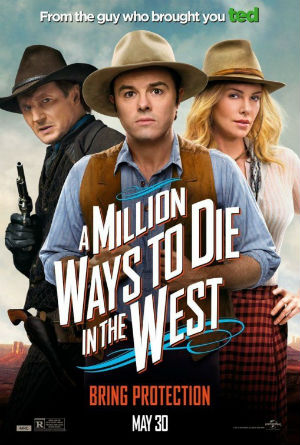
A_Million_Ways_to_Die_in_the_West_posterWhen Seth MacFarlane tops his unprecedented success on television with three animated series (“Family Guy,” “The Cleveland Show,” “American Dad”) and his first feature film was a blockbuster — the talking teddy bear movie Ted is the highest grossing R comedy of all time, in both senses of the word, with a sequel in the works.  He also found time to put out an album of American songbook standards that received widespread if somewhat grudging critical acclaim (Music Is Better Than Words) and produce a popular reboot of Carl Sagan’s “Cosmos” series.  His only real flop to day was his disappointing hosting job at the Oscars (the song “We Saw Your Boobs” and sexist jokes did not go over well).  So, he can write his own ticket in Hollywood.  And that is what he has done with “A Million Ways to Die in the West,” a silly comedy that reflects the excessive deference given to someone with that track record.  You want to do a western?  Fine!  You want to not just write and direct but also cast yourself as the lead opposite top-ranked actors?  With lots of fart jokes?  Where do we sign?
And that is how “A Million Ways to Die in the West” got made.  It is too long, too dumb, and too gross.  But sometimes funny.

The saucer-eyed MacFarlane plays Albert, a sheep farmer who hates living in the west where “everything that is not you is trying to kill you.”  A motif of the film is the many ways minor characters are killed off, intentionally or by accident.  We meet Albert talking his way out of a shootout on the main street, to the disappointment of the assembled townsfolk and his fiance, Louise (Amanda Seyfried, the local schoolmarm).  Louise dumps him, and Albert is devastated.  His friends Edward (Giovanni Ribisi) and his fiancee Ruth (Sarah Silverman) try to comfort him, but he is inconsolable until he meets Anna (Charlize Theron), new in town.  She offers to help him make Louise jealous, but they find themselves attracted to one another.  Unfortunately (as we know early on but Albert does not), Anna is married to the West’s most notorious gunslinger, with the macho name of Clinch Leatherwood (Liam Neeson).

The movie looks and sounds like a classic western, with sun-burnished views of Monument Valley from Director of Photography Michael Barrett and an evocative score by Joel McNeely, both MacFarlane regulars.  Neeson is outstanding, as always, never winking at the camera.  Neil Patrick Harris is a pleasure as Albert’s romantic rival, a mustachioed slicker who can dance up a storm.   Theron manages the more challenging trick of making Anna feel real, even though she is delivering contemporary dialog in buckskin and a bustle.  It is a wonderfully natural, appealing performance that does wonders to give MacFarlane more humanity and make him seem a little less whiny and juvenile.

Unfortunately, the move keeps things pretty whiny and juvenile anyway, with MacFarlane taking full advantage of the MPAA’s notoriously lax standards for a studio comedy to include material that is more tiresome than outrageous.  More unfortunately, it goes on at least 40 minutes too long, with an extended drug trip hallucination sequence that feels as endless as your college roommate’s moment by moment rendition of his dream.  Lame humor includes an extended conversation about people in olden days not smiling in photographs and Ruth’s activities as a prostitute who as a good Christian won’t sleep with her boyfriend until they are married.  There are no set-pieces as funny as Mark Wahlberg’s recitation of trashy girl names in “Ted” and the guest stars feel stunt-ish, not a part of the storyline as Sam Jones and Norah Jones were in that film.  By the time the sheep is peeing on Albert’s face, the audience may feel that in the old west as ever, dying is easy but comedy is hard.

Translation: Constant extremely crude and gross-out humor with very explicit and raunchy sexual references and situations and extensive bodily function humor, nudity, jokes about prostitution and child molestation, racial and sexual orientation humor, western-style violence with shoot-outs and many characters injured and killed, disturbing images, drinking, smoking, drug use, very strong and explicit language including the r-word

Family discussion: What do the “straight” western elements of this film like the cinematography, landscapes, and score contribute to its overall effect? Do you think any of these jokes went too far?

If you like this, try: “Ted” and “Blazing Saddles”

Related Tags:


Comedy Western

X-Men: Days of Future Past

Posted on May 22, 2014 at 6:00 pm

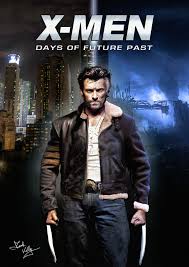
x-men dofpX-Men fans will see this film anticipating the pleasure of watching their favorite X-Men characters in one of the comic book series most acclaimed storylines: the time-bending saga of a desperate trip to the past to undo one tragic mistake. Wolverine, Mystique, and the old and new versions of Professor X and Magneto are all here and there are grandly staged action scenes involving the White House lawn, Chinese ruins, and a sports stadium. But the powerhouse knock-you-socks-off what-did-I-just-see moments come from a new character in the movie franchise, Quicksilver (Evan Peters), who does a little time-bending of his own in the most dull and domestic of settings, a kitchen. Well, it’s a kitchen in the Pentagon, but still. Part “Matrix,” part Chuck Jones, it is sure to be on end of the year best lists.  And of course Jennifer Lawrence is terrific as the conflicted Raven/Mystique, whose loyalties shift almost as often as her chameleonic exterior, and who looks sensational in a costume so revealing that would make a Las Vegas showgirl look like she’s wearing a parka.

Marvel’s X-Men are mutants, the next stage of evolution past homo sapiens, with a range of intriguing and sometimes mutable superpowers. They also represent the next stage of evolution as superheroes, with conflicted characters and complex extended storylines that resonate the themes of societal, political, and psychological struggles. Characters go back and forth between the “good guy” (want to work with humans) and “bad guy” (believe humans can never accept or keep up with them so they should be wiped out in a Darwinian overthrow of the less-fit) teams.

We’ve seen the present-day X-Men in a trilogy of films and stand-out Wolverine (Hugh Jackman) in two starring vehicles. And saw the origins of the first X-Men, Charles Xavier, known as Professor X, and Erik Lehnsherr, known as Magneto, in X-Men: First Class. Now, everything comes together in the time-travel saga “Days of Future Past,” a little bit “Terminator,” a little bit “Back to the Future,” as Wolverine goes back in time to change one event in order to prevent the creation of an army of killer robot drones that wiped out most of the mutants and humanity, too.

This will require getting the band back together, including teaming up sometime friends/sometime enemies Charles Xavier (played in the past by James McAvoy and in the present and future by Patrick Stewart) and Magneto (played in the past by Michael Fassbender and in the present and future by Ian McKellen).  (Nerd note: In the comic book series, it is Kitty Pryde (Ellen Page) who transmits her consciousness back in time to her younger self, but in the movie she sends Wolverine’s consciousness back to his younger self instead.)  Thankfully, they minimize the “How do I know you’re really from the future?” stuff and get to the action, starting with breaking Magneto out of the most secure prison facility on earth, buried under the Pentagon.  This is where Quicksilver comes in very handy.

Newcomers will enjoy the action and it may lead them to check out the earlier movies and the comics to find out more about the X-Men universe.  Fanboys and fangirls will appreciate a couple of insider references.  Those old enough to remember the 70’s will appreciate some insider references, too, like the recording device in Richard Nixon’s oval office and the synth-infused score.  As in all the best X-Men stories, the themes feel visceral to our times — national security, the definition of “other.”  Just don’t try to resolve all the temporal anomalies, and you’ll have a blast.

Parents should know that this film has extended action/comic-book humor, with many characters injured and killed, guns, explosions, fire, some graphic and disturbing images, some strong language, drug use, brief nudity and very revealing attire.

Family discussion: If you could go back in history and change one thing, what would it be?  If you could have any of the powers of the X-Men, what would you choose?  How should the government make decisions about threats like the X-Men?

If you like this, try: the other “X-Men” movies and “The Avengers”

Related Tags:


Action/Adventure Comic book/Comic Strip/Graphic Novel Fantasy Scene After the Credits Science-Fiction Series/Sequel Superhero

Blended

Posted on May 22, 2014 at 6:00 pm

blendedOh, if perennial Razzie-winner Adam Sandler must keep making movies, I suppose they are less terrible when he includes his sweetest co-star, Drew Barrymore. She always brings out the best in him (“The Wedding Singer,” “50 First Dates”). The imperishable sunniness of Drew can somehow persuade us that Sandler is not as unlikeable as he seems. Sandler just might escape the Razzie award for cinematic atrocity this year. That might not be progress, but at least it’s a respite.

Thankfully, Sandler does not do that awful baby-voice or force Rob Schneider into another disgusting cameo in “Blended,” and no one has sex with an old lady. So, as Adam Sandler movies go, this is not as terrible as some of them. Yay! Of course that does not mean that Sandler foregoes his trademarks: a lot of gross-out humor involving bodily parts and functions, adults behaving like children and children precociously preoccupied with sex, and a lazy, almost haphazard approach to the story. Plus: Sandler regulars Kevin Nealon and Alexis Arquette, the genuinely funny Terry Crews and Wendy McLendon-Covey (“Bridesmaids”), a bunch of less funny people in the credits with the last name “Sandler,” a walloping product placement placement from a tourism bureau, this time South Africa, and a gooey, sentimental, retro vibe to remind us that boys are boys and girls are girls and it is great to be part of a family. While there was laughter in the theater, it is telling that following a fire alarm and brief evacuation, about a third of the audience decided not to come back. Consider yourself warned.

Sandler plays Jimmy, manager of a sporting goods store and single father of three girls he calls by boy names, one named for his favorite television network: Espn. He dresses them in khakis and polo shirts. Drew plays Lauren, a single mother of two sons, one who throws tantrums when he strikes out in Little League, one exploding with adolescent hormones.

We meet Jimmy and Lauren on their disastrous blind date, for each of them the first date since before they were married. They are awkward with each other and agonizingly uncomfortable. He brings her to Hooters. She has not one but two spit-takes. He looks at the TV while she’s talking.  “There’s a very tight game going on up there.”  And he insults her closet organizing business.  “Did you start by organizing glove compartments?”  They agree on just one thing — they never want to see each other again.

But then they end up on the same trip to Africa. Lauren and Jimmy discover they are on the “blended family-moon,” a special week for second-marriage couples and their children. Their loathing turns to respect and affection as they go on adventures and bond with each other’s children. If you guessed that this bonding would include a makeover for Jimmy’s 15-year-old girl (hair extensions, lipstick, miniskirt) to help her achieve her goal (attention from a boy) and batting practice and boxing lessons for Lauren’s sons, then you are familiar with the “Brady Bunch”/Bazooka Joe level of plot and character development that Sandler inflicts on his fans.  The retro humor crosses the line from lazy to skeezy, with locker-room-style gender and sexual orientation jokes that were outdated twenty years ago.

Intended to be a laugh riot: a child repeatedly having his head slammed into walls and doors when his mother tries to carry him, a young teenager who puts his babysitter’s face on a nude fold-out that he keeps under his bed, a “meet cute” involving the two leads’ mutual inability to cope in the drugstore as Jimmy is trying to buy tampons for his daughter and Lauren is trying to buy porn for her son.  There is attempted comedy about the appropriate tampon circumference for a 15-year-old and the appropriate masturbation material for a middle schooler.

Closer to the mark: the always-great Terry Crews as a pec-popping tummeler with a traveling group of township jive-singers, ubiquitous white minivans, and a couple of the jokes. A couple as in two.

Most of the jokes are disappointingly lazy, as usual in Sandler films. These are joke-ish, not actual jokes. In one scene, Jimmy’s youngest daughter (a darling Emma Fuhrmann) looks in a mirror and realizes that what she thought was cute kitty cat make-up face paint applied by her father was a mess. She screams that she looks like the “Walking Dead.” This is supposed to be funny because she is surprised that it looks different from what she envisioned and because a little kid knows about “The Walking Dead.”

But it’s a sloppy, easy, cheap joke, and it’s a sloppy, easy, cheap movie. Sandler should keep working with Drew Barrymore, and next time he should also film a script that has had more than one draft.

Parents should know that this movie includes very strong and crude language for a PG-13 and a lot of sexual humor including extended references to teen masturbation and discussion of adultery and divorce and jokes about Kegel exercises, bondage, a 15-year-old’s private parts, cameltoe, animals having sex, and giving someone a rufie. There is comic peril and violence and a sad off-screen death of a parent and a joke about developmental disabilities.

Family discussion: What did Lauren and Jimmy learn from watching each other as parents?  Which of the activities in Africa would you like to try?

If you like this, try: “The Wedding Singer”

Related Tags:


Comedy

Godzilla

Posted on May 15, 2014 at 6:01 pm

41U90dIWTDL._SY300_All the basic ingredients are there for a slam-bang summer monster movie.  We have people in helmets and hazmat suits running to try to get away from something scary.  We have a scientist pleading with a military officer to trust him and the guy in camo responding that he can’t take that chance.  We have a guy everyone thinks is crazy who turns out to be right.  We have mumbo-jumbo about radiation and bio-acoustics.  We have a tentacle(?) tease 40 minutes in.  We have a corporate/government cover-up.  People say things like, “There’s been a breach,” and “I can prove to you and the world that this was not a natural disaster.”  Oh, and “I’m going to find the truth and end this, whatever it takes.”  And “It’s going to send us back to the stone age.”

Buildings will be destroyed and a bridge will collapse.  People will be told to stay home and then traffic will be at a standstill as they all ignore directions.  We have a lot of globe-hopping so that international forces can be involved and iconic skylines can be trashed. And, most important, we have a very, very big monster to do the trashing.  Enormous ships will be tossed around like a rubber duckie in a bathtub.

What we don’t have is a very good story.  And for a movie with a lot of destruction, not enough of a sense of real investment in the outcome.  The good news about CGI is that you can make anything happen on screen.  The bad thing is that everyone knows you can make anything happen, so at a fundamental level, it does not feel real.

“Godzilla” begins promisingly, with a terrific opening credit sequence over “archival” footage and glimpses of redacted government reports.  And ash, lots of ash, detritus from atomic fallout, pretty cool in 3D. Then there’s a little backstory.  In 1999 we see the discovery of a skeleton in a Philippine mine.  The rib cage is the size of an apartment building.  And there’s goop!  If there’s one thing we’ve learned from monster movies over years, it has to be DON’T TOUCH THE GOOP.

Meanwhile, still in 1999, we get our introduction to the adorable family — there always has to be an adorable family — living near a nuclear energy plant in Japan who will provide the emotional core of the film.  There’s loving American father (Bryan Cranston) Joe Brody, distracted by some inexplicable but rhythmic tremors.  There’s loving French wife (Juliette Binoche), who also works at the plant.  And there’s a son, cute tyke Ford.  “Earthquakes are random, jagged,” Joe explains.  What he is hearing is “consistent and increasing.”  We know he will have a hard time persuading his bosses, but we know he is right.  And soon tragedy strikes and the cooling towers collapse.  The entire community is contaminated and shut down.

Fifteen years later, Ford (Aaron Taylor-Johnson of “Kick-Ass”) is coming back from a military deployment where his job is “stopping bombs.”  After he has an adorable reunion with his own adorable wife (Elizabeth Olsen) and son, he gets a call.  Joe has been arrested in Japan, where he is still obsessed with finding the truth about what happened.  He has a crazy room with walls covered in clippings connected by string to show the various conspiracies.  Ford thinks his dad is nuts.  He’s about to find out that he is right.

I don’t want to give away any monster spoilers here, so I’ll just say that there are some surprises for anyone not thoroughly immersed in “Godzilla” lore.  I liked seeing the creature pop nuclear warheads into his mouth like Popeye knocks back spinach.  And it steps things up nicely when the monster’s power charge shorts out the grids.   The special effects are excellent, though only a high-altitude/low opening parachute jump makes full use of the 3D.  But the story is weak and the characters are cardboard.  The original 1954 “Godzilla” resonated because it personified (monstronified?) our then-new fears about the atomic age.  With so many contemporary scares about environmental damage, they should have been able to find something equally potent.

Parents should know that this is a sci-fi movie in the tradition of all monster movies, with extensive mayhem,scary surprises, some disturbing images, and many characters injured and killed.  There is some strong language.

Family discussion:  What made the scientist and the military come to different conclusions — information or training?  What was the significance of the pocket watch?

If you like this, try: the original Japanese “Godzilla” movies

Related Tags:


3D Action/Adventure Fantasy IMAX Remake Science-Fiction Thriller

Million Dollar Arm

Posted on May 15, 2014 at 6:00 pm

milliondollararm

The folks behind feel-good, based-on-a-true-sports-Cinderella-story, Disney movies “The Rookie” and “Miracle” are back with another.  This time it is the story of a real life Jerry Maguire sports agent named J.B. Bernstein (a terrific Jon Hamm) who has fallen on hard times, despite the optimistic name of his firm: 7 Figures Management.  Think of it as Jerry if Cuba Gooding, Jr.’s character quit him, too.  He needs some athletes to sell to major league baseball and there isn’t anyone in the world who plays baseball who isn’t already represented.  He even has a line almost identical to Jerry’s famous “Help me help you.”

In one of those crazy ideas borne out of complete desperation (plus watching Susan Boyle wow the judges on “Britain’s Got Talent”), Bernstein figures that the only place left to look is India, which must be perfect because (1) no one there plays baseball, so no agents have signed anyone up, and (2) it is the second most populous country in the world, so the odds are that there must be someone there who can throw a fastball.  What do they play in India instead of baseball?  Among other sports, they play cricket, which J.B. describes, with all the cultural diplomacy we might expect from someone who has some important lessons to learn by the time we finish our popcorn, as looking like “the insane asylum opened up and all the inmates made up a game.”

He decides to go to India to look for what we like to call a long shot.  He will stage an “American Idol”-style competition with (per the title) a million dollar prize.  He gets the money for this from the wealthy Mr. Chang (Tzi Ma), who is not too worried about whether there really is a major league throwing arm in India because he figures that the competition will stir up interest in baseball for the first time in a brand new country with up to a billion new fans.  And that is money in the bank.

So J.B. goes off to India where, predictably, he runs into problems with exotic food and cultural and language barriers.  “Indians love honking and bypassing the system,” his affable new aide advises him.  Less predictably, he runs into not one but two young men who can throw fastballs hard, Rinku (Suraj Sharma, who had his own “Million Dollar Arm” moment in real life when he was selected from 3000 actors who auditioned to star in “The Life of Pi”) and Dinesh (Madhur Mittal of “Slumdog Millionaire”).  He finds them with the help of an adorably cranky old scout played by Alan Arkin, as always, the best part of any movie he’s in.  Of course he’s the old guy showing everyone how it’s done playing the old guy who shows everyone how it’s done, so he’s got that going.  “Don’t wake me up until someone’s throwing a baseball,” he says, explaining he does not have to look at the contestants because he can hear pitching speed.  And he can.

Slight problem: they not only have never played baseball before; they have never seen a baseball game and have no idea how to play or what the rules are.  And it is difficult for them to learn because (1) their knowledge of English is only slightly better than their completely nonexistent knowledge of baseball, and (2) playing any sport at the professional level is very, very, very, very hard for people who have been working on it for decades and has to be impossible for anyone who has never played before.

But then, if they couldn’t do it, we wouldn’t be here, now, would we?

J.B. brings two young men back home to California.  The only thing he has paid attention to is the number on that radar gun that clocks the speed of the throws, which is an impressive number.  And maybe the number in his bank account, which is not a good number.  He has not noticed that these are very fine young men or that they have never been away from home before.  He learns very quickly that he cannot leave them in a hotel.

They move into his bachelor pad, marveling over the room for just one man but confused that they don’t see anywhere to pray.  They are befriended by his tenant, a beautiful and kind-hearted doctor (Lake Bell).

JB turns the young men over to college coach Tom House (Bill Paxton), who explains why you can’t turn a non-baseball player into a major league pitcher in a matter of months, in time for the try-out Mr. Chang has put together.  “It’s completely different motions, biometrics.”  They do not know what a baseball glove is.  But J.B. is good at one thing, persuasion.  “You certainly don’t need any help with your pitching,” House tells J.B. He agrees to try to teach them that “it is not about throwing hard, but throwing right.”  And they study a copy of Baseball for Dummies.

Writer Tom McCarthy (“The Station Agent,” “Win Win”) keeps things from getting too twee.  The film clearly respects Rinku and Dinesh and their country, though it skirts very close to Magical Negro territory and the fish-out-of-water cultural clashes stay on the surface.  The young men are not allowed to be much more than amiable innocents whose job is to give the soulless white guy an important opportunity to reconnect with his humanity (and, as a consequence, with the beautiful doctor as well).  This is J.B’s story and Hamm is a pleasure to watch, with full-on, big-time movie star magnetism, and his scenes with the lovely Bell (“In a World”) have a real warmth that makes the happy ending feel earned.

Parents should know that this movie includes some mild language and sexual references.  Characters have casual sex (off-screen).

Family discussion:  What were the most important things JB learned in India?  When he got home?

If you like this, try: “The Rookie” and “Miracle” from the same producers and also “Bend it Like Beckham”

Related Tags:


Based on a true story Sports
THE MOVIE MOM® is a registered trademark of Nell Minow. Use of the mark without express consent from Nell Minow constitutes trademark infringement and unfair competition in violation of federal and state laws. All material © Nell Minow 1995-2026, all rights reserved, and no use or republication is permitted without explicit permission. This site hosts Nell Minow’s Movie Mom® archive, with material that originally appeared on Yahoo! Movies, Beliefnet, and other sources. Much of her new material can be found at Rogerebert.com, Huffington Post, and WheretoWatch. Her books include The Movie Mom’s Guide to Family Movies and 101 Must-See Movie Moments, and she can be heard each week on radio stations across the country.

Website Designed by Max LaZebnik