The LEGO Movie

Posted on February 6, 2014 at 6:00 pm

A-
Lowest Recommended Age: Kindergarten - 3rd Grade
MPAA Rating: Rated PG for action and crude humor
Profanity: Some schoolyard language ("butt")
Alcohol/ Drugs: None
Violence/ Scariness: Cartoon-style peril and violence, no one hurt
Diversity Issues: Diverse characters
Date Released to Theaters: February 7, 2014
Date Released to DVD: June 18, 2014
Amazon.com ASIN: B00HEQOC2A

LEGO movie Everything is awesome in this fast, fresh, funny, and utterly adorable movie set in the vast world of LEGOs.

Last year at Comic-Con the filmmakers said that there are two great things to do with LEGOs — you can follow the instructions and make something awesome.  Or, you can ignore the instructions and make something awesome.  Here, they pay tribute to both in the storyline and in their own meta-approach to the material, deconstructing classic movie narratives over here, re-constructing them over there, and adding in some delicious humor and sublime guest stars of both the LEGO and human variety.  So when a Gandalf-y looking guy with the deep, familiar voice of Morgan Freeman intones a prophecy about a chosen one, we file it away as the underlying frame for the story — for a couple of seconds until he advises the confused crowd that it has to be true because it rhymes.  Big-time Lugnuts and Brick-heads will find plenty of in-jokes and wonky charm and those who don’t know their minifigures from their master builders will enjoy the wit, the silliness, and the surprisingly touching conclusion.

The movie winsomely begins with LEGO logos, immediately welcoming us into a playful, tactile world.  And then we meet our unassuming hero, the cheerful Emmet (a terrific Chris Pratt), who greets each day with joyful energy and loves everything about his life.  At least, that’s what he tells us as he follows the instructions for getting ready for work on a construction site.  The song “Everything is Awesome” (from Tegan and Sara) plays brightly everywhere.  Instructions are clear and faces are painted in a smile.  But Emmett is lonely.  Everyone seems to have friends to hang out with but no one invites him to come along.  He loves being part of a team but kind of misses having something special and different.

And then, the brave and glamorous Wyldstyle (Elizabeth Banks), with her fetching streaked ponytail, shows up and he follows her down the LEGO equivalent of a rabbit hole to discover that everything he thought he understood about his world of following instructions and being part of a team is at risk.  President Business (Will Ferrell) is about to unleash a terrible weapon, and apparently Emmet is the only one who can stop him.  There are worlds beside and under worlds and within other worlds here — you could make an “Inception”-style map that takes you from the wild west and Middle Zealand to Cloud Cuckoo-land.  The film makes clever use of the properties of LEGOs, their endless variety of characters and projects and their comforting sameness of structure and inflexibility.  It avoids becoming an infomercial by keeping the focus on the story and the goal of creativity.  Emmet and Wildfire are joined by Batman (Will Arnett’s dry baritone nails it), Vitruvious (Freeman), a pirate cyborg (Charlie Day), and a rainbow unicorn-kitty (Alison Brie).  Their foes include President Business’ two-faced henchman whose head swivels to allow him to be both good and bad cop (a very funny Liam Neeson).  It would be criminal to give away any of the movie’s many surprises and the mind-bendingly cool guest appearances, but I will mention that a couple of them arrive from a galaxy far, far away.

There are some unexpectedly heartwarming moments about family and the importance of imagination.  The bad guy is not called President Business for the usual reasons.   And there’s an unusually astute resolution to the final confrontation.  I especially enjoyed some very clever satire about the kind of entertainment we too often settle for.  If only they had known about Facebook’s 10th anniversary gift to each of its subscribers of “look back” mini-movies of their own lives — but not even “The LEGO Movie” could have come up with anything that solipsistically deranged.   But this movie is itself the best possible antidote to the tendency to settle for lowest-common-denominator formula story-telling.  It won’t just inspire you to see better movies; it will inspire you to make your own.

Parents should know that this film has cartoon-style peril and violence with many threatened injuries but no one hurt, a parent-child confrontation, some potty humor, and schoolyard language.

Family discussion: How do you decide whether you are special? Is it more fun to follow directions or make something up? What parts of the LEGO world do you recognize?

If you like this, try: the “Toy Story” movies and “Robots” — and build something with LEGOs!

Related Tags:


3D Animation Comedy DVD/Blu-Ray Pick of the Week Family Issues Fantasy For the Whole Family

Labor Day

Posted on January 30, 2014 at 6:00 pm

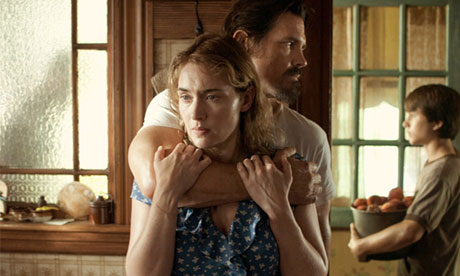
Labor Day film stillOn the surface, “Labor Day” feels like would-be Nicholas Sparks, a syrupy romance about two people with damaged hearts finding a healing love in a picturesque setting. But like a pretty chocolate candy with a filling that turns out to be surprisingly sour, this film based on the novel by Joyce Maynard is poisoned by Maynard’s trademark narcissism and her notion of love that never progressed beyond pulp-infused fantasies.  For Maynard, the only purpose of perfect love is to be endlessly worshiped by everyone, including a hunky guy who can literally and metaphorically clean her gutters and change her oil and also bake overripe peaches into a swoon-worthy pie, no measuring cup needed.

Youch.  Maynard, the empress of TMI, is a gifted writer who endlessly plumbs her favorite subject — herself.   The New York Times Magazine cover story in which she attempted to define her generation at age 18 led to a book contract (Looking Back: A Chronicle of Growing Up Old in the Sixties) and a series of fan letters from J.D. Salinger that invited her to drop out of college and move in with him.  And all of that led to a series of non-fiction and thinly disguised fictional stories and books about her dysfunctional parents, her marriage, her divorce, her children, her sister who is not as close to her as she would like, her beautiful homes and wonderful cooking, more more more on her children (the three she gave birth to and two more she adopted until the adoption did not work out and she found another home for them), more on her divorce, the first breast implants, the second breast implants, the removal of the implants, many splendid pies and many not so splendid relationships including a famously reclusive author and an intense correspondence with a prisoner that was one of the inspirations for this story.  The primary themes of her writing, lurking just under the surface tone of intimacy and comfort, are her fantasy of being utterly adored and the pain and never-ending sense of surprise and disappointment of discovering, over and over again, that she cannot seem to find it.

Those themes can be and have been turned into compelling stories, even literature.  But that requires a level of self-awareness that is utterly beyond Maynard, or, apparently director Jason Reitman, who wrote the screenplay based on her book.  Compare her novel, To Die For, based on the real-life case of the young wife who persuaded her 15-year-old lover and his friends to kill her husband, to the far superior movie starring Nicole Kidman and Joaquin Phoenix.  Thanks to screenwriter Buck Henry (“The Graduate”) and director Gus Van Sant, one key difference is that the film version slyly tweaks her story.  The film has some perspective on its clueless, narcissistic, chocolate spider of an anti-heroine (a sizzling portrayal by Kidman), while Maynard’s version seems to suggest that it sure would be nice to be so loved that you could talk someone into killing for you.

And that brings us to this story, in which Adele (a game but pasty-looking Kate Winslet), a depressed and fragile single mother, is unreservedly loved not just by her 13-year-old son Henry (Gattlin Griffith) and by Frank (Josh Brolin), the escaped prisoner who takes her hostage (but in the most gentlemanly way possible, performing all kinds of handyman chores, teaching her son manly throwing skills, being kind to a kid in a wheelchair, and making the gooey, luscious, no measuring cups allowed pie).  Even (spoiler alert) the ex-husband (Clark Gregg) has to chime in as well with the ultimate fantasy of the wife left for the babysitter — a confession that the ex-wife was just too beautiful and deep and all-around fine for him to handle.  The narrator is the now-adult son (Tobey Maguire), looking nostalgically back on end of the summer of 1987, when his efforts to cheer up his mother included a “Husband for a Day” coupon book.  Maynard has said this was inspired by a gift from her own son.  The film conveys no understanding that this might be evidence that she should be more careful about boundary issues (even worse is her sex talk) or that it is parents who should care for children, not the other way around.

Henry has outgrown his clothes, so he has to cajole Adele into a rare trip to the store.  There he is sized up by Frank, bleeding and wounded, who grabs a hat and sweatshirt from the rack and tells Adele that Henry has agreed she will give him a ride.  He tells her to drive him to her house, and then he tells her he will just stay until dark.  But pretty soon he is literally and metaphorically oiling her hinges.  Politely tying her up just to preserve her deniability in case he is found, he takes a few ingredients he finds in the kitchen and whips together a succulent chli, feeding her almost tenderly.  And then a neighbor comes over to drop off some ripe peaches, and they make every attempt to do to pastry what “Ghost” did for a potter’s wheel.  Unfortunately, it does to pastry what the many spoofs of the potter’s wheel scene have done instead.

Hunky as he is, we are never in thrall to Frank as Adele and Henry are.  His handyman perfection and meaningful glances are just too over the top and the backstory, when it finally comes, does not satisfy our need to understand and forgive him.  The entire last third of the film involves so many bad decisions — no, not just bad, catastrophically imbecilic — that we lose our sympathy for just about everyone involved.

Parents should know that there are some disturbing images of a bloody wound and a homicide and an off-camera very sad death of an infant.  There are sexual references and references to adultery and non-explicit situations.  Characters are in peril and there are some uncomfortable family interactions.

Family discussion:  What did Frank and Adele understand about each other?  What could Gerald have done to be a better father?  Why did Henry want to stay with his mother?

If you like this, try: the books and movies from Nicholas Sparks and “The Bridges of Madison County”

Related Tags:


Based on a book Family Issues Romance

That Awkward Moment

Posted on January 30, 2014 at 6:00 pm

that awkward moment

A cast of exceptionally appealing performers and some very funny lines are not enough to make this raunchy comedy overcome its essential charmlessness.  At its heart, it wants to be a romantic comedy, a chick flick from the perspective of the guys.  But even Zac Efron, Miles Teller, and Michael B. Jordan cannot make us wish these guys on anyone, and especially not on Ellie (Imogen Poots) and Chelsea (Mackenzie Davis).

Best bros/ladykillers Jason (Efron), Daniel (Teller), and Mikey (“Fruitvale Station” breakout Michael B. Jordan) make a pledge to avoid entanglements of the romantic kind and devote themselves to a “roster” of willing lovelies, kicking to the curb any woman who has the temerity to start a sentence with “So.”  “So,” it seems, never leads to anything good.  It is always the precursor to some version of “where do you think this is going?”  If it is supposed to be endearing that Jason’s response to a “So” conversation from a woman he has been having sex with for six weeks is an internal “I didn’t know we were dating” while he comforts her with a variation of “It’s not you, it’s me,” it fails to persuade us.  “I’m not even close to the guy you need, the guy you deserve,” he comforts her as he escorts her to the door.

Brief interruption for an important message: Guys, if you sleep with someone, it is likely that she thinks you’re in a relationship.  Ladies, unless you don’t care whether you’re in a relationship or not, don’t sleep with him until you have a relationship first.  And if you are looking for someone who has a bed frame and does not drink coffee from a cereal bowl, then check those things out before you go to bed with him.

Mikey gets dumped by his wife, who tells him she is having mind-blowing sex with her lawyer, who, according to Mikey, looks like Morris Chestnut.  A repeated joke that white people do not know who Morris Chestnut is will not make sense to those who are fans of the handsome actor or those who do not know his work.

Jason and Daniel, who work together illustrating book covers, decide that the best way to comfort the devastated Mikey is to make a promise that they will sleep with a lot of women and not get emotionally entangled.  As has been true ever since before Shakespeare, this pledge is always immediately followed by meeting an irresistible woman.

Daniel has been relying on his gal pal Chelsea to act as his wingwoman, though her role is limited to some mild banter interspersed  with the highly unoriginal tactic of complimenting pretty women’s shoes and then turning her over to Daniel with some outrageous lie intended to capture their interest and sympathy (“he’s a virgin”).

Jason meets a smart, pretty girl named Ellie at a bar, has sex with her, and then concludes, based on the flimsiest of evidence, that she is a hooker (his term), despite the fact that she didn’t make any effort to negotiate payment.  So, he dashes out while she is asleep, only to find, in a highly unoriginal “Top Gun”/”Grey’s Anatomy” twist, that she is a client of his firm and he is supposed to impress her.

And Mikey tells the guys he is pursuing a girl he met in the bar, but in reality he is pursuing the wife who asked him for a divorce.

The ups and downs of these relationships are thin at best and most often icky and crass.  Another plot development seems lifted from the vastly superior “High Fidelity.” And another asks us to find theft and deception endearing.  The female characters are underwritten male fantasies — easily seduced, easily placated, undemanding, and with mad Xbox skillz.  Even the big public apology that is the very hallmark of a chick flick is unimpressive.  What people seem to miss is that if a raunchy comedy is supposed to be romantic, the worst of the raunch has to be by proxy with the least sympathetic character, as in “American Pie.”  This movie is not even close to the one we need, the one we deserve.

Parents should know that this movie is extremely raunchy, with explicit sexual references and situations, some graphic images, and brief pharmaceutical abuse.

Family discussion: What scares Jason about the “so” sentences? Why were the guys afraid to tell each other the truth? Why did Chelsea spend so long acting as wing woman?

If you like this, try: “Going the Distance” with Drew Barrymore and Justin Long

Related Tags:


Comedy Romance

Gimme Shelter

Posted on January 23, 2014 at 6:00 pm

B+
Lowest Recommended Age: Middle School
MPAA Rating: Rated PG-13 for mature thematic material involving mistreatment, some drug content, violence, and language, all concerning teens
Profanity: Very strong language
Alcohol/ Drugs: Drugs
Violence/ Scariness: Abuse including attack by a parent
Diversity Issues: Diverse characters
Date Released to Theaters: January 24, 2014
Date Released to DVD: April 28, 2014
Amazon.com ASIN: B00HW3EJQE

vanessa hudgens gimme shelterVanessa Hudgens gives a touching and sensitive performance in this fact-based story of a pregnant, homeless teenager. Both Hudgens and writer/director Ron Krauss moved into a shelter so that they could do justice to the stories of these young women.  That dedication and integrity lifts this above the Afterschool Special formula for an affecting drama that shows us the resilience and courage of girls who have to learn very quickly to be the loving parents they never had.

Hudgens plays Agnes, who insists on being called “Apple,” for reasons we do not learn until the end of the story.  We first see her hacking off her hair, whispering reassurance to herself as she gets in a cab to run away from her shrieking, strung-out mother (a feral Rosario Dawson).  She is going to find her wealthy father (Brendan Fraser), who has never seen her before.  She briefly stays with him, but it is clear that she does not fit in with his elegant wife and pampered children.  They do not trust her and she is not ready to trust anyone.  When they find out that she is pregnant, they pressure her to have an abortion.  She runs away again.

In a hospital, recovering from an accident, she meets a kind priest (James Earl Jones), who brings her to a shelter based on Several Sources, established by Kathy DiFiore, who, as she explains in one scene, was once homeless herself and as soon as she was able to take care of herself devoted her life to taking care of young women in need of support.  DiFiore is played by the always-outstanding Ann Dowd (“Compliance,” “Garden State”), with enormous compassion and strength.  Apple has a lot to overcome, including the fury of her mother, who wants her back so she can get the welfare money Apple and her baby will receive, but most of all, she has to learn how to be a part of a family, how to trust others, and how to trust herself.  Somewhere inside her, all along, there is the hope of a different life, almost overshadowed by the fear that she does not deserve it.  Hudgens shows us Apple’s ferocity, her vulnerability, all the ways she has been beaten down and all of the strength she has to keep coming back.  The result is a story that is touching and inspiring, with photos in the closing credits to show us that happy endings are not just for fairy tales.

Parents should know that this movie’s themes include homelessness, drug abuse, child abuse, teen pregnancy, abandonment, and homelessness.  There are portrayals of a brutal attack by a parent, a car crash, and tense and angry confrontations.

Family discussion:  Why did Agnes decide to be called Apple?  What did the girls learn from reading their files?  What did she find in the shelter that she could not find anywhere else?

If you like this, try: “Riding in Cars with Boys,” “Juno,” and “Homeless to Harvard”

Related Tags:


Based on a true story DVD/Blu-Ray Pick of the Week Family Issues Stories about Teens

It’s a Mad Mad Mad Mad World

Posted on January 20, 2014 at 6:00 am

A-
Lowest Recommended Age: All Ages
MPAA Rating: G
Profanity: None
Alcohol/ Drugs: None
Violence/ Scariness: Extended comic slapstick peril and violence
Diversity Issues: Diverse characters
Date Released to Theaters: 1963
Date Released to DVD: January 20, 2014
Amazon.com ASIN: B00GBT61YS

What could be better than a 2 1/2 hour movie with every comedian and comic actor in Hollywood in a madcap masterpiece about the race to a hidden fortune?  A new Blu-Ray edition with deleted scenes, commentary, and interviews!

Directed by a man not known for comedy, Stanley Kramer, this 1963 film begins with Jimmy Durante literally kicking the bucket after confessing to a group of random strangers on the highway that he has hidden $350,000 in stolen money at “the big W.” At first, the group tries to be cooperative and civilized, but that is quickly abandoned as they decide it will have to be winner take all. Each takes off to see if they can find the big W first, creating chaos in every relationship and by every possible mode of transportation along the way. It is wild, silly fun and highly recommended for the sheer pleasure of seeing a movie that includes top comedy performers from television, vaudeville, movies, and theater, with everyone from Mickey Rooney, Sid Caesar, Buddy Hackett, Phil Silvers, Edie Adams, Mickey Rooney, Jonathan Winters, to Ethel Merman are among those trying to get to the money before anyone else and Tracy and William Demerest are the cops who have been trying to find the stolen money for 15 years. Even Jerry Lewis and the Three Stooges show up in cameos.

The opening credits by credit-sequence master Saul Bass are featured in my book, 101 Must-See Movie Moments. It is a “visual overture,” in the words of producer Walter Parkes, an introduction to the movie’s tone and themes, an invitation into the world the movie will create.

“It’s a Mad Mad Mad Mad World” presented Bass with quite a challenge: dozens of names.  The contracts of movie stars often spell out in great detail the size, placement, and order of their names in the credits.  The enormous cast of very successful performers could have led to an opening title sequence that looked like a page in the telephone book.  But Bass made it into an advantage, using each list of names to help convey something about the comedy that was coming.  It begins with a simple red frame, the score by Ernest Gold sounding like a slightly off circus.  A little animated man in black carries out an enormous globe, which topples him over.  Then a saw starts poking out of the globe and cuts out a square.  A hand reaches out holding a flag with the name of the movie’s biggest star, Spencer Tracy.  A hand comes down to nail the globe shut again and the fight is on.   The globe is opened like a tuna can and more names tumble out, “in alphabetical order,” but they start scrambling over each other to be on top of the list.  The globe bounces like a ball, cracks open like an egg, and gets ridden like a unicycle.  We get information but more important we get a sense of the mad mad world that we are about to enter.

This new edition includes some treasures among the extras, including deleted scenes, plus:

  • New audio commentary featuring It’s a Mad, Mad, Mad, Mad World aficionados Mark Evanier, Michael Schlesinger, and Paul Scrabo
  • New documentary on the film’s visual and sound effects, featuring interviews with visual-effects specialist Craig Barron and sound designer Ben Burtt
  • Excerpt from a 1974 talk show hosted by director Stanley Kramer and featuring Mad World actors Sid Caesar, Buddy Hackett, and Jonathan Winters
  • Press interview from 1963 featuring Kramer and cast members
  • Excerpts about the influence of the film from the 2000 AFI program 100 Years . . . 100 Laughs
  • Two-part 1963 episode of the TV program Telescope that follows the film’s press junket and premiere
  • The Last 70mm Film Festival, a 2012 program featuring Mad World cast and crew, hosted by actor Billy Crystal
  • Selection of humorist and voice-over artist Stan Freberg’s original TV and radio ads for the film, with a new introduction by Freberg
  • Trailers and radio spots

Parents should know that this movie includes extended cartoon-like comic peril and violence and some silly and greedy bad behavior.

Family discussion:  How did the money affect different characters differently?  Did you sympathize with anyone?  What would you do with $350,000?

If you like this, try: more work by these actors and an uneven but enjoyable update, “Rat Race”


Related Tags:


Classic Comedy DVD/Blu-Ray Pick of the Week For the Whole Family
THE MOVIE MOM® is a registered trademark of Nell Minow. Use of the mark without express consent from Nell Minow constitutes trademark infringement and unfair competition in violation of federal and state laws. All material © Nell Minow 1995-2026, all rights reserved, and no use or republication is permitted without explicit permission. This site hosts Nell Minow’s Movie Mom® archive, with material that originally appeared on Yahoo! Movies, Beliefnet, and other sources. Much of her new material can be found at Rogerebert.com, Huffington Post, and WheretoWatch. Her books include The Movie Mom’s Guide to Family Movies and 101 Must-See Movie Moments, and she can be heard each week on radio stations across the country.

Website Designed by Max LaZebnik