
Freaky Friday

Posted on July 19, 2003 at 2:48 pm

A-
Lowest Recommended Age: 4th - 6th Grades
MPAA Rating: Rated PG for mild thematic elements and some language
Profanity: Schoolyard language
Alcohol/ Drugs: Social drinking
Violence/ Scariness: None
Diversity Issues: All major characters white, strong women
Date Released to Theaters: 2003
Date Released to DVD: 2004
Amazon.com ASIN: B00005JMCW

Jamie Leigh Curtis and Lindsay Lohan play a mother and teenager who switch bodies in this third version of the book by Mary Rodgers.

Curtis is Tess, a compassionate therapist and a loving, if harried mother of two children (there is a cute moment as she loads her pager, cell phone, and PDA into her purse). Her husband died three years ago, and she is about to be married to the devoted and understanding Ryan (the always-gorgeous Mark Harmon).

Lohan is her daughter Anna, and like most 15-year-olds, she thinks that she has both too much of her mother’s attention (when it comes to telling her what to do) and not enough (when it comes to knowing what is important to her, which she should just be able to intuit, since Anna does not really want to tell her anything).

When the two of them get into an argument at a Chinese restaurant, the owner’s mother gives them magic fortune cookies. The next morning, they wake up as each other. While they figure out how to return to their own bodies, each has to spend the day living the other’s life.

That means that Tess has to cope with high school, including a teacher with a grudge, a former friend-turned rival, a guy Anna has a crush on, and a big exam. Anna has some fun with her mother’s credit cards but then has to cope with needy patients and a television appearance promoting her mother’s new book. And both start to understand the pressure of the schedule conflict that is at the center of their conflict with each other — the rehearsal dinner before the wedding is at the same time as an important audition for Anna’s rock band.

Curtis and Lohan are so clearly enjoying themselves that they are fun to watch and the story moves along so briskly that its logical flaws barely get in the way.

Parents should know that characters use rude schoolyard words (“sucks,” “blows,” etc.). Anna wants to get the side of her ear pierced, and when she is in her mother’s body, she does. There is some kissing (the ew-factor of Ryan’s wanting to kiss Tess, not knowing that Anna is occupying her body, is handled with some delicacy). There are some tense family scenes and the movie deals with issues of parental control and teen rebellion.

Families who see this movie should talk about why it is hard for Tess and Anna to understand each other at the beginning of the movie. If the parents and children in your family switched places, what would be the biggest surprises? Families will also want to discuss some of the choices Tess and Anna make, especially the resolution of Anna’s problems with her English teacher and the honors exam. And it might be nice to compare this to the original movie, in which the mother is a full-time mom in a two-parent household, and the daughter’s challenges center around housework.

Families who enjoy this movie will enjoy the original Freaky Friday or the 1995 made-for-television version starring Shelley Long. Mary Rodgers is also the author/composer of the delightful musical “Once Upon a Mattress.” It is not available on video, but you can get the marvelous original cast album with Carol Burnett on CD. And every family should see the movie musicals composed by Rodgers’ famous composer father, Richard, including Oklahoma, South Pacific, Carousel, and The Sound of Music).
Related Tags:


Movies -- format

Finding Nemo

Posted on May 21, 2003 at 1:10 pm

Pixar Studios may have the most advanced animation technology in the world, but they never forget what matters most in a movie: story, characters, imagination, and heart. “Finding Nemo” has it all.

It is an epic journey filled with adventure and discovery encompassing the grandest sweep of ocean vastness and the smallest longing of the heart.

Marlin (Albert Brooks) is a fond but nervous and overprotective clown fish. A predator ate his wife and all but one of their eggs. The surviving egg becomes his son Nemo (Alexander Gould), and when it is time to start school, Nemo is excited, but Marlin is very fearful.

Nemo has an under-developed fin. Marlin has done a good job of making Nemo feel confident and unselfconscious. They call it his “lucky fin.” But it still makes Marlin a little more anxious about protecting Nemo, and it still makes Nemo a little more anxious about proving that he can take care of himself.

On his first day of school, Nemo swims too far from the others and is captured by a deep sea diver, a dentist who keeps fish in his office aquarium. Marlin must go literally to the end of the ocean to find his son and bring him home.

And so, in the tradition and spirit of stories from the Odyssey to “The Wizard of Oz,” Marlin takes a journey that will introduce him to extraordinary characters and teach him a great deal about the world and even more about himself. He meets up with Dory (Ellen DeGeneres), a cheerful blue tang who has a problem with short-term memory loss. They search for Nemo together, despite stinging jellyfish, exploding mines, and creatures with many, many, many, many teeth.

Meanwhile, Nemo has made some very good friends in the dentist’s aquarium, including a tough Tiger Fish (Willem Dafoe) who helps him plan an escape before the dentist can give Nemo to his careless eight-year-old niece, whose record with fish portends a short lifespan.

The movie is a visual feast. The play of light on the water is breathtaking. The characters imagined by Pixar in “Monsters, Inc.” were fabulously inventive, but they have nothing on the even more fabulously inventive Mother Nature. This movie will make an ichthyologist out of anyone, because all of the characters are based on real-life ocean species, each one more marvelous than the one before. While preserving their essential “fishy-ness,” Pixar and the talented people providing the voices have also made them each wonderfully expressive, and it seems only fair to say that they create performances as full and varied as have ever been on screen.

There are some scary moments in this movie, including the off-screen death of Marlin’s wife and future children. It is handled very discreetly, but still might possibly be upsetting to some viewers. There are terrifying-looking creatures, but one of the movie’s best jokes is that even the sharks are so friendly that in an AA-style program, they keep reminding each other that “we don’t eat our friends.” There really are no bad guys in this movie — the danger comes from a child’s thoughtlessness and from natural perils. The movie has no angry, jealous, greedy, or murderous villains as in most traditional Disney animated films.

Another strength of the movie is the way it handles Nemo’s disability, frankly but matter-of-factly. But best of all is the way it addresses questions that are literally at the heart of the parent-child relationship, giving everyone in the audience something to relate to and learn from.

And there is another special treat — the chance to see Pixar’s first-ever short feature, “Knick-Knack,” shown before the feature. It shows how far the technology has advanced, but it also shows that Pixar’s sense of fun was there right at the beginning.

Parents should know that even though there are no traditional bad guys in this movie, there are still some very scary moments, including creatures with zillions of sharp teeth, an apparent death of a major character, and many tense scenes with characters in peril. At the beginning of the movie, Marlin’s wife and all but one of their eggs are eaten by a predator. It is offscreen, but might upset some viewers. There is a little potty humor. The issue of Nemo’s stunted fin is handled exceptionally well.

Families who see this movie should talk about how parents have to balance their wish to protect their children from being hurt (physically or emotionally) with the need to let them grow up and learn how to take care of themselves. They should talk about Nemo’s disability and about everyone has different abilities that make some things easier for each of us to do than for most people and some things harder. How do you know what your abilities are, and what do you do to make the most of them?

Families who enjoy this movie will also enjoy the other Pixar films, “A Bug’s Life,” the “Toy Story” movies, and “Monsters Inc.” They will appreciate other movies with underwater scenes, including Disney’s “The Little Mermaid,” “Pinocchio,” and “Bedknobs and Broomsticks,” and “Yellow Submarine,” with innovative animation, a witty and touching script, and, of course, glorious music from the Beatles. Families with younger children will enjoy reading “The Runaway Bunny,” and families with older children will enjoy “Amazing Fish” from the outstanding Eyewitness series.

Related Tags:


Action/Adventure Animation Classic Family Issues For the Whole Family Talking animals

Muppets From Space

Posted on December 13, 2002 at 10:52 am

Like all Muppet movies, this latest entry has plenty of jokes to keep the parents happy while the kids are enjoying the story. This time, the story focuses on a question that has intrigued Muppet fans for years: exactly what IS Gonzo? Gonzo feels alone and outcast, even in the midst of the busy Muppet group house. He dreams that Noah refuses to let him on the ark because there is only one of him, and Noah wants only pairs. But then he begins receiving messages and learns that he is an alien, and that his alien family is coming to meet him.

There is a problem, though. Edgar Singer (Jeffrey Tambor of television’s “Larry Sanders Show”), who works at a mysterious government office that tracks aliens, captures Gonzo and orders a scientist to remove his brain for study. Gonzo’s pal Rizzo the Rat is put in a cage with lab rats. Kermit, Miss Piggy, Animal, and the others set out to rescue them.

The movie has sly references to just about every space movie classic, from “The Day the Earth Stood Still” to “Independence Day” and “Men in Black” (plus “The Shawshank Redemption”), cameos from stars including Andie MacDowell, Ray Liotta, and David Arquette, and a bouncy score of rock classics. While the score draws from performers like James Brown, The Commodores and Sly and the Family Stone, the human performers are overwhelmingly white, a mistake also too often committed by the sci-fi movies so lovingly parodied. With that caveat, and with the further warning that this may not be the Muppets’ all-time best, it is a very pleasant way to spend a quick 90 minutes, and the best movie of the summer for families with younger children.

Related Tags:


Animation Based on a television show Comedy For all ages For the Whole Family Talking animals

XXX

Posted on December 13, 2002 at 5:18 am

B
Lowest Recommended Age: Mature High Schooler
Profanity: Some strong language
Alcohol/ Drugs: Drinking, smoking, and drug use; hero does not do any
Violence/ Scariness: Peril and action-style violence, not too graphic
Diversity Issues: Black character is respected and capable
Date Released to Theaters: 2002

Every summer needs an esplosion movie, and for the summer of 2002 it is “XXX,” with Vin Diesel as an extreme sports enthusiast recruited by the CIA. Yep, this is a movie about extreme spying.

That means that this is not a movie about plot or character. It is a movie about gadgets, girls, and “golly, did you see that?” They have taken the essence of 14-year-old boy fantasy and put it up on the screen. This is “The Dirty Dozen” with one guy playing all twelve parts.

Vin Diesel plays Triple X, an underground superstar for stunts like stealing a fancy car from a right-wing politician and filming himself driving it off a bridge, riding it down like a surfboard. The problem with filming yourself doing something illegal is that it makes it pretty easy for the cops to make a case against you, though. So when spy chief Gibbons (Samuel L. Jackson) offers him the chance to work for the good guys instead of going to jail, X takes it. But never fear, he doesn’t take it because he is afraid or because he feels any kind of soft emotion like patrotism. He takes it because he gets a taste of some of the terrifying tasks involved, and, as he puts it, “I live for this .”

In the first scene, a James Bond-type takes off his wet suit to reveal impeccable black tie and ends up getting killed at a rave instead of retrieving the crucial computer chip. The big shots at CIA central conclude that it is time to “stop sending a mouse into a snakepit and send in our own snake.” So they seek out a man who is trainable and “expendable.”

In training exercises, X reveals that he is not just fearless but smart and loyal — at least, loyal to anyone he thinks of as being like him. He says, “If you’re going to send someone to save the world, make sure they like it the way it is.”

The CIA needs information about a group in Prague that seems to be involved in more than the usual nastiness of drugs, stolen cars, and very loud music. Of course, after an exchange of a few lines of very tough dialogue (“If you’re going to shoot anyone, shoot whoever sold you that suit.”), they immediately take to X and invite them into their little group and into their headquarters, a sort of Playboy mansion if Hugh Hefner was the editor of Vibe, where the bad guys convieniently speak English to each other.

X likes “anything fast enough to do something stupid in,” which is a good thing, because he gets to work down a checklist of fast and stupid things as he incorporates every extreme sport into his efforts to stop the bad guys from sending out a lethal biological agent (with oddly 1970’s control boxes) to random cities. It is clear who this movie is aimed at — X shouts to an accomplice, “Start thinking Playstation – blow up!”

There are some great stunts, especially a snowboard race with an avalanche that would be scarier if it didn’t recall the similar scene with Scrat at the beginning of “Ice Age.” It is too bad that the bad guy is not as interesting as X — he’s just a generic post-communist era guy with an evil plan, a big mouth, a remote control, a girlfriend who is too smart and pretty for him, and a getaway speedboat. But this movie is clearly designed as the first of a series, and it is all about X. Diesel is just the guy for the part, delivering the lines, the kisses, and the action scenes with attitude to spare.

Parents should know that the movie has a lot of intense action sequences and strong language for a PG-13. Characters use drugs, drink, and smoke. In one scene, a number of people are killed in a particularly heartless fashion, while others watch and make fun of them. There are implied sexual situations, including a character telling his girlfriend to have sex with someone else and a woman given to X as a sexual favor, but nothing explicit is shown. A character explains his plans for world anarchy in a manner that is worth discussing with teenagers who see the film.

Families who see the movie should talk about the different definitions of “freedom” that bad guy Yorgi, X, and Gibbons mean when they use the term. What is your own definition? Why? How does X decide who deserves his loyalty? How does Yorgi? How does Gibbons?

Families who enjoy this movie wll also enjoy a brilliant documentary about the origins of the very first extreme sport, Dogtown and Z-Boys and Vin Diesel’s breakthrough performance in The Fast and the Furious. They might like to see Diesel do some fine acting in a very different role in Boiler Room.

Related Tags:


Movies -- format

Mary Poppins

Posted on December 13, 2002 at 5:18 am

A+
Lowest Recommended Age: Kindergarten - 3rd Grade
MPAA Rating: G
Profanity: None
Alcohol/ Drugs: None
Violence/ Scariness: None
Diversity Issues: The cause of votes for women is presented as unimportant, even daffy; subtext that parents should spend time with their children in
Date Released to Theaters: 1964
Date Released to DVD: December 09, 2013
Amazon.com ASIN: B00E9ZAT4Y

marypoppins5In honor of the upcoming “Saving Mr. Banks” and the 50th anniversary of the original film, Disney is releasing a superclifragilisticexplialidocious new edition of Mary Poppins.

Based on books by P.L. Travers (whose reluctance to allow a film to be made is the subject of “Saving Mr. Banks,” the film switches the 1930’s-era setting to the more picturesque London of 1910, where the Banks family has a loving, if rather chaotic, household. A nanny has just stormed out, fed up with the “incorrigible” children, Jane and Michael. Mr. Banks (David Tomlinson) writes an ad for a new nanny and the children compose their own, which he tears up and throws into the fireplace. The pieces fly up the chimney, where they reassemble for Mary Poppins (Julie Andrews), who is sitting on a cloud. The next day, a great wind blows away all of the nannies waiting to be interviewed, as Mary floats down.

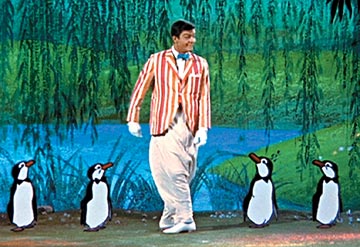
Somehow, she has a mended copy of the qualifications written by the children that Mr. Banks tore up and threw into the fireplace.  To the children’s astonishment, she slides up the banister.Out of her magically capacious carpetbag she takes out a tape measure to determine the measure of the children (“stubborn and suspicious” and “prone to giggling and not tidying up”) and her own (“practically perfect in every way”).  She directs them to clean up the nursery, and shows them how to make it into a game (“A Spoonful of Sugar Helps the Medicine Go Down”). Once it is clean, they go out for a walk, and they meet Mary Poppins’ friend Bert (Dick Van Dyke) drawing chalk pictures on the sidewalk. They hop into the picture and have a lovely time, or, rather, a “Jolly Holiday” in a mixture of live-action and animation that has Bert dancing with carousel horses and penguins.

Mary-Poppins-RooftopMary takes the children ato see her Uncle Arthur (Ed Wynn), who floats up to the ceiling when he laughs, and they find this delightfully buoyant condition is catching. Later, Mr. Banks takes the children to the bank where he works, and Michael embarasses him by refusing to deposit his tuppence because he wants to use it to buy crumbs to feed the birds. There is a misunderstanding, and this starts a run on the bank, with everyone taking out their money. Mr. Banks is fired.

Mr. Banks realizes that he has been too rigid and demanding. He invites the children to fly a kite with him. Mrs. Banks realizes that in working for the vote for women, she had neglected the children. Her work done, Mary Poppins says goodbye, and floats away.

This sumptuous production deserved its many awards (including Oscars for Andrews and for “Chim Chimeree” as best song) and its enormous box office. It is fresh and imaginative, and the performances are outstanding. (Watch the credits carefully to see that Van Dyke also plays the rubber-limbed Mr. Dawes.) The “jolly holiday” sequence, featuring the live-action characters interacting with animated ones, is superb, especially Van Dyke’s dance with the penguin waiters.

The resolution may grate a bit for today’s families with two working parents, but the real lesson is that parents should take time to enjoy their children, not that they should forego all other interests and responsibilities to spend all of their time with them.

Family discussion:  If you were writing a job notice for a nanny, what would it include?  Which of the children’s adventures did you most enjoy and why?

If you like this, try: books by P.L. Travers and the documentary about this film’s Oscar-winning song-writers, The Boys: The Sherman Brothers’ Story. And go fly a kite!

Related Tags:


Based on a book Classic Comedy DVD/Blu-Ray Pick of the Week Family Issues Fantasy For the Whole Family Musical Stories About Kids
THE MOVIE MOM® is a registered trademark of Nell Minow. Use of the mark without express consent from Nell Minow constitutes trademark infringement and unfair competition in violation of federal and state laws. All material © Nell Minow 1995-2026, all rights reserved, and no use or republication is permitted without explicit permission. This site hosts Nell Minow’s Movie Mom® archive, with material that originally appeared on Yahoo! Movies, Beliefnet, and other sources. Much of her new material can be found at Rogerebert.com, Huffington Post, and WheretoWatch. Her books include The Movie Mom’s Guide to Family Movies and 101 Must-See Movie Moments, and she can be heard each week on radio stations across the country.

Website Designed by Max LaZebnik