A Hard Day’s Night

Posted on December 13, 2002 at 5:17 am

One of the greatest musicals of all time has a gorgeous new Criterion edition in honor of its 50th anniversary.

The documentary style of this movie masks its tight construction, clever script, and sublime anarchy second only to the Marx brothers. A surrealistic day in the life of the most overwhelmingly popular rock group of all time, it portrays the Beatles sympathetically — like the heroine of “It Happened One Night,” they are constantly told what to do and smothered by all they have. Part of the humor is that it is not the members of the Beatles but Paul’s “clean” grandfather who causes most of the trouble. Musical numbers include “Can’t Buy Me Love” and “Should Have Known Better” as well as the title song, inspired by Ringo’s warped syntax after a long recording session.

http://www.youtube.com/watch?v=wiW003U4iA8

The deluxe anniversary edition includes lots of extras:

  • New 4K digital film restoration, approved by director Richard Lester, with two audio options—a monaural soundtrack and a new 5.1 surround soundtrack made by Apple Records—presented in uncompressed monaural and DTS-HD Master Audio on the Blu-ray
  • Audio commentary featuring various members of the film’s cast and crew
  • In Their Own Voices, a new piece combining interviews with the Beatles from 1964 with behind-the-scenes footage and photos
  • You Can’t Do That: The Making of “A Hard Day’s Night,” a 1994 documentary program by producer Walter Shenson
  • Things They Said Today, a 2002 documentary about the film featuring Lester, music producer George Martin, writer Alun Owen, cinematographer Gilbert Taylor, and others
  • New piece about Lester’s early work, featuring a new audio interview with the director
  • The Running Jumping and Standing Still Film (1959), Lester’s Oscar-nominated short featuring Peter Sellers and Spike Milligan
  • Anatomy of a Style, a new piece on Lester’s approach to editing
  • New interview with Mark Lewisohn, author of Tune In: The Beatles: All These Years—Volume One
  • Deleted scene
  • Trailers
  • One Blu-ray and two DVDs, with all content available in both formats
  • PLUS: A booklet featuring an essay by critic Howard Hampton


Families who see this movie should talk about the nature of fads and the problems created by success.

Families who enjoy this movie together will also enjoy the Beatles in “Help!” and “Yellow Submarine,” but skip the movie “Magical Mystery Tour” and just listen to the music instead. Kids 12 and up might enjoy “I Wanna Hold Your Hand,” about teens overcome by Beatlemania or “That Thing You Do,” written and directed by Tom Hanks, the story of a 1960s Erie, Pennsylvania, rock group that has an unexpected hit song.


Related Tags:


Classic Comedy For the Whole Family Musical

Friendly Persuasion

Posted on December 13, 2002 at 5:17 am

Plot: This is the story of the Birdwells, a loving Quaker family in the midst of the Civil War. Eliza (Dorothy McGuire), a devout woman, is the moral center of the family. Jess (Gary Cooper) is a thoughtful man, not as strict as Eliza on prohibitions like music and racing his horse, but with a strong commitment to his principles. Their children are Joshua (Anthony Perkins), a sensitive young man who opposes violence but feels that he must join the soldiers; Mattie (Phyllis Love), who falls in love with Gord, a neighbor who is a Union soldier; and Young Jess, a boy who is fascinated with the talk of war and battles.

A Union soldier comes to the Quaker prayer meeting to ask the men to join the army. They tell him that they cannot engage in violence under any circumstances. “We are opposed to slavery, but do not think it right to kill one man to free another.” Even when the soldier points out that this means others will be dying to protect their lives and property, no one will support him.

The Confederate army approaches, and Joshua and Enoch, a freed slave who works on the Birdwell’s farm, decide to join the Union. Eliza does everything she can to keep Joshua from going, even telling him that in doing so he will not only reject what he has learned in church but he will reject her, too. Jess says that Joshua has to make up his own mind. “I’m just his father, Eliza. I’m not his conscience. A man’s life ain’t worth a hill of beans unless he lives up to his own conscience. I’ve got to give Josh that chance.” Joshua prays for guidance, and leaves to join the army the next morning. At first Eliza won’t respond, but then she runs after him to wish him well.

As the war gets closer, Jess and Eliza refuse to run away from their farm as others are doing. When Josh’s horse comes back without him, Jess goes looking for him. He finds his good friend Sam mortally wounded by a sniper. When the sniper shoots at Jess, too, Jess takes his gun away, but will not harm him; he tells the sniper, “Go on, get! I’ll not harm thee.” Josh is wounded, and deeply upset because he killed a Confederate soldier. Jess brings him home.

In the meantime, the Confederates ride into the farm, and in keeping with her faith, Eliza welcomes them and gives them all her food. But when one of the soldiers goes after her beloved pet goose, she whacks him with the broom, amusing her children and leaving herself disconcerted and embarassed. Jess and Josh return, and the family goes off to church together, to continue to do their best to match their faith to their times.

Discussion: This is an exceptional depiction of a loving family, particularly for the way that Jess and Eliza work together on resolving their conflicts. They listen to each other with enormous respect and deep affection. Jess does his best to go along with Eliza’s stricter views on observance, because in his heart he believes she is right. Nevertheless, he cannot keep himself from trying to have his horse beat Sam’s as they go to church on Sunday, and he decides to buy an organ knowing that she will object. In fact, he doesn’t even tell her about it. She is shocked when it arrives and says that she forbids it, to which he replies mildly, “When thee asks or suggests, I am like putty in thy hands, but when thee forbids, thee is barking up the wrong tree.” Having said that if the organ goes into the house, she will not stay there, she goes off to sleep in the barn. He does not object — but he goes out there to spend the night with her, and they reconcile and find a way to compromise.

All of this provides a counterpoint to more serious questions of faith and conscience. In the beginning, when the Union soldier asks the Quakers if any of them will join him, one man stands up to say that nothing could ever make him fight. Later, when his barn is burned, he is the first to take up a gun. Even Eliza, able to offer hospitality to the same men who may have just been shooting at her son, finds herself overcome when one of them captures her beloved pet goose.

Jess is willing to admit that the answer is not so simple. All he asks is that “the will of God be revealed to us and we be given the strength to follow his will.” He understands the difficulty of finding the right answer for himself and for Joshua. He resolves it for himself in his treatment of the sniper, and he respects Joshua and the issues involved enough to let Joshua make his own choice.

The movie is a rare one in which someone makes a moral choice through prayer, which many families will find worth emphasizing. Josh, who was able to respond without violence to the thugs at the fair, decides that he cannot benefit from risks taken by others unless he is willing to take them, too. He cries in battle, but he shoots.

The issue of how someone committed to non-violence responds to a violent world is thoughtfully raised by this movie.

Questions for Kids:

· How is the religious service in the movie similar or different from what you have experienced?

· How was the faith of the characters tested in this movie? What did they learn from the test?

· How should people who are opposed to violence respond to violence when it is directed against them? When it is directed against others?

Connections: The screenplay was written by Michael Wilson, who received no screen credit because he was blacklisted during the Red Scare. His involvement makes the issues of conscience raised in the book even more poignant. The book on which the movie is based, by Jessamyn West (a Quaker, and a cousin of Richard Nixon) is well worth reading. Cooper faces some of the same issues (and has a Society of Friends bride) in “High Noon.” “Shenandoah,” with Jimmy Stewart as the father of a large family who tries to keep his sons out of the Civil War, raises some of the same themes without the religious context. It later became a successful Broadway musical.

Related Tags:


Based on a book Drama Epic/Historical War

Major Barbara

Posted on December 13, 2002 at 5:17 am

Plot: Major Barbara (Wendy Hiller) is a member of a mission devoted to saving souls, and she promotes temperance, non-violence, and socialism. Adolphus Cusins (Rex Harrison), a classics professor, falls in love with her, but before she accepts his proposal, she insists that he must meet her family. He is surprised to find out that she is the daughter of a wealthy industrialist.

Her father, Andrew Undershaft (Robert Morley), a munitions manufacturer, returns to the family after an absence of many years. He tries to convert Barbara to his views by presenting her with an ethical dilemma. Will she accept large contributions to her mission from the makers of munitions and liquor, the very things she opposes? She cannot, and is disillusioned but understanding when her superior accepts the funds, reasoning that despite their source, the money will do some good.

Barbara visits the munitions factory and sees that her father is right about capitalism. It does not mean much when someone accepts her views in order to get food and shelter. But if she can persuade people simply by the force of her ideas, those are converts worth having. Furthermore, she can aid the poor by providing good jobs, good wages, and good benefits. Her father says that being a millionaire is his religion. Christianity is Barbara’s religion, but she will pursue it through capitalism.

Discussion: More directly political than “Pygmalion,” this provides a good opportunity for a discussion of what is now termed “corporate social responsibility,” and the role of the government, the church, and the corporation in meeting society’s needs.

Questions for Kids:

· How socially responsible should corporations be? How should they balance the interests of employees, customers, shareholders, suppliers, and the community?

· Who is in a better position to help society, government, religion, or business? Which kinds of help are each uniquely able to provide?

Connections: Robert Morley, age 32 when this movie was made, was only four years older than the actress who played his daughter. A very young Deborah Kerr appears as Jenny Hill, and Emelyn Williams, author of the autobiographical “The Corn is Green,” appears as Snobby Price. Wendy Hiller, picked by Shaw himself to appear in this movie and “Pygmalion,” also appears in “A Man for All Seasons” and “Murder on the Orient Express.”

Playwright and co-screenwriter Shaw was one of the twentieth century’s most brilliant writers, well known as a dramatist, essayist, critic, and social reformer. He was awarded the Nobel Prize for Literature in 1925. His play, “Pygmalion” (also filmed with Wendy Hiller) became the musical “My Fair Lady.” Among the many pleasures of his work are the superb female characters — strong, intelligent, and principled.

Activities: Teenagers may want to read or even act out some of Shaw’s other plays, including “The Man of Destiny,” “Misalliance,” “Caesar and Cleopatra,” and “Arms and the Man,” and will also enjoy his essays and criticism.

Related Tags:


Drama Romance

Spider-Man

Posted on December 13, 2002 at 5:17 am

Remember when “Superman” was released with the tagline, “You will believe a man can fly?” Well, “Spider-Man” will not only make you believe that a teenager can swing from the skyscrapers; it will almost make you believe that you are up there swinging with him.

Comics were hugely popular back in the days when they could show us stories that no one else could. But now, movies can show us anything that can be imagined, and a movie like this does it so well it makes you think that this is what imagination is for.

Toby Maguire plays Peter Parker, a brilliant and sensitive high school senior, so deeply in love with his red-headed next door neighbor Mary Jane (Kirsten Dunst) that he can barely bring himself to say hello to her. On a school field trip, he is bitten by a genetically engineered spider and the next morning he wakes up with some distinctly arachnid-like qualities. He can see without his glasses and he has become muscular. He can climb walls, eject webbing with the swinging power of rope and the strength of steel, and anticipate danger.

So, like any teenager, the first thing he does is impress a girl and humiliate a bully. He enters a wrestling match to get money so he can buy a car to impress the girl even more. His decision not to interfere with an armed robber has tragic consequences, and so he learns that his uncle was right in telling him that with great power comes great responsibility. Great risk comes as well — everyone he cares about is put at risk because of who he is.

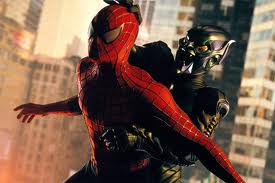
Meanwhile, Peter’s best friend’s father, industrialist Norman Osborn (Willem Dafoe) has decided to try out his company’s new product on himself. He, too, develops extraordinary power and a mad fury. He is dubbed the Green Goblin for his bizarre armor-like covering.

Maguire is just right as Peter, thoughtful, sensitive, thrilled with his new powers. You can believe that he is the kind of kid who would spend his time a little bit apart from the others, taking photographs that are clear and perceptive. The supporting cast is great, especially stage star Rosemary Harris as Aunt May and J.K. Simmons as Peter’s bombastic editor. The script is excellent, and strikes just the right note of respect and affection for the source material. It has a contemporary feel without being showily post-modern or ironic.

The special effects are thrilling. New York City is brilliantly stylized. Peter’s relationship with MJ is sweetly romantic. And when a bunch of New Yorkers throw things at the Green Goblin, yelling, “This is New York and we fight back!” it is genuinely touching.

The movie’s weakest point is that it fails in the single most important requirement for a comic book-based movie — the villain is not unforgettably crazy or evil or larger-than-life. The best Batman movies featured Jack Nicholson as The Joker and Jim Carrey as The Riddler. Willem Dafoe is a brilliant actor (just take a look at his Oscar-nominated performance in “Shadow of the Vampire”), but the part of Osborn/Green Goblin is just not interesting enough to be truly scary. The flying surfboard he rides around on is very cool, but his exoskeleton costume and mask are just dumb-looking.

Parents should know that the PG-13 rating comes from a couple of mild words, a clingy wet t-shirt, and a great deal of violence. The violence gets very intense, and includes not just fires and explosions but people getting vaporized, shot (off-camera), and impaled. Characters lose people close to them to violent deaths. A group of schoolchildren are in peril. Parents emotionally abuse their children.

For parents who are struggling with whether this movie is appropriate for kids under 13, the best guide I can provide is to say that it is about at the level of X-Men. I recommend caution, especially for children under 10. Keep in mind that just because a child can repeat after you “it’s only pretend” does not mean that he fully understands what that means until he is 10 or even older, and that the terrorist attacks may make some of the material scarier than it would have been before (scenes featuring the World Trade Center have been removed from the movie). Some kids may see the movie and appear to have no problems with it, but may act out in other ways. Be watchful for kids who respond by desensitizing themselves to violence or re-enacting it. And if you are going to let childrn see the movie, make sure that they know that this is an exception and that you will not be permitting them to see any PG-13 just because you allowed this one.

Families who see this movie should talk about the idea that the people we love make us feel good about who we are at the same time they make us see a way to be better. Do you agree that “people love to see a hero fail?” Characters in the movie keep a lot of secrets. What makes them decide not to tell, and who is and is not right in making that choice?

Families who enjoy this movie will also enjoy Superman and Batman. Mature audiences will enjoy Toby Maguire’s outstanding performances in “Wonder Boys,” “The Cider House Rules,” and “The Ice Storm.”

Related Tags:


Action/Adventure Comic book/Comic Strip/Graphic Novel Romance Superhero

The Sword in the Stone

Posted on December 13, 2002 at 5:17 am

Plot: Based on the book by T.H. White, this is the story of the early years of King Arthur. Nicknamed “Wart,” the future King Arthur is squire to a knight when he meets Merlin the magician, who promises to take on his education. Merlin turns him into a fish, a bird, and a squirrel to teach him lessons like the importance of brains over brawn. He gets to see this in action when Madame Mim, Merlin’s enemy, challenges Merlin to a duel by magic, and, though she cheats, Merlin is able to defeat her.

Wart still has his duties as a squire, and, having forgotten the sword for a jousting match, he runs to get it. He sees a sword stuck in a stone and pulls it out, not knowing the legend that whoever will pull the sword out of the stone will be the rightful king. He becomes King Arthur, and listens when Merlin reminds him that knowledge is the real power.

Discussion: The Arthur legend has fascinated people for centuries, and this story about Arthur’s childhood as special appeal for children. Aside from the fun of seeing what it is like to be a bird, a squirrel, or a fish, and from having your very own wizard as a teacher, there is the highly satisfying aspect of having one’s worth, unappreciated by everyone, affirmed so unequivocally.

Questions for Kids:

· What made Arthur the one who could pull the sword out of the stone?

· What did he learn from his adventures with Merlin?

· How will what he learned help him to be a good king?

· How did Madame Mim cheat?

· How did Merlin fight back when she did?

Connections: Older kids may like to see “Camelot,” the musical by Lerner and Lowe (of “My Fair Lady”), to find out some of what happened to Arthur later (WARNING: the focus of that movie is on Guinevere’s infidelity with Lancelot). Mature teenagers might like the rather gory “Excalibur,” which has some stunning images.

Related Tags:


Based on a book Stories About Kids
THE MOVIE MOM® is a registered trademark of Nell Minow. Use of the mark without express consent from Nell Minow constitutes trademark infringement and unfair competition in violation of federal and state laws. All material © Nell Minow 1995-2026, all rights reserved, and no use or republication is permitted without explicit permission. This site hosts Nell Minow’s Movie Mom® archive, with material that originally appeared on Yahoo! Movies, Beliefnet, and other sources. Much of her new material can be found at Rogerebert.com, Huffington Post, and WheretoWatch. Her books include The Movie Mom’s Guide to Family Movies and 101 Must-See Movie Moments, and she can be heard each week on radio stations across the country.

Website Designed by Max LaZebnik