
The Scorpion King

Posted on December 13, 2002 at 5:17 am

Some very scary looking guys are about to kill a guy who would be even scarier-looking if he wasn’t tied up. But then everyone steps back in awe of a guy who steps in looking scariest of all and as they hesitate, he cocks an eyebrow and says simply, “Boo.” That is the Rock (WWF star Dwayne Johnson) and he plays the title role in this prequel to the “Mummy” movies, giving us the background of the character who appeared briefly but memorably in the second one as half-man, half very large bug.

This movie does not pretend to having anything like the wit and charm of the “Mummy” movies, which were a loving tribute to Saturday morning serials. It is produced by Vince McMahon, Chairman of the WWF (and one of its star performers). McMahon has made a fortune making wrestling matches into stories, with vivid characters and dramatic confrontations. “The Scorpion King” just takes it one step further, a three-act wrestling drama with computer graphics. Maybe the next step will be adding arias and turning it into an opera.

On the silly popcorn scale, it works pretty well, largely due to its star. The Rock has genuine screen presence. He even manages most of the material better than Michael Clarke Duncan (“The Green Mile,” “The Whole Nine Yards”) who is just too much of an actor to deliver the cheesy dialogue with the right mix of sincerity and irony, and Peter Facinelli (“Can’t Hardly Wait,” “The Big Kahuna”), whose thin-voiced delivery doesn’t convey the necessary petulant malevolence.

The Rock is the good guy. He has a comical sidekick. No one bothered to give him a name. He is actually listed in the credits as “Comical Sidekick” (Grant Heslov). There is also a bad guy (English accented, of course), evil dictator Memnon (Steven Brand), who relies on a sorceress (Kelly Hu) to guide him in battle. The sorceress is beautiful. You get where this is all going; I don’t have to spell it out.

There is one innovation worth mentioning. In action movies, the hero is almost always stoic, even when he gets hurt. Think of Rambo sewing up his own wounds. But the Rock, carrying over the conventions of professional wrestling, grimaces in pain when he gets hurt. It doesn’t rise to the level of acting, but in a funny way I think that it adds some heart to the story.

Parents should know that the movie has a lot of action violence, meaning that it is not too graphic or gory. There are some vivid images, including attacking cobras, an impaled body, and a dead child. And there are very vivid sound effects making on- and off-screen violence more explicit with spurting and squishing sounds. There are sexual references and non-explicit sexual situations, including two women in a man’s bed. There are no four-letter words, but there are some strong epithets.

Families who see this movie should talk about Memnon’s claim that order was better than freedom. They may also want to talk about how the sorceress protected herself from Memnon.

Families who enjoy this movie should watch The Mummy and The Mummy Returns.
Related Tags:


Action/Adventure Series/Sequel

Amadeus

Posted on December 13, 2002 at 5:17 am

Antionio Salieri (F. Murray Abraham in an Oscar-winning performance), the court composer, should have been Mozart. He followed all the rules, worked hard, and cared deeply. Music was his life. Mozart (Tom Hulce) arrives, a bawdy, bratty, foolish boy whose music could enchant the angels. Salieri, ironically the only one who understands music well enough to realize Mozart’s genius, is consumed with jealousy.

Teens will be interested to learn that this movie was written by a man whose twin brother was for a time the more commercially successful of the two, both playwrights, which surely influenced his choice of subject and his approach.

Families who enjoy this movie should see Ingmar Bergman’s movie version of Mozart’s The Magic Flute.

Related Tags:


Based on a true story Drama

E.T. The Extra-Terrestrial

Posted on December 13, 2002 at 5:17 am

A+
Lowest Recommended Age: Kindergarten - 3rd Grade
MPAA Rating: Rated PG for language and mild thematic elements
Profanity: Brief but very strong language for a PG
Alcohol/ Drugs: E.T. gets tipsy
Violence/ Scariness: Characters in peril, apparent death
Diversity Issues: All characters white
Date Released to Theaters: 1982
Date Released to DVD: October 8, 2012
Amazon.com ASIN: B003UESJLK

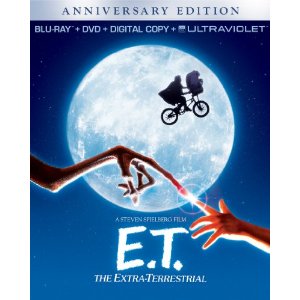
“E.T’s” 30th anniversary is being celebrated with a gorgeous new re-issue and I have one to give away.  To enter, send me an email at moviemom@moviemom.com with E.T in the subject line and tell me your favorite movie alien.  Don’t forget your address!  (US addresses only.)  I’ll pick one winner at random on October 14.  Good luck!

A young boy named Elliott (Henry Thomas) finds an extraterrestrial who has been left behind when his expedition of alien botanists had to depart quickly to avoid detection. He brings E.T. home, finding through their connection a way to begin to heal his sense of loss at his father’s absence.

E.T. loves Elliott, but begins to weaken in the Earth’s atmosphere and needs to go home. With the help of Elliott and the neighborhood children, he sends a message to his friends. But before they can come for him, he is captured by government scientists. E.T.’s connection with Elliott is so strong Elliott becomes very ill, too. But both recover, and the children return E.T. to the spaceship, after E.T. reminds Elliott that they will always be together in their hearts.

This is an outstanding family movie, with themes of loyalty, friendship, trust, and caring. One of the most purely magical scenes in the history of film is when Elliott’s bicycle lifts off up into the sky.

Parents should know that the movie has scenes of peril that may be too intense for younger children. An apparent death is also upsetting. There is brief very strong language for a PG movie. This film was justifiably criticized for its almost complete absence of non-white characters.

DVD extras: Making of documentary, cast reunion, archives, trailer, behind-the-scenes footage, etc. Families who see this movie should talk about the way that the adults and the kids see things differently, and have a hard time understanding each other’s perspective. One reason is that they don’t try to share their feelings with each other. Could Elliott have talked to his mother about E.T.?

Families who enjoy this movie will also enjoy “Close Encounters of the Third Kind,” and they should try some Reese’s Pieces! They might also want to check out the classic movie E.T. catches a glimpse of, “The Quiet Man.”

Related Tags:


Action/Adventure Classic Contests and Giveaways Drama DVD/Blu-Ray Pick of the Week Science-Fiction Stories About Kids

Local Hero

Posted on December 13, 2002 at 5:17 am

Plot: McIntyre (Peter Reigert) is an ambitious executive with a Knox Oil & Gas, based in Houston, Texas. He is dispatched by Happer (Burt Lancaster), the company’s eccentric billionaire chief executive, to a remote corner of Scotland to acquire a fishing village named Ferness and the land surrounding it for an oil refinery and storage facility.

McIntyre, all business, arrives in Ferness with Danny Oldsen (Peter Capaldi), a Knox employee from Scotland. At first, McIntyre finds it hard to adjust to the pace of Ferness. Gordon Urquhart (Denis Lawson), the local innkeeper and resident accountant, tells him to enjoy the area for a couple of days before they open negotiations. Gordon tells the villagers about the offer from Knox. They are delighted at the prospect of being bought out and begin to debate the relative merits of a Rolls Royce over a Maserati. The only hitch to finalizing the deal is Ben, a reclusive beachcomber who lives in a shack by the shore. He owns several miles of beach and refuses to sell.

Meanwhile, McIntyre sheds his hurried Houston style and comes to enjoy the tranquil rhythms of the village. In a whisky-induced moment, he tells Urquhart that he wants them to swap jobs. Following Happer’s order to “watch the sky,” he is dazzled by the aurora borealis, the Northern Lights, and calls Happer to report.

Happer arrives from Houston. He establishes an instant rapport with Ben, and decides that instead of the refinery, he will create an observatory and marine laboratory — the Happer Institute. McIntyre is sent back to Texas to organize the changes. McIntyre returns to Houston, deeply missing the charm and character of his brief Highland life.

Discussion: McIntyre’s life in Houston is cluttered but empty. He resorts to phoning colleagues seated ten yards away to see if they are free for lunch. he cares a great deal about material things. In Ferness, his expensive watch falls into the water, and he doesn’t miss it. He learns to enjoy collecting shells and examining the night sky.

In a poignant final shot we see McIntyre calling the village’s pay phone.

It rings and rings, but no one answers. The suggestion is that while the village has invaded McIntyre’s soul, he has not had a similar impact in return. McIntyre represented a fleeting interest in lives that run to slower rhythms.

The film is to be noted less for its messages or themes than its magnificent cast of quirky, delightfully observed characters and gorgeous location photography. There is a touch of magic in the story, with a marine biologist who seems to be part mermaid, and a deus ex machina happy ending for most of the characters.

Note: This movie has the feel of a fairy tale, but there are some odd moments that may bother some kids. Happer hires a “therapist” for a bizarre “abuse therapy.” Danny saves a rabbit that is then cooked and served to Danny and McIntyre by Gordon. And the very un-Hollywood resolution, with McIntyre back in Texas by himself, should prompt some discussion of what kids think may happen to him.

Questions for Kids:

· What does McIntyre list as the requirements for an excellent life in Houston? Do the villagers agree with him, since all but Ben are anxious to sell?

· Why does the girl with the punk outfit say that she likes McIntyre?

· Why didn’t Ben want to sell?

· Why, when McIntyre calls the village pay phone at the end of the film, does no one answer?

Connections: Forsyth is also the director of the wonderful “Gregory’s Girl.”

Activities: Find Scotland on a map. Visit a marine study facility like the one they plan to build in Ferness.

Related Tags:


Not specified

Singin’ in the Rain

Posted on December 13, 2002 at 5:17 am

A+
Lowest Recommended Age: Kindergarten - 3rd Grade
MPAA Rating: G
Profanity: None
Alcohol/ Drugs: None
Violence/ Scariness: None
Diversity Issues: None
Date Released to Theaters: 1952
Date Released to DVD: July 16, 2012
Amazon.com ASIN: B0087YYHZU

The 60th anniversary of one of the best-loved movies of all time is being celebrated with gorgeous new DVD and Blu-Ray releases.

Silent movie star Don Lockwood (Gene Kelly) is paired on screen with Lina Lamont (Jean Hagan), who would like to be paired with him offscreen as well. But Lina’s personality is as grating as her squeaky, nasal voice. She is mean, selfish, arrogant, and stupid. Chased by fans following the opening of their latest movie, Don jumps into the car of Kathy Seldon (Debbie Reynolds), who tells him she is a serious actress, and not at all interested in the movies. But later, at a party celebrating the new movie, Kathy appears again, jumping out of a cake. Don teases her about her “art” and she throws a pie at him, getting Lina right in the face by mistake. Lina, furious, has Kathy fired.

At the party, the guests are treated to an exhibition of the latest technology, “talking pictures.” Everyone present dismisses it as a novelty. But when “The Jazz Singer” becomes a hit, everyone in Hollywood begins to make talkies. Production is halted on the latest Lockwood/Lamont movie, “The Dueling Cavalier,” while the stars are coached in vocal technique (with a delightful song mocking the exercises, “Moses Supposes”). But the movie is a disaster. Test audiences jeer and laugh.

Meanwhile, Don and Kathy have fallen in love. After an all-night session, Don, Kathy, and Don’s best friend, Cosmo (Donald O’Connor), come up with an idea. They can make it into a musical, “The Dancing Cavalier,” dubbing Kathy’s voice for Lina’s. Don resists at first, because it is unfair to Kathy. But they persuade him that it will just be this one time, and he goes along.

With Kathy’s voice and some musical numbers, the movie is a success. Lina insists that Kathy continue to dub all her movies, and, when the audience insists on hearing her sing, Lina forces Kathy to stand back stage so she can perform. But Don, Cosmo, and the beleagered studio head reveal the secret, and Don introduces Kathy to the audience as the real star of the movie.

Discussion: This is often considered the finest musical of all time. Certainly it has it all, classic musical numbers and a witty script, unusually sharp and satiric for a musical comedy, especially one making fun of the industry that produced it. Asked to name the top ten moments in the history of movies, most people would include the title number from this movie, in which Gene Kelly splashes and sings the rain with what Roger Ebert called “saturated ecstasy.” When he swings the umbrella around and around and dances on and off the curb, his “glorious feeling” is contagious. Only in a movie containing that sequence would Donald O’Connor’s sensational “Make ‘Em Laugh” number be mentioned second. It is a wildly funny pastiche of every possible slapstick gag, done with energy and skill so meticulous that it appears it is entirely spontaneous.

Screenwriters Betty Comden and Adoph Green, asked to use some of the classic songs by Arthur Freed (later producer of most of the great MGM musicals) and Nacio Herb Brown, decided to set the movie in the era in which they first appeared, the early talkies. This gave them a chance to use some of the Hollywood folklore of that era, when careers like John Gilbert’s were destroyed overnight, as audiences found out that their voices didn’t match their faces. One especially funny scene has the technicians trying to find a way to record Lina’s dialogue. When they put the microphone on her dress, all you hear is the sound of her pearls as she rubs them. When they put it lower down, you hear her heartbeat. When they put it near her, her voice fades in and out as she tosses her head. Note that the cameras are put inside huge boxes — that is authentic, as the cameras of that era were so loud that they had to be encased to prevent their own whirring from being recorded.

Don and Cosmo are consummate adaptors. As we see in flashback, they have already switched from vaudeville to movies, and then Cosmo from performer to accompanist (to musical director) and Don from stunt man to leading man. Lina resists change and tries to bully her way out of it, but Don, Cosmo, and Kathy all demonstrate resilience and openness to new ideas, and a willingness to be creative in solving problems.

Questions for Kids:

· Why does Kathy at first lie about liking the movies?

· Why does Don lie about his background? How is that different from the way that Lina behaves?

· Have there been any new inventions that you have seen that have changed people’s jobs a lot?

· What inventions do you use that your parents didn’t have when they were children? Your grandparents?

Connections: The transition from silent movies to talkies was also lampooned in the first play by George S. Kaufman and Moss Hart, “Once in a Lifetime.” A silent star who has become deranged is the centerpiece of “Sunset Boulevard.” When told “You used to be big in pictures,” she says, “I’m still big — it’s the pictures that got small.” She also says, memorably, that in her day stars didn’t need to talk: “We had faces then!”

Activities: Children might like to see some of the early silent movies to get an idea of what Hollywood was like in the days depicted in this movie. The films of Charlie Chaplin, Laurel and Hardy, Buster Keaton and Harold Lloyd are still wonderful, and kids will enjoy learning that a story can be told without words.

Related Tags:


Classic Comedy Date movie DVD/Blu-Ray Pick of the Week For the Whole Family For Your Netflix Queue Movie Mom’s Top Picks for Families Musical Romance
THE MOVIE MOM® is a registered trademark of Nell Minow. Use of the mark without express consent from Nell Minow constitutes trademark infringement and unfair competition in violation of federal and state laws. All material © Nell Minow 1995-2026, all rights reserved, and no use or republication is permitted without explicit permission. This site hosts Nell Minow’s Movie Mom® archive, with material that originally appeared on Yahoo! Movies, Beliefnet, and other sources. Much of her new material can be found at Rogerebert.com, Huffington Post, and WheretoWatch. Her books include The Movie Mom’s Guide to Family Movies and 101 Must-See Movie Moments, and she can be heard each week on radio stations across the country.

Website Designed by Max LaZebnik