
Kubo and the Two Strings
Posted on August 18, 2016 at 8:00 am
A-| Lowest Recommended Age: | Kindergarten - 3rd Grade |
| MPAA Rating: | Rated PG for thematic elements, scary images, action and peril |
| Profanity: | None |
| Alcohol/ Drugs: | None |
| Violence/ Scariness: | Monsters, peril, sad offscreen deaths |
| Diversity Issues: | None |
| Date Released to Theaters: | August 19, 2016 |
| Date Released to DVD: | November 20, 2016 |
| Amazon.com ASIN: | B01KMKM4TW |

LAIKA Studios’ fourth film, “Kubo and the Two Strings,” is a fable of exquisite beauty and meaning, gorgeously produced in the most painstaking of all forms of filmmaking, stop-motion animation. They are the modern-day equivalent of the monks who labored for years on each page of illuminated manuscripts.
Every detail in every frame and every element of the story, set in a magical version of ancient Japan, reflects the simple profundity of the ancient and contemporary Japanese art that inspired it. LAIKA’s last film, “The Boxtrolls,” was set in a cluttered, sooty, steampunkish imaginary Victorian London, and the studio’s motto was “no square corners, no straight lines.” This time it went in the opposite direction, with the muted palette and spare, carefully balanced settings of Japanese woodblock prints and the sharp lines and perfect corners of origami.
One of the hardest elements to get right in stop-motion is water, because it is impossible to control it frame to frame. In “Boxtrolls,” the studio’s greatest technical triumph was an elaborate set-up for a brief scene in which a character touched standing water and created some ripples. LAIKA loves to challenge itself, and so this film starts with a storm at sea. A woman we will learn is Kubo’s mother is desperately trying to stay upright on a tiny boat. We know she is escaping someone or something, but we are not sure yet what or who it is. And we do not learn until she is washed up on the shore, exhausted and hurt, that she is not alone. In her backpack, there is a baby. It is Kubo.
Like Harry Potter, Kubo had a father who died trying to protect him from a danger so great that Kubo bears a wound. One of his eyes is gone. Kubo’s mother survived, but she used all of her magic to save him and now she is frail, forgetful, and inconsolable.
When we next see them, he is about 11, and has been caring for her all his life. Each day, he makes her food and feeds her. And then he walks from their home in a cave on top of a cliff into the nearest town, where he tells stories in the market. He has the power to bring origami characters to life to act out thrilling tales of the great samurai warrior Hanzo. The townspeople love his stories, which always end with a cliffhanger, and they toss him coins.
The community has an annual Obon festival, where they light lanterns and remember the dead. Kubo wants to go, so he violates his mother’s rule about never being out after dark. And the danger she protected him from years ago comes after him in the form of his mother’s two spooky sisters, both voiced by Rooney Mara and both wearing implacable-expression white masks and terrifying swoopy capes made of black feathers.
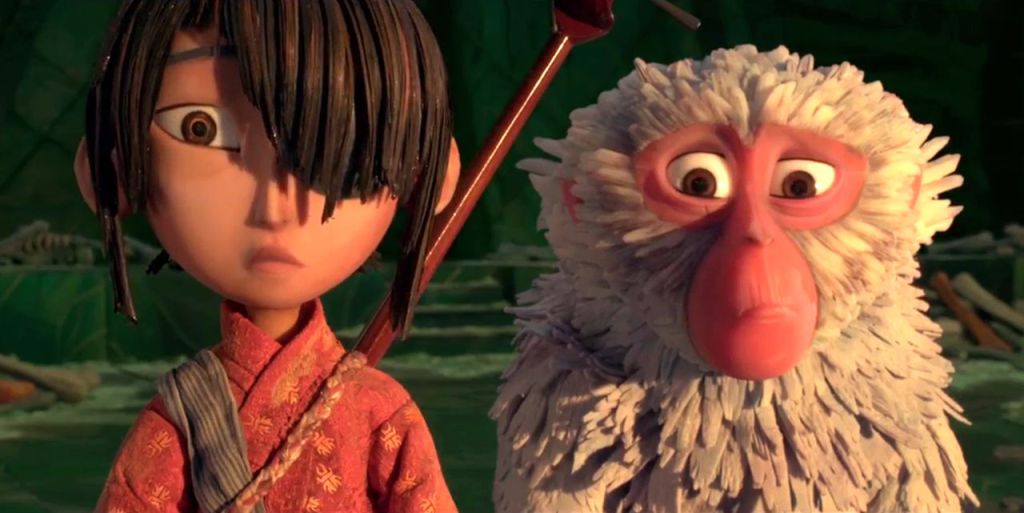
Kubo’s mother has just enough magic left to save him one more time. And then she is gone, and Kubo finds himself on a journey, accompanied by the live version of the small monkey charm he always carried in his pocket. He and Monkey (Charlize Theron) set off to find the three pieces of Hanzo’s armor that he will need to fight the sisters and their father, who wants Kubo’s other eye. Along the way they meet a samurai who has been cursed and turned into a giant beetle (Matthew McConaughey). And they meet and fight three different monsters, a giant skeleton, an underwater garden of eyes, and an enormous, floating, reticulated moon serpent, each giving Kubo a chance to discover his courage and power.
This is a gorgeous, epic adventure with grandeur, scope, and spectacular settings, every bit of it wonderfully imaginative. It reflects LAIKA’s own adventurous spirit in taking on narrative and technical challenges as daunting as that faced by any hero. Who else would try to create a stop-motion battle under water? Or take on, in a family movie, a quest that encompasses themes of family, story, courage, loss, destiny, and meaning? LAIKA understands that the most enduring fairy tales are not afraid to deal with darkness because that is the only way to understand its true message, here delivered in a breathtaking conclusion, of tenderness and forgiveness.
Parents should know that this film includes fantasy-style peril and violence with monsters and magic, and sad deaths of parents.
Family discussion: Why did Kubo answer his grandfather’s questions the way he did? Why didn’t Monkey tell Kubo where she came from? Why did the two strings make a difference?
If you like this, try: “Coraline,” “Paranorman,” and “The Boxtrolls”