Rango

Posted on March 3, 2011 at 5:37 pm

B+
Lowest Recommended Age: Middle School
MPAA Rating: Rated PG for rude humor, language, action, and smoking
Profanity: Some crude schoolyard language
Alcohol/ Drugs: Drinking, smoking
Violence/ Scariness: Western-style violence with shoot-outs, characters in peril, injured and killed with some graphic images, snake
Diversity Issues: None
Date Released to Theaters: March 4, 2011

“Rango” is a deliciously demented and slyly satiric take on westerns, which means it takes on America’s deepest myths about our identity. It is wild and strange and blessedly idiosyncratic, with a witty and heartfelt performance by Johnny Depp in the title role.

Don’t let the PG rating fool you. This is not a movie for kids. This is a movie for cool, sophisticated, highly discerning teenagers and adults. Children who see it will have the pleasure of decades of “Ah, that’s what that reference in Rango was about” moments as they expand their knowledge of classic film and American history and folklore. But older audiences will be able to appreciate the way the movie salutes, tweaks, and repurposes western traditions, with shout-outs to a cornucopia of films and icons, from Hunter Thompson to Clint Eastwood and joyously cracked dialogue about conflict, irony, power, heroes, and destiny. And a brave girl lizard named Beans (voice of Isla Fisher), a mayor who is a turtle in a wheelchair (voice of Ned Beatty), a scary snake (voice of Bill Nighy), and some mangy varmints who are actual mangy varmints. And an adorable bird mariachi band to comment on the story.

It begins with an actor, a literal and metaphoric chameleon in a literal and metaphoric glass cage, sealed off from the world, his only co-stars a plastic fish and a headless Barbie torso. He is so existentially changeable that he can hardly tell reality from performance and like his cinematic western forebear, he has no name.

When a highway accident tosses his lizard tank on to the desert highway, it shatters and our hero for the first time must find a destiny and an identity. A mythic armadillo directs him toward a town called Dirt so he can find water. Once there, he picks a name for himself: Rango. And soon he is made sheriff. But it takes a bit longer for him to understand what that really means and what it will take for him to protect the town.

It’s all about water. The town needs it. But “the immutable law of the desert is — control the water and you control everything.” Rango will have to become more than a chameleon — he will have to become a hero.

There is so much going on it will require a second and third viewing, each more enjoyable than the last. Just watch Rango’s attire adapt as he gets in touch with his inner hero. There are hundreds of clever details and imaginative flourishes to make this film worthy of being put into the same category as the films to which it so charmingly pays tribute.

Related Tags:


Animation Comedy Fantasy Movies -- format Talking animals Western

Interview: Topher Grace and Dan Fogler of ‘Take Me Home Tonight’

Posted on March 2, 2011 at 3:24 pm

Topher Grace (“That 70’s Show,” “”) and Dan Fogler (Tony award winner for “The 25th Annual Putnam County Spelling Bee”) co-star in the wild, raunchy, but sweet comedy “Take Me Home Tonight,” a loving tribute to the 80’s and 80’s music and movies. Grace plays a recent college graduate who is a little afraid to get on with his life until he runs into his high school crush (Teresa Palmer) and has one wild night risking everything to try to get her attention. Fogler plays his best friend and Anna Faris plays his twin sister. IMG_9274.JPG
This is like the movie John Cusack never made.
TG: That’s exactly what we wanted it to be. That’s a great review! It’s just as much genre travel as time travel. When we started the process, me and my friend said, “What happened to those John Hughes movies where you can do great comedy and great drama and work with great friends like Dan?” There are movies that are all raunchy now, and they’re great for what they are, or all romance. But we missed those movies from John Hughes and Cameron Crowe like “Fast Times at Ridgemont High” and “Say Anything” with actors that weren’t huge movie stars yet.
My producing partner pointed out that “Dazed and Confused” took place in the 70’s and was shot in the 90’s. “American Graffiti” took place in the early 60’s and was shot in the 70’s. I think 20 years are a revolution of time, where the 50’s are like the 70’s and the 60’s are like the 80’s.So if we made this now, we’d be the right distance from the time period. So we married those two themes together and began with the soundtrack.
It’s a great soundtrack! It does feel like a soundtrack with a movie attached — it has such a strong and evocative collection of songs.
DF: There’s a great song for every scene. I love the “Straight Outta Compton” one when we steal the car. I love the “You can Dance” getting into the dance-off.
TG: We wanted it to be like a musical, where the feeling of the character is so much they can’t just talk about it, they have to sing. We wanted the music to be so of what these characters are going through that the soundtrack had to come first.
What is it about 80’s movies that makes them special?
DF: Nostalgia. It was definitely a rabid cocaine-fueled peacock as far as decades go. So even if you weren’t growing up in that era, it’s still a fascinating time because everything is so in your face. I was born in 1976 so a lot of my formative years were in the 80’s and it was a total pleasure to go back and spend some time there again.
TG: We didn’t want to make fun of the time period. We wanted the movie to be about the characters and the decade but not to spoof it. It’s a hard decade not to make fun of. But we wanted it to be more like a time travel back to it. The real trick is that in movies like “American Graffiti” and “Dazed and Confused,” they deal with timeless issues and characters you want to watch, no matter when it takes place.
DF: It’s very relevant today, with economy issues and people getting out of college and not knowing what to do.
TG: I hope years from now, people won’t remember whether this movie came out in the 80’s or later on.
Your father in the movie is an 80’s icon, Michael Biehn of “The Terminator.”
TG: We wanted someone who was of the 80’s but not stuck in the 80’s. He is so talented and so great in the scene where he finds us in the car. And it is funny to think that in real life now we’re past the time when he was supposed to be living in the future.
I really enjoyed those moments that reminded me of details of the era I had forgotten, like Drexel Burnham, the powerhouse financial firm that collapsed after its most important trader, Mike Milken, went to jail).
TG: Yes, we had a couple of Mike Milken jokes in there but didn’t want to gild the lily, as they say.

What are your favorite 80’s movies?

DG: “Bachelor Party,” “Ferris Bueller” is probably my favorite, “Back to the Future,” “Breakfast Club”
TG: Our one wink to John Hughes is the name of the high school in the movie: Shermer. I liked “Fast Times at Ridgemont High” because not everything works out all right. They didn’t pull any punches. There’s stuff coming at you that’s dangerous and sexy and weird. And it has great characters.

Related Tags:


Actors Interview
Tribute: Jane Russell

Tribute: Jane Russell

Posted on March 2, 2011 at 12:21 pm

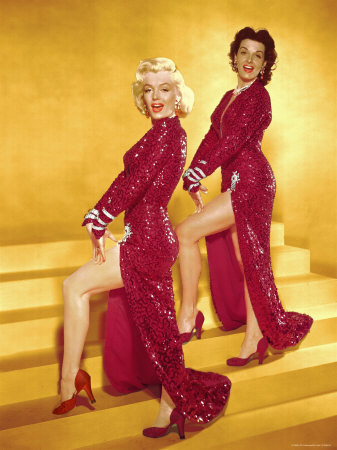
Jane Russsell Gentlemen.jpg

We lost a true Hollywood icon this week when Jane Russell passed away on February 28 at age 89. Russell had brassy, good-natured quality that made her seem like the girl next door — if the girl next door had a sensationally curvy figure.

She was born in Minnesota, the oldest of six children and the only girl. She was discovered by Howard Hughes, who signed her to a seven-year exclusive contract and famously used his skill as an engineer to design a bra for optimal display of her generous bust. (She later said it was so uncomfortable that she tossed it away). Her bust was also the focus of a widely distributed publicity still for “The Outlaw” and for the film itself — today no one remembers much about it except that its release was held up for two years over debates about the display of Ms. Russell’s cleavage.

russell.jpg

What Hughes didn’t seem to notice was her talent as a comic actress, singer, and dancer. After her contract with Hughes was up she made her best-known films, Gentlemen Prefer Blondes as the wisecracking sidekick to Marilyn Monroe, and The Paleface and Son of Paleface with Bob Hope.

In her later years, she continued to perform, making her Broadway debut at age 60 and recording pop, standards, and Christian music. Her great heart and generous spirit shone through all of her work and she will be missed.

Related Tags:


Actors Tribute
Interview: George Nolfi of ‘The Adjustment Bureau’

Interview: George Nolfi of ‘The Adjustment Bureau’

Posted on March 2, 2011 at 8:00 am

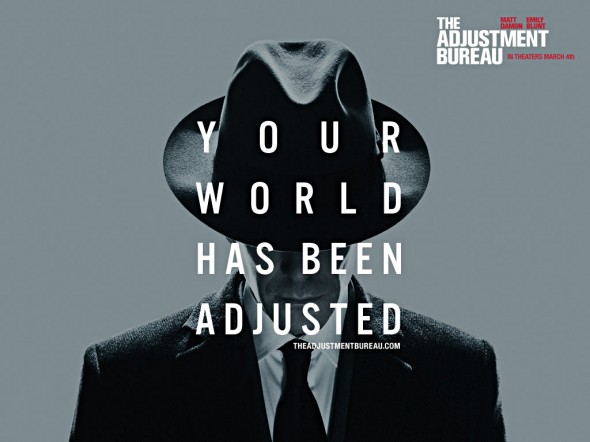
“The Adjustment Bureau” is the first great film of 2011, a big and hugely entertaining film that takes on big ideas — love, free will, destiny, God, and the meaning of life. I was lucky enough to speak with writer and first-time director George Nolfi about being inspired by a short story from Philip K. Dick.adjustment-bureau-poster-3.jpg
The movie is very different from “Adjustment Team,” the original story by Philip K. Dick. How did you approach adapting it for the screen?
The short story is just that, short. And it has a character at the center of it who is explicitly an everyman and so there isn’t much of a character to play there. It was going to need some adaptation one way or another. I was interested in a different thing than Philip K. Dick was. The story can be read from one angle was “Is this real or is this not real?” I wanted it to be — this thing happens and it spins the guy’s whole life on its head and all of his conceptions about the laws of physics and the universe are turned upside down. And he has to accept it because the evidence is just so overwhelming. What does that do to a person?
When my producing partner brought me the short story, I thought, what a great conception for a movie, the idea that fate is a group of people subtly pushing you back on plan. He also said, “You could do this as a love story. Your lead falls in love for the first time in his life and the adjuster comes along and says, ‘Sorry, there’s been a mistake. You weren’t even supposed to meet her.'” For whatever reason, my reaction to that was, “I think I know how to write that.” I didn’t know what I was going to put in the script but I thought the blending of genres would be fascinating and it would get me into territories of these much larger questions that every great system of thought — philosophical, literary, science-fiction, theological — this story would allow me to get there. There are not many stories that make big movies that take you to those questions.
It is unusual for a big-time movie with big-time movies stars to take on questions of life and fate and meaning and free will. I love the fact that it wasn’t focus-grouped away from engaging on those issues.
I optioned the rights and controlled them for six or seven years. I gave the script to Matt Damon and got some thoughts from him about his character. Neither of us thought his character was fully developed yet. I rewrote it to give his character more layers and more interesting things for him to play. And he said yes and we got it financed outside the studio system, from a group called MRC. When we then went to the studios we were able to say, “We have this movie and we have this movie star” and give them a fully-formed movie, so you don’t have this automatic development process where it’s nobody’s fault but things tend to get homogenized.
And Universal was really supportive, right from the beginning. They were on board with the notion of trying something that was really reaching. They were just like — let’s go for it. They thought people would leave the theater feeling satisfied even though we were blending genres. I had no interference while I was making the movie. In post-production they had just a few thoughts which in the Hollywood scheme of things would be considered minuscule. They had thoughts about the music but that was temp music anyway. I didn’t think the original ending worked and they agreed. So it was good people we were in business with and we were all pulling the same way. They were completely supportive of what we were trying to do, and so was Matt.
As a screenwriter, you’ve worked with directors but this is the first time you have directed. What did you learn from the directors you’ve observed?
I was on the set for all the movies I am credited on. And for “Oceans 12,” I knew I was basically going to be there the whole time. I said to Steven Soderbergh, “I’m interested in being director, are you cool with my occasionally ask you why you’re doing what you’re doing?” And he was extremely gracious to explain some of his thought processes about why he was choosing certain shots and so on. But the single biggest piece of advice he gave me that really stuck with me was, “In a perfect world you want to choose your shots and assemble to the movie so that the sound could go out and people could still follow the story.” That’s telling a story through pictures.
Clearly you listened to him! For a writer turned director, this is a very visual film. The effects are very significant and essential to the narrative.
As a writer making the leap to directing the first time, it was very important to me to make a film that was visually significant, to use visuals and music and sound as well as the performances of the cast to tell the story — those are the things you don’t have as a writer. I really wanted to do visual story-telling. I write scripts that are very visual but you can’t know until you try it whether it would come easily to me as a director, but I loved it.
I liked the idea that the Adjusters could do a lot of things but in a way the humans adjusted their options, too. They were nudging each other.
Thematically, I had this idea that the Chairman was limiting the Bureau in all kinds of different ways. That’s too many ripples so you have to go to a higher authority. Or you can’t go through that door unless you are wearing a hat. Or it’s raining out and water kind of blocks our ability. Those are foreshadowing the way that the Chairman will turn out to be supportive of free will.
And of love! It’s a very romantic movie.
I hope so! I hope you experienced it that way. I think it is.
And it is very spiritual, as well.
I wasn’t trying to make a religious film per se, but the most comprehensive attempts to make sense of the world are theological. In terms of fate and free will, that’s the oldest question human beings struggle with. It’s there in Gilgamesh and ancient Greece. Is it fate or do we have choices? There’s a reason for that. Human beings are questioning animals and we want to understand our existence.
Looked at in much less grand terms, most people have some sense that the person they turned out to be, the job they have, their moral code, their interests, their religion, were shaped by what country they were born in, what neighborhood they were born into, their family, their friends, their schools, their chance encounters have put them on a path. Even things considered more deeply personal choices like who your spouse is — you were introduced by friends or met at a wedding or you had mutual interests or whatever it is. So we have this sense that the course of our life is shaped by outside forces, whether a divine hand or your surrounding influences. But we also experience our lives as a series of choices. No religion has successfully answered that. We did an inter-faith screening with an audience of followers of Christianity, Judaism, and Islam, and we had a discussion with experts in all all three. They discussed faith and free will and pointed out to the audience that the importance of free will was found in all of them. They have to, in order to make sense of existence.

Related Tags:


Behind the Scenes Directors Interview Science-Fiction Spiritual films Writers
THE MOVIE MOM® is a registered trademark of Nell Minow. Use of the mark without express consent from Nell Minow constitutes trademark infringement and unfair competition in violation of federal and state laws. All material © Nell Minow 1995-2026, all rights reserved, and no use or republication is permitted without explicit permission. This site hosts Nell Minow’s Movie Mom® archive, with material that originally appeared on Yahoo! Movies, Beliefnet, and other sources. Much of her new material can be found at Rogerebert.com, Huffington Post, and WheretoWatch. Her books include The Movie Mom’s Guide to Family Movies and 101 Must-See Movie Moments, and she can be heard each week on radio stations across the country.

Website Designed by Max LaZebnik