Socalled: A Documentary about a Klezmer/Hip-Hop/Cowboy/Video-Artist

Posted on March 19, 2010 at 3:42 pm

Socalled is a documentary with 18 short films about klezmer hip-hop music and video Montreal-based artist Josh “Socalled” Dolgin, featuring Katie Moore, Fred Wesley, C-Rayz Walz, David Krakauer, Matt Haimovitz, Arkady Gendler, Benjamin Steiger Levine, D-Shade, Gonzales and lounge legend Irving Fields. For a limited time, the entire Socalled movie is available for viewing for 99 cents on YouTube.

Related Tags:


Documentary Music

Clash of the Titans — the Original

Posted on March 19, 2010 at 3:00 pm

Get ready for the upcoming release of the new “Clash of the Titans” by taking another look at the original, starring Harry Hamlin as Perseus and Laurence Olivier as Zeus, now available on Blu-Ray and on iTunes. It is an epic fantasy, filled with drama, passion and old-school stop-motion animated creatures from creative genius and special effects wizard, Ray Harryhausen.
The new “Clash of the Titans” stars Liam Neeson, Ralph Fiennes and “Avatar’s” Sam Worthington and will be in theaters April 2.

Related Tags:


For Your Netflix Queue

World Premiere of ‘Wimpy Kid’ at Alexandria’s Riverside School

Posted on March 19, 2010 at 7:17 am

Alexandria, Virginia’s Riverside Elementary School hosted the World Premiere of “Diary of a Wimpy Kid,” thanks to a winning entry selected out of 5000 competing schools in a competition to host the premiere for their students.

The school safety patrols lined up on the playground to yell “I am a Wimpy Kid!”

The premiere event was held after school yesterday in conjunction with the National Education Association’s (NEA) “Read Across America” program, which focuses on motivating children and teens to read through events, partnerships, and reading resources; the NEA has designated March as National Reading Month. NEA also sponsored the contest, along with 20th Century Fox, School Library Journal, and publisher Harry N. Abrams Inc. The School Library Journal hosted and facilitated the promotion, and Promethean presented the school with its ActivClassroom technology.

There was a full Hollywood-style red carpet with the school patrol kids providing security. I spoke to April Cage, the instructional coach who wrote the winning entry.

Author Jeff Kinney told me that the question he gets asked most often by kids is “What does ploopy mean?” It’s just a made-up word that his sister used to call him.

I asked Robert Capron about playing Rowley (note the Zooey Mama t-shirt!):

Director Thor Freudenthal talked about how happy he was to bring the movie to the Riverside school.

IMG_7283.JPG

Zachary Gordon told me how lucky he felt to play Wimpy Kid Greg Heffley — and to go to a school that is the opposite of the one in the movie because it’s the kind of place where “if you fall everyone comes over to make sure you’re all right.”

Related Tags:


Tweens Understanding Media and Pop Culture

Botox vs. Acting

Posted on March 18, 2010 at 8:00 am

Amanda Fortini writes in New York Magazine about the impact that Botox and other beauty treatments have had on acting. What is a star to do when deciding between a face that can show emotion and one that looks younger but can’t move?

These days, to watch television or to go to the movies is to be jarred, put off, and sometimes saddened by our nonstop exposure to cosmetic interventions. We’re all familiar with the usual specimens, the Heidi Montags and Mickey Rourkes, whose many extreme surgeries and baroque physical changes are routinely dissected by blogs and tabloids. But I’m talking about a different species of performer. Less freakish yet far more abundant are the actors who, by virtue of a range of injectable substances (Botox and its cousin, Dysport; Restylane, Juvéderm, and other fillers of this ilk), are mysteriously unaffected by gravity, childbearing, or free radicals. They seem to have avoided growing old entirely or, like Benjamin Button, to be growing younger with each year. Either that or they look as if they’ve ripened abnormally, their features drifting off in odd, conflicting directions.

What I like about this article is the way it goes beyond the usual tabloid “who’s had work done?” or even “who’s had freakishly bizarre work done?” articles to talk about the way these treatments have affected the style of acting. If you watch early talkies, movies from the 1930’s-late 1940’s, you will still see remnants of early 20th century stage acting with its arch, mid-Atlantic cadences and theatrical gestures. Movie acting was still in its infancy and it really was not until the 1950’s that what we think of today as acting, the natural, intimate, style of performers who understand that the camera will pick up their smallest changes of expression.

The Method brought Freudianism to the screen. Its numerous devotees (Marilyn Monroe, James Dean, Paul Newman, Jane Fonda) ushered in an era of fluid, naturalistic acting that has continued to flourish to this day….The aim of the Method has, over time, come to define the fundamental mission of dramatic acting itself: to use the face and the body to express subtle, complex, conflicting psychological and emotional states.

But by freezing the face and removing the ability to convey emotion and character with the eyebrows, the forehead, and the mouth, Botox and other treatments have led to a return to acting through more emphasis on gesture and voice, and Fortini says the result is a different kind of character.

Some actors appear to be underplaying their characters, consciously making them cool, without affect. If you can’t move your face, why not create an undemonstrative character? Others have taken the opposite approach: On two cable dramas starring actresses of a certain age, the heroines are brassy and expansive, with a tendency to shout and act out, yet somehow their placid foreheads are never called into play. Usually, when a person reenacts a stabbing or smashes a car with a baseball bat, some part of the face is going to crease or bunch up. Not so with these women. As though to compensate for their facial inertia, both perform with stagy vigor, attempting broad looks of surprise or disappointment, gesticulating and bellowing. If you can’t frown with your mouth, they seem intent on proving, you can try to frown with your voice.

The conflict is getting even more pointed as HD televisions threatens to do to less-than-perfect faces what the introduction of sound did to actors whose voices did not match their profiles. On the other hand, “Avatar” would not have been nearly as affecting without the performance of Zoe Saldana, whose stunningly expressive face was translated by computers that could never hope to replicate true the communication of true emotions, making, for that film, acting the real special effect.

Related Tags:


Commentary Understanding Media and Pop Culture
The Twilight Saga: New Moon

The Twilight Saga: New Moon

Posted on March 16, 2010 at 8:00 am

“You’re good with weird,” a character tells Bella mid-way through “The Twilight Saga: New Moon.” That’s an understatement. In the first Twilight movie, as in the first of the series by Stephanie Meyer, high school student Bella Swan (Kristen Stewart) moved to the rainiest town in the US, Forks, Washington and fell deeply in love with Edward (Robert Pattinson), who looked like a teenager but was in fact a vampire who was more than 100 years old. He and his “family,” the Cullens, are sort of vampire vegetarians, living on animal blood. But there are other vampires who continue to prey on humans, and they almost killed Bella before Edward rescued her. And then they lived happily ever after until it was time for another book/movie, and that is where we begin.
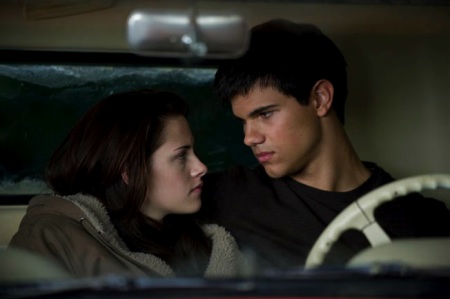
Edward, convinced that their relationship will always put Bella in danger, leaves, telling her he will never see her again. She is devastated and isolates herself from everyone. She discovers that Edward appears to her when she is in danger, so she takes some foolish risks, just to feel close to him. But then the quiet support and gentle teasing of her friend Jacob (Taylor Lautner) begin to make her feel that she is able to be a part of the world again.
bella-jacob-072309.jpg Like Edward, Jacob loves Bella and would do anything to protect her. And like Edward, Jacob has a secret. He is part of a tribe of wolf-people. Like “The Hulk,” his anger manifests itself in a powerful transformation. And Bella finds herself at the center of a centuries-old war between the vampires and the wolves.
The wildly popular Twilight Saga has the core elements of girl-friendly romances from “Wuthering Heights” to “Titanic:” a boyfriend who is not approved by parents who is utterly undone by the appeal of the female lead, and something to make sure that their relationship is about longing, not satisfaction. Just in case you aren’t paying close attention, we see Bella sleeping with a copy of “Romeo and Juliet” on her pillow, and her English class watching a video of the play. The teacher calls on Edward to recite one of Romeo’s speeches. And later, Edward, like Romeo, believes that his love is dead and decides he cannot live without her.
There is a lot of longing. Characters exchange meaningful looks and take an extra beat before responding to allow for some strategic intakes of breath and swelling of the score. There are moments that are more perfume commercial than movie. And as in the book, this big love Bella and Edward feel is expressed mostly in talking about the big love they feel. In a way, this is wise; we never see them doing or seeing anything that would interfere with our ability to project onto them whatever the specifics of our own fantasies of love look like. All we know or need to know is that Bella and Edward have the big, total, all-encompassing, would do anything for each other love. Just like Romeo and Juliet.
And we have Lautner’s excellent abs, which play such a significant role they should have their own billing. Lautner also has an easy confidence and sincerity on screen that nicely leavens the intensity and drama of the Bella-Edward connection. The screenplay is seasoned with some humor and a reference to self-referential cleverness that is almost meta.
New director Chris Weitz does not have Catherine Hardwicke’s feel for the rhythms of teenage interactions and the intensity of teen romance. And he does not have her ability to tell the story through the settings; we miss the lush natural world of the first chapter. Weitz and screenwriter Melissa Rosenberg also have to grapple with a transitional story that translates less well to screen than the first one. But the film benefits from his greater experience with special effects and a bigger budget. He catches the spirit of the story and allows the natural chemistry between his leads do the rest. And that is enough to make this movie enormously enjoyable and keep us looking forward to the next one.

(more…)

Related Tags:


Based on a book Fantasy Romance Series/Sequel
THE MOVIE MOM® is a registered trademark of Nell Minow. Use of the mark without express consent from Nell Minow constitutes trademark infringement and unfair competition in violation of federal and state laws. All material © Nell Minow 1995-2026, all rights reserved, and no use or republication is permitted without explicit permission. This site hosts Nell Minow’s Movie Mom® archive, with material that originally appeared on Yahoo! Movies, Beliefnet, and other sources. Much of her new material can be found at Rogerebert.com, Huffington Post, and WheretoWatch. Her books include The Movie Mom’s Guide to Family Movies and 101 Must-See Movie Moments, and she can be heard each week on radio stations across the country.

Website Designed by Max LaZebnik