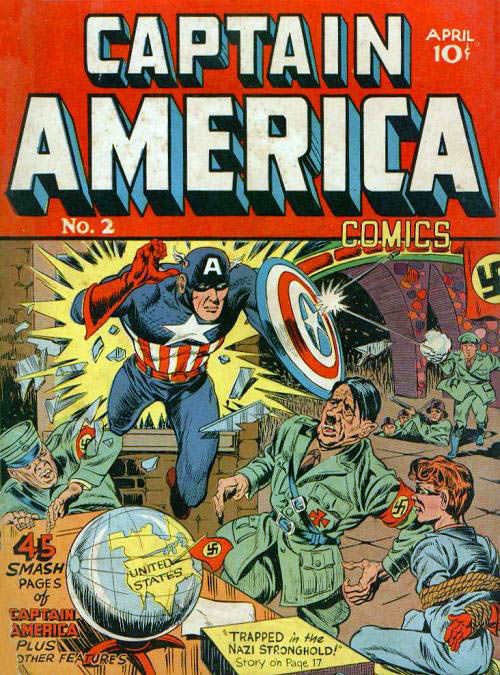
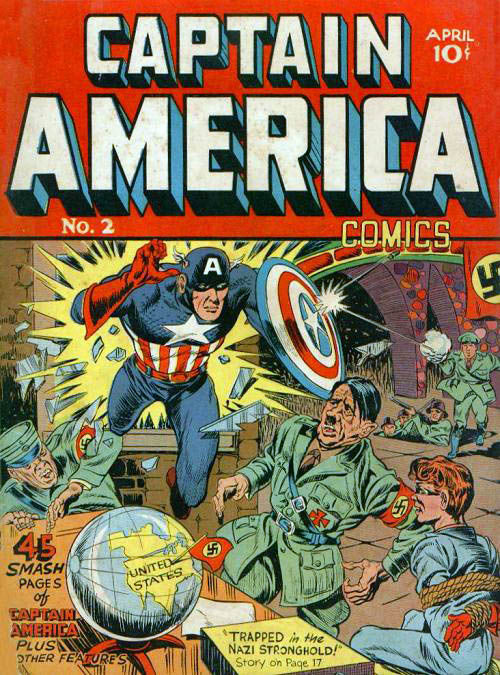
This week’s announcement that Chris Evans (“The Fantastic Four”) will star in a new “Captain America” movie makes this the right moment to think about the history and meaning of the character. Never as iconic and popular as Superman or Batman, Captain America’s status has risen and fallen according to the political sentiments of the era. Unsurprisingly, he first appeared at a time of the most vibrant patriotism, the beginning of WWII. The character was Steve Rogers, a sickly young man who was given an experimental Super-Soldier Serum and “Vita-Ray” treatment that made him very strong and healthy in order to aid the United States war effort. His costume was inspired by the American flag. He has no superpowers but he carries a red, white, and blue indestructible shield. Captain America was often portrayed as fighting for the Allies and he was Marvel’s most popular hero during the war.
But his popularity waned in the Cold War era. His explicit Americanism did not fit either the complacence and materialism of the 1950’s or the Cold War concerns. He disappeared from comics until 1964. Interestingly, a character who appeared to be Captain America was featured in a comic book story starring the Fantastic Four’s Johnny Storm (also played by Evans on screen). But that character turned out to be a villain in disguise. The unabashed pro-Americanism of the character did not fit well with the turbulence of the 1960’s and Captain America himself became so disillusioned with the government following Watergate that he took on another persona for a while. In another episode he led a protest against government oppression of superheroes that was a commentary on infringement of civil rights. The character has had many different iterations and the Steve Rogers alter ego has died and been brought back and been in suspended animation and been brought back as the Captain America identity has shifted as well for a while being taken over by Roger’s one-time sidekick. There is also a black Captain America named Isaiah Bradley, whose origin was explicitly inspired by the real-life Tuskegee experiments. He was injected with the serum before Rogers.
Chris Evans was one of the best things about the uneven “Fantastic Four” movies and I look forward to seeing where he takes this character.
Opening this Week: Hot Tub Time Machine and How to Train Your Dragon
Posted on March 23, 2010 at 1:49 pm
The silly gross-out comedy “Hot Tub Time Machine,” starring John Cusack, Craig Robinson, and Rob Corddry opens this week, with three forty-something buddies getting sent back to 1986. It co-stars two performers who were making some of the most popular movies of the 1980’s. The animated 3D film How to Train Your Dragon is one of the best films I have seen this year. It features three actors who were in far poorer films earlier this month — Jay Baruchel of She’s Out of My League, Gerard Butler of The Bounty Hunter, and America Ferrara of Our Family Wedding and so it was especially nice to see all three of them in a movie I really loved. I’ll be posting an interview with the writer/directors later this week — stay tuned because they are as much fun as their movie is.
Humorous use of the word "cuss" in place of swear words
Alcohol/ Drugs:
Character smokes a cigar, alcoholic cider
Violence/ Scariness:
Characters in peril, violence includes guns, fights, explosions, character injured but no one seriously hurt
Diversity Issues:
Diverse characters, retro gender roles
Date Released to Theaters:
November 25, 2009
Date Released to DVD:
February 18, 2014
Amazon.com ASIN:
B00GRA7KBY
Today Criterion issues a gorgeous new Blu-Ray edition of “Fantastic Mr. Fox” with lots of great behind-the-scenes extras. Director Wes Anderson has often seemed more interested in his films’ props and sets than the characters and stories. His last movie’s most memorable character was a set of luggage (The Darjeeling Limited). The previous one’s most memorable image was a cutaway that turned a sea-going vessel into a sort of doll’s house (The Life Aquatic with Steve Zissou). And so perhaps it is not surprising that his liveliest and most appealing movie is “Fantastic Mr. Fox,” a story told through stop-motion animation, every shot filled with precise and intricate detail. This is movie-making as Cornell Box.
The effect might be suffocating but for Anderson’s superbly chosen collaborators. While his previous films have been based on original material, this time he uses a beloved book by one of the foremost children’s book authors of the late 20th century, Road Dahl (Charlie and the Chocolate FactoryJames and the Giant Peach). And as voice talent, he has George Clooney and Meryl Streep, whose smooth, subtle performances lend emotional grounding to balance Anderson’s clever but claustrophobic tendencies.
It’s a Peter Rabbit-style story, with the title character in a battle with three farmers: “Boggis, Bunce, and Bean, one fat, one short, one lean,” according to a taunting children’s song. Fox (Clooney) agreed to stop stealing from the farmers when Mrs. Fox (Streep) became pregnant and has settled into a foxy middle-class life, working as a newspaper columnist. But he feels the call of the wild — and the call of the farmers’ plump chickens, apple cider, and geese. He starts stealing again, bringing down the wrath of the farmers on the whole animal kingdom. It is up to Fox to find a way to save them all.
The theme of the call of the wild comes up several times as the story shifts back and forth between ultra-civilization (Fox wears a shirt and tie) and the animal instincts of the non-human characters. The combination of the very familiar (Fox’s son Ash feels neglected, especially after his more talented and cool cousin comes to stay), the very cerebral (the “Oceans 11”-style heist plans), and the strangely feral (watch the way Fox eats) keeps the story as intriguing as the tiny props and costumes and the odd, stiff movements of the stop-motion figures. Unlike plasticine-based stop-motion (“Coraline,” “Wallace and Gromit”), the high-touch textures of the figures make them seem like toys come to life.
The screen is filled with enticing details, but it is the performances that keep us connected to what is going on. The script is filled with arcane non sequiturs but the warmth of those voices, with able support from Anderson’s brother Eric and regulars Bill Murray, Jason Schwartzman, and Owen Wilson, keep us in the story. And that really is fantastic.
My beloved spoke, and said unto me: ‘Rise up, my love, my fair one, and come away. For, lo, the winter is past, the rain is over and gone; The flowers appear on the earth; the time of singing is come, and the voice of the turtle is heard in our land; The fig-tree putteth forth her green figs, and the vines in blossom give forth their fragrance. Song of Solomon
Daffodils that come before the swallow dares and take the winds of March with beauty. Shakespeare, A Winter’s Tale
in Just-
spring when the world is mud-
luscious …
when the world is puddle-wonderful E. E. Cummings
Happy spring!
These movies celebrate the return of longer days, milder breezes, and a sense of promise and renewal.
1. Seven Brides for Seven Brothers Bachelor mountain men brothers capture young women from the town one winter so they can marry them. An avalanche blocks off the pass and keeps their families from coming after them. But the women are furious and banish the men to the barn — until spring thaw, when everyone comes outside to enjoy the weather and sing Johnny Mercer’s lyrics: “Oh, the barnyard is busy in a regular tizzy, And the obvious reason is because of the season. Ma Nature’s lyrical, with her yearly miracle. Spring, Spring, Spring.”
2. The Secret Garden There are three excellent versions of this classic book about the sour orphan and her ailing cousin who are both made whole and healthy when they find a locked garden and bring it back to life. My favorite is the British miniseries, which is the closest to the text, but I love them all.
3. State Fair The only Rodgers and Hammerstein show written directly for the screen takes place at the end of the summer, but it has one of the greatest songs ever written about spring, the Oscar-winning “It Might as Well Be Spring.” The lovely Jeanne Crain sings, “I am starry eyed and vaguely discontented, like a nightingale without a song to sing, O why should I have spring fever, when it isn’t even spring.”
4. Random Harvest One of the sweetest love stories in the movies is about a merry young woman who falls for a man who has lost his memory. They get married and are very happy until he regains his memory and goes back to his old life, no longer able to remember her or their life together. A lot more happens over many years, and the final scene takes place by the lilacs on a spring day that shows us — and the couple — all we need to know about renewal.
5. Where the Boys Are Four girls leave their snowy college campus for spring break in Fort Lauderdale, Florida. It was considered very racy back in 1960 for its discussion of premarital sex (including one character who pays a very heavy penalty for having sex with a boy she barely knows) but is something of an artifact these days. Still the performances by Dolores Hart (who later became a nun), Jim Hutton, and Paula Prentiss and the themes of finding a way to balance intimacy and self-respect still hold up.
6. Bambi “Nearly everybody gets twitter-patted in the springtime,” says the owl in this animated Disney classic about the young fawn. The spring scenes are among the most enchanting in a woodland story about young animals growing up. (NOTE: some scary scenes including a forest fire and a hunter who shoots the deer)
7. Spring, Summer, Fall, Winter… and Spring An isolated Buddhist monastery sits on a quiet lake in the middle of a forest, where one monk and his very young apprentice live a life of quiet prayer and contemplation. The film takes us through the seasons of the younger man’s life, from childhood through old age, with the final spring as a time of renewal, the now-old monk teaching his own young apprentice about life’s cycles and interconnections.
8. The Four Seasons Alan Alda wrote and directed a film that takes four couples through a year to the music of Vivaldi. It begins with a spring trip to the country, when they cook an elaborate dinner and plan the rest of their trips together for the rest of the year. But one couple breaks up and the husband wants to bring his new young girlfriend, it leads to some mid-life questions about meaning, trust, and loyalty. Alda’s wise script and sensitive direction and outstanding performances from Carol Burnett, Len Cariou, Jack Weston, and Rita Moreno make this one of the best films ever about grown-up friendship.
9. “It Happens Every Spring” Ray Milland stars in a sweet fantasy about a baseball-loving professor who invents a chemical that acts as a wood repellent. He realizes that if he rubs a little on a baseball glove, it makes him the greatest pitcher in the world because the bats cannot connect with the ball. Written by the author of “Miracle on 34th Street,” this is a gentle fairy tale with some of Hollywood’s greatest character actors among the players and a hark back to an era before steroid scandals and superstar salaries.
10. The First of May This modest little gem is the story of a boy named Cory (“Cougar Town’s” Dan Byrd) who runs off one spring to join the circus. It is a sweet, episodic story with many magical moments, including delightful backstage glimpses of life in the big top. Co-stars include the brilliant Julie Harris and Mickey Rooney and Cory even gets some batting advice from Joe DiMaggio, who appears as himself. Families of all kinds will respond to this story about people who triumph over a series of obstacles to create a family for themselves.
Linda Holmes of NPR’s great Monkey See blog has a list of tired cliches that should be barred from all future romantic comedies because they are not funny and they are not romantic. Not coincidentally, several are featured in the movie and even the trailer for the dreary mess, “The Bounty Hunter.” The romantic kidnapping, for example, which in the “Bounty Hunter” trailer has Gerard Butler tossing Jennifer Aniston into the trunk of his car. As Holmes says, this is not funny — it’s creepy. Holmes also wants to prohibit the winking references to Pride and Prejudice’s Mr. Darcy, the trashy best friend, the rain-soaked fights (take it inside, people), and punches in the crotch. Hear that, Hollywood?



 ). And as voice talent, he has George Clooney and Meryl Streep, whose smooth, subtle performances lend emotional grounding to balance Anderson’s clever but claustrophobic tendencies.
 Bachelor mountain men brothers capture young women from the town one winter so they can marry them. An avalanche blocks off the pass and keeps their families from coming after them. But the women are furious and banish the men to the barn — until spring thaw, when everyone comes outside to enjoy the weather and sing Johnny Mercer’s lyrics: “Oh, the barnyard is busy in a regular tizzy, And the obvious reason is because of the season. Ma Nature’s lyrical, with her yearly miracle. Spring, Spring, Spring.”
 The only Rodgers and Hammerstein show written directly for the screen takes place at the end of the summer, but it has one of the greatest songs ever written about spring, the Oscar-winning “It Might as Well Be Spring.” The lovely Jeanne Crain sings, “I am starry eyed and vaguely discontented, like a nightingale without a song to sing, O why should I have spring fever, when it isn’t even spring.”
 One of the sweetest love stories in the movies is about a merry young woman who falls for a man who has lost his memory. They get married and are very happy until he regains his memory and goes back to his old life, no longer able to remember her or their life together. A lot more happens over many years, and the final scene takes place by the lilacs on a spring day that shows us — and the couple — all we need to know about renewal.
 Four girls leave their snowy college campus for spring break in Fort Lauderdale, Florida. It was considered very racy back in 1960 for its discussion of premarital sex (including one character who pays a very heavy penalty for having sex with a boy she barely knows) but is something of an artifact these days. Still the performances by Dolores Hart (who later became a nun), Jim Hutton, and Paula Prentiss and the themes of finding a way to balance intimacy and self-respect still hold up.
  “Nearly everybody gets twitter-patted in the springtime,” says the owl in this animated Disney classic about the young fawn. The spring scenes are among the most enchanting in a woodland story about young animals growing up. (NOTE: some scary scenes including a forest fire and a hunter who shoots the deer)
 An isolated Buddhist monastery sits on a quiet lake in the middle of a forest, where one monk and his very young apprentice live a life of quiet prayer and contemplation. The film takes us through the seasons of the younger man’s life, from childhood through old age, with the final spring as a time of renewal, the now-old monk teaching his own young apprentice about life’s cycles and interconnections.
  Alan Alda wrote and directed a film that takes four couples through a year to the music of Vivaldi. It begins with a spring trip to the country, when they cook an elaborate dinner and plan the rest of their trips together for the rest of the year. But one couple breaks up and the husband wants to bring his new young girlfriend, it leads to some mid-life questions about meaning, trust, and loyalty. Alda’s wise script and sensitive direction and outstanding performances from Carol Burnett, Len Cariou, Jack Weston, and Rita Moreno make this one of the best films ever about grown-up friendship.