Why (and how) do we like to be scared? What do you think is scary?

Posted on January 5, 2008 at 5:46 pm

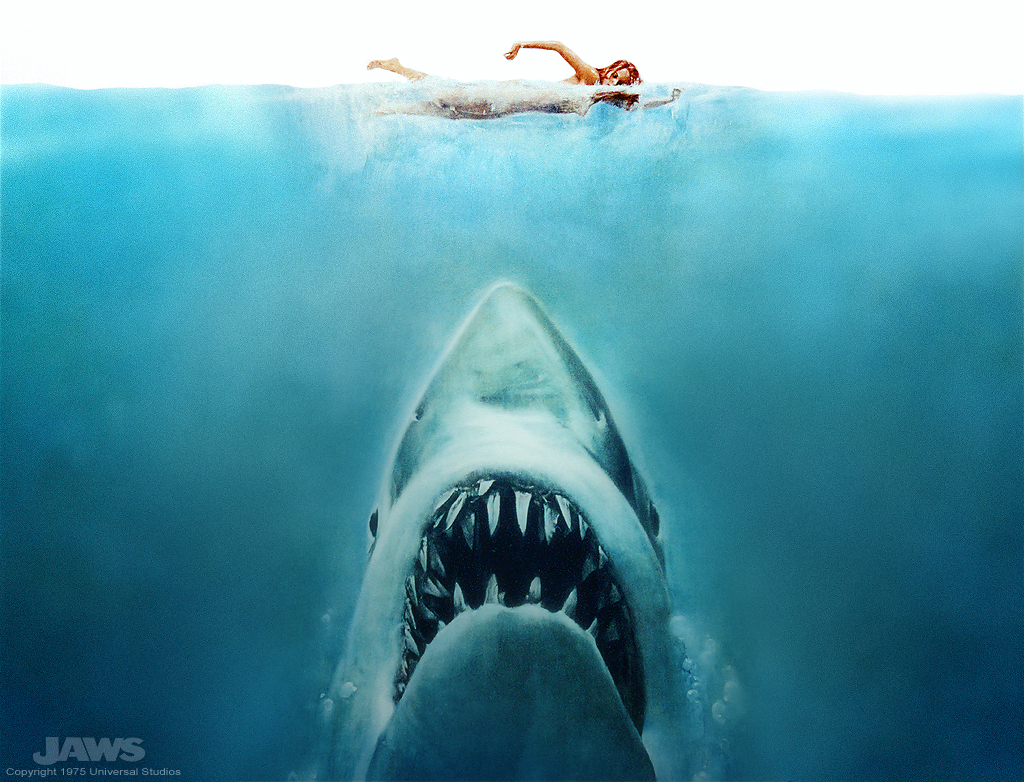
Before there were scary movies, there were scary plays. Before there were scary plays, there were scary stories. Scary has been very popular for a very long time. The top twenty box office champs are all scary, from Titanic to the Indiana Jones and of course the first modern blockbuster Jaws, which still has some people afraid to go into the water. Horror and terror have been popular since stories began. Jaws.jpg Did you hear the story about the man who chopped up his enemy’s children into a pie and fed them to him? It was written by the same guy who wrote about suicidal teenagers and murderously ambitious would-be kings — Shakespeare. And then there’s the one about the guy who killed his father and put out his own eyes — written around 429 B.C.

Scary movies are especially popular with teenagers. They serve as a sort of training wheels for social interaction and a way of letting off steam. Teens watch them in groups, grabbing each other and screaming, then talking afterward about the experience.

The two best pieces I have read recently on the subject of scary movies are Desson Thomson’s article in the Washington Post about the difference between what is scary and what is gory and a piece by Grady Hendrix in Slate about the grisly and very popular “Saw” movies.

Related Tags:


Commentary

Shrek the Third

Posted on November 15, 2007 at 10:48 am

Did you ever wonder what happens to the villains while the hero and heroine are living happily ever after? We get to find out in this third chapter in the saga of Shrek. In the previous episode, Prince Charming failed in his attempt to marry Princess Fiona (voice of Cameron Diaz) and take over the Kingdom of Far Far Away. Now he has been consigned to the vile dust from whence he sprung, unwept, unhonor’d, and unsung. In other words, he’s doing dinner theater.


Meanwhile, over in Far Far Away, Shrek (voice of Michael Meyers) and Fiona are a few happilys short of an ever after themselves. Fiona’s father, the king (voice of John Cleese), transformed back into a frog at the end of the second film, is very ill. And after he, uh, croaks, Shrek and Fiona will have to take over, unless they can find the next in line for the throne, cousin Arthur (voice of Justin Timberlake). And just as the journey to find Arthur begins, Shrek is presented with an even more terrifying new responsibility. He’s going to be a father.


Shrek, Donkey (voice of Eddie Murphy), and Puss in Boots (voice of Antonio Banderas) find Arthur in a terrifying environment filled with pain beyond measure — high school. Meanwhile, Prince Charming and all the other villains decide that they are entitled to some happily ever after, too. Captain Hook, the Wicked Witch, the Cyclops, some enchanted trees, and the rest of the baddies take over Far Far Away capture Fiona and the Queen (voice of Julie Andrews) along with the princesses who are visiting for a baby shower, Snow White, Cinderella, Sleeping Beauty, and Rapunzel (voices of Amy Poehler, Amy Sedaris, Maya Rudolph, and Cheri Oteri). And Prince Charming gets ready to settle things with Shrek once and for all — in front of an audience.


It’s still funny and even a little heartwarming, but it isn’t fresh anymore and — it has to be said — the character of Arthur isn’t very interesting. Because he is at the center of much of the story, for the first time the Shrek saga drags. The new voices and characters add very little. When Regis Philbin joins Larry King as the voice of the ugly step-sisters, there’s a joke about Merlin’s robe not quite covering all it is supposed to, and Donkey and Puss switch bodies, it feels like they’re running out of ideas.


The animation continues to get better and better and the faces are marvelously expressive, especially Arthur’s dimple and the frog king’s…croaking. The fairy-tale high school is a hoot, it is fun to see the princesses learn to rescue themselves, and it is a treat to see how cleverly the film avoids much of the predictable violence. The po-mo humor sensibility continues to stay on the safe side of snarky, though one has to wonder in the midst of all this grrrl power why it is that no one ever thinks of making Fiona the ruler after her father’s death. But by the time Shrek and Arthur are learning that it is okay for them to be themselves, it is starting have that “very special episode” feeling that even a kickin’ rendition of “Thank You (Falettinme Be Mice Elf Agin)” can’t make work and we’re wondering if Shrek wasn’t a little more fun when he was a little more ogre-ish.

Parents should know that, like the earlier films, this one has some mildly mature material, including some schoolyard crude humor (the gingerbread man poops a gumdrop), some potty humor, and a mild drug joke (reference to puffing on “frankincense and myrrh”). There is some cartoon violence and some drinking (scenes in a bar, references to alcoholic drinks). Parents should also know that while the Shrek character is being used by the Department of Health and Human Services to promote healthy eating and exercise, he has also been licensed to promote more than seventy different products, including many different kinds of candy and junk food.

Families who see this movie should talk about why some people might think it is scary to be a parent. Why did Arthur change his mind about Shrek? Do you ever feel that people want you to be something different from what you are?

Families who enjoy this film will also enjoy Shrek and Shrek 2, as well as Ella Enchanted, Hoodwinked, and The Best of Fractured Fairy Tales, Vol. 1 (1961). They will also enjoy books like Outspoken Princess and the Gentle Knight, Tatterhood and Other Tales: Stories of Magic and Adventure, and the original book by William Steig that inspired the series, though its Shrek is not as cuddly.

Related Tags:


Animation Family Issues

Crying movies

Posted on November 6, 2007 at 11:03 am

Movies that make you cry (or sob or blubber uncontrollably)
Desson Thomson has a wonderful piece in the Washington Post about movies that make us cry, and a list of some examples sent in by readers. The usual suspects are there, from “Dumbo” to “Field of Dreams,” but some surprises, including Adam Sandler’s “Click” (“Never thought I would cry at an Adam Sandler movie — I usually don’t even admit to even going to one.”), “Star Trek: The Search for Spock,” and “Terminator 2: Judgment Day.” I admit to tearing up at the end of that one, too. Some of the other movies that have made me cry: Waterloo Bridge, A Little Princess, Steel Magnolias, the one Thomson refers to as “that Michael Keaton movie” (My Life) and yes, An Affair to Remember.
Be sure to listen to Thomson’s graceful audio commentary on his own list, with such classic choices as “Old Yeller” and “Terms of Endearment.” I enjoyed the quotes from experts, especially Professor Mary Beth Oliver of Penn State, who said that these movies
cause us to contemplate what it is about human life that’s important and meaningful. . . . Those thoughts are associated with a mixture of emotions that can be joyful but also nostalgic and wistful, tender and poignant. Tears aren’t just tears of sadness, they’re tears of searching for the meaning of our fleeting existence.
Just reading those words made me a little damp-eyed. Sorry, I just need a minute here.

Related Tags:


Lists

Books Into Movies

Posted on October 3, 2007 at 10:14 pm

I’ve seen four movies based on books in the past week and all made me think about the perils of adapting novels to the screen. I once heard Peter Hedges speak about the difference between plays, novels, and movies. His novel, What’s Eating Gilbert Grape, was adapted into a fine movie by Lasse Hallström, and he described the experience as a master class in understanding the difference between print and film. He said that novels are about what people think and feel, plays are about what they say, and movies are about showing what the characters think and feel, most often without saying anything.
I did not think much of the book The Jane Austen Book Club. If any other author’s name was in the title, it would not have been a best-seller. The movie version is far better, genuinely enjoyable. Feast of Love and O Jerusalem did not live up to their source material. The Dark is Rising, The book that inspired “The Seeker” was so diluted in the final script that it had the same relaitonship to the source material that a homeopathic remedy has to its active ingredient. And the result was less efficacious.
It is not just about the acting. “The Jane Austen Book Club” has first class actors who bring more subtlety and complexity and life to the characters than the author ever did, but “Feast of Love” has Morgan Freeman, Jane Alexander, and Greg Kinnear, who all do the best they can but never make the relationships on screen feel immediate or alive. It just has to do with showing, not telling, and “The Jane Austen Book Club” manages that act of alchemy where the others fail.

Related Tags:


Commentary Understanding Media and Pop Culture

Emile Hirsch Goes Into the Wild

Posted on September 24, 2007 at 10:18 pm


Emile Hirsch gives a magnificent performance in one of the year’s best films, Into the Wild. I met with him in Georgetown to ask him about making the film.
What does Sean Penn as an actor bring to directing?
He has that whole wealth of experience since he’s done it on the actor’s side. So you trust him so much. Everything he asked me to do, certain things I was hesitant to do, he did first. He ate squirrel. He went first on the Colorado River. He let me know I could do it. Sean was an incredible director. He let me learn for myself, He helps you bring out the best in yourself and there’s no greater gift.
All of the movies Penn has written and directed are in some way about lost children. Why do you think that is?
He is a man of high intellect but also a very keen instinct. A lot of his choices are on an instinctual level in a very pure way. One of the things I admire about him so much is the kind of strong-willed instinct that he has and the confidence to trust that instinct and move forward. Where so many people are in the back rubbing sweaty palms, he is doing it. He wanted to do this movie because he always had a really strong wanderlust, as do I. It was infectuous, the idea that you want to go out and live your life all the way and have more meanng, live it while you have it.
You play a real-life character who died of starvation in Alaska. Did he have poor judgment? Was he self-destructive? Where would he have gone next?
He made a couple of really crucial errors, not bringing things with him like a map. But he purposefully did not bring them because he wanted to shave he margin of error. He shaved it a little too much. He had amazing wanderlust and also had a lot of personal problems.
Did he learn from the people he met or were they just way-stations on his journey to sever all ties?
He was very determined. The people on the road started to open his eyes, but it took the total solitude for him to find himself and what the meaning of his life could possibly be.
It’s quite a contrast to go from this film to your next film, “Speed Racer.” How do you prepare for such different genres?
The directors of “Speed Racer,” the Wachowski brothers, the guys who did The Matrix, have a particular sensibility about performances they expect. It was like being in a sauna for eight months and jumping into an ice bath without a break — with the lid locked!
Were there elements of the real-life story that were especially meaningful to you in portraying Chris McAndless?
The abandoned bus he lived in, which he called “the magic bus.” It was like a waystation, always symbolzing the journey, Where he learns about himself. It symbolizes the question, “Where is he going?” And I read the books he was reading, Walden by Thoreau, Emerson, Dr. Zhivago by Pasternak, Jack London’s Call of the Wild. What Chris did was very similar to what Thoreau did.

Related Tags:


Actors Interview
THE MOVIE MOM® is a registered trademark of Nell Minow. Use of the mark without express consent from Nell Minow constitutes trademark infringement and unfair competition in violation of federal and state laws. All material © Nell Minow 1995-2026, all rights reserved, and no use or republication is permitted without explicit permission. This site hosts Nell Minow’s Movie Mom® archive, with material that originally appeared on Yahoo! Movies, Beliefnet, and other sources. Much of her new material can be found at Rogerebert.com, Huffington Post, and WheretoWatch. Her books include The Movie Mom’s Guide to Family Movies and 101 Must-See Movie Moments, and she can be heard each week on radio stations across the country.

Website Designed by Max LaZebnik