
Peter Pan

Posted on December 13, 2002 at 5:17 am

B+
Lowest Recommended Age: Kindergarten - 3rd Grade
Profanity: None
Alcohol/ Drugs: None
Violence/ Scariness: Characters in peril; a swordfight
Diversity Issues: Sexist comments about girls, insensitive comments about Indians
Date Released to Theaters: 1953
Date Released to DVD: February 4, 2013
Amazon.com ASIN: B00A0MJ9ZA

Disney’s latest release is a beautiful Blu-Ray of one of its animated classics, the Disney version of the Victorian classic about the boy who would never grow up. Wendy, Michael, and John Darling, three London children, meet Peter Pan, a boy who can fly. He has been drawn to their warm, comfortable home, and to Wendy’s stories. He sprinkles them with fairy dust and they fly off past the “second star to the right,” where he lives in a magical place called Neverland. There they rescue an Indian princess, and fight pirates led by Captain Hook, before returning home to wave goodbye as Peter returns to Neverland without them.

The animation in this movie is as lively as its energetic hero. The scenes set in Victorian London are beautiful, and the shift in perspective as the children round Big Ben and fly off to Neverland is sublimely vertiginous.

Most children see Peter as that wonderful ideal, a child with the power to do whatever he pleases for as long as he pleases. The story does have moments that are whimsical but also very odd — the nanny is a dog, the crocodile that ate Captain Hook’s hand keeps following him for another taste, Peter loses his shadow, the Lost Boys have no parents, and unlike Peter, no special powers, fairy guardian, or unquenchable brio. Some children find this engaging, but a few find it troublesome, or worry about what happened to Peter’s parents and whether he will be all right without them. They may also be sad that the story ends with Peter bringing the Darling children home and then going back to Neverland without them.

Parents should know that the “What Makes the Red Man Red” song is embarrassingly racist and sexist. There is also a sexist overlay to the entire story, with Peter rapturously adored by all the females and at best indifferent in return. A best-selling pop psychology book of some years ago played off of this notion, theorizing that some men suffer from “The Peter Pan Syndrome” (fear of commitment), dividing women into two categories, mother-figure “Wendys” and playmate “Tinkerbells.” Tinkerbell, who is, of course, a fairy, is the only female in the story who is capable of much action other than nurturing, and she is petty and spiteful (though ultimately loyal). When he first meets Wendy, Peter says “Girls talk too much,” which one boy who watched with me thought was rapturously funny.

Families who watch this movie should talk about these questions: Have you ever thought that you didn’t want to grow up? Have you ever thought that you’d like to be a grown up right now? What would you do? Would you like to visit Neverland?

Families who enjoy this movie will also enjoy the many other versions of this popular story. Interestingly, this animated version was the first to feature a real boy (instead of a woman) in the title role. The Mary Martin version for television that parents of today’s kids may remember from their own childhoods is available on video, with Cyril Ritchard impeccable as Mr. Darling/Captain Hook, and a terrific score that includes “I’m Flying” and “Tender Shepherd.” A remake with Cathy Rigby as a very athletic Peter is also very good. Don’t waste your time on Steven Spielberg’s 1991 sequel, “Hook,” with Robin Williams as a grown- up Peter Pan who must go back to rescue his children from Dustin Hoffman as Captain Hook with the help of Julia Roberts as Tinkerbell. The stars, the production design, and some spectacular special effects cannot make up for the incoherent joylessness of the script and genuinely disturbing moments like the death of one of the lost boys.

Related Tags:


Action/Adventure Animation Based on a book Based on a play Classic Comedy DVD/Blu-Ray Pick of the Week Fantasy For the Whole Family Musical Stories About Kids

The Maltese Falcon

Posted on December 13, 2002 at 5:17 am

Plot: Sam Spade (Humphrey Bogart) is a private detective. A woman who says her name is Ruth Wonderly (Mary Astor) comes to see him, asking for help in finding her sister. Sam sends his partner, Miles Archer (Jerome Cowan) to follow her when she meets Floyd Thursby, the man she thinks her sister is with, and both Archer and Thursby are killed. It turns out that the woman has given him a false name. She is really Brigid O’Shaughnessy, and it turns out it is not her sister she is seeking, but a small, jeweled statue of a falcon, and she is mixed up with some people who will do anything to get it.

One of those people is Joel Cairo (Peter Lorre), who comes to see Sam to insist — with a gun — that he be allowed to search Sam’s office to see if it is there. Sam is not at all intimidated by Joel, but allows him to search. Also after the statue is Mr. Gutman, “the fat man” (Sidney Greenstreet), with his “gunsel,” Wilmer. They alternately threaten and attempt to bribe Sam, while Brigid appeals to his protective nature and his heart. But Sam turns them all over to the police, including Brigid, whom he loves.

Discussion: One of the most interesting aspects of this classic movie is the way that Sam Spade thinks though the moral dilemmas. When he is deciding whether to tell the police about Brigid, he is very explicit about weighing every aspect of his choices. It is not an easy decision for him; he has no moral absolutes. On one hand, he loves her, and he did not think much of his partner. On the other, he does not trust her, he does not think she trusts him, and he knows that they could not go on together, each waiting to betray or be betrayed. And he has some pride; he says that when your partner is killed, you are supposed to “do something.” While it may be good for business not to appear too ethical, it is bad for business to allow a partner in a detective firm to get killed without responding. If he turns her over to the police, he loses her. But if he does not, he loses a part of himself, his own kind of integrity.

When this movie was made, moviegoers were used to cool, debonair detectives (like Philo Vance and Nick Charles, both played by William Powell), a sort of cross between Sherlock Holmes and Fred Astaire. But Sam Spade, created by Dashiell Hammett based on his experiences as a detective, was a modern day version of the cowboy, a loner with his own sense of honor.

This was the first movie directed by John Huston, who also wrote the screenplay, but he was already a master. Watch the two scenes where Sam goes to talk to Gutman, and see how the camera angles in the first scene lead the viewer to suspect that Sam’s drink is spiked (it isn’t), and then how different angles are used in the second one to make the viewer confident that it won’t be (it is).

Questions for Kids:

· What does Sam mean when he says the statue is “the stuff dreams are made of”?

· Where is Sam faced with moral conflicts? How does he resolve them? What are his reasons?

Connections: Bogart appeared as a similarly tough detective, Philip Marlowe, in “The Big Sleep,” based on the novel by Raymond Chandler. The books by Hammett and Raymond Chandler are well worth reading. Note the director’s father, Walter Huston, in an uncredited brief appearance as Captain Jacobi. Jerome Cowan, who appears briefly as Miles Archer, plays the prosecuting attorney who tries to prove that Kris Kringle is not Santa Claus in “Miracle on 34th Street.”

Related Tags:


Based on a book Classic Crime Thriller

A Room With a View

Posted on December 13, 2002 at 5:17 am

Plot: Lucy Honeychurch (Helena Bonham Carter) arrives in Italy with her strait-laced aunt Charlotte (Maggie Smith). Disappointed at not getting the room with a view they had been promised when making their reservations at the inn, they are not sure whether it is proper to accept the offer of Mr. Emerson (Denholm Elliot) and his son George (Julian Sands), staying at the same inn, to switch rooms so they may have a view after all. Reassured by the clergyman, Mr. Beebe (Simon Callow), they agree.

Later, out in the countryside, George impetuously kisses Lucy, and her aunt, horrified, whisks her back to England. There, Lucy is engaged to Cecil, a prissy man, who likes Lucy’s “freshness” and “subtlety,” and kisses her lightly, only after asking her permission. Mr. Beebe says that “If Miss Honeychurch ever takes to live as she plays (the piano), it will be very exciting–both for us and for her.” He clearly does not think the engagement to Cecil is evidence that she has.

The Emersons move into a cottage near the Honeychurch family, invited by Cecil, who does not realize that Lucy knows them. Lucy is distressed, partly because she wanted two elderly ladies she met in Italy to live there, and partly because having George so near is disturbing to her. She does her best to resist her attraction to him and to the passionate reality that he offers, but ultimately breaks the engagement to Cecil, marries George, and returns with him to the room with a view.

Discussion: Lush natural settings have a powerful affect on fictional characters, especially those in love, or wanting to fall in love. In Shakespeare, lovers go to the woods to straighten things out. In the British literature of the 19th and early 20th century, they often go to Italy, which represents freedom from repression, with “Enchanted April” and this film as prime examples. The wheat field where George kisses Lucy is in sharp contrast to the manicured lawns of the Honeychurch home, as the precise and cerebral Cecil is in contrast to the passionate George.

This is a movie about having the courage to face one’s feelings, and to risk intimacy, fully knowing and being known by another person. George never hesitates to take that risk. Cecil, sensitively played by Daniel Day-Lewis as a full character and not a caricature of a fop, has feelings but will never be able to “take to live as (he) plays.” Clearly, he does care deeply for Lucy, but he does not have the passionate nature to respond to hers fully, as George does. As George says, Cecil “is the sort who can’t know anyone intimately, least of all a woman,” someone who wants Lucy as an ornament, perhaps to enjoy her passionate nature by proxy, not realizing that his own proximity is likely to stifle it. George wants Lucy “to have ideas and thoughts and feelings, even when I hold you in my arms.”

Questions for Kids:

· Mr. Emerson refers to a “Yes! And a Yes! And a Yes” at the “side of the Everlasting Why.” What does this mean?

· What leads Lucy to break her engagement to Cecil? What leads her to accept her feelings for George?

· What is the meaning of the title?

Connections: Some of the themes of this movie are reminiscent of movies like “I Know Where I’m Going,” “Born Yesterday,” “Sabrina,” “Breakfast at Tiffany’s,” “It Happened One Night,” and others in which the leading lady ends up marrying someone other than the man she planned to marry, choosing true love and intimacy over comfort and a relationship that seemed safer.

Activities: Teenagers might enjoy the book by E.M. Forster, and some of his other books, including Howard’s End.

Related Tags:


Based on a book Epic/Historical Romance

Chariots of Fire

Posted on December 13, 2002 at 5:17 am

A+
Lowest Recommended Age: Kindergarten - 3rd Grade
MPAA Rating: Rated PG for adult situations and language
Profanity: None
Alcohol/ Drugs: Social drinking
Violence/ Scariness: Tense moments of competition
Diversity Issues: A theme of the movie
Date Released to Theaters: 1981
Date Released to DVD: July 9, 2012
Amazon.com ASIN: B00284AVN

In honor of the 2012 Olympics in London, this 1981 classic and winner of the Oscar for Best Picture has been reissued.

This is the true story of two athletes who raced in the 1924 Olympics, one a privileged Jewish student at Cambridge (Ben Cross as Harold Abrahams), the other a missionary from Scotland (Ian Charleson as Eric Liddell). Wonderfully evocative of the time and place, with superb performances, the movie shows us the source of the runners’ determination, for one a need to prove his worth to himself and the society that discriminates against him, for the other, a way of connecting to God.

The movie begins with the memorial service for Harold Abrahams, and then goes back to his first day at Cambridge, just after World War I. A speaker reminds the entering class that they must achieve for themselves and for those who were lost in the war. Abrahams is a bit arrogant, but finds friends and impresses the whole university by being the first to meet a long-term challenge and race all the way around the quad within the twelve strokes of the clock at noon.

Liddell is deeply committed to missionary work. But when his sister asks him to give up running so that he can go with her, he explains that “I believe God made me for a purpose. He also made me fast. And when I run, I feel his pleasure.”

Abrahams is devastated when he loses to Liddell, saying he won’t race unless he can win. But his girlfriend reminds him that he can’t win unless he races. Both Abrahams and Liddell make the Olympic team. There is a crisis when Liddell’s event is scheduled for a Sunday, because he will not run on the Sabbath. But Lord Lindsay (Nigel Havers) graciously allows Liddell his place in a different event, “just for the pleasure of seeing you run,” and both Liddell and Abrahams win.

Both of the athletes must make difficult choices with a great deal of opposition. One uses a coach (who isn’t even English), in defiance of tradition and expectations. The other resists the urging of his sister, the person he loves most, who wants him to quit racing and defies the Prince of Wales, who wants him to race on the Sabbath.

One of the themes of the movie is the problems that the Jewish athlete has dealing with the prejudice of society. The other athlete has to confront the conflict between the dictates of his religion and the requirements of the sport (including the entreaties of the heir to the throne) when he is asked to compete on the Sabbath.

Families who watch this movie should talk about these questions: Why was running so important to these men? Was it different for different athletes? Why does Harold Abrahams think of quitting when he loses to Liddell? Have you ever felt that way? What did you do? Why doesn’t Eric’s sister want him to race? Why does he race despite her objections? Why don’t the teachers at Harold Abraham’s school think it is appropriate to have a coach? Would anyone think that today?

This movie deservedly won the Oscars for best picture, screenplay, costume design, and music.

Families who enjoy this movie will also enjoy a two-part made for television miniseries called “The First Olympics — Athens 1896,” about the American team entering the first modern Olympics in 1896. It features Louis Jourdan (of “Gigi”), David Caruso (of the original cast of television’s “NYPD Blue”) and David Ogden Stiers (of Disney’s “Beauty and the Beast”). While it does not have the resonance and meaning (or the production values) of “Chariots of Fire,” it is heartwarming, funny, exciting, and a lovely period piece. Not currently available on video, it usually shows up on television around the time of Olympic competitions. An extremely silly movie about the first modern Olympics is “It Happened in Athens,” with Jayne Mansfield and real-life Olympic athlete Bob Mathias.

“Miracle on Ice,” another made for television movie, is the true story of the 1980 U.S. hockey team, which astonished the world at the Olympics in Lake Placid. Yet another Olympic made for television movie, “The Golden Moment,” is the story of a romance between a Soviet gymnast and an American athlete. Its primary charm is the fact that it takes place at an Olympics in which, in real life, the U.S. never competed — that was the year the U.S. protested the Soviet invasion of Afganistan by boycotting the Moscow Olympics.

See also “Cool Runnings” about the 1988 Jamaican bobsled team, “The Bob Mathias Story,” with the real-life decathalon champion playing himself, “The Jesse Owens Story,” with Dorian Harewood as the legendary athlete, and “Babe” with Susan Clark as Babe Deidrickson Zaharias.

On the silly side, try “Animalympics,” an animated spoof of the Olympics with some comical moments, and the very funny “Million Dollar Legs,” with W.C. Fields as the President of Klopstockia, a country entering the Olympics.

And of course Bud Greenspan’s documentaries about the Olympics are always worth watching, for the stories and the personalities as much as for the athletic achievements.

Related Tags:


Based on a true story Classic Drama DVD/Blu-Ray Pick of the Week For Your Netflix Queue Movie Mom’s Top Picks for Families Spiritual films Sports

Lady and the Tramp

Posted on December 13, 2002 at 5:17 am

A+
Lowest Recommended Age: Kindergarten - 3rd Grade
MPAA Rating: NR
Profanity: None
Alcohol/ Drugs: None
Violence/ Scariness: Characters in peril
Diversity Issues: A theme of the movie
Date Released to Theaters: 1955
Date Released to DVD: February 6, 2012
Amazon.com ASIN: B0061QD82E

Perfectly timed for Valentine’s Day, Disney’s romantic animated classic “Lady and the Tramp” is out this week for the first time in a Diamond DBD/Blu-Ray combo.

Lady is the pampered cocker spaniel of a couple she knows as “Jim Dear” and “Darling.” Her best friends are Jock (a Scottie) and Trusty (a basset hound who has no sense of smell). They ignore a stray named Tramp. When Darling has a baby, Lady is apprehensive, but Jim Dear and Darling assure her that she is still important to them. The couple has to go away, though, and Aunt Sarah arrives, with her nasty Siamese cats, to care for the baby. The cats make a mess of the living room and Lady gets the blame. Aunt Sarah puts Lady in a muzzle, and Lady, hurt and humiliated, runs away.

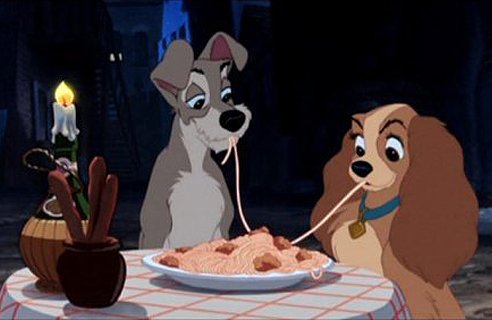
She meets Tramp, who finds a way to get the muzzle off with the help of an obliging beaver (Stan Freberg). Then Tramp takes Lady out on the town, ending with a romantic spaghetti dinner at Tony’s restaurant. The next morning, on her way home, she is captured by the dogcatcher. At the pound, she hears from Peg (Peggy Lee) that Tramp is a rogue with many lady friends, and she is disillusioned.

Aunt Sarah gets Lady and takes her home, banishing her to the doghouse. But with Tramp’s help Lady gets inside to save the baby from a rat. The crib is knocked over, and Aunt Sarah blames Tramp. She calls the dogcatcher to take him away. Just in time, Jim Dear and Darling return, and understand what has happened. With the help of Jock and Trusty, they get Tramp back. Trusty is hurt, but not badly, and he and Jock go to visit on Christmas to see Lady and Tramp and meet their new puppies.

This is one of Disney’s best animated films, with an appealing story and memorable music by Peggy Lee and Sonny Burke. Kids with new (or expected) siblings may like to talk about Lady’s concerns about the new baby. The way the story is told from the dogs’ perspective may be of interest to younger kids, who are just learning that not everyone sees the same things exactly the same way. And many kids will identify with Lady’s sense of frustration when the adored Siamese cats frame her for destroying the living room.

Parents should know that there are some tense moments and mild peril.

Family Discussion:  Why does Lady think her owners’ names are “Jim Dear” and “Darling?”  Why was Lady worried about what would happen when the baby came?  How did Lady feel when Aunt Sarah blamed her for what the cats did? Why didn’t Lady like Tramp at first? What made her change her mind?

Activities: Make up a story about what might happen with the puppies after the movie ends. And have a spaghetti dinner!

If you like this, try: other Disney animated classics like “Pinocchio” and “101 Dalmatians”

Related Tags:


Animation Based on a book Classic DVD/Blu-Ray Pick of the Week For the Whole Family For Your Netflix Queue Movie Mom’s Top Picks for Families Musical Romance Talking animals
THE MOVIE MOM® is a registered trademark of Nell Minow. Use of the mark without express consent from Nell Minow constitutes trademark infringement and unfair competition in violation of federal and state laws. All material © Nell Minow 1995-2026, all rights reserved, and no use or republication is permitted without explicit permission. This site hosts Nell Minow’s Movie Mom® archive, with material that originally appeared on Yahoo! Movies, Beliefnet, and other sources. Much of her new material can be found at Rogerebert.com, Huffington Post, and WheretoWatch. Her books include The Movie Mom’s Guide to Family Movies and 101 Must-See Movie Moments, and she can be heard each week on radio stations across the country.

Website Designed by Max LaZebnik