The Friend

The Friend

Posted on March 25, 2025 at 5:36 pm

B +
Lowest Recommended Age: Mature High Schooler
MPAA Rating: Rated R for language including a sexual reference
Profanity: Very strong language
Alcohol/ Drugs: Drinking and drunkenness
Violence/ Scariness: Sad death by suicide
Diversity Issues: None
Date Released to Theaters: March 28, 2025
Copyright 2025 Bleecker Street

“How can you explain death to a dog?”

A character in “The Friend” asks that question as she tries to persuade Iris (Naomi Watts) to take a very sad dag who is mourning the loss of Walter (Bill Murray). It is the hardest kind of death to explain to anyone, canine or human. Walter took his own life.

Walter was a writer and he loved to tell the story of how he found the dog, a very large black and white Great Dane named Apollo. Walter’s widow is the rather imperious Barbara (Noma Dumezweni), his fourth wife. She does not like dogs. Iris, also a writer, is an animal person, but she likes cats, not dogs. Her building does not permit animals of any kind. Yet when she finds out that Barbara has sent Apollo to a kennel, she allows herself to be persuaded — temporarily. Iris lives in a rent-controlled apartment. She cannot move. And yet once Apollo gets past the tearing up the pillows and knocking over the furniture phase and Iris gets used to giving him the bed and sleeping on a blow-up mattress, she finds she is very attached to him.

Walter was Iris’ closest friend, and his death is devastating. Iris is struggling with her latest book and also teaching college students and working on a book of Walter’s collected letters with the help of his daughter, Val (Sarah Pidgeon). We get a brief look at a happy dinner party, and it is clear Walter is a natural story-teller who relishes being on center stage, being charmingly incorrigible. It is also clear that Iris relishes challenging him with love and humor as only the dearest friends can. Later she will speak fondly of the way they talked for hours about books and people and we can imagine that their conversations were playful, heartfelt, and very literary, lots of witty references and ripostes.

One of the best scenes in the film has Iris meeting with a therapist for what she thinks is going to be a simple request. Tom McCarthy, better known as a director of films like “The Station Agent” and “Spotlight,” gives a beautiful performance as the sympathetic doctor, gently asking Iris what she would say to Walter if he was there. Watts shows us the pain and confusion Iris is feeling, and the anger she has not been willing to allow herself to feel. Being honest with herself gives her the insight she needs to tell her own story, gently revealed to us in an imaginary conversation between Iris and Walter.

McCarthy is just one of the outstanding cast in supporting roles, including Constance Wu and Carla Gugino as Walter’s previous wives, Sara Pidgeon as the daughter Walter did not know about until she was an adult, Josh Pais as Iris’s editor, who cheerfully tells her that Walter’s suicide has made him “hotter than ever,” which will help sales of the book of his letters, and Felix Solis as Hektor, the super in Iris’ building who tries to enforce the no-pets rule.

“The Friend” is based on a best-selling book of that name by Sigrid Nunez, winner of the National Book Award. While we see the Iris-Apollo relationship develop from putting up each other to deep affection, the movie is much more a meditation on grief, and it matches the literary grace of the book with delicacy and depth.

Parents should know that this film includes discussion of suicide and loss, some strong language, drinking and drunkenness, and sexual references.

Family discussion: Would you want to be friends with Walter? Why were people so devoted to him despite his faults? Was the solution Iris came up with fair?

if you like this, try: “Can You Ever Forgive Me?” and “Wonder Boys”
Related Tags:


Based on a book Drama movie review Movies -- format Movies -- Reviews
The Glass Castle

The Glass Castle

Posted on August 10, 2017 at 5:41 pm

B +
Lowest Recommended Age: High School
MPAA Rating: Rated PG-13 for mature thematic content involving family dysfunction, and for some language and smoking
Profanity: Some strong language
Alcohol/ Drugs: Smoking, alcohol and alcohol abuse
Violence/ Scariness: Domestic violence, child badly burned in a cooking accident, child neglect and endangerment
Diversity Issues: None
Date Released to Theaters: August 11, 2017
Date Released to DVD: November 6, 2017

Copyright 2017 Lionsgate

In her 1986 best-seller, Necessary Losses, author/poet Judith Viorst talks about the beliefs each of us has to give up in order to move forward. The first and in some ways the most difficult is the understanding that our parents are not all-powerful and all-knowing, and that they cannot kiss all of our hurts and troubles away forever. Some of those realizations are worse than others. Most of us, I hope, do not have to give up on the idea that our parents at least want to take care of us and that they do their best. But parents who neglect or abuse their children take away something worse than food and safety; they take a child’s senses of trust and pride.

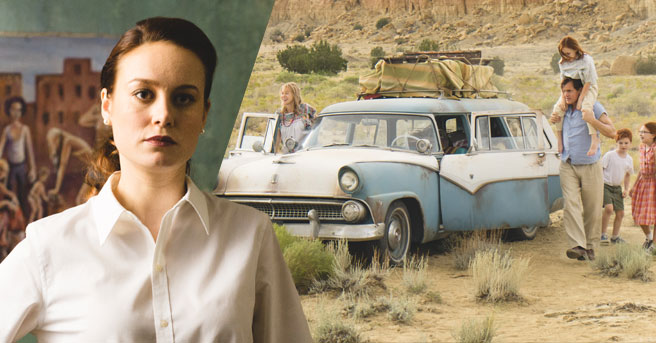
And so “The Glass Castle,” based on the best-selling memoir by Jeannette Walls, begins with Walls, a sophisticated, elegant, and successful New York journalist (Oscar-winner Brie Larson) on her way home in a cab after dinner in an expensive restaurant with her fiance and his prospective client, seeing her parents dumpster diving. They were homeless.

And so, we go back in time to see her as a very young child, telling her mother, Rose Mary (Naomi Watts) she is hungry. “Would you rather me make you some food that will be gone in an hour or finish this painting that will last forever?” It is a rhetorical question. Young Jeannette (Chandler Head) toddles over to the stove to make herself some hot dogs. But her dress catches on fire and she is badly burned.

When her father, Rex (Woody Harrelson) decides to take her out of the hospital, without doctor permission and without paying. At this point, Jeannette is still young enough to believe everything her parents tell her, like “our home goes wherever we go.” Rex, probably self-medicating for undiagnosed bipolar disorder, was immensely brilliant and charismatic. The glass castle of the title was the home he kept promising to build the family, and he spent years drawing plans for it. Rex and Rose Mary were less and less able to maintain any kind of stability at the same time that the children became more and more aware of what they were entitled to expect and unlikely to get. Instead of excitedly making plans for the castle, they began pleading with him to stop drinking. And then, when he could not, they decided to take responsibility for themselves and each other.

Writer/director Destin Daniel Cretton worked with Larson in the outstanding “Short Term 12,” which also had themes of abuse, damage, and resilience. He is especially good here in dealing with the challenge of three different performers, some quite young, portraying Jeannette and her siblings, maintaining consistency as they grow up, but using the cinematography to help convey the journey from their glowing memories of childhood, believing in their parents’ view of the world as beneath them, to the grittier life of deprivation and uncertainty. The spot where the glass castle was supposed to be built literally becomes a garbage dump.

What’s wisest and most significant is that the film becomes more than the story of survival. It is really only when Jeannette stops being afraid to tell the truth about herself that she is able to accept the best of what Rex and Rose Mary brought to her life. As Walls — and Viorst — might agree, necessary losses are worth the pain when they lead to the freedom that only comes from being true about and to yourself.

Parents should know that this film concerns the neglect and abuse of children, parents with substance abuse and mental illness problems. It includes smoking, drinking and drunkenness, domestic abuse, a child burned in a fire, strong language, and a sexual situation.

Family discussion: Why did Jeanette decide to tell her story? What was she grateful for receiving from her parents? If there was a movie about your family, who would you like to play you?

If you like this, try: “Running with Scissors,” “The Prize Winner of Defiance, Ohio” (another real-life story with Woody Harrelson as a father with a drinking problem), and “Infinitely Polar Bear,” and the book by Walls

Related Tags:


Based on a book Based on a true story Coming of age Drama DVD/Blu-Ray Family Issues movie review Movies -- Reviews
The Book of Henry

The Book of Henry

Posted on June 15, 2017 at 5:37 pm

D
Lowest Recommended Age: High School
MPAA Rating: Rated PG-13 for thematic elements and brief strong language
Profanity: Brief strong language
Alcohol/ Drugs: Drinking and drunkenness, drug reference
Violence/ Scariness: Theme of child sexual abuse, attempted murder, suicide, medical issues, sad death, peril
Diversity Issues: None
Date Released to Theaters: June 17, 2017
Date Released to DVD: October 2, 2017

Copyright 2017 Focus Features

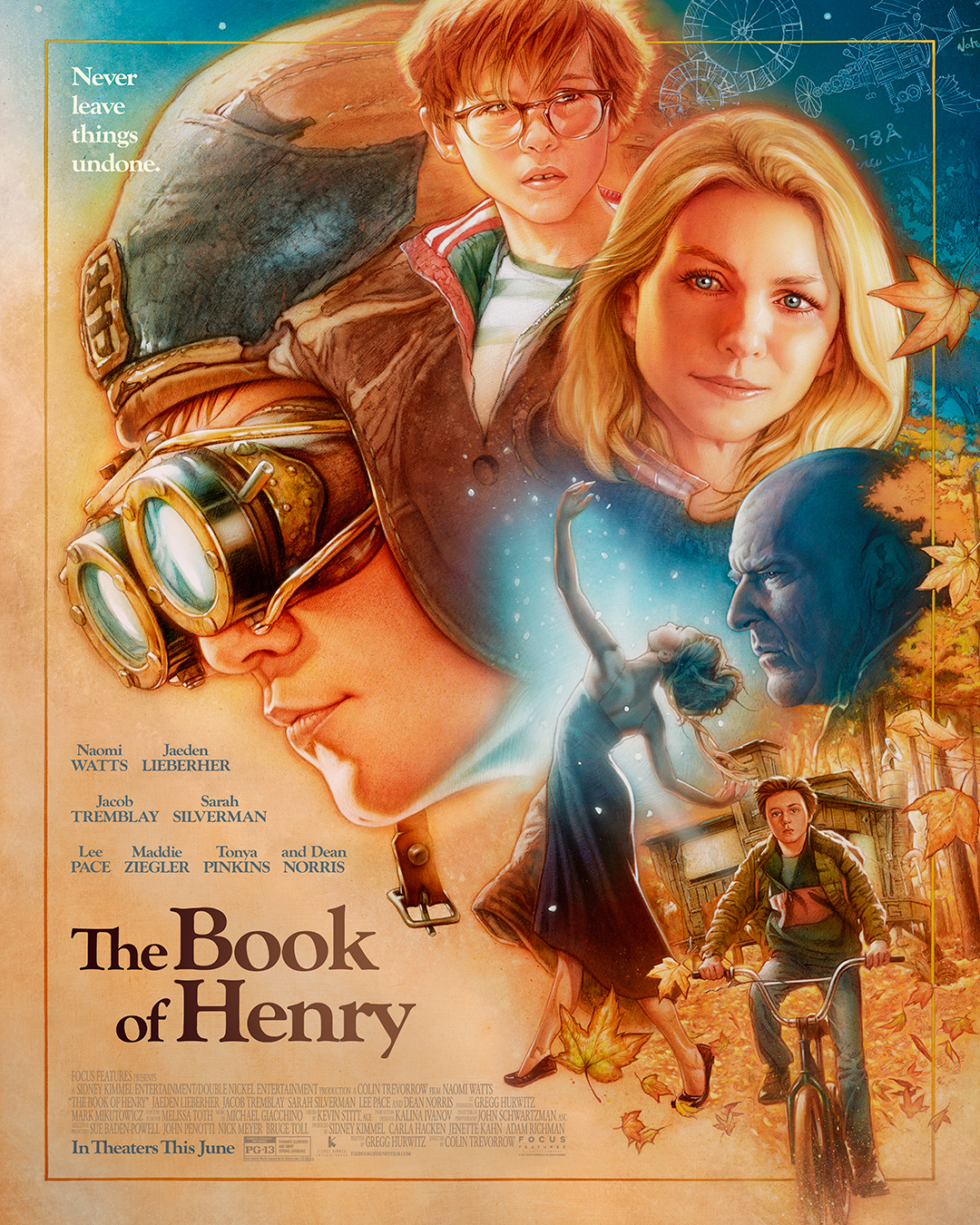
I’ve got a pretty high tolerance for movies, even syrupy ones, about super-gifted kids and am generally willing to give them some leeway as metaphor or fairy tale.  So I’m okay with “August Rush,” “Pay it Forward,” “A Monster Calls,” etc.  But “The Book of Henry” crosses the line from syrupy to smarmy, and where it wanted to be endearing, it was annoying, and then infuriating.

Jaeden Lieberher, who is making a career out of playing preternaturally wise and powerful children, has the title role as Henry, an 11-year old who is the kind of genius only found in movies. Not only is he a total braniac who understands architecture, finance, electronics, existential conundrums, weapons, and engineering, he has a rapier wit and knows the difference between different kinds of tumors and can read an MRI. Furthermore, he is a near-empath who instantly understands the people he cares about. In other words, he is not a character; he is a symbol and his purpose in the story is to give other characters important life lessons.

Henry has a younger brother, Pete (Jacob Tremblay of “Room”), who is in the movie to play the role of Normal Kid. And they have a mother, Susan (Naomi Watts), who is loving and devoted but irresponsible. Henry is the grown-up in the family, stopping at a phone booth after school to place complicated brokerage orders.

Let’s pause for a moment on that last point. Yes, I said phone booth. Even though the movie takes place sort of now (there are cell phones, a coffeemaker, video games, and a super-duper weapon), it has a deliberately retro feel. Henry and Pete use old walkie-talkies, barely a glimpse of a laptop (who needs one; Henry’s a walking Wikipedia). Susan is a waitress at a diner that could be out of the 1950’s, though her boss (“SNL’s” Bobby Moynihan) offers to pay her by direct deposit. You do not need to be Henry to figure out that this is supposed to lull us into cutesy-ness.

Henry has a crush on the girl next door, a classmate named Christina (Sia muse Maddie Ziegler), who lives with her stepfather, Glenn (Dean Norris), the town’s police commissioner. Henry senses that Glenn is abusing Christina. When Glenn’s position of power makes it impossible to protect her through official channels, he comes up with a dangerous plan to keep her safe.

To say more would be to risk spoilers, so I will just note that pretty much everything that happens after that is intended to be touching and poignant but  none of it is .   Lee Pace does his best with the thankless role of Doctor Perfect, who would make Prince Charming look like the guy who gets eliminated in the first episode of “The Bachelorette.” And Sarah Silverman adds some sass as Susan’s best pal, who joins her in wisecracks about how they aren’t rich and in getting drunk.  Christina has a lovely dance number in the school talent show.  And Watts is marvelous as always.  But the story’s preposterousness and manipulation thwarts their best efforts to provide some grounding.

Parents should know that the movie’s themes include child sexual abuse, attempted vigilante murder, and a very sad death of a child, and suicide. There is some strong language, a drug reference, and drinking and drunkenness.

Family discussion: What should Susan have done about the couple in the store? What made Susan change her mind?

If you like this, try: “Phenomenon” and “Disturbia”

Related Tags:


DVD/Blu-Ray Family Issues Stories About Kids
Demolition

Demolition

Posted on April 7, 2016 at 5:44 pm

B+
Lowest Recommended Age: Mature High Schooler
MPAA Rating: Rated R for language, some sexual references, drug use, and disturbing behavior
Profanity: Very strong language
Alcohol/ Drugs: Alcohol, drugs, smoking (by a young teenager)
Violence/ Scariness: Fatal car crash, guns, dangerous and destructive behavior
Diversity Issues: None
Date Released to Theaters: April 8, 2016

Copyright Fox Searchlight 2016
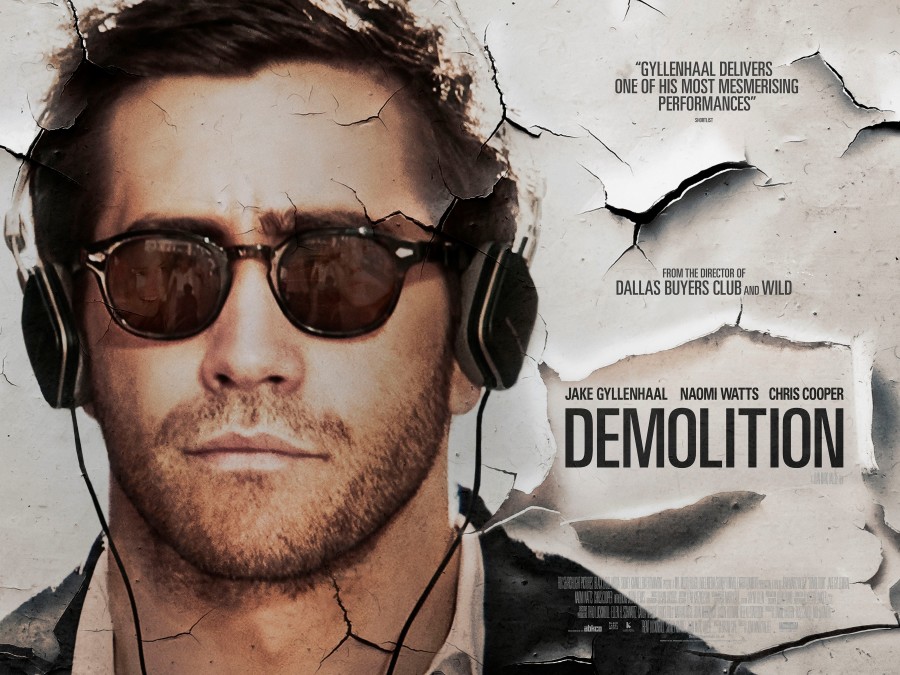
As the title suggests, this is a movie about taking things apart, literally and spiritually. And Jake Gyllenhaal gives a performance of shattering intensity as Davis, a finance executive whose wife is killed in a car accident.

At the hospital, he puts five quarters into a vending machine, which fails to deliver the peanut M&Ms he has selected. So he goes home and writes a long, detailed letter of complaint to the vending machine company. And then another one. And then another one. And then another one.

And he begins to take things apart. Screenwriter Bryan Sipe says the idea was inspired by the time he spent knocking down damaged houses for his father’s insurance company. Davis says he feels numb. He says he did not really know his wife. And he really wants satisfaction for that undelivered bag of peanut M&Ms.

His father-in-law, also his boss (Chris Cooper, who played Gyllenhaal’s dad in “October Sky”), is devastated. He immediately plans a tribute to his daughter and wants Davis to support it. But Davis just wants to take things apart.

A call from the complaints department at the vending machine company leads to an adventure. Davis ends up spending time with an angry teenager (Judah Lewis) who has been suspended from school. They do things that would get him expelled and probably arrested. Those scenes are the best in the film as the kid who feels too much meets the adult who cannot feel at all.

The film, directed by “Dallas Buyers Club’s” Jean-Marc Vallee, is uneven but arresting and impressively ambitious. He maintains a fascinating, heightened tone that never interferes with the real humanity of the characters. Gyllenhaal, long one of the most underrated actors, shows once again that he can take on an exceptionally challenging role and bring enormous depth and authenticity. More important, even before Davis is able to connect to his own feelings, he is able to connect to ours.

Parents should know that this film includes a sad death, fatal accident, very strong language, drinking, drugs, smoking (by a child), sexual references including adultery, destructive and dangerous behavior, and guns.

Family discussion: Why did Davis write the letters? What do we learn from his decision about how best to honor his wife?

If you like this, try: “Donnie Darko”

Related Tags:


Drama Movies -- format

While We’re Young

Posted on April 2, 2015 at 5:12 pm

B+
Lowest Recommended Age: Mature High Schooler
MPAA Rating: Rated R for language
Profanity: Very strong language
Alcohol/ Drugs: Drinking and drug use
Violence/ Scariness: Mild
Diversity Issues: None
Date Released to Theaters: March 27, 2015

Copyright 2015 A24
Copyright 2015 A24

“While We’re Young” opens with an exchange from Ibsen’s “The Master Builder” about what happens when the young come knocking at the door. But it might just as well begin with the wry Amish aphorism, “We grow too soon old and too late smart.”

Writer/director Noah Baumbach’s work often centers on the perils, agonies, and humiliations, and fears of growing up — including the attempts to avoid it. From the 20-somethings of “Kicking and Screaming” and “Frances Ha” to the immature parents with a teenager struggling through adolescence in his most autobiographical film, “The Squid and the Whale,” he shows us characters who try –unsuccessfully — to hold on to the optimism and narcissism of youth while having access to the powers and privileges of adulthood. Wouldn’t that be nice?

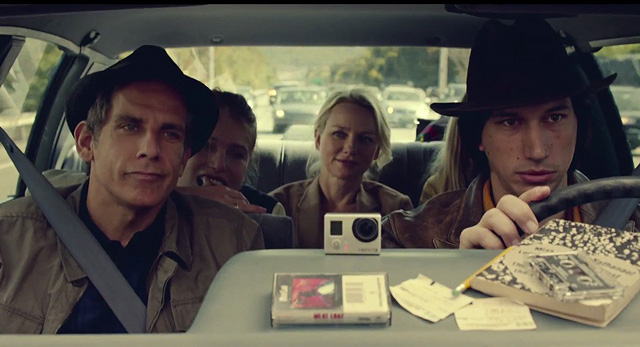
One of the toughest losses of adulthood is the sense of limitless possibilities. That is the moment at which we meet Josh (Ben Stiller) and Cornelia (Naomi Watts). Their friends all have babies. But after miscarriages and failed fertility treatments, they are giving up on having children and trying to convince themselves that they are happy to have nothing to keep them from spontaneous adventures — even if they never take them. Maybe planning a month ahead of time can still be spontaneous, but they don’t do that, either.

Josh is a documentary filmmaker who has been working on the same amorphous film for eight years. The version he is currently editing is so long it seems like it would take eight years to watch it. One problem is that he is not able to explain what it is about. Or, rather, it is about everything, including the very reality of being able to make a movie about whatever it is about. Also about America. So he is pretty much stalled in his personal and professional life.

And then he meets the adorably artisanal newlyweds Jamie (Adam Driver) and Darby (Amanda Seyfried), who have all the dewiness and boundless optimism Josh would love to feel. And, they have something even more important. They are so young that they think he is cool. They attend a class he is teaching and tell him they admire one of his documentary films, which they found on eBay. Josh and Cornelia are enraptured by the younger couple, who remind them of what they once were, while their old friends remind them of what they cannot have. In one sequence, Cornelia disastrously agrees to accompany her closest friend to a music session for infants, then runs out to join Darby at a hip hop dance class. She is hilariously out of place at both, but loves the feeling of being included with the hip hoppers.

Meanwhile, Josh starts wearing a hat just like Jamie’s and riding bicycles with him through the Brooklyn streets. But Josh’s best friend (played by Beastie Boy Adam Horovitz) tells Josh he’s “an old man with a hat” and Josh gets out of breath on the bike. Jamie calls Josh “Joshie,” affectionate but also infantilizing.

Both young and old will find a lot to laugh at in this film, which has Baumbach’s frothiest dialog and shrewdest characterizations.  “Arthritis arthritis?” Josh asks his doctor in dismay when he gets a diagnosis, hoping that perhaps he has some sort of specialized temporary form of arthritis that young people get.  “I usually just say ‘arthritis,'” his doctor dryly replies.  Josh and Cornelia are mesmerized by the preciously retro decor of Jamie’s and Darby’s apartment, with rows of LPs.  “It’s like they have everything we threw out but with them it looks good,” says Cornelia.

Then Jamie’s own documentary starts coming together, and Josh turns from mentor to stepping stone.  The documentarian’s obsession with truth-telling takes a twist. And the issue of fathers and sons takes another, as we learn that Cornelia’s father was a one-time mentor of Josh’s and is a possible mentor for Jamie.  

The final scene brings us full circle.  Baumbach’s past films have been perceptive and wryly funny, sometimes sympathetic, but here we get to see some tenderness for his characters.  As former poet laureate Billy Collins says when people use the word some critics are using about this film: “accessible,” this is not “accessible.”  It is welcoming.

Parents should know that this movie has very strong language and some drinking and drug use.

Family discussion: Who was right about Jamie’s movie? Ask the older people in your family what they like best about not being young anymore.

If you like this, try: “Metropolitan” and “Kicking and Screaming”

Related Tags:


Drama Movies -- format
THE MOVIE MOM® is a registered trademark of Nell Minow. Use of the mark without express consent from Nell Minow constitutes trademark infringement and unfair competition in violation of federal and state laws. All material © Nell Minow 1995-2026, all rights reserved, and no use or republication is permitted without explicit permission. This site hosts Nell Minow’s Movie Mom® archive, with material that originally appeared on Yahoo! Movies, Beliefnet, and other sources. Much of her new material can be found at Rogerebert.com, Huffington Post, and WheretoWatch. Her books include The Movie Mom’s Guide to Family Movies and 101 Must-See Movie Moments, and she can be heard each week on radio stations across the country.

Website Designed by Max LaZebnik