
Inside “Inside Out” — Takes on Pixar’s Hit Movie About Feelings

Inside “Inside Out” — Takes on Pixar’s Hit Movie About Feelings

Posted on July 6, 2015 at 3:35 pm

“Inside Out” is not just one of the best movies of the year (animated and live action). It is also one of the most psychologically profound and astute films about emotions and the mind ever made. It set the all-time box office opening weekend record for a non-series film and reached number one at the box office this week, out-doing two huge holiday weekend releases, “Terminator Genisys” and “Magic Mike XXL.”

Copyright 2015  Pixar
Copyright 2015 Pixar

And it has provoked some exceptionally thoughtful responses from movie critics and specialists in child development. My friend Jen Chaney wrote one for The Dissolve, tying the movie’s themes to other Pixar films that touch on the bittersweetness of the end of childhood, but explaining how this film takes it to a new depth.

According to Inside Out, the middle-school-girl brain is simultaneously orderly yet fragile, crowded with highly charged voices (some previously heard on NBC sitcoms, The Daily Show, and/or Saturday Night Live), and aesthetically similar to a pinball machine, a Lite-Brite, and multiple levels of Candy Crush. It’s rare in a children’s film—or for that matter, any film—to see elements of the human nervous system rendered with such exquisite care and unmitigated glee.

But the film’s point of view is more important than its plot, or its sophisticated view of the machinations behind Riley’s meltdown. For the first time, a Pixar film is confronting how much it hurts when a child realizes her childhood will end—while it’s still ending. It literally gets inside her head, then bluntly announces that being a kid hurts because it doesn’t last. That feels refreshingly candid, even for Pixar.

Dacher Keltner and Paul Ekmanhe, scientists who consulted on the film wrote about their experience for the New York Times.

he movie’s portrayal of sadness successfully dramatizes two central insights from the science of emotion.

First, emotions organize — rather than disrupt — rational thinking. Traditionally, in the history of Western thought, the prevailing view has been that emotions are enemies of rationality and disruptive of cooperative social relations….Second, emotions organize — rather than disrupt — our social lives. Studies have found, for example, that emotions structure (not just color) such disparate social interactions as attachment between parents and children, sibling conflicts, flirtations between young courters and negotiations between rivals.

They would have preferred that Sadness have a less dreary affect. And they note that they recommended many more emotions, but Pixar explained that they could not handle that many characters.

Dan Kois wrote more as a parent than a critic for Slate.

he emotional messages of most entertainment for kids are pretty relentlessly positive: Love your family, stay true to yourself, keep positive, never give in to despair. As the research of Stanford’s Jeanne Tsai has shown, one of the emotions that Americans in particular privilege is joy—excited pleasure. Children see around them, in books and movies and advertisements, exemplars of delight at growing up. “That makes it harder to grapple with sadness,” University of California, Berkeley psychology professor Dacher Keltner told me. “It’s a vacuum in our culture.”

But, points out Keltner, who consulted with Pixar’s Pete Docter on the film, sadness is a powerful tool, a trigger that sends kids back to their parents for comfort and connection. “You gotta hang on to that sadness,” he told me, because in the tumult of early adolescence, it’s the thing that can bring parent and child back together.

Over at Zero to Three, Claire Lerner echoes the importance of teaching kids to recognize their feelings and acknowledging them, pointing out the applicability of the insights in the film even to the youngest children.

Major kudos are due Pixar and Disney for elevating the importance of the emotional lives of children and providing a creative vehicle for helping kids learn to understand and manage their complex emotions. Most importantly, the film reminds parents that having a happy child does not mean your child must always be happy.

Young children are deeply feeling beings. Starting in the earliest months of life, well before they can use words to express themselves, babies have the capacity to experience peaks of joy, excitement, and elation. They also feel fear, grief, sadness, hopelessness, and anger—emotions that many adults understandably find it hard to believe that such young children can experience. But just as Riley in the film needs her parents to hear and empathize with her difficult feelings of pain and loss—which helps her move on in positive ways—so do babies and toddlers.

She concludes with some very practical recommendations for parents.

And be sure to listen to co-writer/director Pete Docter, who spoke about what was behind the film and the crucial moment that changed everything in an interview with “Fresh Air’s” Terry Gross.

Related Tags:


Critics Parenting Understanding Media and Pop Culture
Inside Out

Inside Out

Posted on June 18, 2015 at 5:53 pm

A-
Lowest Recommended Age: Kindergarten - 3rd Grade
MPAA Rating: Rated PG for mild thematic elements and some action
Profanity: Some schoolyard language
Alcohol/ Drugs: None
Violence/ Scariness: Some peril and anxiety, sad death
Diversity Issues: None
Date Released to Theaters: June 19, 2015
Date Released to DVD: November 3, 2015
Amazon.com ASIN: B00YCY46VO
Copyright 2015  Pixar
Copyright 2015 Pixar

Roger Ebert liked to refer to movies as an “empathy machine.” He said that the great gift of movies, more than any other art form, is the way they can put us inside the world, experiences, culture, and perspective of someone completely outside our own experience. But the best movies do that in a way that helps us understand ourselves as well. “Inside Out” is a rare film that takes us inside the mind of one very particular 11-year-old girl in a way that illuminates the vast breadth of human experience, with deep insights about our own particular quirks, struggles, and emotions. It is exciting, hilarious (two of the funniest jokes you will see on screen this year), and deeply profound, making the most complex concepts accessible in so that children and adults will learn more about who they are and how they got that way.

Riley (Kaitlyn Dias) is in the midst of internal and external turmoil. She was very happy in Minnesota, playing on a hockey team, with lots of friends, and feeling, well, at home. But her parents have just moved to San Francisco, so that her father can take a new job with a start-up. Everything is new and different and scary. Everything she liked about her life, everything she took for granted, is up for grabs. And all of this is happening just as that developmental leap that comes around age 11 is causing her to change from the bright-spirited, optimistic, happy little girl who was confident in herself and in her family.  She is getting old enough to see and feel more of what is going on inside and out. Her parents try to be reassuring, but she knows that her father’s new job is risky. She does not know anyone at school and they do not know her. The old friends from the place she still thinks of as home do not have as much time for someone who is far away.

Of course we have seen this before. There are a lot of movies about people of all ages who are forced to adjust to changed circumstances, or to find a way to make a strange new place feel like home. What is different about “Inside Out” is that Riley is not the character we follow through this story. She has her own adventure, but the story takes place in her mind and it is her emotions who take center stage. They operate the helm of the — yes — Headquarters.

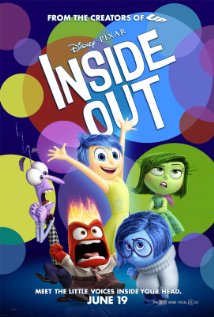
The characters are Joy (Amy Poehler), a pixie-ish blue-haired sprite who is resolutely energetic and upbeat, Anger (Lewis Black), a stocky red fellow who is fiery-tempered and easily outraged, Disgust (Mindy Kaling), green, with a round head, long eyelashes, and a sensitive spirit quick to resist anything new or icky, Fear (Bill Hader), a lean blue creature who usually assumes the worst, and Sadness (Phyllis Smith), who feels everything very, very, very, very deeply. Each of these characters is introduced with what they help Riley do. Anger helps her see unfairness. Disgust helps her to avoid poisonous foods. Fear helps keep her safe. Joy helps her see the world as a place filled with imagination, adventure, and opportunity. And Sadness — we will learn more about what Sadness does later, but for now we will say that it helps her feel empathy. Joy is the leader of the group. She is the most focused and direct and the best able to negotiate with the others. But her goal is to keep all of Riley’s memories happy, and that might not be possible.

As Riley tries to use her mind, her memories, and her emotions to navigate her new community, Joy and Sadness are accidentally transported to where Riley’s memories are stored, and they must make it through an Oz or Wonderland-style land where we learn about everything from abstract thinking to why you CAN’T GET THAT DARN JINGLE FROM THAT STUPID COMMERCIAL OUT OF YOUR HEAD.  A surprising — in every sense of the term — new character shows up to provide support and insight, and to embody the sweet sorrow of growing up.  Co-writer/director Pete Docter told Terry Gross that it was when Mindy Kaling came to talk to him about the film that he understood what it was really about: you have to grow up, and it’s okay to be sad about it.  That applies whether you are the one growing up or just watching it as a parent or friend.  This movie speaks to all of us, whether we have children, are children, were children, or still keep the child we were near our hearts.  A lot of good movies are smart.  But this one is wise.

Parents should know that this movie includes some mild peril, family tension, running away, and a sad death.

Family discussion: Can you think of a time that Joy was steering your mind? How about the other emotions?  When can you feel them working together?  Did you have a Bing Bong? Why did he make that choice?

If you like this, try: “Everybody Rides the Carousel,” “Up,” and “Monsters Inc.”

Related Tags:


3D Animation Comedy Coming of age Drama DVD/Blu-Ray Pick of the Week For the Whole Family

Clip: Disgust and Anger in “Inside Out”

Posted on June 18, 2015 at 8:00 am

https://www.youtube.com/watch?v=AQ3hjymiCCg

In this clip, we meet two of the emotions living inside toddler-age Riley: Disgust (Mindy Kaling) and Anger (Lewis Black). I love the way emotions thought of as negative are shown here to play an essential and even constructive role.

Related Tags:


Trailers, Previews, and Clips

Susan Wloszczyna Interviews Pete Docter about “Inside Out”

Posted on June 16, 2015 at 8:00 am

My friend Susan Wloszczyna interviewed “Inside Out’s” co-writer/director Pete Docter for IndieWire. The film takes place primarily inside the mind and emotions of an 11-year-old girl who has just moved to a new home and a new city with her parents. Docter acknowledged that Pixar has been slow to give girls and women lead roles in their films, in part because they reflected the perspective and experience of the men who worked there. But this film was inspired by Docter’s own daughter (who previously provided the voice for young Ellie in “Up”). He added,

We contemplated why a girl? The reason is that research has found that no one is more socially attuned and keyed in on expressions and little interactions than a girl aged 11 to 17. I see this in my daughter. She will come home from school and say, “Oh, my best friend doesn’t like me anymore.” How did she know that? Maybe from a certain look. On the other hand, no one is less socially attuned than an 11-to- 17-year-old boy. Walk around girls that age, and they are dressing like women, while boys are 3 feet of awkwardness.

Related Tags:


Directors
THE MOVIE MOM® is a registered trademark of Nell Minow. Use of the mark without express consent from Nell Minow constitutes trademark infringement and unfair competition in violation of federal and state laws. All material © Nell Minow 1995-2026, all rights reserved, and no use or republication is permitted without explicit permission. This site hosts Nell Minow’s Movie Mom® archive, with material that originally appeared on Yahoo! Movies, Beliefnet, and other sources. Much of her new material can be found at Rogerebert.com, Huffington Post, and WheretoWatch. Her books include The Movie Mom’s Guide to Family Movies and 101 Must-See Movie Moments, and she can be heard each week on radio stations across the country.

Website Designed by Max LaZebnik