
Trailer: About Ray with Dakota Fanning as a Trans Teen
Posted on August 13, 2015 at 8:00 am
Posted on August 13, 2015 at 8:00 am
Posted on August 12, 2015 at 8:49 pm
The smart alecks behind the Harvard Lampoon magazine parodies of Cosmopolitan and Time created their own magazine, the National Lampoon, in 1970, and it was like taking everything the Baby Boomers loved about the subversive humor of MAD Magazine and making it dirty, nasty, and offensive. Its most notorious cover featured a gun pointing at a dog’s head and the headline “Buy This Magazine Or We’ll Kill This Dog.” This documentary about the magazine will be in theaters, on iTunes, and on demand on September 25, 2015.
Posted on August 7, 2015 at 8:00 am
Posted on August 6, 2015 at 5:48 pm
“Aren’t you allowed to have two dreams?”
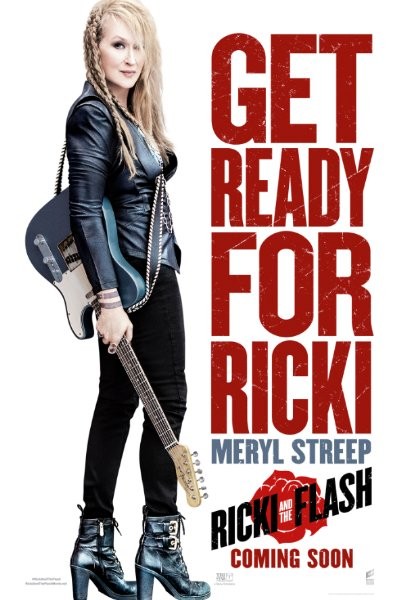
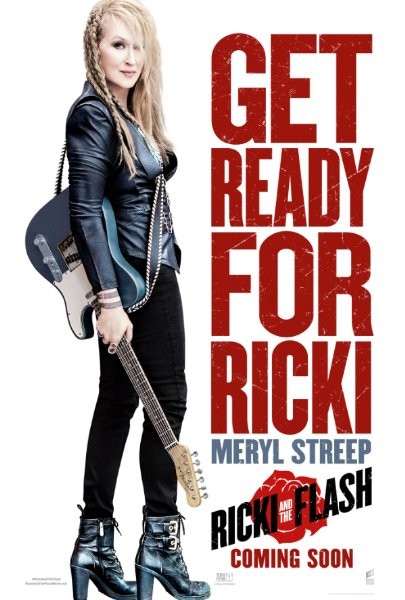
The person asking the question is Ricki (as she is now known), played by Meryl Streep. She has just accused her ex-husband, Pete (Kevin Kline), of not supporting her dream of playing rock music. And he has responded, “I thought we were your dream.” Years ago, Ricki was a suburban housewife named Linda, with a husband and three young children. She left them to be a rocker, and now fronts a cover band called Ricki and the Flash, performing at night for a small group of loyal fans at a bar in Tarzana, California. During the day, she is a cashier for a warehouse store. Neither job pays well; she is about to declare bankruptcy.
But first she has to go home. Her daughter Julie (Streep’s real-life daughter Mamie Gummer) is having a breakdown because her husband is in love with someone else. Pete’s wife is away, caring for her ailing father. So Pete calls Ricki and asks her to come home and help him take care of Julie. She arrives, with her guitar and dressed in 70’s rocker drag, at his gracious gated community and enters Pete’s grand and elegant home, where everything seems effortlessly comfortable. And where Ricki, with her stringy braids and kohl-rimmed eyes and tattoo is very out of place.
Screenwriter Diablo Cody (“Juno”) gives Ricki some unexpected characteristics and of course Streep brings her to life. Linda/Ricki loves to perform and loves the look and shock-the-bourgeois attitude of a rock musician, even at her other job. But she is not the stereotype anarchist/liberal. The tattoo on her back is a proudly waving American flag and she calls out “Support the troops!” from the stage. We learn a little bit more about where that comes from in one of the movie’s highlights, when Pete’s second wife, played with depth, heart, and resolve by Broadway star Audra McDonald, returns home and the two women have a conversation about what is best for Julie. It is couched in the kind of “we don’t have to like each other but we need to get along” terms of two very different women who share the experience of having been married to the same man and, in their own ways, mothering his children.
Streep clearly loves being back with her “Sophie’s Choice” co-star, and she and Kline create a palpable sense of history with each other in some touching moments, especially when they join forces to confront Julie’s ex. And it is a joy to see Steep and Gummer together. Their trust and connection is so solid that it gives them both the freedom to make their relationship complicated and painful, wanting so much from one another, and still wanting to give to one another, too.
Rick Springfield (yes, that Rick Springfield) is excellent as lead guitar of The Flash and sometime boyfriend for Ricki.
The film is awkwardly constructed, and the ending, while sweet, is abrupt and unrealistic. It makes sense for the storyline that Ricki is not a great singer or musician, with a dozen cover songs on the soundtrack, director Jonathan Demme’s commitment to using the live performances without any studio sweetening is questionable. But the musical performances are joyous, tender-hearted and true. And it explores essential questions: How do we love the people who cannot love us back the way we want them to? What do you do when your dreams do not fit together? What will you give up for someone you love?
Parents should know that this movie includes tense and unhappy family confrontations, discussion of a suicide attempt, strong language, drinking, marijuana, and sexual references and situations.
Family discussion: Can you have two dreams? How does Pete feel about Ricki? How can you tell? Why does Ricki hurt Greg?
If you like this, try: “The Rocker” and “Juno” and see Streep and Kline together in “Sophie’s Choice”
Posted on August 6, 2015 at 5:20 pm
B+| Lowest Recommended Age: | Mature High Schooler |
| MPAA Rating: | Rated R for language including some sexual references |
| Profanity: | Very strong and crude language |
| Alcohol/ Drugs: | Drinking and smoking |
| Violence/ Scariness: | Reference to suicide |
| Diversity Issues: | None |
| Date Released to Theaters: | August 7, 2015 |
| Date Released to DVD: | November 9, 2015 |
| Amazon.com ASIN: | B0153C71X8 |
Form illuminates content in this imperfect but compelling film based on the real-life audiotapes of a four day interview of author David Foster Wallace in the final days of his book tour for Infinite Jest
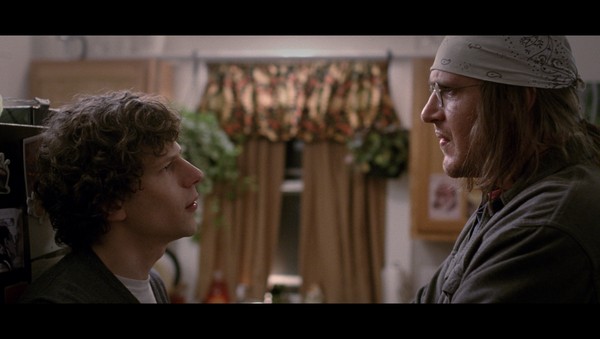
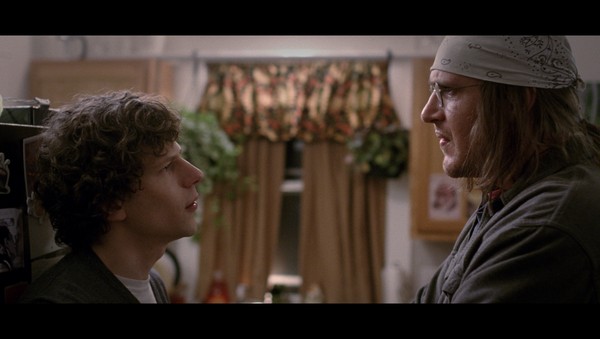
The subject of the interview is David Foster Wallace (Jason Segel), whose writing was densely and intricately layered. The journalist doing the interview is David Lipsky (Jesse Eisenberg), also a recently published novelist, though his book attracted no attention.
Lipsky persuades his editor at Rolling Stone that Wallace, whose book is a critical and commercial hit, would be a good subject for the magazine. And Wallace, now in the final days of his book tour, agrees to let Lipsky come along. Their wide-ranging (in geography and subject matter) conversation over four days reflects a constantly shifting set of expectations, assumptions, and goals for a construct so essentially artificial it hardly makes sense to call it a relationship. And yet, Lipsky literally moves into Wallace’s man cave of a home and for that time there is a simulation of some kind of friendship between them, at times even a sense that they could be friends, which they both seem to find unsettling and appealing. Wallace’s writing had a fractured, self-referential quality, filled with asides and meta-commentary. So it makes sense that the film has some of those qualities as well. If there were such a thing as cinematic footnotes, they’d be here. Instead, the context itself provides the footnotes. Wallace, whose great subject was American consumer culture, ends up in Minnesota’s Mall of America, eating in the food court as the indoor roller coaster zooms by.
Janet Malcolm famously described a journalist as “a kind of confidence man, preying on people’s vanity, ignorance, or loneliness, gaining their trust and betraying them without remorse.” We see some evidence of that in “The End of the Tour” but there are several other layers as well. The two men are about the same age, both writers, one lauded as one of the great novelists of his generation, one who released a book that got no attention at all. So Lipsky wants more from Wallace than a story. He is looking for guidance, validation, understanding. He acknowledges that he wants what Wallace has. At the same time he wants to understand why Wallace does not seem to want it. The two men are both relentless, even obsessive, self-observers. As Lipsky is recognizing the gulf between the kind of superficial details that make up a celebrity profile and what it means to actually know someone, he tries to find some kind of foothold. He wants to prove himself to his editor (in real life, the article was never published). And he wants to prove to himself that he is somehow in the same species as Wallace. There is a Mozart/Salieri element here as Lipsky’s greatest talent may be his ability to appreciate Wallace’s genius.
The commitment to verisimilitude is claustrophobic at times because almost all of the dialogue is taken directly from the tapes. An opening scene where Lipsky first hears of Wallace’s suicide and digs out the tapes adds nothing to the story. And yet again this is a case of form following content, as the near-obsessive, even fetishishtic, constricted particularity of the conversation is the kind of thing one of Wallace’s characters might do. The most telling moment in the film is when Wallace admits that he does not mind being profiled in Rolling Stone. He just does not want the profile to make it appear that he wants to be profiled in Rolling Stone. That is exactly the kind of fractured, Schroedinger-ian attraction/repulsion Wallace felt to the themes of his work: the gulf between presentation and reality, between observing and being, between attention and distraction. As Lipsky knew, it is a privilege to be a part of that conversation, even as we must be aware that it is the kind of entertainment — even at this ambitious level — Wallace would both want and not want to see.
Parents should know that this film includes very strong and crude language, sexual references, drinking, and smoking.
Family discussion: Why did Wallace agree to the interview? Why did he get angry with Lipsky?
If you like this, try: the books by David Foster Wallace and “My Dinner with Andre” and listen to the excellent interview with David Lipsky on the podcast, “The Moment“