And So It Goes

Posted on July 24, 2014 at 6:00 pm
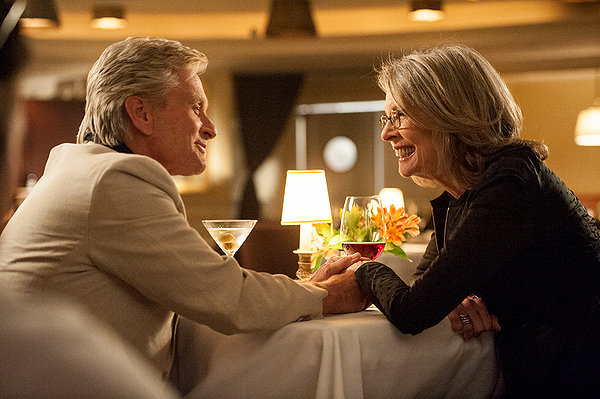
12 June 2013 Photo by Clay Enos – © 2013 ASIG Productions LLC

A second marriage is, as Samuel Johnson famously said, “The triumph of hope over experience.” And as lyricist Sammy Cahn wrote in the song Bing Crosby sang in “High Time,” “Love is lovelier the second time around.” In this slight but endearing new film, director Rob Reiner and screenwriter Mark Andrus (“As Good as it Gets”) bring us an autumn-years love story. Oscar-winners Michael Douglas and Diane Keaton play two characters with little in common but the experience of great loss, the knowledge that love carries great risks, and the fear that there may not be another chance.

Douglas is Oren, a successful realtor and even more successful misanthrope. He insults people.  He is bitter.  He shoots a dog with a paintball gun.  He does not like anyone and no one likes him, with the exception of his longtime colleague played by the invaluable Frances Sternhagen.   Keaton plays Leah, a widow experimenting with singing at a restaurant.  She is universally beloved, especially by her neighbors in a fourplex and her loyal accompanist (played by the director himself).  Oren lives in the fourplex, too, ironically named “Little Shangri-La,” and is revealed early on to be the owner as well.  He hopes for one last big-ticket house sale so he can retire and move away and never deal with anyone ever again.

But life has a way of entangling those who most try to rid themselves of obligations and relationships — at least in movies.  Oren’s long-estranged son arrives to inform his father that (1) he is no longer a drug addict, (2) he has a daughter, and (3) he needs Oren to care for her while he serves a prison term.

Oren refuses, saying “I already tried to raise a kid and it didn’t work out.”   So Leah steps in and says the girl can stay with her.  She is Sarah (Sterling Jerins).  And anyone who has ever seen a movie (or read “Heidi”) knows that the girl will charm her grandfather and open the hurting hearts of both Oren and Leah to her and to each other.  Oren finally admits to Leah, “I like you and I don’t like anyone.”

Despite contemporary references like “Duck Dynasty” and “Hoarders,” this film has a musty, retro feel, like a script that has been sitting in a drawer for a couple of decades.  The plot is predictable and creaky.  An attempt to return Sarah to her mother goes exactly the way you think.  The caterpillar Sarah collects is exactly the metaphor you think. The pregnant neighbor provides exactly the opportunity for Oren’s showing what he is capable of that you thought but hoped you could avoid.  The racial humor is painfully out of date, so you didn’t predict it, but that does not make it a good surprise.  Far from it.

What the movie does have, though, is Douglas and Keaton, and they triumph over the limitations of the material, making us believe that the greatest love in our lives may still be waiting for us.

Parents should know that this film includes  sexual references, some crude, childbirth scene, some strong language, some racial insults, drinking, drug abuse, references to sad deaths

Family discussion: Why was it so hard for Oren to be nice to people? How did Leah make Sarah feel at home?

If you like this, try: “As Good as It Gets” and “Something’s Gotta Give”
Related Tags:


Comedy Drama Romance

Boyhood

Posted on July 17, 2014 at 6:00 pm

A-
Lowest Recommended Age: Mature High Schooler
MPAA Rating: Rated R for language including sexual references, and for teen drug and alcohol use
Profanity: Very strong language
Alcohol/ Drugs: Teen and adult drinking, teen drug use
Violence/ Scariness: Domestic abuse, guns
Diversity Issues: None
Date Released to Theaters: July 18, 2014
Date Released to DVD: January 5, 2015
Amazon.com ASIN: B00MEQUNZ0

Boyhood_film

“A boy’s will is the wind’s will/And the thoughts of youth are long, long thoughts.” (Longfellow)

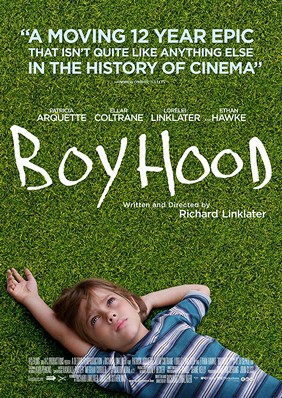
We first see Mason (Ellar Coltrane) lying on the ground, looking up at the sky, and it is clear that his thoughts are very long indeed.  We will stay with Mason and — in an unprecedented longitudinal form of filmmaking from writer/director Richard Linklater — portrayed by Coltrane for twelve years, until he leaves for college at age 18.  This film deservedly appears on most of the year’s top ten lists and has been selected by several critics groups as the best film of the year.

Linklater has followed characters over the years before.  We have seen the romantic relationship of Celine and Jesse in three 24-hour episodes (all involving walking through European cities) in the “Before” films, plus an intriguing segment of the animated “Waking Life.”  That series is an extraordinary, and I hope, continuing undertaking, with stars Julie Delpy and Ethan Hawke working with Linklater to create the storyline and script.

Hawke is in this film, too, as Mason’s father, Mason senior. Patricia Arquette plays his mother and Linklater’s daughter Lorelei plays his older sister, Samantha. All are superb.  Linklater says that he knew what the last shot would be from the beginning. For the rest, he trusted his stars and the developments of the dozen years ahead of them. As the children got older, they joined Linklater, Hawke, and Arquette in helping to fill in the details.

And it is the details that are the story here, giving it a unhurried yet mesmerizingly enthralling feel and an unexpected power. At first, it seems like time-lapse footage of a flower blooming. Then it feels like watching someone’s home movies. By the end, we are so invested in Mason’s life we feel we are watching our own.

Linklater and his cast met for just a few weeks each year to film a little more.  Unlike a conventional narrative, where, as Chekov put it, economy of storytelling means that a gun over the fireplace in act one has to go off by act three, this story is not linear.  But non-linear does not mean random.  The incidents chosen are not necessarily the high points of Mason’s years, but they are indicators that create a mosaic of the fuller picture. Mason sees his mother, who has gone back to graduate school, talking to one of her professors.  But it is unlikely that he understands the meaning of the look they exchange.  We are not surprised to find them married in a subsequent scene.  And we do not need a slow build-up or full character arc to understand the import of the succeeding conflicts between the stepfather and stepson.

Meanwhile, Coltrane and Lorelei Linklater do something no one has ever done quite this way before on screen.  They grow up.  And Richard Linklater trusts the audience enough to let that in and of itself be the dramatic arc of the story.   There were laughs and hoots in the audience over the antiquated look of the computers at Mason’s school.  There are references to the first Obama Presidential campaign and the release of a new Harry Potter book.  But these are all organic, as much as his first heart-break, his second stepfather, and new stepmother, and tough words from his teacher.  There is no micro-managed re-creation of the past; this is the past, our past as well as Mason’s.  It feels real, it feels lived in, and, as he leaves for college, it feels bittersweet but filled with promise.

Parents should know that this film includes domestic abuse, tense family confrontations, guns, very strong language, sexual references (some crude), and teen drug and alcohol use.

Family discussion:  Do you agree with Mason’s photography teacher about what he should do?  Mason had many different role models for masculinity — which do you think he will follow?

If you like this, try: Richard Linklater’s other films, including “Before Sunrise,” “Before Sunset,” and “Before Midnight” and “Waking Life”

Related Tags:


Coming of age DVD/Blu-Ray Pick of the Week Family Issues Stories About Kids Stories about Teens

Planes: Fire & Rescue

Posted on July 17, 2014 at 5:59 pm

Planes_fire_rescue_poster

The visuals are stunning, the details are witty, the 3D effects are splendid,  the songs are lively, the voice actors are top-notch, but the storyline feels like an episode of “Thomas the Tank Engine.”  That’s when it was still analog and old-school and before it went to animation, but still — especially as the gender politics of this film are uncomfortably old-school as well.

Last year’s Planes added another mode of transportation to the charmingly retro world of Cars. A plucky crop-duster named Dusty (Dane Cook) learned to race and became a champion. As this movie begins, he is an international superstar. But his vintage gearbox has been worn down by the races, and no replacement is available. Dusty is going to have to find something that is as meaningful to him as racing.

When he accidentally starts a fire at Piston Peak National Park, Dusty sees that old Mayday (Hal Holbrook), the fire and rescue truck is not quite up to the task.  More important, he is not up to code.  The stern Transportation Management Safety Team inspector informs them that they need more capacity if they are going to stay in business.  That means some upgrades for Mayday and it also means a second firefighter.  Dusty feels responsible. And if he cannot race, he has to find something new to do, to help make up for his mistake. So he agrees to take the training to become a certified fire fighter.

Dusty is welcomed by the team, including the flirtatious Lil Dipper (“Modern Family’s” Julie Bowen), the heavy-lift helicopter Windlifter (Wes Studi), ex-military transport Cabbie (Captain Dale Dye) and The Smokejumpers, a brave collection of all-terrain vehicles who leap out of the planes and parachute down to the fire.  But he stern Blade Ranger (Ed Harris), who is in charge of the training facility, is not at all sure Dusty is up to the task.

The action sequences are very well staged and the effects, especially the water and sky images, are truly astonishing. The usual pun-studded, meta humor for the series shows up throughout, from the show business trade news magazine titled “Cariety” to a female vehicle dismissing a lame come-on with a cool, “Pick-up trucks!” The choicest surprise is a videotape with a car-ified version of a classic television series, with that very recognizable series star contributing a character voice.  Of course the television show appeared in the late 70’s-early 80’s, so it is likely to be over the heads of today’s children and their parents, too.

The real villain here is the fire, of course, but there is also a comic villain, a pompous administrator voiced by John Michael Higgins.  But the movie never works up much interest in him or his schemes, and the post-credits stinger barely stings.

More troubling is the poor treatment of the female characters, despite being called out for that same problem in the first one.   At least in the original, the female characters were capable and independent.  Poor Bowen is relegated here to a role that recalls the man-chasing stereotypes of television in the 1960’s, often played by Rose Marie or Ann B. Davis.  She is constantly trying to tell Dusty that they are on a date and, when he politely says they will be going as a group, dementedly agrees that it is a good thing for her to meet his friends until he reminds her that the firefighting team members are her friends.  And a major plot twist occurs when the previously ultra-capable mechanic voiced by Teri Hatcher is casually outdone by a male character.  It’s completely unnecessary, it subverts the primary premise of the storyline, and it demeans the female mechanic for no reason.  It isn’t Dusty who’s got filings in his gearbox.  It’s the script.

Parents should know that this film includes peril, including fire, collapsing bridge, rapids, engine failure, action and some violence (no one irreparably hurt, but a reference to a sad death), and some bathroom humor.

Family discussion: Who in this movie has to decide how to handle it when their plans do not work out? How do you think about your own back-up plans?  What does “better than new” mean?

If you like this, try: “Cars” and “Planes”

Related Tags:


3D Animation Fantasy Series/Sequel

Dawn of the Planet of the Apes

Posted on July 10, 2014 at 6:00 pm

dawnoftheplanetoftheapesceasarAll hail Caesar!

The intelligence-enhanced ape from Rise of the Planet of the Apes takes center stage in this sequel, which begins ten years after the last film. The virus we saw infecting the human population has now wiped out almost all human life. The assorted apes, led by Caesar, have asserted their primacy over other animals. In the opening scene, we see them hunting with spears they have crafted, killing a bear, and riding on horses. They live in homes they have constructed from logs, communicate — mostly via sign language — teach their children the alphabet in school, and have an organized society, with Caesar as their leader. They demonstrate loyalty and tenderness.  They adorn themselves; Caesar’s mate wears a small crown.

Ceasar is played by the brilliant motion-capture actor/artist Andy Serkis and the CGI work of the geniuses at Weta Digital.  The seamless integration of the CGI characters and the human characters and the subtlety of the apes’ eyes and facial expressions brings us straight into the story, underscored by the immersive 3D.  It is dramatic, not stuntish, with the possible exception of some spear-throwing toward the screen.

The film recalls old-school cowboys-and-Indians westerns, with the apes riding into battle on horses and the humans and their armory holed up in the ruins of San Francisco like it is Fort Apache.  Then the apes get the guns, and everything escalates fast.  The film wisely gives both groups of primates a range of characters, some wise and trustworthy, some bigoted and angry.  Both species have to learn that respect has to be based on character and actions, not on genetics.  The division is not between man and ape but between those who can envision a future with cooperation and trust and those who cannot.

There are some thoughtful details.  The destroyed city tells the story of a decade of unthinkable loss and also of great courage.  A dropped sketchbook conveys information that in a world without mass communications is revelatory.  A long-unheard CD plays The Band and we see the humans react, thinking of where they were the last time they heard it and what access to electricity could mean for them now.  The humans have the advantage of knowing how to create and use power; they also have the disadvantage of needing it.

In the midst of the battle, there is a quiet moment when a small mixed group hides out together in a location with a lot of resonance from the previous film.  It lends a solemnity to the story, even a majesty, that gives it weight.  Even those who seem from our perspective to be making decisions that are disastrously wrong do so for reasons we can understand.  The action is compelling but it is the ideas behind them that hold us.

Parents should know that this film includes constant peril and violence, post-apocalyptic themes and images, many characters injured and killed, guns, fire, drinking, smoking, and some strong language.

Family discussion: Why were there so many different opinions within both the ape and the human communities? How did they choose their governing structure? Why didn’t Carver want to listen to Ellie’s explanation of the source of the virus?

If you like this, try: the original “Apes” movies to compare not just the stories but the technology used by the filmmakers

Related Tags:


3D Action/Adventure Based on a book Drama Fantasy Romance Science-Fiction Series/Sequel Talking animals

Life Itself

Posted on July 3, 2014 at 6:00 pm

A
Lowest Recommended Age: High School
MPAA Rating: Rated R for brief sexual images/nudity and language
Profanity: Some strong language
Alcohol/ Drugs: References to drinking and alcohol abuse
Violence/ Scariness: Scenes of illness, sad death
Diversity Issues: Diverse characters
Date Released to Theaters: July 4, 2014

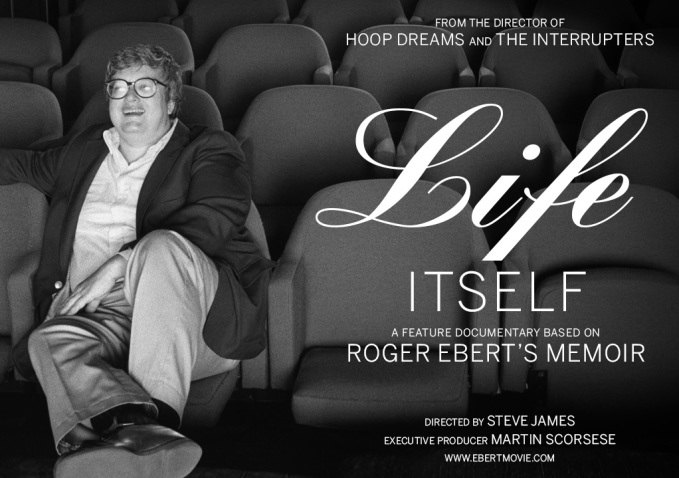
LifeItselfRoger Ebert, the most influential film critic of all time, gets the film he deserves directed by one of the many filmmakers he championed, Steve James (“Hoop Dreams,” “The Interrupters”).  It is co-produced by Martin Scorsese, whose emotional appearance in the film to talk about the impact of the support—and criticism—he received from Ebert is one of the highlights.

But this is not the story of a movie critic.  It is the story of a life, a big, grand, messy, vital, generous life.  It was a life with every bit as much drama, comedy, tension, romance, insight, compassion, and, as Ebert would say, civilizing influence and empathy creation as any of the films included in Roger’s pantheon of Great Movies.

The film shows us Ebert as a child in the university town of Urbana, Illinois, as a college student there, as a young newsman who, still in his 20’s, became the movie critic for the Chicago Sun-Times, and later a pioneering presence on television and online. He drank too much until he admitted that he was an alcoholic.  He and Chicago Tribune critic Gene Siskel created a television show that began on the local PBS channel, WTTW, and then went into national syndication and moved to commercial television.  While some print critics complained that it was stunt-ish, the show elevated serious engagement with movies to a nationwide conversation.  A highlight of the film is the testy outtakes from the show, making it clear that the competitiveness and tinge of animosity that made their on-screen interactions so fascinating were toned down from the real strains between them.  And it turns out Siskel hung out with Hugh Hefner at the Playboy Mansion during the wild era of the 60’s.  “Roger may have written ‘Beyond the Valley of the Dolls,’ but Gene lived it,” Siskel’s widow says with a smile.

The intensity of the competition between the two critics is very funny. So are the outrageously awful clothes and haircuts (there are some things even the ’70s does not excuse) and the amateurishness of the early episodes. But the very real respect and, ultimately, admiration, between them makes it clear that this was one of the most significant relationships of Roger’s life. It was his devastation over Siskel’s decision not to tell anyone about his own illness that made Roger resolve to be very open and honest about his own.

Ebert had great hungers, which led to excesses, not just in alcohol and food but in work, producing more reviews and books than any other critic and dabbling as a screenwriter in the legendarily awful “Beyond the Valley of the Dolls.”  Once he stopped drinking, he developed the courage to pursue his greatest hunger, the hunger for love and intimacy.  The man who called movies “an empathy machine” was ready, at age 50, to begin to feel those feelings outside of the screening room.  It is deeply moving to witness Ebert’s transformation through his finding a deep romantic love and a large extended family at age 50 with Chaz.  And then he got cancer, and we see the impact his illness had on his writing. He lost a great deal, but, James shows us, he found more.

Roger loved movies deeply, personally, viscerally. With this documentary, the movies return that love.

Parents should know that this movie includes scenes of illness and a sad death, some strong languages, discussions of alcohol abuse and alcoholism, smoking, and some sexual references and images from movies with adult material.

Family discussion:  What were the most important turning points in Ebert’s life?  Do you agree that film is an “empathy machine?”

If you like this, try: Roger Ebert’s books and his mesmerizing shot-by-shot commentary on Citizen Kane

Related Tags:


Critics Documentary Movies -- format
THE MOVIE MOM® is a registered trademark of Nell Minow. Use of the mark without express consent from Nell Minow constitutes trademark infringement and unfair competition in violation of federal and state laws. All material © Nell Minow 1995-2026, all rights reserved, and no use or republication is permitted without explicit permission. This site hosts Nell Minow’s Movie Mom® archive, with material that originally appeared on Yahoo! Movies, Beliefnet, and other sources. Much of her new material can be found at Rogerebert.com, Huffington Post, and WheretoWatch. Her books include The Movie Mom’s Guide to Family Movies and 101 Must-See Movie Moments, and she can be heard each week on radio stations across the country.

Website Designed by Max LaZebnik