
Son of God

Posted on February 27, 2014 at 6:00 pm

B
Lowest Recommended Age: Middle School
MPAA Rating: Rated PG-13 for intense and bloody depiction of The Crucifixion, and for some sequences of violence
Profanity: None
Alcohol/ Drugs: Wine
Violence/ Scariness: Intense and graphic torture and abuse and disturbing images in depiction of crucifixion, swords
Diversity Issues: Religious diversity issues
Date Released to Theaters: February 28, 2014
Date Released to DVD: June 2, 2014
Amazon.com ASIN: 1455585831

son-of-god“Son of God,” re-cut and expanded from the popular miniseries produced by Roma Downey and Mark Burnett, “The Bible,” tells the story of Jesus from birth to crucifixion and resurrection in a thoughtful, reverent, and dignified manner. This is a movie made by believers for believers. It expects viewers to be familiar enough with the story to fill in some of the gaps and devout enough to assume the significance of each moment. It tells the story in a westernized, conventional manner that can seem superficial at times, more a cinematic Sunday School lesson than a movie.  It is unlikely to persuade anyone, but it is undeniably moving and many believers will find it inspiring.

The production values are high, with Morocco providing the Biblical landscapes, elaborate sets and costumes, and a stirring Hans Zimmer score.  Portuguese actor Diogo Morgado plays Jesus with dignity.  He is very handsome, though his western features seem out of place.  The portrayal of the Jews is always a sensitive issue in the depiction of the New Testament story.  This version is more sympathetic than some, showing the political pressure that gave the Jewish community in Rome-occupied Jerusalem little choice.  But it seems odd that Jesus and his followers, who considered themselves Jews, show no evidence of Jewish practice other than the Hebrew prayer for he dead following the crucifixion.  Even the Last Supper, which has no elements of a Passover seder, though the Gospel of Mark says that Jesus prepared for the Last Supper on the “first day of Unleavened Bread, when they sacrificed the Passover lamb.”

The movie also reflects its source with some odd re-cuts and deletions.  Those who are not familiar with the details of the Gospels may have trouble understanding who some of the characters are and how they fit in.  The death of John the Baptist is mentioned briefly without making it clear what his contribution was and how he died.  Roma Downey has explained that they chose to literally cut the devil out of the story, in part as a result of some claims that the actor cast in the role for the television version bore a resemblance to President Obama.  But that means eliminating a key element of the story, the Garden of Gethsemane, which is an important part of understanding the way Jesus saw his role and his sacrifice. This is an accessible version of the story, but it is also a simplified one.

Parents should know that the New Testament storyline includes illness, bigotry, and graphic and disturbing images of torture, abuse, and crucifixion.

Family discussion: How does this differ from other versions of the story?  What was Jesus’ most important statement and why?

If you like this, try: the rest of “The Bible” miniseries and other depictions of the life of Jesus including “The Gospel of John” and “King of Kings”
 

Related Tags:


Based on a book Drama DVD/Blu-Ray Pick of the Week Epic/Historical Spiritual films

3 Days to Kill

Posted on February 20, 2014 at 6:00 pm

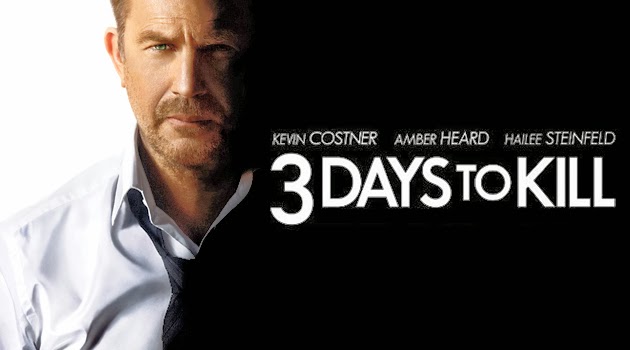
3DaysToKill-PosterKevin Costner is back, big time, with five scheduled releases this year. It’s only February, and this is his second big spies-and-shoot-outs action film of 2014, following Jack Ryan: Shadow Recruit.  This one, from writer Luc Besson and director McG (“Charlie’s Angels”) seems inspired by Liam Neeson’s annual series of middle-aged action films (“Taken,” “Taken 2,” next week’s “Non-Stop”).  This will not go down as an especially memorable entry in the filmography of Costner or Besson, but it is a big improvement over Besson’s previous middle-aged star action film, From Paris With Love, with John Travolta, also set in Paris.  Costner reminds us why he is a movie star with ease and likability that is a perfect on-screen match for Besson’s trademark mash-up of intense action, gooey sentiment, and goofy comedy.

Costner plays Ethan Renner, a long-time CIA operative.  He is not a spy.  He is an assassin.  He is sent in to kill people, presumably bad guys, and he is very good at it.  But when we meet him chasing after a bad guy known as “the albino” and clearly not feeling well.  It turns out he has cancer.  A doctor tells him to get his affairs in order and crisply thanks him for his service to the CIA.

Ethan returns to his apartment, where a large family of sweet-natured squatters from Africa have moved in and repainted his bedroom.  Under the law, squatters cannot be evicted until spring, plus one of them is a young pregnant woman, so he lets them stay.  Ethan contacts his estranged-but-n0t-divorced wife, Christine (Connie Nielsen) and his teenaged daughter, Zoey (Halliee Steinfeld) to spend time with them while he can.  And then Vivi (Amber Heard), a CIA operative who dresses like Lady Gaga, makes him an offer he can’t refuse.  If Ethan will take one last job, she will give him an experimental drug that could cure his cancer and give him more time.

Ethan races around Paris, alternately torturing the director of a high-end limo service to get information about the whereabouts of The Albino’s accountant and asking him for parenting tips, giving his daughter lessons in bike-riding and, with the help of that accountant, a recipe for spaghetti sauce, hallucinating due to the effects of the experimental drug and swigging vodka as an antidote, and doing some very bad things to some very bad guys.  A lot of it makes no sense, but let’s face it, that’s not why we’re here.

Parents should know that this film has extensive spy-style action peril and violence. A character is an assassin and many other characters are injured and killed with guns, chases, explosions, fights, some disturbing images, mortal illness, drinking, smoking, drugs, some nudity and suggestive dancing, non-explicit childbirth scene, and some strong language.

Family discussion: Is Ethan a good dad? How did the theme of fatherhood come up in different ways throughout this film?

If you like this, try: “The Professional” and “The Transporter”

Related Tags:


Action/Adventure Spies Thriller

Pompeii

Posted on February 20, 2014 at 6:00 pm

pompeii posterIn 79 AD Mount Vesuvius erupted, wiping out the city of Pompeii. Director Paul W.S. Anderson, who gave us movie versions of “Resident Evil” and “Mortal Kombat,” presents the story as a video game. If what you are looking for is special effects and well-staged action, or even buff bodies, you’re all set.  But those who are looking for history, meaningful drama, character development, or good dialog — well, they weren’t paying attention a moment ago when I mentioned the director of game console-to-movie theater movies and Paul W.S. Anderson.  It is basically “The Legend of Hercules” with a volcano.

“Game of Thrones'” Kit Harington plays Milo, who as a child saw his entire community brutally slaughtered by the vicious and corrupt Roman soldier Corvus (an imperious Kiefer Sutherland).  Milo escaped by hiding in a pile of dead bodies.  He is later captured and sold into slavery, where his outstanding fighting skills bring him to the attention of a purveyor of gladiator battle-to-the-death entertainment.  He travels to the big city of Pompeii to compete in the arena there.  Along the way, he sees a beautiful young woman named Cassia (Emily Browning) and he impresses her by putting her injured horse out of its misery.  Cassia is returning to her parents (Jared Harris and Carrie-Ann Moss) after a visit to Rome, where she attracted the attention of Corvus, now a high-ranking Senator.  But Milo has attracted her attention.  In an example of dialog that could have come out of a middle school slam book, a character says, “I never saw you look at any man the way you looked at that slave.”

Milo is set to fight the enormous and powerful Atticus (“Thor’s” Adewale Akinnuoye-Agbaje), who can earn not just his life but his freedom with one more win in the arena.  They end up forming an alliance like that of Kirk Douglas and Woody Strode in the classic “Spartacus.”  Meanwhile Corvus is attempting to extort Cassia’s hand in marriage from her father, who needs the support of Rome for his building project.

And all of this is about to be trumped by a nearby mountain and some seismic movement of the earth.  There are huge sinkholes and then there is an ocean of burning lava and chokingly thick ash.  Every element of the lives of the Pompeiians is turned upside down as all societal restrictions are removed and all anyone wants to do is stay alive.  Well, you’d think that, but unfortunately the storylines that have already more than overstayed their welcome drag on, interfering with what we really want to see — the special effects — and jettisoning any possible remaining legitimacy of the plot.

Harington is very good as Milo and he and the excellent Akinnuoye-Agbaje make the fight scenes exciting and compelling.  Sutherland has a nice sneer (I could not help remembering his bully in “Stand By Me.”)  The special effects, especially in 3D, are impressive.  But the movie is dragged down by its cheesy storyline.

This is not the first movie version of the story of Pompeii and it will not be the last.  Pliny the Younger’s eyewitness description of what happened when the volcano erupted excerpted in the opening moments of the film, is still more vivid and powerful than any version yet put on screen.

You might hear the Shrieks of Women, the Cries of Children, the Noise of Men: Some called aloud for their Parents, some for their Husbands, and knew them only by their Voices; some bewailed their own Share in the Calamity; and others that of their Neighbours; some wished for Death from the Fear of Dying; many lifted up their Hands to Heaven; a Multitude disbelieved all the Gods, and looked upon the Time to be the last eternal Night, that has been prophesied. Some improved the real Dangers by feigned and imaginary Fears; others gave it out, that this House at Misenum was fallen, that was burnt; both falsely, but they met with Believers. A Glimpse of Light appeared, that did not show us the Return of Day, but the Approach of the Fire that threatened us: The Fire indeed, stood at a Distance; then the Darkness revived, and after that, a plentiful Shower of Ashes and Cinders: We rose up now and then and shook them off, otherwise we should have been covered and oppressed with the Weight of them. I could boast, that neither a Sigh, nor a complaining Expression dropped from me in the midst of these Alarms; but I was supported by this Consolation, not very Reasonable indeed, but natural enough, to think that all the World perished with me. 

Parents should know that this film has extensive sword and sandal-era violence including the slaughter of a village, a child seeing his parents get killed, a horse put down, and many gladiator fighting scenes with many characters injured and killed. Also, natural disaster violence destroys an entire city with some disturbing images and there is a brief sexual situation (slaves as prostitutes) and reference to a brothel.

Family discussion: Why didn’t Milo want to say his name? What kind of culture finds gladiator fighting entertaining?

If you like this, try: read up on the real history of Pompeii and watch classics like “Gladiator,” “Ben Hur” and “Spartacus”

Related Tags:


3D Action/Adventure Drama Epic/Historical Inspired by a true story Tragedy
THE MOVIE MOM® is a registered trademark of Nell Minow. Use of the mark without express consent from Nell Minow constitutes trademark infringement and unfair competition in violation of federal and state laws. All material © Nell Minow 1995-2026, all rights reserved, and no use or republication is permitted without explicit permission. This site hosts Nell Minow’s Movie Mom® archive, with material that originally appeared on Yahoo! Movies, Beliefnet, and other sources. Much of her new material can be found at Rogerebert.com, Huffington Post, and WheretoWatch. Her books include The Movie Mom’s Guide to Family Movies and 101 Must-See Movie Moments, and she can be heard each week on radio stations across the country.

Website Designed by Max LaZebnik