
Trailer — The Hobbit: The Desolation of Smaug
Posted on October 3, 2013 at 1:27 pm
Posted on October 3, 2013 at 1:27 pm
Posted on October 1, 2013 at 8:00 am
DreamWorks Pictures’ “Need for Speed” is a return to the great car culture films of the 1960’s and 70’s, when the authenticity of the world brought a new level of intensity to the action on-screen. Tapping into what makes the American myth of the open road so appealing, the story chronicles a near-impossible cross-country journey for our heroes — one which begins as a mission for revenge, but proves to be one of redemption. Based on the most successful racing video game franchise ever with over 140 million copies sold, “Need for Speed” captures the freedom and excitement of the game in a real-world setting, while bringing to life the passion for the road that has made our love of cars so timeless.
The film centers around Tobey Marshall (Aaron Paul), a blue-collar mechanic who races muscle-cars on the side in an unsanctioned street-racing circuit. Struggling to keep his family-owned garage afloat, he reluctantly partners with the wealthy and arrogant ex-NASCAR driver Dino Brewster (Dominic Cooper). But just as a major sale to car broker Julia Bonet (Imogen Poots) looks like it will save Tobey’s shop, a disastrous race allows Dino to frame Tobey for a crime he didn’t commit, sending Tobey to prison while Dino expands his business out west.
Posted on September 29, 2013 at 11:33 pm
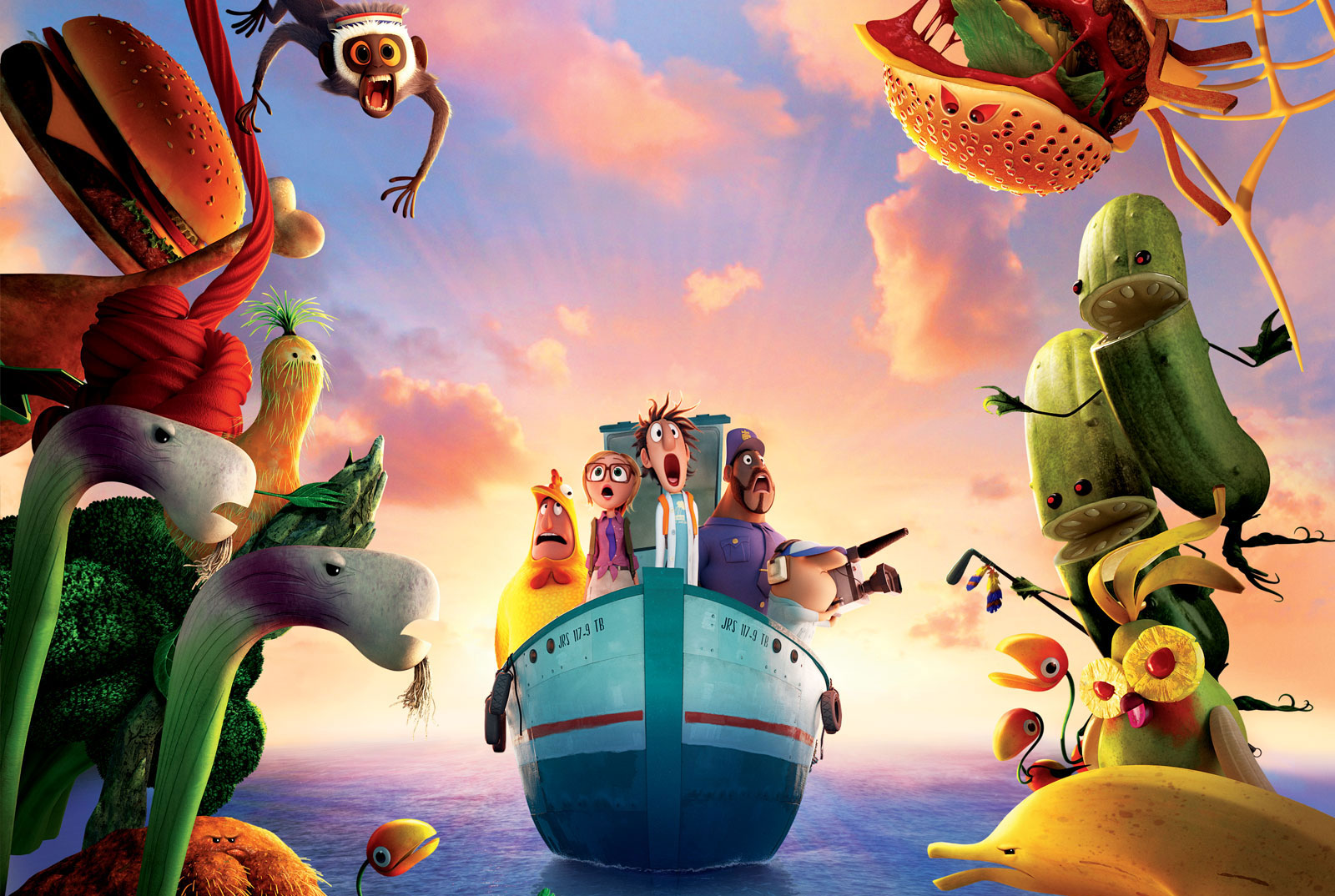 Who would have guessed that the brightest and funniest and most heartwarming animated film of the year would not be from Pixar or Disney but Sony? And that to boot it would be a sequel, or, perhaps given the subject matter, a second helping? “Cloudy With a Chance of Meatballs 2” is a fresh and charming delight especially welcome after a series of animated disappointments.
There’s a quick recap of the first episode, very loosely based on the 1970’s children’s book classic
At first, Flint is hesitant to put on hold his plans to create a lab on the island for his friends, especially meteorologist Sam Sparks (Anna Faris). But Sam knows what it means to Flint to get a chance to work with Chester, so she encourages him to put the plans for the lab on hold. Sam, Flint’s fisherman dad Tim (James Caan), the Chewandswallow police chief (Terry Crews), and their goofy friend Brent (Andy Samberg), all move to California and Flint goes to work in a facility that looks like a tweaked version of the Googleplex with coffee always within reach and caffeine patches on request.
But then it turns out that the FLDSMDFR is somehow working more damage than ever, now producing weird combinations of food and animals — foodimals — with hilariously preposterous visual and verbal puns. There’s the shrimpanzee, the hippotatosaurus, the susheep, and the taco-dile, along with other delicious mash-ups. Chester sends Flint to shut it down, swearing him to secrecy, but Flint tells Sam and ends up taking the whole gang back to Chewandswallow with him. A few mild quibbles — it would be nie in a movie about scientists to have some actual science used in the problem-solving. And after a movie in which adorable marshmallows and strawberries and even cheeseburgers are cavort so endearingly, parents may find it even more difficult to persuade picky eaters and tenderhearted types to eat their dinners.
But there’s a very sweet storyline about the importance of friends — having friends and being a good friend, and a nice aspirational moral about making the world better — and the pure silly fun of a group of animators outdoing each other with escalating puns that range from the outlandish to the almost-but-not-quite unforgivable. Not once, but twice, there are jokes about a leek in the boat, and it is funny both times. Lines of dialogue lie “piece of cake,” “we’re toast,” and “this is bananas” are punctuated with visual counterpoint. And a bright “New” song by Paul McCartney gives the soundtrack as much sunshiney as the adorable creatures and cheery humor.
Parents should know that this movie has some mild potty humor and comic/cartoon-style peril, most shown to be not scary.
Family discussion: Why was it important for Flint to apologize? How was he affected by being bullied? What does Barb learn about Chester? Which one of Flint’s inventions would you like to try? Do you have an idea that could change the world?
If you like this, try: the first film, the book, and “Megamind”
Posted on September 26, 2013 at 6:00 pm
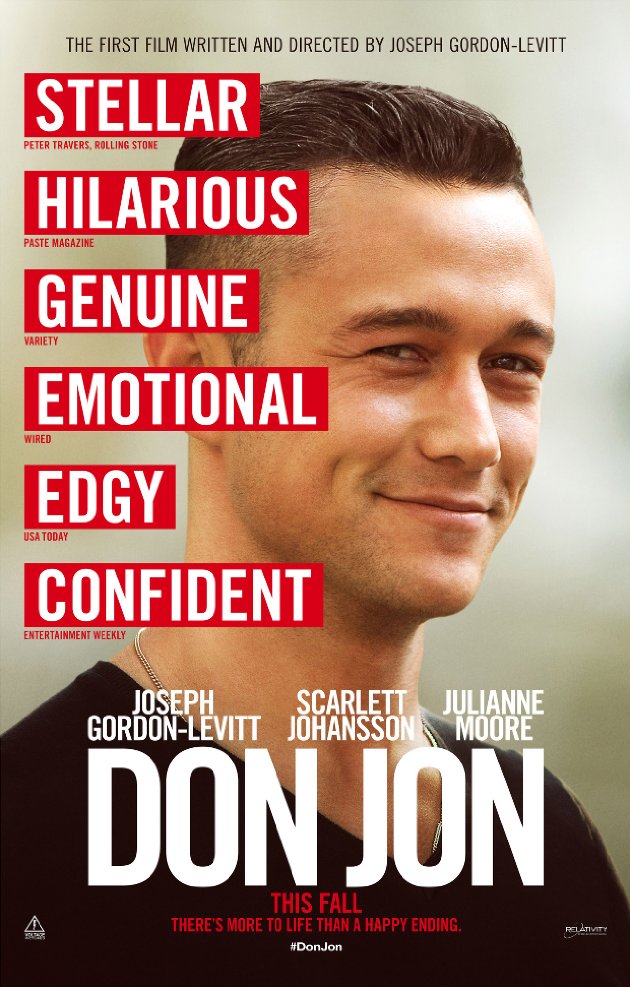 Actor Joseph Gordon-Levitt has made a remarkably assured debut as writer/director, putting him in the front ranks of today’s filmmakers. Gordon-Levitt also plays the lead role, Jon, a New Jersey guy with a high and tight haircut and a spare and immaculate apartment decorated in gray and black. He reels off the list of things he cares about: his body (for working out), his car (for driving and looking cool), his boys (friends), his girls (for sex), his church (for confession), his family (for Sunday dinners), and porn (you know what that is for). Those are the parameters of his life, and that seems fine to him because he knows who he is and how things fit together. The title is a reference to the legendary libertine who symbolizes all men who seduce many women without forming any attachments to them.
Jon and his friends like to go to the club and rank the ladies, an endlessly fascinating conversation about various body parts and the optimal shapes and proportions of each. Sex with those ladies is primarily a contest between the men, and Jon is by far the leader. His success with nines and “dimes” (a ten) is about status and competition, and he tells us that he prefers pornography to sex with real girls. One night, Jon sees a solid dime named Barbara (Scarlett Johansson). For the first time, he becomes involved with a woman who is more than a one-night stand and he has to earn her affection. She has her own ideas of what a “dime” equivalent looks like, and he finds himself going to romantic comedy movies and taking a community college class. He even brings her home to meet his family, where she gets a very enthusiastic response from his parents (a wonderful Glenne Headley and Tony Danza).
And then things get more complicated. Gordon-Levitt has crafted a whip-smart, richly cinematic film with some very funny moments and a lot of heart. He makes it clear that Jon is not the only one who is numbing his feelings. His father is more absorbed in watching the football games than in talking to his family and Barbara’s aspirations are almost as based on fantasy as the images Jon connects to online. Watch how the settings help tell the story, and style of the movie changes as Jon goes from the techno-pumping macho world of his friends to the more romantic, orchestral environment of dating. And then it shifts again as other changes happen. Keep an eye on Jon’s sister, played by the superb Brie Larson (“The Spectacular Now,” “Short Term 12”), who appears to be as addicted to her devices as Jon, never saying a word to her family as she stares into her phone, texting back and forth. She will make it clear that she has been more connected to what is going on with the people she loves than anyone else in the film. And Julianne Moore gives an earthy but sensitive performance as a classmate of Jon’s who surprises and disconcerts him with her honesty.
Seeing Jon begin to learn to interact with the world with feelings, not just sensations, is a pleasure. But seeing one of today’s best young actors bloom into one of tomorrow’s best young filmmakers is even greater.
Parents should know that this movie is about a young man who is addicted to pornography. It includes very explicit sexual references and situations, nudity, very strong and crude language, drinking, and drugs.
Family discussion: How did other characters aside from Jon find ways to avoid their feelings? How did Joseph Gordon-Levitt use different film-making styles to show the different moods of his time with his friends, with Barbara, and with Esther?
If you like this, try: “Thanks for Sharing” and some of Joseph Gordon-Levitt’s other films like “Brick” and “Mysterious Skin”
Posted on September 26, 2013 at 6:00 pm
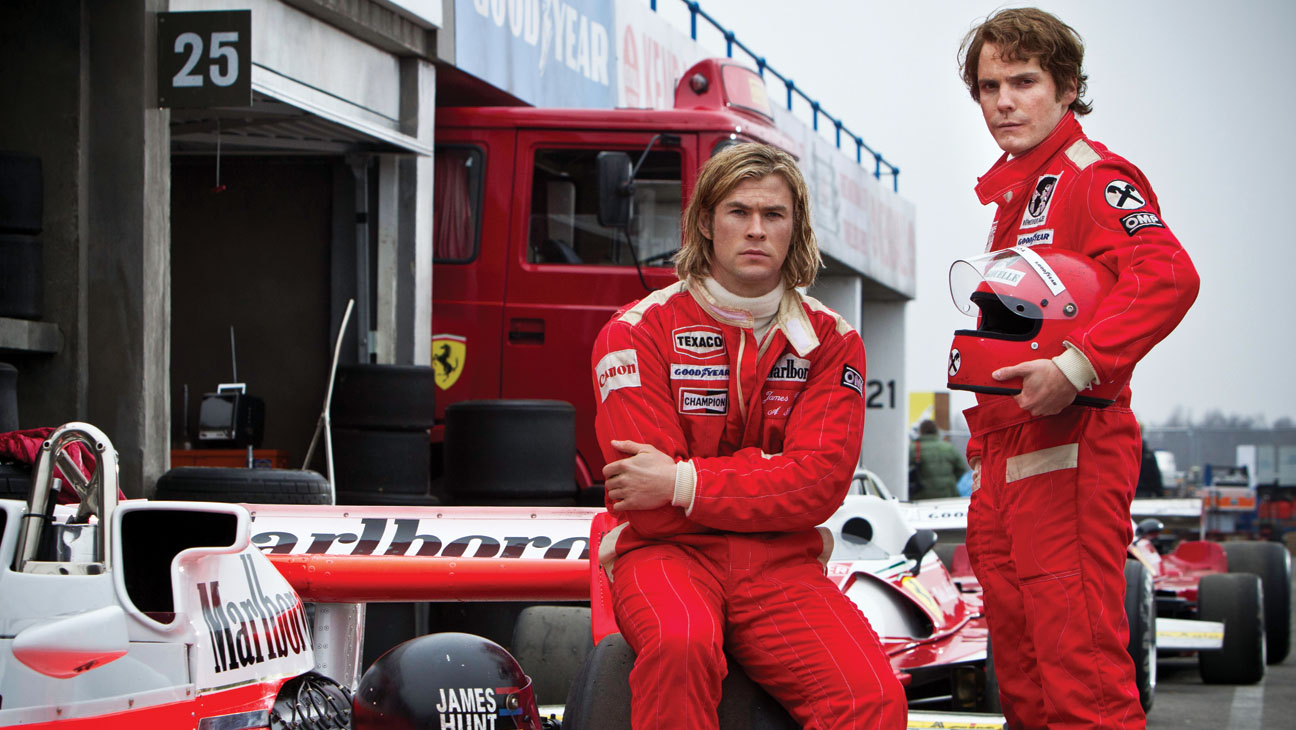 The immensely gifted screenwriter Peter Morgan reunites with his “Frost/Nixon” director Ron Howard and returns to his favorite theme, a real-life drama about the clash between two brilliantly talented but flawed figures. This time it is the bitter rivalry between Formula One race car drivers James Hunt (“Thor’s” Chris Hemsworth) and Niki Lauda (“Inglourious Basterds'” Daniel Brühl). The British Hunt is Maverick to the Austrian Lauda’s Iceman, the Michael to his Sonny, the id to Lauda’s superego.
Both were the rebellious sons of wealthy fathers. Hunt is handsome, careless, and catnip to the ladies. “He will have you pulling your hair out nine days out of ten,” a character says, but on the tenth day, when you need him, he will deliver. Lauda is methodical and analytical. He calculates the odds. But they both know that they are among the very few who know what it feels like to get into a car that is essentially a bomb on wheels and speed it around a racetrack. They both do it not because they like driving in circles but because they like to test themselves. They both like to win, even need to win. And, as they remind us perhaps one or two times too many in this film, they both know that the best way to do that is to compete against one another. “The only people I can get along with are those who can drive fast,” Hunt says. He does not really get along with them, either.
Hemsworth, 30 pounds lighter than his Thor/Avengers muscled-up Norse god look, is able to make Hunt magnetic even in 70’s hair. We meet him as he walks into an emergency room with a bashed nose, not from a racing accident, from a jealous husband. The pretty nurse (Natalie Dormer) asks what he did to anger the husband and he rakishly offers to show her. The curtain rings squeal against the rod as it is quickly swung around and soon he is introducing her to his pit crew as “Nursie.” No time to learn her name, and no need.
Hunt was the James Bond of race car drivers, sexy, sophisticated, and fearless. But I don’t think James Bond ever threw up before a confrontation. “Rebels, lunatics, dreamers,” he tells us about race car drivers. “People who are desperate to make a mark and willing to die for it.” Formula One averaged two deaths a year. But, he adds, “The closer you are to death, the more alive you feel.”
Lauda says his brain is not that strong but his ass is very smart. He can tell from a car’s vibrations under the seat that a fan belt will be in trouble and which tire needs air. He negotiates his driving deals the way he drives, calmly but ruthlessly. He gets up early to walk the track. He calculates risk constantly and accurately. When he explains that one race should be called off because the heavy rainstorm has made conditions unsafe, Hunt, behind on points, persuades the other drivers to vote to continue. Lauda is very badly injured, including burns on his face and severe lung damage. In one of the most extraordinary comebacks in the history of sports, Lauda was back on the track 42 days later, against doctor’s orders but able to compete. In what passed for cheerfulness from the dour Austrian, he told the press that there was one advantage to the skin grafts on his forehead. They don’t sweat, so he would no longer be bothered by sweat dripping in his eyes. And, has his wife told him, you drive with your foot, not your face.
Howard conveys the pressure and the thrill of Formula One racing, giving us the view from inside the helmet, and showing us that Hunt’s air of casual mastery is accompanied by a nervous habit of playing with the cap on his cigarette lighter. He shows us how Hunt and Lauda are always racing, whether it is Hunt visualizing the track or Lauda walking it, competing for the best cars and sponsors, or exchanging barbed comments about whether it is more important to be feared than loved. The action is electrifying, on and off the track.
Parents should know that this movie includes some disturbing images of crashes and injuries, very strong language, sexual references and situations with nudity, drinking, smoking, and drug use, as well as a great deal of reckless behavior.
Family discussion: What were the most important ways in which Hunt and Lauda were alike? If you were a sponsor, which would you hire and why?
If you like this, try: “Winning” with Paul Newman, “Grand Prix” with James Garner, and “Le Mans” with Steve McQueen, and Peter Morgan’s “The Damned United” about another real-life sports rivalry.