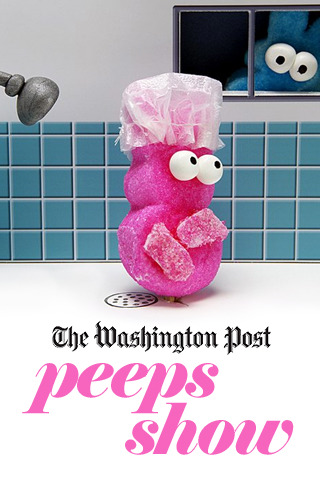
I am besotted with the annual Washington Post Peeps contest, where artists and craftspeople and peep-lovers of all kinds are invited to create dioramas featuring the pink and yellow and blue marshmallow bunnies and chicks that are sold every spring for Easter baskets.
This year, there were more than 1100 entries. Be sure to take a look at the winner, “EEP,” inspired by the Pixar movie, “Up,” a floating house held aloft by peeps. And you will also enjoy the runners-up, especially the ones based on children’s books like “Madeline,” “Goodnight Moon” (with a quiet old peep whispering the peepish equivalent of “Hush”) and “Where the Wild Things Are” as well as peep-or-amas inspired by “Mad Men,” the balloon boy, Shaun White, “Avatar,” the viral video with the wedding party dance down the aisle, and Washington’s historic Snowapalooza. And of course there were entries featuring Washington’s most famous family is represented with peeparific displays of the White House vegetable garden, the President and his dog, Bo, and of course the infamous White House party crashers.
The Washington Post even has an iPhone app to show off the top peep contestants.
And why shouldn’t Hollywood love a good wedding? With its swirl of heightened emotions, its simmering leitmotifs of love and loss, fear and hope, all swathed in a frothy confection of pink roses, white butter cream and queen-for-a-day tulle, the wedding provides an irresistible trope, from the ditziest rom-com to the bloodiest gangster epic. It’s a tiny three-act drama in microcosm (the incident-filledrun-up to the ceremony, the ceremony itself, the aftermath) that can give audiences insta-catharsis. And whether a marriage is meant to be or doomed to fail, there’s something viscerally satisfying about a wedding, in all its reassuring ritual….We cherish them not just as classic examples of courtship at its most idealized but also as trenchant social commentaries. If they initially charmed audiences with gorgeous movie stars, dreamy romance and zany comedy, they endure because they’re such revealing reflections of their times.
There are weddings in romance movies, of course, and in comedies and dramas, but you can find them even in gangster movies, war movies, movies for children and movies for adults. Sometimes the main character is the bride or groom but very often the wedding couple are secondary characters and the wedding is just a place for all the drama or comedy or even action to play out. Sometimes a movie wedding is the culmination of the plot because the couple gets married and sometimes it is the culmination of the plot because the ceremony is interrupted. The Baxter makes the guy whose job in the story is to get left at the alter the center of the movie. (One of the highlights is the wonderful Peter Dinklage as a wedding planner.)
Before there were movies, there were fairy tales that often ended with a wedding. Weddings are in the same category as the lost ark or the secret formula or the capturing of the bridge or winning the big game. Love is life’s big adventure and a wedding is the symbol of its ultimate expression. And it is also a lot of fun to see other cultures and traditions. Here are some of my favorite movie wedding scenes. I’d love to hear yours, too.
1. The Godfather One of the greatest American films begins with a wedding reception that gives us unforgettable introductions to the entire cast, their values, and their relationships.
2. The Deer Hunter A agonizing film about the impact of the Vietnam war on three friends begins with an extended wedding scene that establishes the foundation for what is to come by making us not just care about the characters; after that wedding reception, filmed with such intimacy, we almost feel like part of the family.
3. The Philadelphia Story My all-time favorite movie is this sophisticated and witty story about the forthcoming wedding of a wealthy woman to an executive with political ambitions. Complications ensue when a reporter, a photographer, and her ex-husband show up for the festivities.
4. The Graduate A very few movies seem to express and even shape the themes of their time. And a small fraction of those hold up over time as works of art. “The Graduate” leads that category with brilliant direction from Mike Nichols, a haunting soundtrack by Simon and Garfunkel, and superb performances by Dustin Hoffman as Ben, the title character, who symbolizes the disaffection of his generation and Anne Bancroft as Mrs. Robinson, the friend of his parents who symbolizes the emptiness of hers. When Ben finds something meaningful in a relationship with Mrs. Robinson’s daughter, he ends up disrupting her wedding in a scene that has become iconic.
5. Four Weddings and a Funeral Screenwriter Richard Curtis based this on his own experience of finding himself at a seemingly endless stream of weddings. Charlie (Hugh Grant, in a star-making role) meets Carrie (Andie MacDowell) at the first of the weddings and their relationship evolves over the rest of the title ceremonies. But this is really the story of Charlie and his friends, all of whom find love by (but sometimes not until) the closing credits.
6. Bend it Like Beckham Parminder Nagra plays Jesminder, the daughter of a traditional Punjabi Sikh family in London who wants to play soccer. Her sister’s wedding plans provide a context for her struggles against her family’s reluctance to let her play, especially when it turns out that the soccer finals are at the same time.
7. Lovers and Other Strangers The wedding at the center of this film is the setting for a wide variety of happy and sad, healthy and dysfunctional love relationships among the extended family, played by a stand-out cast including Gig Young, Cloris Leachman, Anne Meara, Bea Arthur, and Anne Jackson. The Carpenters’ standard, “For All We Know” was written for this film.
8. Father of the Bride There has never been a more beautiful bride than Elizabeth Taylor in this affectionate comedy about the impact of a wedding on the family. Spencer Tracy plays the beleaguered father who is expected to pay endless bills and endure endless relatives on both sides. The scene where he comforts her after she (briefly) breaks off the engagement is one of my very favorites.
9. Fiddler on the Roof This classic musical based on the stories of Sholom Aleichem about a small Jewish village in late 19th century Russia. The main character is a poor milkman who has a lot of challenges in marrying off three of his daughters. The themes of tradition and change in the romances of the three daughters and in the community at large come together in the warm and loving wedding celebration (with the lovely song “Sunrise, Sunset”).
10. My Big Fat Greek Wedding Inspired by the real-life experience of Nia Vardalos, the daughter of Greek immigrants, this touching and hilarious story of a shy young woman in a big, noisy family who finds love with a kind-hearted teacher, leading to some confusion and misunderstandings but also a lot of laughter and new connections.
It’s everywhere at the multiplex these days: religion. Or if that word makes you uncomfortable, you can go with the more general “spirituality.”
In movies as varied as the dead serious “The Road,” the uplifting family picture “The Blind Side,” the biting comedy “The Invention of Lying” and even James Cameron’s sci-fi opus “Avatar,” issues of faith and morality and mankind’s place in the universe are all the rage.
Not all of these movies embrace religion. Some question human gullibility. Some ask for evidence of a higher purpose in what often seems a random universe. But whether they encourage prayer or doubt, they’re all part of the zeitgeist.
Butler asked some thoughtful observers of the influence that religion and pop culture have on each other to comment on this trend, but, as usual, everyone forgets that it takes many years for a movie to be made — twelve years in the case of “Avatar” — and so it does not make sense to try to tie them to current economic conditions. It may, however, affect the audience response to those themes. “Up in the Air” is mentioned in the article as not specifically religious in its themes but compared to “A Christmas Carol” as a story of a man who finds that there is more meaning in personal connections than in money. It benefitted from the timeliness of its character’s job, flying from company to company to tell workers they were being laid off. But it was based on a book that was published nine years ago.
The portrayal of religious themes I have found the most meaningful this year was in “The Blind Side,” with its unabashed and explicit acknowledgement that Christian faith was a guiding inspiration and base of support in the real-life story of a wealthy family who adopted a homeless teenager. This — and the box office success of “Fireproof” and other modestly-budgeted films with Christian themes targeted to a Christian audience — should address some of Hollywood’s traditional skittishness about portraying people of faith in a positive way.
Upcoming films with themes of religion and spirituality include “The Lovely Bones” (told by a murdered girl from a sort of heavenly waiting room), “Legion” (a battle between angels for the future of humanity), and “The Last Station” (about writer Leo Tolstoy’s religious conversion and its effect on his wife).



 makes the guy whose job in the story is to get left at the alter the center of the movie. (One of the highlights is the wonderful Peter Dinklage as a wedding planner.)
 One of the greatest American films begins with a wedding reception that gives us unforgettable introductions to the entire cast, their values, and their relationships.
 A agonizing film about the impact of the Vietnam war on three friends begins with an extended wedding scene that establishes the foundation for what is to come by making us not just care about the characters; after that wedding reception, filmed with such intimacy, we almost feel like part of the family.
 My all-time favorite movie is this sophisticated and witty story about the forthcoming wedding of a wealthy woman to an executive with political ambitions. Complications ensue when a reporter, a photographer, and her ex-husband show up for the festivities.
  A very few movies seem to express and even shape the themes of their time. And a small fraction of those hold up over time as works of art. “The Graduate” leads that category with brilliant direction from Mike Nichols, a haunting soundtrack by Simon and Garfunkel, and superb performances by Dustin Hoffman as Ben, the title character, who symbolizes the disaffection of his generation and Anne Bancroft as Mrs. Robinson, the friend of his parents who symbolizes the emptiness of hers. When Ben finds something meaningful in a relationship with Mrs. Robinson’s daughter, he ends up disrupting her wedding in a scene that has become iconic.
 Screenwriter Richard Curtis based this on his own experience of finding himself at a seemingly endless stream of weddings. Charlie (Hugh Grant, in a star-making role) meets Carrie (Andie MacDowell) at the first of the weddings and their relationship evolves over the rest of the title ceremonies. But this is really the story of Charlie and his friends, all of whom find love by (but sometimes not until) the closing credits.
 The wedding at the center of this film is the setting for a wide variety of happy and sad, healthy and dysfunctional love relationships among the extended family, played by a stand-out cast including Gig Young, Cloris Leachman, Anne Meara, Bea Arthur, and Anne Jackson. The Carpenters’ standard, “For All We Know” was written for this film.
  There has never been a more beautiful bride than Elizabeth Taylor in this affectionate comedy about the impact of a wedding on the family. Spencer Tracy plays the beleaguered father who is expected to pay endless bills and endure endless relatives on both sides. The scene where he comforts her after she (briefly) breaks off the engagement is one of my very favorites.
 This classic musical based on the stories of Sholom Aleichem about a small Jewish village in late 19th century Russia. The main character is a poor milkman who has a lot of challenges in marrying off three of his daughters. The themes of tradition and change in the romances of the three daughters and in the community at large come together in the warm and loving wedding celebration (with the lovely song “Sunrise, Sunset”).
  ,
,  ,
,  ,
,  , and the French movie it was based on, “Cousin, Cousine.”