The breadth of this great country and the “eternal vigilance” of its people is truly remarkable, and it is thrilling to have it documented in such an immediate fashion. I especially love to see the young students interviewing the older people.
The FCC, the Supreme Court, and the F- and S-Words
Posted on November 4, 2008 at 8:00 am
As we go to the polls today, honoring our Constitution’s fundamental principles of representative democracy, another key element of Constitutional system of checks and balances is also at work. And it may include consideration of yet another key founding principle of the United States, the right of freedom of speech and the press under the First Amendment of the Bill of Rights.
Today the Supreme Court will hear arguments in the case of Federal Communications Commission v. Fox Television Stations. The FCC, an independent agency of the federal government, will argue that it has the authority to ban “fleeting” expletives after the FCC issued warnings to broadcasters after celebrities used certain terms in live broadcasts.
The case is not strictly speaking a First Amendment case. As legal challenges often do, it relates more specifically to the procedures followed by the FCC in determining their policy on the words at issue. And as always happens with high-profile Supreme Court cases, there have been many filings by “amici” (“friends of the court”) — advocacy groups, television producers, even the pediatrician’s trade association — all expressing their views about who should decide what is appropriate, when they should decide it, and how the decision should be implemented. A group of former FCC Commissioners and staff wrote that while they were “not without sympathy” for the the FCC’s views on obscenity, they were concerned about: decisions that have transformed a hitherto moderate policy of policing only the most extreme cases of indecent broadcast programming into a campaign of regulatory surveillance that will chill the production of all but the blandest of broadcast programming.
The words at issue raise an interesting problem in the arguments before the Court, where lawsuits are always argued with decorum and formality. According to the Supreme Court blog SCOTUS: Unless Chief Justice John G. Roberts, Jr., intervenes, some of the argument in the Supreme Court chamber next Tuesday morning may sound at times like a typical conversation in a seventh grade boys’ restroom — the uninhibited use of four-letter words. And, if Roberts allows it, such a display of blue language will be heard on TV and radio — in the middle part of the day — across America, and may be read the next morning in many newspapers. But, apparently, not in every news outlet.
The Court may very well rule that the FCC may not interfere with the “fleeting” use of these words on the air. And they may do so without using the words themselves, as they did in the famous case where they upheld the use of the f-word in a political protest. They noted that the word could be considered indispensable to make exactly the objection that the protester wanted to without saying what the word was. According to the book, The Brethren, Burger approached Justice John M. Harlan, the opinion’s author, and said: “John, you’re not going to use ‘that word’ in delivering the opinion are you? It would be the end of the Court if you use it, John.” And Harlan did not. It was included, though, in the Court’s opinion finding that Cohen’s First Amendment rights had been violated. Justice Harlan described Cohen’s message as one involving a “scurrilous epithet,” but he also wrote: “While the particular four-letter word being litigated here is perhaps more distasteful than most others of its genre, it is nevertheless often true that one man’s vulgarity is another’s lyric.”
What should the policy be about the language used on broadcast television? There are no restrictions on the language used on cable programs. The last time the Court ruled on this issue it made a distinction based on the unique availability of broadcast television and radio for children. But in a world of internet, podcasts, and DVDs (not to mention schoolyards, shopping malls, and newspaper articles), that distinction no longer applies. I look forward to reports on the arguments and to the Court’s decision.
Many thanks to Mitchell Keller and his syndicated Back Porch show, featuring “real country music,” for inviting me to be their movie critic. I’ll be on every week talking about the new releases at the theater and on DVD. Thanks for adding me to the website and the show!
Po (voice of Jack Black) is a soft, sweet-natured cuddly panda. He works as a waiter in his father’s noodle shop but dreams of being a kung fu champion. He studies kung fu history and cherishes his action figures of the Furious Five, the country’s top martial arts masters: Tigress (Angelina Jolie), Crane (David Cross), Monkey (Jackie Chan), Viper (Lucy Liu), and Mantis (Seth Rogen). They are trained by Shifu (Dustin Hoffman) under the guidance of the Master (Randall Duck Kim).
The great villain Tai Lung (Ian McShane, providing the obligatory deep voice and English accent), guarded by 1000 soldiers, breaks out of prison and the Master must select a new Dragon Warrior to defend the people. The whole town gathers to see which of the Furious Five it will be. In what appears to everyone — including Po — to be a mistake, the Master points to the panda as the chosen one. And it is up to Yoda, I mean Shifu, to train him.
The Furious Five are, well, furious. Like a group of middle school mean girls, they tell Po he does not belong. Shifu is frustrated and impatient, insisting that the panda cannot be trained. He does not have the grace or balance for martial arts.
The panda is part teddy bear, part Pillsbury Doughboy, part Cookie Monster, all soft, sweet, and cuddly. Like Santa, he has a belly that shakes like a bowl full of jelly, a long way from a lean, mean fighting machine. He is also unsure of himself, ashamed of his clumsiness. He is afraid to try for his dreams — afraid to upset the father he loves (Po never seems to notice they are of different species) and afraid he does not have the ability to do better. When he fails in training, he says dejectedly, “I probably sucked more than anyone in the history of kung fu…more than anyone in the history of sucking.” He admits to Shifu that he only stayed “because I thought if anyone could change me, make me not me, it was you.” But Po will learn that the source of his strength is what no one can teach him — his sincerity and humility. Po will find within himself the strength, focus, and resolve to face Tai Lung.
As wise and experienced as he is, Shifu has some lessons to learn as well. He has to find a whole new way of teaching — it turns out the way to a Dragon Warrior’s heart may be through his stomach. And he has to explore some regrets and mistakes from his past.
All of this is handled very lightly — the film spends more time on the pratfalls than on the brisk training montage and the fight sequences are well within the PG range. The sweet-natured lumbering bear with the big tummy trying to achieve the grace, discipline, and balance of kung fu gives the animators a lot of opportunities for offbeat variations, sight gags, and contrasts, a cartoon tradition going back as far as the ballet-dancing hippos in “Fantasia.” And the scroll-inspired landscapes and colors are spectacularly beautiful.
The fortune cookie-like “everyone is special” lessons of the film get a little murky, though, and parents will want to talk to children about alternatives to violence, safe participation in martial arts, and telling the truth. But the film’s unpretentious sweetness, the striking visuals and fresh settings, and strong voice characterizations by Black, Hoffman, Rogan, and Cross make this satisfying family entertainment.

 , has given Beliefnet
 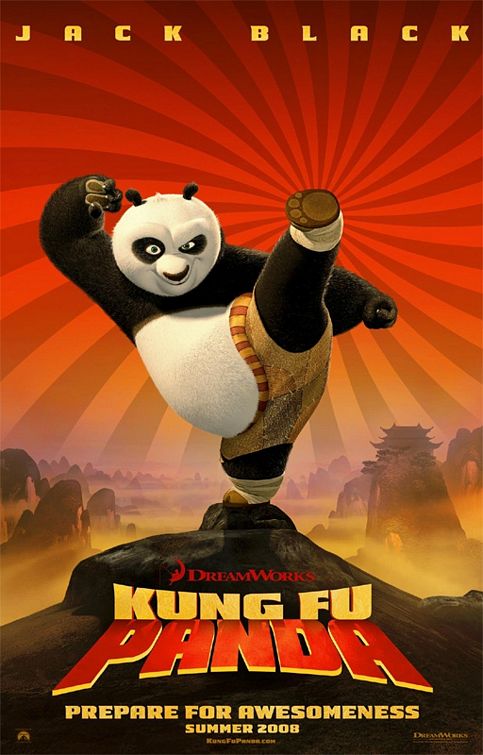 Po (voice of Jack Black) is a soft, sweet-natured cuddly panda. He works as a waiter in his father’s noodle shop but dreams of being a kung fu champion. He studies kung fu history and cherishes his action figures of the Furious Five, the country’s top martial arts masters: Tigress (Angelina Jolie), Crane (David Cross), Monkey (Jackie Chan), Viper (Lucy Liu), and Mantis (Seth Rogen). They are trained by Shifu (Dustin Hoffman) under the guidance of the Master (Randall Duck Kim).