Interview: Coach Cathy Rush of ‘The Mighty Macs’

Interview: Coach Cathy Rush of ‘The Mighty Macs’

Posted on October 19, 2011 at 8:00 am

Coach Cathy Rush arrived at tiny Immaculata College at a moment when there were big changes in women’s basketball.  The rules were changed to allow women for the first time to play the all-out game by the same rules as the men.  And for the first time there was a national championship.  Coach Rush took her team to the national title for three of the first four years.  And this week, a movie based on her story is opening.  It is called “The Mighty Macs.”

I was delighted to get a chance to speak to Coach Rush about her experiences at Immaculata and what she is doing now.

You must be very excited about the movie!

The excitement is really building as we approach the premiere.  I’ve been traveling around doing pre-release screenings and we’ve had standing ovations.  We showed it in New York and they were ecstatic.

What was the rule change that was so important in the early 70’s?

This goes back to the 1930’s when my mother was playing basketball.  They didn’t think women could run up and down the court more than once or twice so there were three players on one side and three on the other and you never went full court.  You were not allowed to cross half-court. One group of three would shoot and the other side was just defense.

Because women were too frail?

Absolutely!  The Olympics didn’t have a marathon for women until the 90’s.  And then people realized women were capable of more.  In the 60’s it had morphed into a huge scoring game where it was too easy to score.  One player in Iowa was averaging 58 points a game.  It was too easy to score when you were playing three on three?

Did you have a nun as an assistant coach as happens in the movie?

That is actually not true but part of the Immaculata story could never be repeated because of the community that was there and was so important.  The Mother Superior was not really with us in the beginning so the assistant coach character was the embodiment of all the nuns who loved us and prayed for us and did extraordinary things to support us.  Even after we started winning there was some controversy about whether Immaculata should be known as a jock school.  Everyone had to wear skirts to class and the dining hall — it was a different era.

Wasn’t it a challenge that you did not have a chance to recruit talented high school players?

Whoever showed up on your college campus was who you used.  Coincidentally — we’ve often thrown around the idea of Divine Intervention — Theresa Shank Grentz was intending to go to Mount St. Mary’s.  Her family home burned down and the family basically got out with what they had on.  She didn’t have money or clothes.  So she ended up commuting to Immaculata and was one of our strongest players.  Because there were no scholarships we had nothing to offer players except the chance to be a part of the program.  I did start recruiting later on and found Mary Ann Crawford Stanley who was fabulous.  So we decided not to leave in fate’s hand and recruit some players but all we could offer them was a good education and a good program.

I think it is a testament to your vision and leadership that so many of your players became coaches — even more than that they became champions.  What inspired them to follow in your footsteps that way?

Their experience at Immaculata, certainly, but also Title IX had just come in and major universities realized they had to find coaches and provide a little equality, well, not a whole lot but a little.  So these people went right into Division 1 jobs.  Part of it was the opportunity that they had.  Teresa was a biology-chem major and I asked how that prepared her to coach and she said she should have been a Psych major.  We’ve also had a bunch of doctors and other amazing women.  They came to Immaculata for an education first.

You had some unusual drills in the movie — were those things you really did?

We did a lot of stuff.  I did bring in boys to compete against.  We had 11 kids on the team and when we went from the first five to the second five the competition was not at good, so we brought in the boys.  I was blessed to be in the Philadelphia area where there were great men’s coaches who knew the 5-member game and they were kind enough to let me see all of that and put it into our own system so I was very, very lucky.

What is important for a coach to know?

Coaching is really teaching.  We’re all teachers of some kind — parents are teachers, too.  The players who became coaches do not coach like me; they are all smart enough to coach within the framework of their personality.  I was not a screamer.  I didn’t have to yell to get across what we needed to do.  Being so young, I had kind who were two and three years younger than me but there was no question of my authority.  I was Mrs. Rush or Coach.  People need to lead by example.

The movie makes it clear how much some things have changed since the 1970’s.
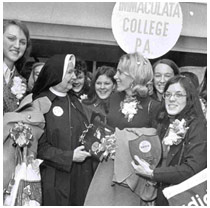
I was a 60’s woman and not the Berkeley 60’s.  I was from a small town and went to a conservative college and then coached at an even more conservative college.  It was a different time.  My life plan at that time was to get married, teach for three years, and have a family and never work again.  When I say that to kids today, they do not understand it.  But in those days people had different expectations for their sons than their daughters.

What are you doing these days?

I have a girls’ basketball camp.  This is our 41st year, our biggest year ever, over 9000 kids in camp.  My youngest son runs the business and every now and then I come in and tell him what he’s doing wrong .

You’re still coaching!

That’s right!


Related Tags:


Behind the Scenes Sports The Real Story
The Pediatricians Really Mean It: No TV, Movies, or Computers for Under-Twos

The Pediatricians Really Mean It: No TV, Movies, or Computers for Under-Twos

Posted on October 19, 2011 at 7:00 am

The American Academy of Pediatrics has said it again.  They do not recommend any screen time for children under two.  They first issued this recommendation in 1999.  But in the last 12 years, family media use has skyrocketed.

The temptation to rely on media screens to entertain babies and toddlers is more appealing than ever, with screens surrounding families at home, in the car, and even at the grocery store. And there is no shortage of media products and programming targeted to little ones….In a recent survey, 90 percent of parents said their children under age 2 watch some form of electronic media.  On average, children this age watch televised programs one to two hours per day. By age 3, almost one third of children have a television in their bedroom. Parents who believe that educational television is “very important for healthy development” are twice as likely to keep the television on all or most of the time.

The new report finds:

  • Many video programs for infants and toddlers are marketed as “educational,” yet evidence does not support this. Quality programs are educational for children only if they understand the content and context of the video. Studies consistently find that children over 2 typically have this understanding.
  • Unstructured play time is more valuable for the developing brain than electronic media. Children learn to think creatively, problem solve, and develop reasoning and motor skills at early ages through unstructured, unplugged play. Free play also teaches them how to entertain themselves.
  • Young children learn best from—and need—interaction with humans, not screens.
  • Parents who watch TV or videos with their child may add to the child’s understanding, but children learn more from live presentations than from televised ones.
  • When parents are watching their own programs, this is “background media” for their children. It distracts the parent and decreases parent-child interaction. Its presence may also interfere with a young child’s learning from play and activities.
  • Television viewing around bedtime can cause poor sleep habits and irregular sleep schedules, which can
  • adversely affect mood, behavior and learning.
  • Young children with heavy media use are at risk for delays in language development once they start
  • school, but more research is needed as to the reasons.

The report recommends that parents and caregivers:

  • Set media limits for their children before age 2, bearing in mind that the AAP discourages media use for this age group. Have a strategy for managing electronic media if they choose to engage their children with it;
  • Instead of screens, opt for supervised independent play for infants and young children during times that a parent cannot sit down and actively engage in play with the child. For example, have the child play with nesting cups on the floor nearby while a parent prepares dinner;
  • Avoid placing a television set in the child’s bedroom; and
  • Recognize that their own media use can have a negative effect on children.

My own recommendations: no television in children’s bedrooms, during meals, or in car rides under two hours, no earphones in the car, no television as background noise or for adults to watch while children are around.  Set an example by letting your children, even the toddlers, see you talking, playing, exercising, reading, listening to music, and sitting down on the floor to help them play with blocks and toys.  One of the most important lessons they will learn is how we decide what is important.

Related Tags:


Parenting Understanding Media and Pop Culture
It’s Not Your Daddy’s ‘Star Wars’

It’s Not Your Daddy’s ‘Star Wars’

Posted on October 18, 2011 at 3:52 pm

Just last week, I decided to watch the original 1977 “Star Wars” again and enjoyed it very much.  I’ve lost count of how many times I have seen it, but I can tell you that when my then-fiance and I saw it in the theater, we sat through it twice.  (How long has it been since you could do that?)

But, as an amusing and informative piece in Slate by Michael Agger points out, even a sturdy knowledge of the original trilogy is of no help at all when the younger generation is hooked on the latest iteration of the saga that takes place a long time ago in a galaxy far, far away: Star Wars: Clone Wars.  This animated “microseries” takes place between Star Wars: Episode II – Attack of the Clones and Star Wars: Episode III – Revenge of the Sith, the 4th and 5th of the movies as released but the second and third in the chronology.  The animated series is hugely confusing for the generation that grew up on the live action movies in part because the focus is on Anakin Skywalker, who we know from all six of the previous films is not going to end up a good guy (“Nooooooo” notwithstanding) and in part because the good guys in this kind of dress like the bad guys we thought we knew.  Just like the films, the series gives kids a rich imaginary world with many, many opportunities for memorization that will quickly eclipse the capacity of anyone over age 16.  Agger’s crib notes are a big help.

Related Tags:


Action/Adventure Animation Science-Fiction Television
Interview: Mark Henn of ‘The Lion King’

Interview: Mark Henn of ‘The Lion King’

Posted on October 17, 2011 at 3:59 pm

I had a lot of fun talking to animator Mark Henn about “Winnie the Pooh” last summer so it was a pleasure to get to talk to him again, this time about The Lion King, which has had surprise box office success as a 3D theatrical re-release and in its first Blu-Ray edition.

Were you surprised by the support for the theatrical re-release of a 1994 movie?

Yes — seventeen years gone by and this little film that we had no idea how well it would do back then is surprising us again even today.  Still the king of the beasts, I guess, and a nice shot in the arm for hand-drawn animation, which is still viable.

I think it is less due to the 3D than because people want to go to the theater to see a movie the whole family can enjoy.

I don’t disagree.  The 3D is a hook but it is still a great movie.  I haven’t seen it in a long time and even I went, “Wow, this is a really good movie!”  And the 3D on top of it gave it a fresh twist but it’s really a great movie and there’s a whole new generation to see it, too.

You start by going there.  I was not a part of the original research trip but the directors, head of story, head of layout and head of background go on these trips.  I did one for “Mulan.”  They went to Africa and I had the opportunity several years after the film came out to go to Africa to do a promotional trip and when I showed up there, I said, “Oh, my gosh, there’s Pride Rock!  There’s where the wildebeests were!”

It all goes back to Walt Disney.  He believed everything had to be based in reality and fact and then you go from there.  We went to zoos and studied real lions.  Even though there are some liberties with color and things like that, that’s what you can do with this medium, adjust the colors and moods but it is all based in fact and reality.

What was your role on the movie? 

We’re the actors.  In a live action movie we can offer it to Tom Hanks or Brad Pitt but for animation we are usually cast on a specific character.  I was responsible for young Simba, the beginning of the movie through “Hakuna Matata,” those scenes of him growing up.  Animators, like actors, have a variety of strengths, some are better with villains or comedy but I’ve tended to do more lead characters, especially the girls.  The directors, when the sequence is ready to go into production they can sit down with us and communicate what Simba is doing and part of my job is not just the design of the character, what he looks like, but how he acts and moves.  So I act like quality control between the director and the other animators working on Simba, and make sure that what they do is what the directors want and consistent in the way he looks and acts throughout the the film.

One of the highlights of the film for me is when young Simba sings “I Just Can’t Wait to be King.”  How do you make a lion dance?

You have to know how a lion walks and moves first, and how they’re put together.  And then you can break the rules and have some fun with it.   You push it until it looks broken and then you back it up.  It wouldn’t be appropriate for him to get up on two legs — you had the rhythm and choreography but it had to be on all fours.

We have the voice and the music, particularly with songs, but the rest of the score comes in later.  We get the very specific musical beats and highlights and accents they need to hit and the lyrics — you have that to move the character to.

What does the 3D add to it?

It completes it, in a way.  The film was already very vast and epic in the way it was laid out.  We did what we could with the tools that were available in 1994 to make it that way.  If we had this technology then we would have used it.  So the technology has caught up with us to provide the final piece of the puzzle.  It is really something to see Zazu walking the lion cubs out into the middle of the Savannah.  You can feel him floating in the air with the cubs below him and it is really neat, an extra little tool that enhances the movie-going experience.


Related Tags:


Animation Behind the Scenes Interview
THE MOVIE MOM® is a registered trademark of Nell Minow. Use of the mark without express consent from Nell Minow constitutes trademark infringement and unfair competition in violation of federal and state laws. All material © Nell Minow 1995-2026, all rights reserved, and no use or republication is permitted without explicit permission. This site hosts Nell Minow’s Movie Mom® archive, with material that originally appeared on Yahoo! Movies, Beliefnet, and other sources. Much of her new material can be found at Rogerebert.com, Huffington Post, and WheretoWatch. Her books include The Movie Mom’s Guide to Family Movies and 101 Must-See Movie Moments, and she can be heard each week on radio stations across the country.

Website Designed by Max LaZebnik