
“Becoming Santa” — OWN Documentary
Posted on December 15, 2012 at 5:41 pm
The wonderful, poignant OWN documentary “Becoming Santa” is now available on DVD. I wrote about the movie when it was shown on OWN.
Posted on December 15, 2012 at 5:41 pm
The wonderful, poignant OWN documentary “Becoming Santa” is now available on DVD. I wrote about the movie when it was shown on OWN.
Posted on December 15, 2012 at 8:00 am
 Please take a moment during the holiday season to remember those who make great sacrifices to protect our freedoms. You can send Christmas boxes to the troops or even Christmas stockings. And Operation Ensuring Christmas cares for the families of fallen military, to let them know they are not alone.
Posted on December 14, 2012 at 8:00 am
Posted on December 13, 2012 at 6:00 pm
B| Lowest Recommended Age: | Middle School |
| MPAA Rating: | Rated PG-13 for extended sequences of intense fantasy action violence, and frightening images |
| Profanity: | Some strong language |
| Alcohol/ Drugs: | Drinking, smoking |
| Violence/ Scariness: | Extended fantasy violence and peril with swords and arrows, characters injured and killed, scary monsters |
| Diversity Issues: | Diverse characters |
| Date Released to Theaters: | December 14, 2012 |
| Date Released to DVD: | November 4, 2013 |
| Amazon.com ASIN: | B00E8S2JZ4 |
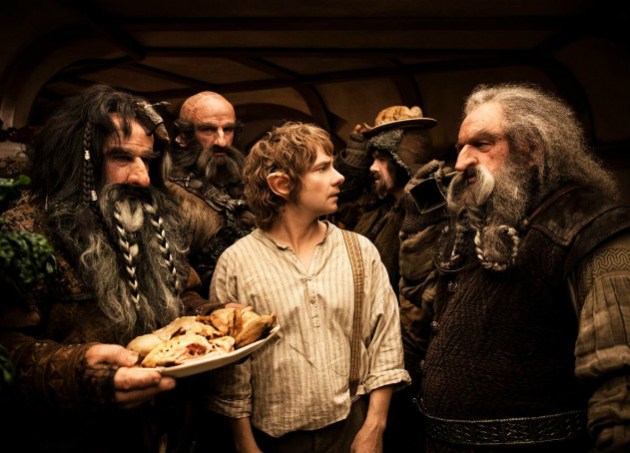
 . Director Peter Jackson returns to J.R.R. Tolkien’s Middle Earth for this “Lord of the Rings” prequel, the adventure of young Bilbo Baggins, the hobbit we meet in the LoTR trilogy as the middle-aged uncle of the heroic Frodo. We see many familiar faces, especially Ian McKellan as the wizard Gandalf, the sepulchral Christopher Lee as Saruman, Cate Blanchett as the ethereal Galandriel, Hugo Weaving as the regally gracious Elrond, and Andy Serkis plus CGI as Gollum, and the now-familiar but still marvelously eye-filling New Zealand locations.What is most different here is that Jackson has doubled the frames-per-second for a new hyper-clarity. The 24 frames per second standard that has been in effect since the beginning of the sound era has been upped to 48, giving the film a depth of detail that is so fresh it can be a little unsettling. We subconsciously associate the quality of light and focus with the video used for news programs and lower-budget sitcoms (think of the difference between the indoor and outdoor scenes in the old “Monty Python” episodes), so it can take a while to get used to it in a richly imagined fantasy, especially when close-ups reveal the pores of a character’s skin like a magnifying mirror at a department store makeup counter and the quality of light seems chillier and more sterile. We get so much visual information that it takes a while to re-calibrate our ability to separate the meaningful from the superfluous.
It does not help that Jackson himself seems to miss the forest of the story for the literal trees. Blowing out the shortest and most accessible of the books to a projected trilogy of nearly nine hours suggests that Jackson has fallen so in love with the project that he has lost touch with what it feels like not to be completely obsessed with it. Of course, he is enabled by the intensity of the fans, who are famously dedicated to every leaf, twig, and Elvish declension. But he seems to have lost track of the thread of the story and dulled his sense of how to communicate with those who are not as deeply involved with the story as he is. He glosses over the important discussion of Bilbo’s two competing heritages, one open to adventure, one devoted to home and hearth, which makes it hard to understand why he changes his mind about accepting Gandalf’s challenge. Since it is a prequel, we are all familiar with the destructive power of the One Ring to Rule Them All, which makes it confusing when we see it 60 years earlier as a simple and benign invisibility ring. Meanwhile, it takes all of 40 minutes before Bilbo leaves his house as what should have been a 10-minute scene about the unexpected arrival of a bunch of rowdy dwarves is expanded to include two different musical numbers. And yet, it still does not give us enough of a sense of who the individual dwarves are.
The action scenes are filled with vitality and dynamically staged, but the film assumes a commitment and understanding on our part that it has not earned. In a story about a quest of honor, that is an unexpected disappointment.
Parents should know that this film includes many battle sequences and scenes of peril, scary monsters, characters injured and killed, some disturbing images, smoking, drinking, and some potty humor.
Family discussion: Why did Bilbo decide to join the adventure? Why did Gandalf pick him? Why didn’t Gandalf use his powers to help the dwarves sooner?
If you like this, try: The book by J.R.R. Tolkien and the “Lord of the Rings” films
Posted on December 13, 2012 at 5:50 pm
 When Franklin Roosevelt’s sixth cousin Margaret “Daisy” Suckley (pronounced “sook-lee”) died at age 99, a cache of letters was found in a suitcase under her bed. Everyone knew she had spent years working near Roosevelt, and most thought he had kindly provided for her by allowing her to act as his cataloger and librarian. But the letters revealed a close and tender friendship and implied that there was more. And so, in this fact-based story of the first visit to the United States by a British monarch, Franklin and Eleanor Roosevelt (and Franklin’s redoutable mother) welcomed King George V (that’s “The King’s Speech” king, no longer looking like Colin Firth but recognizable by his stutter) and his wife, Queen Elizabeth, the parents of the current about-to-become-a-great-grandmother Queen Elizabeth II to the Roosevelt’s summer home in New York State. And fed them hot dogs.
So there are really two movies here. Bill Murray is superb as Roosevelt, famously described by Oliver Wendell Holmes as having “a second-class intellect, but a first-class temperament.” Murray gives a beautifully subtle, complex and fully immersed performance as the patrician President whose polio-induced paralysis gave him a deeper understanding and sense of purpose. The scene where he has an impromptu late-night meeting with the young king is one of the best of the year.
But the movie gets soapy and uncomfortably speculative when it focuses on the relationship between Daisy and the President. Is it a romance? Is it a story about Daisy’s spirit enlarging as she goes from adolescent crush to a sort of sister-wife support group with the other women in FDR’s harem, including his secretary and, of course, his wife Eleanor, beautifully played with asperity and an endearing sense of rebellion by Murray’s “Rushmore” co-star Olivia Williams. But the film wavers uncertainly between geopolitics illuminated by personality (well handled) and the schoolgirl longings and skeezy predation of his relationship with Daisy.
Parents should know that this film has frank sexual references and situations (one briefly explicit) including approving depiction of adultery, some strong language, and social drinking as well as a positive portrayal of characters with disabilities.
Family discussion: Why do the women forgive Roosevelt? What did the King learn from his conversation with Roosevelt? What did they have in common?
If you like this, try: “The King’s Speech,” “Sunrise at Campobello,” and the book Closest Companion: The Unknown Story of the Intimate Friendship Between Franklin Roosevelt and Margaret Suckley by historian Geoffrey Ward