
Spare Parts

Posted on January 15, 2015 at 5:58 pm
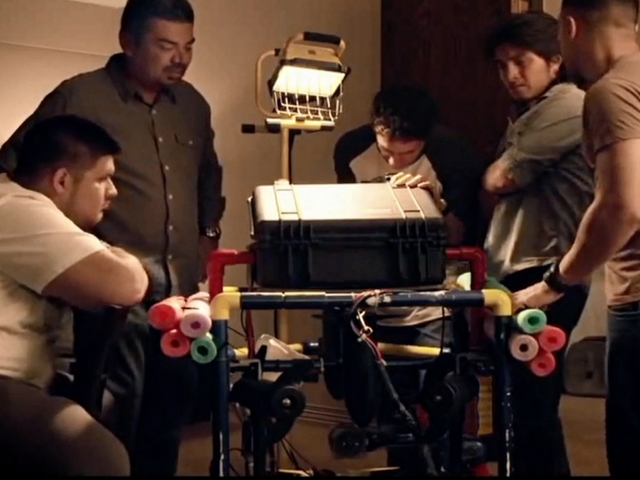
Copyright Lionsgate 2014

It really happened. Four undocumented high school kids from the poorest of communities took on the most brilliant engineering students from the country’s top colleges in a robotics competition and won. The contest results were one in a million, but once it happened, the movie version was inevitable. George Lopez produced the film and stars as the students’ reluctant coach and teacher, Fredi Cameron (based on the two real-life teacher/coaches, Allan Cameron and Fredi Lajvardi).

Unlike its robotic superstar, there is not much ingenuity in the storyline. Everything added on, especially the fictionalized backstory for Cameron, is predictable and superfluous and distracting. Lopez is an amiable presence, but these detours reveal his limits as an actor. We want to focus on the students and their robot, to see them solve problems in engineering and teamwork (which is a form of engineering, too). But too much of the running time is devoted to Cameron’s past and his possible romance with a fellow teacher, played by the always-wonderful Marisa Tomei. If she played the coach, this would have been a much better movie. Still, with a storyline like this one, it cannot help being fun to watch.

Cameron is an engineer with a PhD who tells the school’s principal (Jamie Lee Curtis, in a performance of great warmth and wit) he wants a temporary job as a substitute teacher. She notes that he has moved around a lot, but she does not have any alternatives. He agrees to coach the school’s engineering club because he is assured no one will want to join.

Oscar (Carlos PenaVega) shows up with a flier. He is an outstanding JROTC cadet and was crushed to learn that he cannot join the US Military without proof of citizenship. He thinks participating in a NASA-sponsored robotics competition will make it harder to be turned down. Cameron reluctantly agrees to help.

They assemble a team that includes the brain (David Del Rio), the kid who always gets into trouble but is a whiz at mechanics (José Julián), and the muscle (Oscar Javier Gutierrez II) — one problem they cannot engineer around is that someone has to be strong enough to lift their robot. Each has his own challenges. The brain is bullied at school. The troublemaker is under a lot of pressure to take care of his brother. The muscle has to be able to pass a tough oral exam at the competition to show that every member of the team understands the details of the robot. Oscar falls in love with a pretty classmate named Karla (sweetly played by PenaVega’s real-life wife, Alexa), but worries that his illegal status puts her at risk. All of the students are hiding from the ICE, which has already sent one of their mothers back to Mexico.

And then there is the challenge of the competition itself. Not only does this robot have to operate underwater, it has to execute an immensely complicated series of tasks in a limited time period. When the team shows up, they are so certain they will lose anyway that they decide they might as well compete with the college teams instead of the other high school teams. The night before they have to compete the robot has a disastrous leak. Their very creative and inexpensive (and hilarious) solution is one of the film’s high points.

The film’s name refers to more than the repurposed junk used to assemble the robot. Their triumph is bittersweet because their undocumented status prevents them from taking the opportunities available to those who are citizens. This film makes it clear that it is our loss, as it prevents our country from benefiting from the perseverance and skill that made an $800 robot created by kids kick the robotic butt of the $18,000 robot from MIT.

Parents should know that this film includes some teen crime including armed robbery, violence including bullying, some strong language and tense family confrontations and teen kissing.

Family discussion: What was the team’s most difficult challenge? Who was the teacher who inspired you the most and why?

If you like this, try: the book by Joshua Davis, Spare Parts: Four Undocumented Teenagers, One Ugly Robot, and the Battle for the American Dream, and films like “October Sky” and “Stand and Deliver”

Related Tags:


Based on a true story Drama High School School Stories about Teens

Oscar Nominations 2015: Surprises, Disappointments, Predictions

Posted on January 15, 2015 at 10:17 am

This year’s Oscar nominations are out!  Most of the expected nominees made it, but there were some surprises and disappointments, especially the omission of the Roger Ebert documentary “Life Itself” and the animated mega-hit “The LEGO Movie,” both of which I expected not just to be nominated but to take home the award.  It was good to see a Best Picture nomination for “Selma,” but very disappointing not to see nominations for director Ava Duvernay, star David Oyelowo.  I hoped to have seen Angelina Jolie and Jack O’Connell nominated for “Unbroken” and it would have been nice to see Jennifer Aniston nominated for her brave and vulnerable performance in “Cake” and Oscar Isaac nominated for a complex, deeply felt performance in “A Most Violent Year.” I liked “The Grand Budapest Hotel,” especially (of course) the music and production design and the performance by Ralph Fiennes, but would not have given it a Best Picture nomination.

It is a big disappointment to see yet another year with no acting nominations for performers of color, and no women in the director or screenwriter categories.

I was thrilled to see Laura Dern nominated for her effervescent performance in “Wild.” Marion Cotillard is deservedly an Academy favorite, and, like Dern, gave two superb performances this year. So did also-perennial favorite Jessica Chastain, and it was a disappointment not to see her nominated for “A Most Violent Year.” And so did Gugu Mbatha-Raw, who was incandescent in two films, “Beyond the Lights” and “Belle” and deserved nominations for both.

My predictions for the top awards are: “Boyhood” for Best Picture and Richard Linklater for Best Director, Eddie Redmayne for “The Theory of Everything” for Best Actor, Julianne Moore for “Still Alice” for Best Actress, J.K. Simmons for “Whiplash” for Best Supporting Actor, and Patricia Arquette for “Boyhood” for Best Supporting Actress

Here are the nominees:

BEST PICTURE

American Sniper

Birdman

Boyhood

The Grand Budapest Hotel

The Imitation Game

Selma

The Theory of Everything

Whiplash

BEST ACTOR

Steve Carell, Foxcatcher

Bradley Cooper, American Sniper

Benedict Cumberbatch, The Imitation Game

Michael Keaton, Birdman

Eddie Redmayne, The Theory of Everything

BEST ACTRESS

Marion Cotillard, Two Days, One Night

Felicity Jones The Theory of Everything

Julianne Moore, Still Alice

Rosamund Pike, Gone Girl

Reese Witherspoon, Wild

BEST SUPPORTING ACTOR

Robert Duvall, The Judge

Ethan Hawke, Boyhood

Edward Norton, Birdman

Mark Ruffalo, Foxcatcher

J.K. Simmons, Whiplash

BEST SUPPORTING ACTRESS

Patricia Arquette, Boyhood

Laura Dern, Wild

Keira Knightley, The Imitation Game

Emma Stone, Birdman

Meryl Streep, Into the Woods

BEST DIRECTOR

Alejandro G. Iñárritu, Birdman

Richard Linklater, Boyhood

Bennett Miller, Foxcatcher

Wes Anderson, The Grand Budapest Hotel

Morten Tyldum, The Imitation Game

BEST ANIMATED FEATURE FILM

Big Hero 6

The Boxtrolls

How to Train Your Dragon 2

Song of the Sea

The Tale of the Princess Kaguya

BEST FOREIGN FILM

Ida, Poland

Leviathan, Russia

Tangerines, Estonia

Timbuktu, Mauritania

Wild Tales, Argentina

BEST ORIGINAL SCREENPLAY

Birdman, Alejandro G. Iñárritu, Nicolás Giacobone, Alexander Dinelaris, Jr., Armando Bo

Boyhood, Richard Linklater

Foxcatcher, E. Max Frye, Dan Futterman

The Grand Budapest Hotel, Wes Anderson, Hugo Guinness

Nightcrawler, Dan Gilroy

BEST ADAPTED SCREENPLAY

American Sniper, Jason Hall

The Imitation Game, Graham Moore

Inherent Vice, Paul Thomas Anderson

The Theory of Everything, Anthony McCarten

Whiplash, Damien Chazelle

BEST ORIGINAL SCORE

The Grand Budapest Hotel

The imitation Game

Interstellar

Mr. Turner

The Theory of Everything

BEST ORIGINAL SONG

Everything is Awesome, from The Lego Movie

Glory, from Selma

Grateful, from Beyond the Lights

I’m Not Gonna Miss You, from Glen Campbell…I’ll Be Me

Lost Stars, from Begin Again

BEST CINEMATOGRAPHY

Birdman

The Grand Budapest Hotel

Ida

Mr. Turner

Unbroken

BEST COSTUME DESIGN

The Grand Budapest Hotel

Inherent Vice

Into the Woods

Maleficent

Mr. Turner

BEST DOCUMENTARY FEATURE

CitizenFour

Finding Vivian Maier

Last Days in Vietnam

The Salt of the Earth

Virunga

BEST DOCUMENTARY SHORT

Crisis Hotline: Veterans Press 1

Joanna

Our Curse

The Reaper (La Parka)

White Earth

BEST FILM EDITING

American Sniper

Boyhood

The Grand Budapest Hotel

The Imitation Game

Whiplash

BEST MAKEUP AND HAIRSTYLING

Foxcatcher

The Grand Budapest Hotel

Guardians of the Galaxy

BEST PRODUCTION DESIGN

The Grand Budapest Hotel

The Imitation Game

Interstellar

Into the Woods

Mr. Turner

BEST ANIMATED SHORT FILM

The Bigger Picture

The Dam Keeper

Feast

Me and My Moulton

A Single Life

BEST LIVE-ACTION SHORT FILM

Aya

Boogaloo and Graham

Butter Lamp (La Lampe au Beurre de Yak)

Parvaneh

The Phone Call

BEST SOUND EDITING

American Sniper

Birdman

The Hobbit: The Battle of the Five Armies

Interstellar

Unbroken

BEST SOUND MIXING

American Sniper

Birdman

Interstellar

Unbroken

Whiplash

BEST VISUAL EFFECTS

Captain America: The Winter Soldier

Dawn of the Planet of the Apes

Guardians of the Galaxy

Interstellar

X-Men: Days of Future Past


Related Tags:


Awards

Interview: David Heyman, Producer of “Paddington”

Posted on January 15, 2015 at 10:16 am

David Heyman was selected by Entertainment Weekly as one of the smartest people in Hollywood. It may be because he grabbed the rights to a children’s book called Harry Potter and the Philosopher’s Stone. I enjoyed his latest movie, “Paddington,” also based on a beloved children’s book series, and it was a lot of fun to talk to him about bringing the marmalade-loving bear to life.

Paddington is known for his “hard stare,” and that is one of the highlights of the film. Have you ever tried doing a hard stare yourself?

Not frequently, but yes I have. I’m not sure I’m quite as effective as Paddington or can make people feel quite as uncomfortable but every once in a while I have to call upon my own hard stare.

It seems like Paddington’s hard stare would be a special challenge for the animators.

Copyright 2014 StudioCanal

I think that one of the reasons why it has taken so long for Paddington to get the film to actually happen is because the technology was not around to realize the bear. To have a bear who you are meant to feel with and care for, you know it’s the emotional center of the film. To have that little digital creation would not have been possible 10 years ago. To have eyes that listen, to make you look into them and make you feel sympathy and when he had the hard stare make you feel frightened is a great challenge and is a real testament to the brilliant people at Framestore who did the visual effects. They also did a film I made last year called “Gravity.”

Did Ben Wishaw, who provided the voice for Paddington, get wired up like Andy Serkis?

No, the difference between “Planet of the Apes” and Gollum and Paddington is Paddington is not a humanoid. So that motion capture we felt wouldn’t work and Framestore works more with animation than taking lots of reference. They did take some reference from, the brilliant clown called Javier Marzan who did a lot of comic work and tWhishaw, we filmed him performing as well.

Ben Wishaw’s voice is just perfect for Paddington.

Well, thank you. We began with Colin Firth who we thought we were so lucky to have and Colin was brilliant but his voice was just too chocolatey and velvety and mature for Paddington. And when we put his voice inside as we began to animate it just didn’t feel right. And it was quite interesting, it was a process and we realized we need someone more youthful, more innocent, with a bigger sense of wonder, a little bit off-center. And Colin obviously came to that realization before we did and so we went to Ben. As soon as we heard his voice it just felt right. He seems less confident, less assured and that felt right for that bear in that particular story.

What makes Paddington such an enduringly popular character?

We all in some ways feel like an outsider and that’s what Paddington is, he’s an outsider. So Ben’s voice really seemed to capture that. What I love about it is that it is about the kindness offered to strangers, it’s about embracing people who are other, it’s about being yourself. Paddington learns to not try and fit in but to be himself and in being himself he finds a home and a place that he belongs. And the Brown family, in our versions they are not the perfect family. They are a little dysfunctional. But through this bear, through embracing him they become whole again. And I think that in today’s world where there is so much friction and there’s so much pointing fingers at people because they’re not like us, I think that message of the kindness to strangers, of embracing others, is a really positive thing. t’s actually is a human story. It is a story about a family coming together it’s a story about an outsider finding a home, it’s about kindness, it’s about generosity, it’s about warmth.

I enjoyed the relationship between Mr. and Mrs. Brown, with him so risk-averse and her so spontaneous.

Sally Hawkins and Hugh Bonneville had almost a theater-length rehearsal period and over that time they begun to shape their characters. And in so doing I think gave it the truth that is not just paper thin.

And, not to give too much away, even your villain was acting out of slightly distorted but genuine family devotion.

There’s a wonderful Graham Greene line: to hate to lack imagination. And hate actually is so diminishing. There’s a context for why people do what they do, good or bad. And it doesn’t mean it’s okay. I’m not saying it justifies it but it explains it. And I think through explaining it in film and in life, in understanding the enemy you allow that not to be repeated. If you don’t understand it then it can just happen again and again if you just hate it you are diminishing it will happen again and again and again. To provide that motivation makes it more truthful.

I think that ultimately if you want to educate, encourage, effect change you need to make people realize the possibilities in life and embrace them. One thing I’m very proud of with this film is that it’s message is implicit but it’s not explicit. We don’t talk the message but the message is there. Because I think the danger with a lot of films, when you become polemic you end up preaching to the converted. That is why there is something in it for all ages. Seeing Paddington with my six-year-old and with my mother who is 77 and to share in that experience was one of the greatest experiences I’ve ever had in my life.

Related Tags:


Based on a book Behind the Scenes Interview

Spare Parts — The Real Story

Posted on January 15, 2015 at 8:00 am

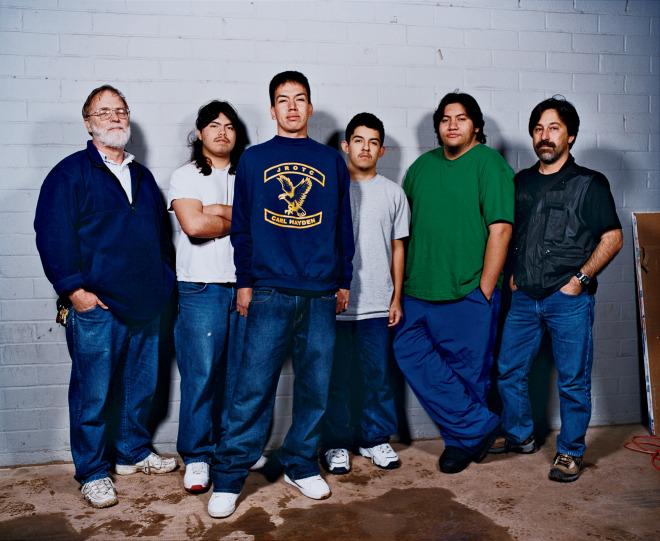
Copyright 2004 Livia Corona/WIRED
If it did not actually happen, no one would believe it. Four undocumented high school students with no money entered an underwater robotics competition, decided to compete against the college teams instead of the other high schools, and won, triumphing over past winner MIT, which had not only some of the top engineering students in the world but a budget more than 20 times bigger.

Wired Magazine wrote the story in 2004. It is well worth a read — the real story is even more improbable and exciting than the film, which is fine, but which adds some unnecessary Hollywood sweeteners, combining the two teacher/sponsors into one character played by George Lopez and adding some superfluous backstory and romance for him. One unforgettable detail from real life becomes one of the movie’s high points. No spoilers here — I’ll just say that the kids had to act quickly to find something small and super-absorbent when their machine had a leak and they came up with an ingenious solution.

Wired also has updates on what the team members are doing now.

Related Tags:


The Real Story

Critic Critiques — Has the Internet Been Good or Bad for Movie Criticism?

Posted on January 14, 2015 at 3:46 pm

Until a few years ago, the movie critics you read were determined by geography.  There were a few critics in national publications, like Pauline Kael in the New Yorker and the critics for Time and Newsweek.  If you lived in Chicago, you got to read Roger Ebert and Gene Siskel, but if you did not, you read the critic in your local paper.  The internet made it possible to read any critic you liked.  And it made it possible for anyone to be a critic.  I started putting my movie reviews online in 1995 and did not start getting paid for it until five years later.

This democratization of movie criticism has been both good and bad.  The worst part has been the result of overall budget-slashing at news organizations across the board.  Film critics are among the first to go.  A documentary called “For the Love of Movies” was a sad elegy to the era of the professional movie critic.

Director David Cronenberg is especially critical of aggregator Rotten Tomatoes.  He said

Even now if you go to Rotten Tomatoes, you have critics and then you have ‘Top Critics’, and what that really means is that there are legitimate critics who have actually paid their dues and worked hard and are in a legitimate website connected perhaps with a newspaper or perhaps not. Then there are all these other people who just say they’re critics and you read their writing and they can’t write, or they can write and their writing reveals that they’re quite stupid and ignorant. … Some voices have emerged that are actually quite good who never would have emerged before, so that’s the upside of that. But I think it means that it’s diluted the effective critics.

It is clear to me that the best part of this access to technology by both critics and filmgoers (and thus the dissolving of the distinction between them) has been the range of new voices.  My friend Sonny Bunch wrote for the Washington Post:

there is some use in examining the way that the movies themselves help us order our existence. The movie screen may not be a mirror for society. But it can be a roadmap for understanding and navigating it. And the non-expert may sometimes, even often, be better equipped to help us travel that path than the expert.

Related Tags:


Commentary Critics Understanding Media and Pop Culture
THE MOVIE MOM® is a registered trademark of Nell Minow. Use of the mark without express consent from Nell Minow constitutes trademark infringement and unfair competition in violation of federal and state laws. All material © Nell Minow 1995-2025, all rights reserved, and no use or republication is permitted without explicit permission. This site hosts Nell Minow’s Movie Mom® archive, with material that originally appeared on Yahoo! Movies, Beliefnet, and other sources. Much of her new material can be found at Rogerebert.com, Huffington Post, and WheretoWatch. Her books include The Movie Mom’s Guide to Family Movies and 101 Must-See Movie Moments, and she can be heard each week on radio stations across the country.

Website Designed by Max LaZebnik