Dan Stevens and Bharat Nalluri on “The Man Who Invented Christmas”

Dan Stevens and Bharat Nalluri on “The Man Who Invented Christmas”

Posted on November 29, 2017 at 4:06 pm

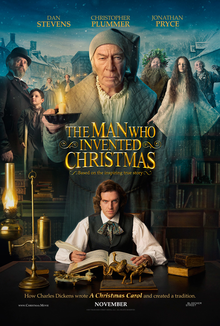
It was a great pleasure to interview actor Dan Stevens, who plays Charles Dickens in “The Man Who Invented Christmas” and the director, Bharat Nalluri.

Dan Stevens shared his thoughts about A Christmas Carol:

It has a lot to say about those in positions of power and wealth and influence and how they wield that in the world around them and how much they’re prepared to overlook in the society around them. That has not changed, and neither has the possibility of redemption. In Dickens’ time, though, it was very unusual to have a character that time travels and went through his own life. It’s almost sci-fi in a way the way he travels back. But also he’s able to go from the archetype of a really not very pleasant character, overnight he’s transformed. And that goes back in the history of theater and literature. You have these archetypes and they pretty much stay bad. The fatal flaw is ultimately fatal. The bad guy comes on stage and we know who he is and he stays pretty bad; he might learn a lesson but here there is more because there is redemption. He has a second chance. He goes through this transformation. It’s so epic and so full of hope that somewhere inside there must be good in this man and that gives us hope about ourselves and the people around us and the possibility of change.

And Bharat Nalluri told me how A Christmas Carol taught him the meaning of Christmas:

When he was writing A Christmas Carol, Christmas celebrations were pretty austere. He wrote a book that gave you a picture postcard idea of Christmas as a time for kindness and generosity. I think the reason it resonates over the decades upon decades and never been out of print is because it actually says something about the human condition. Personally he did invent Christmas for me. I was born in India and my parents brought me into the north of England and Christmas wasn’t a thing that was always huge in my family. I didn’t really know what Christmas but I was surrounded by people in the north of England on the Scottish border where Christmas was just huge and it was a really joyous time for people. I couldn’t quite get it because it just didn’t register with me and then when I was about 10 or 11 I read A Christmas Carol and it completely clicked. I completely got what it was. So in a weird sort of way Dickens really did invent Christmas for me. We all look back and we have this wonderful image of what Christmas should be, that combination of everything we want. We want family life, we want to be around a roaring fire, we want to be roasting chestnuts, we want to hear snow falling but we also want to be good to each other in the human spirit. It’s that combination which is combined so beautifully in Dickens’ book and which we pay tribute to in our film.

Related Tags:


Actors Directors Directors Interview
Coco and Mexican Culture

Coco and Mexican Culture

Posted on November 29, 2017 at 3:57 pm

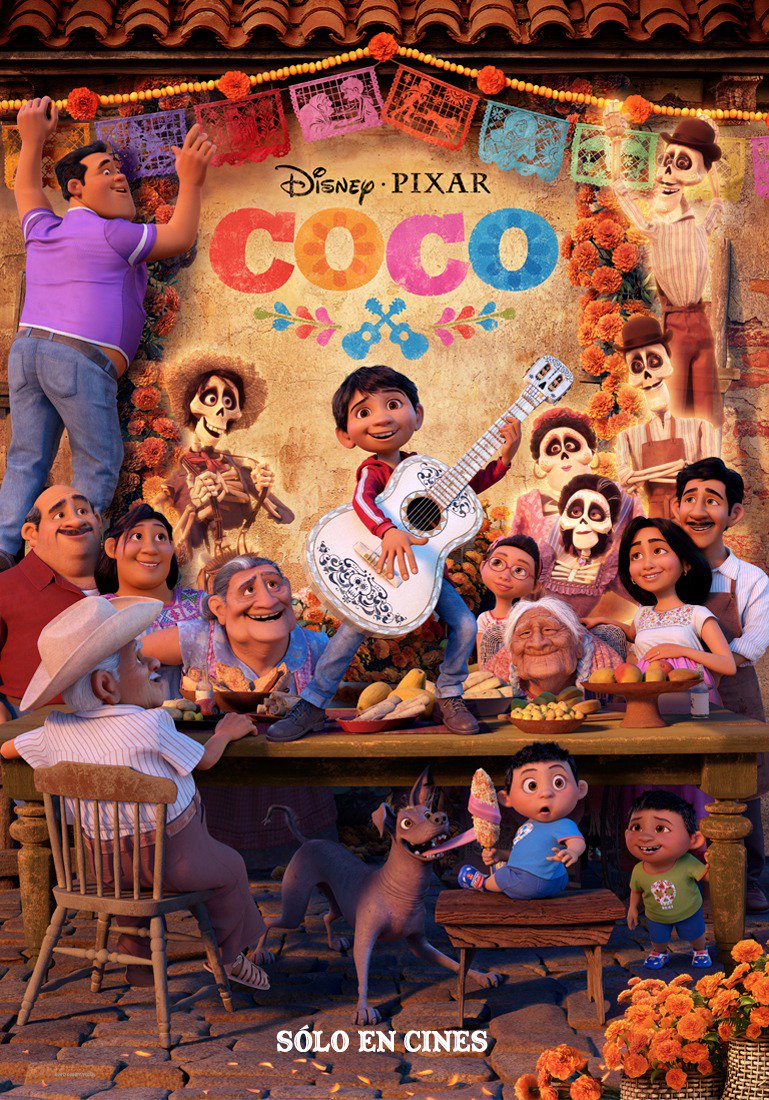
Slate has a great guide to the cultural references in “Coco” that people who are not of Mexican heritage might miss. (Note that co-director Lee Unkrich has responded to one of the points in the Slate article, saying that the use of both Dia dos Muertos and Dia de los Muertos was intentional to reflect the support for both they found in their research.

And this piece by Manuel Betancort about watching “Coco” with a Spanish language soundtrack made me sorry I don’t speak Spanish. He says that “Coco” is “Pixar’s most culturally specific movie in their lauded pantheon.”

Here at last was the kind of dubbing that didn’t feel like it was mangling, or weirdly bending the original into something it was not. It just had its characters talking (and singing) in the very language they were meant to speak. There’s a difference, for example, in hearing Miguel’s family talk about ofrendas (a word that always feels like it’s being italicized by its voice performers when speaking English, eager as they surely are to make it clear it’s a Spanish expression many may not be familiar with), and quite another to see that word just roll along in dialogue that doesn’t needlessly highlight it.

That’s perhaps even truer when it comes to Hector, the bumbling skeleton that Miguel befriends while in the Land of the Dead, and to Ernesto de la Cruz, the famed musical legend the musically inclined young boy admires and hopes to find while in that fantastical world. The former may be voiced by García Bernal in both versions (he’s one of a handful of actors who made good use of his bilingualism to score a double gig) but the latter, played by Benjamin Bratt, was dubbed by Marco Antonio Solís. And not to diminish Bratt’s singing abilities, but it truly is something else to hear the Pedro Infante-like character be portrayed by one of Mexico’s most recognizable voices.

Related Tags:


Behind the Scenes Race and Diversity Understanding Media and Pop Culture

AWFJ’s Movie of the Week: The Dancer

Posted on November 28, 2017 at 10:13 pm

The Alliance of Women Film Journalists has picked “The Dancer” as the MOTW (movie of the week). The recreations of Loie Fuller’s stunning performances are dazzling.

Betsy Bozdech writes:

Chances are, even people who wouldn’t describe themselves as “into dance” have heard the name Isadora Duncan and know something about her career and tragic death. But what about dancer and performance artist Loie Fuller, the innovator of modern dance who helped propel Duncan to superstardom in the early 20th century? Stephanie Di Giusto’s drama “The Dancer” remedies that by telling the story of Fuller’s complex, fascinating and often-heartbreaking life and career.

I’m proud to be one of the critics quoted by AWFJ in support of the film.

Related Tags:


Based on a true story Biography Critics
Lady Bird

Lady Bird

Posted on November 28, 2017 at 10:04 pm

A-
Lowest Recommended Age: Mature High Schooler
MPAA Rating: Rated R for language, sexual content, brief graphic nudity and teen partying
Profanity: Very strong language
Alcohol/ Drugs: Drinking and drunkenness
Violence/ Scariness: Mild peril
Diversity Issues: None
Date Released to Theaters: November 3, 2017
Date Released to DVD: March 5, 2018
Copyright 2017 A24

“Lady Bird? Is that your given name?” the patient priest who is directing the high school play asks at an audition. “Yes.” “Why is it in quotes?” The sign-up sheet reads: Christine “Lady Bird” McPherson (Saoirse Ronan). “I gave it to myself,” she says. “It’s given to me by me.” Perhaps she selected the name because she is getting ready to fly away and the thought thrills and terrifies her.

Christine “Lady Bird” McPherson is a senior in high school, on the brink of that moment when we are heady at the notion of inventing ourselves. We meet her coming home from a trip with her mother (Laurie Metcalf) to visit colleges near their home in Sacramento. They weep silently together at the end of an audiobook and bicker about the things that mothers and teenage daughters bicker about. Lady Bird (as we will call her) wants to go to college in the East, “where writers live in the woods.” Her mother, a nurse, is trying hard to balance the need to be practical about finances — Lady Bird’s father is about to lose his job — with the parental instinct to protect her daughter from the most unpleasant realities of life, including her parents’ inability to make everything work out. Fortunately, if frustratingly, Lady Bird has retained the solipsistic luxury of tuning out most of what her parents tell her.

Writer/director Greta Gerwig captures with breathtaking precision that liminal moment when teenagers manage to mash-up grandiosity that stretches to infinity and soul-crushing insecurity. “Math isn’t something you’re terribly strong in,” a nun (Lois Smith) tells her diplomatically. “That we know of. Yet,” Lady Bird replies. “I just want you to be the best version of yourself,” her mother tells her. “What if this is the best version of myself?” she asks. Metcalf’s expression on hearing this question contains multitudes of sympathy and maybe a touch of envy at the endless possibilities spreading out in front of her daughter.

This is one of the best ensemble casts of the year. Metcalf and Tracy Letts, as Lady Bird’s parents, Smith and Stephen McKinley Henderson as her teachers, “Manchester by the Sea” Lucas Hedges and “Call Me By Your Name” Timothée Chalamet as boys she likes, and Beanie Feldstein and Odeya Rush as her friends are all superb. Gerwig never lets even the smallest roles be anything but specific and complex. The episodic storyline brims with telling, meticulously observed moments. Lady Bird and her mother stop bickering for a moment in the thrift store when they suddenly unite in the ecstasy of finding the perfect prom dress (inspired, Gerwig told me, by “Pretty in Pink”). Her father finds himself competing for a job with his own son, pride and support edging just slightly ahead of desperation. Lady Bird makes some bad mistakes in judgment but there are no bad guys here, just people trying to figure out who they are and connect without hurting or being hurt, still young enough to assume that it’s only a matter of time.

Parents should know that this film includes very strong language, sexual references and situations, teen drinking, and mild peril.

Family discussion: What name would you pick for yourself? Is Lady Bird more like her mother or father?

If you like this, try: “Frances Ha” and “Edge of Seventeen”

Related Tags:


Drama DVD/Blu-Ray movie review Movies -- format School Stories about Teens
Three Billboards Outside Ebbing, Missouri

Three Billboards Outside Ebbing, Missouri

Posted on November 27, 2017 at 6:37 pm

A-
Lowest Recommended Age: Mature High Schooler
MPAA Rating: Rated R for violence, language throughout, and some sexual references
Profanity: Very strong, explicit, and crude language
Alcohol/ Drugs: Drinking, smoking
Violence/ Scariness: Graphic violence, characters injured and killed, suicide
Diversity Issues: None
Date Released to Theaters: December 1, 2017
Date Released to DVD: February 27, 2018
Copyright Fox Searchlight 2017

I sing the rage of Frances McDormand, who plays Mildred Hayes, a grieving mother who is not so much consumed by righteous fury as filled with a desperate need for it to consume everyone else around her. There is no better actor to convey fury than McDormand. When she is good, she is very, very good, but when she is mad she is better.

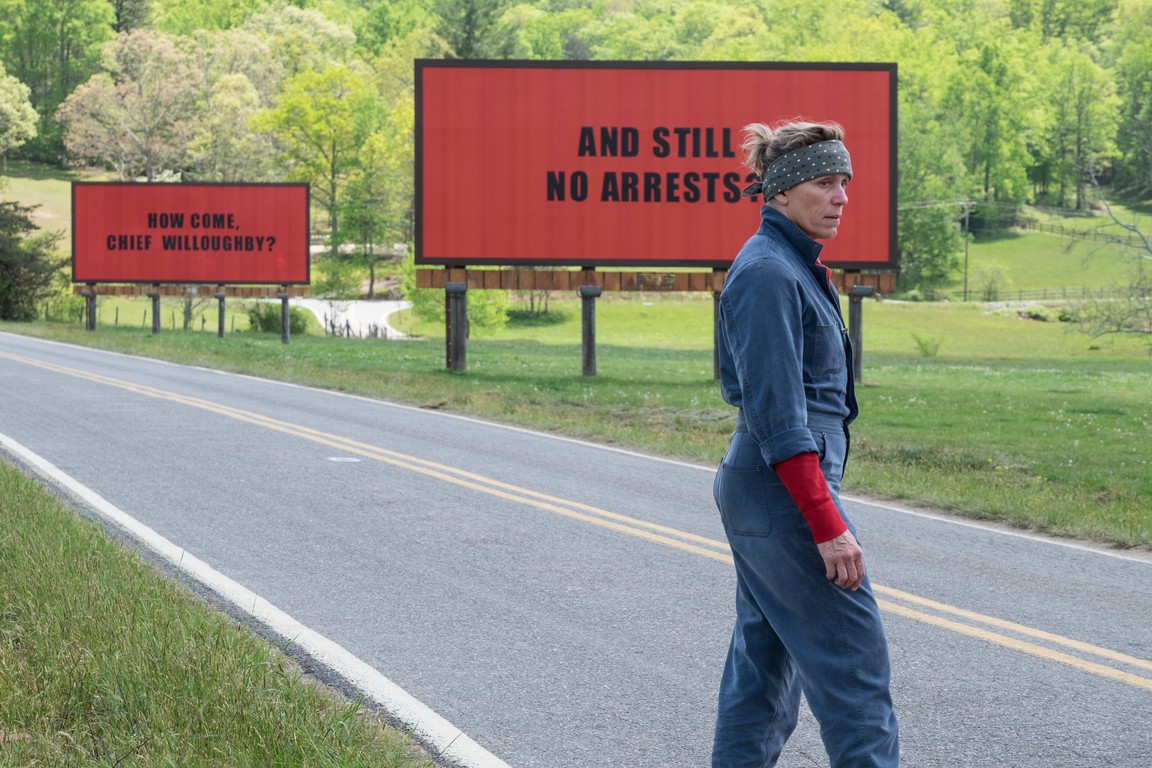
It is seven months after Hayes’ daughter was raped and burned to death and there have been no arrests. There are three billboards near her home in Ebbing, Missouri that are crazy quilts of tattered leftover, shredded images from layers of advertisements brightly urging drivers to buy Huggies or visit the Ozarks. She visits Red (Caleb Landry Jones), who is responsible for renting out the billboards and gives him $5000 for one month. On oxblood-red backgrounds, the stark white letters now say, “Raped while dying,” “And still no arrests,” and “How come, Chief Willoughby?”

That provokes a visit from the police chief (Woody Harrelson) who is compassionate and frank. There were no witnesses. The DNA does not match anyone in the system nationwide. He wants to find out who did it, but there is not much he can do.

The billboards are unsettling to the town, especially Officer Dixon (Sam Rockwell), who is the kind of dim, resentful guy who expresses his insecurities by abusing others, especially African Americans. Only Willoughby sees that Dixon could be a better man. His angry, racist mother spurs him on to worse behavior.

Writer/director Martin McDonagh (“In Bruges,” “Seven Psychopaths”) has a savage humor and an ear for the poetry in the way real people speak. In this film, he shows a warmth and humanity we have not seen before. In one scene, Hayes’ fury is instantly defused when a character shows unexpected vulnerability. In another, she has a conversation with a deer who wanders over to one of the billboards as Hayes is planting flowers. McDormand has always been one of our finest actors and here she gets a chance to inhabit one of her most complex characters and does it beautifully. Whether she is striding around like a warrior in a denim jumpsuit and a bandana wound around her head or unable to conceal a small smile at the ruckus she is creating, she is a force of a nature and a wonder to watch. Everyone in the cast is outstanding, with special mention of Harrelson and Rockwell and of newcomer Jones, a breakout this year in films including “American Made” and “Get Out.” Hayes’ fury is like a firework lighting up the sky, but it is only when it is out that we can see the stars in these deeply compassionate portrayals.

Parents should know that this film includes references to a horrific rape and murder of a teenager and it shows serious violence with severe injuries, as well as very strong and crude language, drinking, and smoking.

Family discussion: Did the billboards help? What else could she have done? What will happen next?

If you like this, try: “In Bruges,” “Fargo,” and “Olive Kitterige”

Related Tags:


Drama DVD/Blu-Ray movie review Movies -- Reviews
THE MOVIE MOM® is a registered trademark of Nell Minow. Use of the mark without express consent from Nell Minow constitutes trademark infringement and unfair competition in violation of federal and state laws. All material © Nell Minow 1995-2026, all rights reserved, and no use or republication is permitted without explicit permission. This site hosts Nell Minow’s Movie Mom® archive, with material that originally appeared on Yahoo! Movies, Beliefnet, and other sources. Much of her new material can be found at Rogerebert.com, Huffington Post, and WheretoWatch. Her books include The Movie Mom’s Guide to Family Movies and 101 Must-See Movie Moments, and she can be heard each week on radio stations across the country.

Website Designed by Max LaZebnik