The Big Sick

The Big Sick

Posted on June 22, 2017 at 5:53 pm

B +
Lowest Recommended Age: Mature High Schooler
MPAA Rating: Rated R for language including some sexual references
Profanity: Strong and explicit language
Alcohol/ Drugs: Alcohol
Violence/ Scariness: Very serious illness
Diversity Issues: A theme of the movie
Date Released to Theaters: June 24, 2017
Date Released to DVD: September 25, 2017
Copyright Amazon 2017

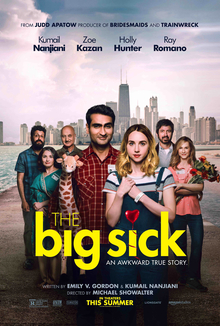
The more specific the story, the more universal. This is a very specific story. Indeed, you are unlikely ever again to see a romantic comedy with one of the pair spending half of the film in a coma. And that is not the couple’s biggest obstacle. Kumail Nanjiani (“Silicon Valley”), plays a character named Kumail Nanjiani in a story based on his relationship to Emily V. Gordon (played by Zoe Kazan and called Emily Gardiner in the film), who is now his wife and the co-screenwriter of the smart, touching, heartfelt and very funny film. It is beautifully directed by Michael Showalter, as always unsurpassed in meticulous casting of even the smallest roles.

Real-life Nanjiani and his movie alter ego are Pakistani immigrants from traditional families. Every time he visits his parents for dinner, an unmarried Pakistani woman “happens to drop in.” They have made it very clear that they expect him to marry a woman who is Pakistani and Muslim. Gordon is neither; she is white and from North Carolina. Just after they break up because he could not say that they could have a future together, she suddenly becomes critically ill and is placed in a medically induced coma.  He gets the call when she is hospitalized and has to be the one to call her parents. He meets them for the first time in the hospital waiting room, where they are understandably frosty (he broke their daughter’s heart) and preoccupied (she’s in a coma).

They would rather that he not be there. And his parents find out that he has not been honest with them and they tell him they cannot accept his feelings for Emily. So, in the second half of the movie there is another kind of love story, about the love between parents and their children and the partners their children choose.

It is also a story about a man learning to be honest with himself about who he is and what he wants. What lifts this out of the recent glut of arrested development movies is its compassion for all parties (the film nicely acknowledges that Nanjiani’s brother has a very successful and satisfying marriage arranged the traditional way and presents as one of the candidates a woman so seemingly perfect for him that we almost root for her) and Nanjiani’s thoughtful, self-deprecating but confident performance. The best stand-up comics mine their own lives for material, with observations that make us see our own lives, and especially our follies and irrationalities, in sharper relief — that’s relief in both senses of the word.

Best of all, the movie itself is proof that they lived happily ever after.

Parents should know that this movie includes strong language, sexual references and non-explicit situations, family conflict, and very serious illness.

Family discussion: Why didn’t Kumail tell Emily about his family’s concerns? How should you decide what traditions to keep and which ones to leave behind?

If you like this, try: “Ruby Sparks” (also with Kazan, who wrote the screenplay) and “50-50” with Joseph Gordon-Levitt and Seth Rogen, also based on a true story
Related Tags:


Based on a true story Comedy Comedy Date movie Drama DVD/Blu-Ray Pick of the Week Family Issues Illness, Medicine, and Health Care movie review Movies -- Reviews Romance
Maudie

Maudie

Posted on June 22, 2017 at 5:29 pm

B +
Lowest Recommended Age: High School
MPAA Rating: Rated PG-13 for some thematic content and brief sexuality
Profanity: Mild language
Alcohol/ Drugs: Alcohol, smoking
Violence/ Scariness: Tense family confrontations, domestic abuse, illness, sad death
Date Released to Theaters: June 24, 2017
Date Released to DVD: October 10, 2017
Copyright Sony Pictures Classics 2017

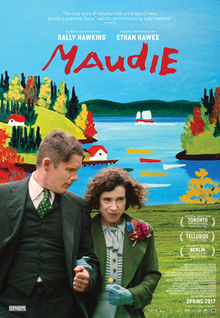
Maudie Lewis was severely disabled and abused. She lived in a tiny house with no electricity or running water in the unforgiving climate of Nova Scotia. And she decorated her tiny world with vibrant, joyful images that captivated the people who came to her door to buy them, usually for as little as $5. Her home, the walls covered with bright flowers and birds and cats painted over 35 years, is now seen by art lovers in the museum where it has been lovingly preserved, and she is recognized as one of the foremost “outsider” (untrained) artists of the mid-20th century.

In “Maudie,” the infinitely gifted Sally Hawkins gives an incandescent performance as the woman whose indomitable spirit shines through her art.

After her parents died, Maudie lived with an aunt who treated her with contempt. She left to take a job as a live-in housekeeper for Everett Lewis (Ethan Hawke), a fisherman taciturn to the point of being a recluse. “You walk funny. Are you a cripple?” he asks bluntly. And he tells her that she comes after the dogs and the chickens in importance. And that he expects her to sleep in his bed as a part of the job. When he wants more, she tells him that he must marry her, and he does.

With some leftover house paint, holding the brush in her arthritic fingers, she paints a flower on the wall. And surprisingly, Everett does not disapprove; he only tells her to leave one section of the wall alone. A summer visitor from the US spots one of her paintings and brings it back to New York. Vice President Richard Nixon buys one, too. Everett is glad for the income and worried that Maudie will become independent and leave him.

Director Aisling Walsh insisted on filming on location and created a meticulous replica of the tiny Lewis home, and the setting itself, bleak and beautiful, with minimal musical score becomes a character in the film. So do Maudie’s pure, simple paintings, expressing her unquenchable joy in observing the world around her and in expressing what she sees. Hawkins is a marvel in every scene; like Maudie herself, she commits herself completely to the creative spirit.

Parents should know that this film includes sexual references and situations, references to out of wedlock child, mistreatment of disabled character, and a sad death. Characters drink and smoke.

Family discussion: Why did Everett tell Maudie not to paint one part of the wall? Why did he change his mind about selling the painting she said was not finished? What was happiness to Maudie?

If you like this, try: “The Straight Story”

Related Tags:


Based on a true story Drama DVD/Blu-Ray Pick of the Week Romance
The Beguiled

The Beguiled

Posted on June 22, 2017 at 5:22 pm

B
Lowest Recommended Age: Mature High Schooler
MPAA Rating: Rated R for some sexuality
Profanity: Mild language
Alcohol/ Drugs: Some alcohol
Violence/ Scariness: War (off-screen), injuries, murder
Diversity Issues: Gender issues
Date Released to Theaters: June 23, 2017
Copyright 2017 Parmount

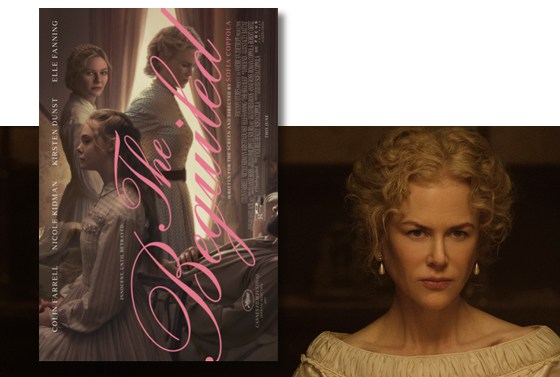
Writer/director Sofia Coppola has taken a 1971 Clint Eastwood movie about a wounded but manipulative Civil War soldier cared for and disruptive of the staff and students of a small girls’ school and reframed it as a story about the staff and students of a small girls’ school who care for and are disrupted by a wounded Civil War soldier. It is not so much telling the story of the spider and the fly from the perspective of the fly; it is more like telling the story with the women as the spider.

From her first film, “The Virgin Suicides,” through “Marie Antoinette,” “The Bling Ring,” “Lost in Translation,” and “Somewhere,” Sofia Coppola has been transfixed by stories of slender, ethereal young women who are a bit lost in a world created by powerful but inadequate men, and she has done her best to transfix the audience as well. Her next project, “La Traviata,” the story of a consumptive courtesan who turns out to be more noble than the man she loves, is certain to fit this pattern as well.

It is impossible to consider this latest work, a remake of a film directed by and starring two of the most testosteronic filmmakers in movie history, without that context. And that context is increasingly repetitive, with each iteration revealing not only the limits of the individual film but also the lacunae of the previous ones as well. What once seemed intriguing, mysterious, and thoughtful now appears, when the work is viewed as a whole, as superficial. It turns out that what was omitted was not because it was subtle and deep but because she had nothing more to say. While this film touches on issues of war (and warring emotions), it eliminates the slave character played in the first film by Mae Mercer, because there is really no way to do that relationship justice and any attempt to do so would throw the rest of the story off balance.

It is a pity, because she is just so good with the externals. The settings, costumes, music, and performances in her films are always superb, which makes the dispiriting emptiness even more disappointing.

Martha Farnsworth (Nicole Kidman) runs a small boarding school for girls, a retreat precariously close to Civil War battles being fought nearby. When one of the girls is out gathering mushrooms in the woods, she discovers a wounded Union soldier, John McBurney (Colin Farrell) and she brings him back to the school for treatment. Miss Farnsworth is not pleased, but she cannot turn him away. She treats him and tries to keep his presence as a male and an enemy combatant from disrupting the students and her co-teacher, Edwina Dabney (Kirsten Dunst). But he is a novelty and a distraction especially for those who long, perhaps unaware how much, for male attention.

McBurney has a gift for making each female in the house feel that he is what they most want him to be, from the teenager (Elle Fanning) to the widow (Dunst). “I’m grateful to be your prisoner,” he says. At first, he is gracious, unassuming, and charming. But he becomes a more ominous presence, dividing and disrupting the women until they take drastic action.

Kidman and Dunst are outstanding, representing two very different reactions to the intruder. It is precisely presented, even beguiling, but Coppola needs to move on or go deeper.

Parents should know that this film contains peril and violence including war (mostly offscreen), a wounded soldier, an accident, amateur surgery, mutilation, and murder, as well as sexual references and a situation, alcohol, and some strong language.

Family discussion: How did McBurney assess the vulnerabilities of each of the women and girls? How does this version reflect our era in differing from the original?

If you like this, try: the original version with Clint Eastwood

Related Tags:


Based on a book Drama Horror Movies -- format Movies -- Reviews Remake War

Interview: Writer/Director/Editor Brett Haley on Sam Elliott and “The Hero”

Posted on June 21, 2017 at 10:00 am

Copyright 2017 Northern Lights
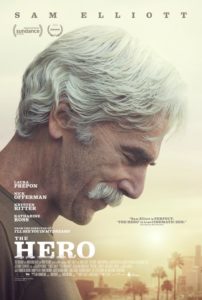
Sam Elliott played a small but very significant role in writer/director/editor Brett Haley’s last film, “I’ll See You in My Dreams,” starring Blythe Danner. The experience inspired Haley to create a lead role for Elliott, based very loosely on his own experience as an actor who has appeared in many westerns and has an iconic image. I interviewed Elliott about the role, and then I spoke to Haley about how it came about. “We became close on the set of ‘I’ll See You in my Dreams,’ and then we really became friends doing promotion for the film and I just knew that I really wanted to work with Sam. I knew that I just admired him as a person and a friend and also an actor and I just really wanted to give him a performance platform essentially and let him do something that we’ve never seen him do before. Of course, he is playing an actor that is known for roles that Sam in real life is known for, so there’s a weird sort of meta thing happening. But I don’t think he’s doing in this film what he’s done previously in other films. I think he shows a incredibly sensitive and vulnerable and humorous side that will be new to his fans. We wanted Sam to play an actor and so it would be hard to avoid the fact that he would be known for his voice and his western kind of status. So we use that in the film to play against and but then we go much deeper into what it means to be known for only one type of thing.”

Lee, the actor Elliott plays in the film, is neither as successful or as stable as Elliott is in real life. In the film, he is something of a has-been, with an estranged daughter and an ex-wife (played by Elliott’s real-life wife, Katharine Ross). Lee very much wants to be cast in a particular role, and in one of the movie’s highlights we see him prepare for an audition by reading lines with his friend and drug dealer, played by Nick Offerman. “We see him be an amazing actor when he’s rehearsing for the audition,” Haley said, “but the way he behaves in the actual audition and his carelessness with his life shows a lack of discipline and professionalism that I think is part of being a good actor. Auditioning and acting are two very different skills. Being a great actor doesn’t always mean that you’re good at auditioning. Auditioning is a whole separate skill. Even the most amazing actors blow an audition because of the pressure or because something is going on in their life. And being a good professional is a great thing but people like Marlon Brando and Orson Welles who are some of the greatest movie stars and actors ever, you could say that they were not always the most professional but I don’t think that makes them any less of an incredible actor. Being difficult or not having a good work ethic, these are human qualities that I don’t think have anything to do with being an actor. It’s really fun to see that Lee still has some gas in the tank as a performer, even if he does not have the discipline to handle the audition.”

Lee is invited to accept a lifetime achievement award from a group of western fans. He brings a much younger woman named Charlotte (Laura Prepon) and they get high together on the way there. “The event is something that’s meant to be seen as initially as disappointing, certainly not the Oscars or the SAG or the Golden Globes. It’s a small society of people that want to keep the western alive, that still love the western. Because Lee is on drugs, he becomes more open to the love that these people have for him, he accepts it. Having fun with it and not taking it so seriously and just being in the moment allowed him to then embrace the love of his fans and understand that it does mean something in the end to be loved by anyone, to be remembered even if it is for just one movie.”

I asked him about the unusual combination of writing, directing, and editing. “They’re all the same basic idea, shaping the story. You’re writing when you write it and you’re writing when you shoot it and you’re writing when you edit the film. You’re rewriting all the time. You’re always working on honing the story and making the elements work. That’s been part of my process since I was a kid making movies. I’m certainly thinking as I film of how to protect myself in the edit.”

Actors who have worked with Haley have said that they appreciate his flexibility in giving them a chance to try different approaches. “That’s all you’re doing as a director to a large degree is collecting material so you have options. You can’t be too set on getting it just one way. I’ve learned over the years you need to get as many ways as you can because you could be wrong and I like being able to play with it in the edit and have fun with it. I know what I want but I also think my actors will do their best when you let them bring their own interpretation to certain things. But I certainly think that we’re all on the same page before we get on set. That’s a really important distinction, so it’s not like they’re doing the scene in a completely different way that I would initially want. So by getting on the same page and then on set we are able to play and try new things and experiment.”

Haley said it was “a real treat” to have Ross play the role of the ex-wife. “Katharine is an icon in her own right, an amazing actor and an amazing woman. To have a real life married couple who play exes made it a lot of fun to play with because there’s a lot of history between Sam and Katherine and I think you can see it come across off screen. I think it was a little weird but also fun for them to play a couple with a lot of history and their real life experience informed a lot of the great work that goes on between them.”

Interviewer: As a writer you kept a lot of information away from us, you know I often think that’s the difference between an independent film and a studio film is how much they feel that they have to explain to you and you didn’t give us a lot of information about what happened in that relationship or what happened in a relationship with our we have a general sense of his not being there but how do you decide sort of where to, how much information to give the audience?

He does not overdo the exposition and backstory in his films. “I think about it in terms of how people actually talk to one another in real life. People don’t do monologues about their backstory when they’re seeing their ex-wife or their daughter or ‘let me list all the ways I was terrible to you’ or ‘you remember that time I was bad.’ I know that audience is a really smart and I think they understand what could have caused the rift between them. It’s clear that he was an absent guy, a selfish guy and I think that’s all they need. I think that the more specific you get when it comes to a back story it just becomes sort of a cheat, it’s telling the audience how to feel instead of letting them just simply feel. I always tend to go for the more subtle approach and let the actors’ faces tell the story rather than my words or some kind of exposition do the work.”

Haley was sensitive to avoiding the usual dynamic of a movie relationship between an older man and a younger woman. “I thought it would be interesting to see this character that Laura I think brilliantly plays, be more of the pursuer. He’s not really sure if he can trust her or not you’re not really sure what her intentions are with Lee. I wanted to play with that. I wanted Lee to be weirded out and cautious and just not comfortable with the situation and I thought that was a really fresh take. That’s what Mark Basch and I like to do. We like to take those cliches and we like to turn them into more honest and more appealing circumstances and characters. So it was a challenge to get right but I’m very proud of that relationship and how it comes off. It goes in very surprising places. It’s not as simple as beautiful young woman, old guy ending up together; it’s a lot more than that.”

Related Tags:


Directors Interview Writers
THE MOVIE MOM® is a registered trademark of Nell Minow. Use of the mark without express consent from Nell Minow constitutes trademark infringement and unfair competition in violation of federal and state laws. All material © Nell Minow 1995-2026, all rights reserved, and no use or republication is permitted without explicit permission. This site hosts Nell Minow’s Movie Mom® archive, with material that originally appeared on Yahoo! Movies, Beliefnet, and other sources. Much of her new material can be found at Rogerebert.com, Huffington Post, and WheretoWatch. Her books include The Movie Mom’s Guide to Family Movies and 101 Must-See Movie Moments, and she can be heard each week on radio stations across the country.

Website Designed by Max LaZebnik