
Interview: Gina Prince-Bythewood of “Beyond the Lights”

Posted on November 14, 2014 at 9:28 am

It was an honor to speak to one of my favorite filmmakers, Gina Prince-Bythewood, writer/director of one of this year’s best romantic dramas, “Beyond the Lights.” As I spoke to her, she had just received word that Gugu Mbatha-Raw, who stars as Noni in the film, had been nominated for a Gotham award.

Copyright 2014 Relativity Media

You must be so proud of this great recognition for Gugu Mbatha-Raw.

It was a pretty phenomenal morning to wake up to that.  Gugu started working on the character really for two years but really hard-core for six months in terms of being in the dance studio for hours, a couple of days a week and then the vocal studio with the vocal coach and the amount of work she put into this character knowing that this character is a hundred and eighty degrees from who Gugu is.  You know how bold and brave she had to be to put this out there and to go there and we knew we had to go there given what is happening in the industry now and needing to compete with that and having the knowledge that you have to lead an audience into a world before you can lead them out. So, the fact that she bought into the vision of the piece and really went there — it is just a beautiful thing that she is being recognized and not only for the incredible work she did but in terms of just the preparation. But she gives a really phenomenal performances. I love that it is being recognized.

As a woman who writes and directs, you did a particularly good job of addressing the objectifying elements of what goes on in show business today. Was that an important theme for you to address?

Absolutely. first as a woman who is seeing what happens especially in the music industry and the blueprints that the young artists have to follow to make any sort of noise when they first come out, it really is hypersexualized. But also as a mother of two boys in seeing the trickle-down effect that is happening, the hyper sexualization becoming normal and teen girls and teen boys – and the things that they are doing now are very frightening to me as a mother. And we really are hoping that the film can change the conversation.

I like what you said a moment ago by taking people into the world before you can take them out of it. Tell me a little bit about what that means to you.

Copyright 2014 Relativity Media

For me to put this out there, I mean it was hard shooting the music video as at the beginning of the film and putting that out there in the world and telling an actor to put that energy out. We went there because it was necessary. This is the character that five minutes later is on the edge of a balcony about to jump and we really needed to show the psychological effects on a 10-year-old girl who just wants to sing, who’s probably in front of a mirror singing into a hairbrush and no one dreams about being in an artist and putting that kind of energy out but to make this dramatic jump to that music video and I want the immediate question of how did that happen, how did that little girl become this and what is the psychological effects of that film. So we had to push it and we had to go there because it was important to the story that we were telling.

You have said that you were very glad to be working with Nate Parker again on this film.  What makes him one of your favorite actors?

I love Nate as an actor because he has no inhibitions and he would just go for it and that karaoke was a scene that he had to do that. Obviously he is not a singer and he just wanted to do it live and whatever came out of his mouth came out of his mouth. There was a real crowd out there but he just threw himself into it and it is so great the reactions that the audience get when they see it because this character has been so reserved and serious. It was really important to see them thrive in Mexico, both of them letting go and finding their voice and falling in love. And that was a really important aspect to see his character see what Noni brings out in him as well as what he brings out in Noni.

What is next for you?

The next one I am going to write, I’m very excited about it but I can’t talk about it too much. It does deal with female friendships.  All my films have a personal aspect and this one is no different, so I’m very excited. And it will be a little more comedic in tone.

You create some of the best love stories that I’ve seen on screen and it is a compliment to say they remind me of the classic romances of the ‘40s with actresses like Bette Davis and Barbara Stanwyck. Are you a fan of that era of movies?

That is a tremendous compliment, thank you. I have to say the great things about film school is being exposed to films that you normally would never see and you get to seei them on the big screen, films like “The Apartment,” which is I think is such a great film influenced on me, “The Rose” is a fantastic film that came out in the ‘70s, “Lady Sings the Blues,” I love that type of romance, to wrecked by movie emotionally and then be built back up and leave inspired.  Those are the kinds of films I love to watch and so for me it is writing what I want to see.

Related Tags:


Directors Gender and Diversity Interview Race and Diversity Understanding Media and Pop Culture Writers

Interview: Laura Poitras of the Edward Snowden Documentary “Citizenfour”

Posted on November 5, 2014 at 12:00 pm

I normally begin my interviews by asking for permission to record the conversation for my notes.  But there was something eerily resonant about that routine request when I spoke to journalist Laura Poitras, director of the new documentary “Citizenfour,” about Edward Snowden, a contractor for the NSA who leaked massive amounts of confidential information about the pervasive and invasive intrusion of government spies into private exchanges by phone or email, even without any evidence of a threat to national security.  Snowden first contacted Poitras, identifying himself only as “citizenfour.”  They agreed to meet in Hong Kong, and most of the film takes place in his hotel room, as, joined by Guardian reporter Glenn Greenwald, they prepare for the release of the information and their stories about it.  Even though we know what happened, it is tense, gripping, and mesmerizing to see those last few moments before Snowden’s face was on front pages and every newscast around the world.

Poitras agreed to be taped, noting that she had to assume she was always being recorded.  I began by asking her about the limitations she felt as a filmmaker in making a visually dynamic film while being confined to just one room.   “At first when I walked in, it was like ‘oh wow, this represents limitations here. We are still stuck in this room, the walls, there is so much white in the room, there is no space.’  That was my first impression but I think actually in the editing room I realized that there are ways in which it was really a blessing, that you get this kind of claustrophobic feeling that increases over the days and that time sort of stops and then slowly we feel the outside world coming in.  So I do think in the end it turned out to be a positive thing. And then in terms of the dynamics that happened, it was pretty extraordinary for the building of events – from the first meeting to the publication to the global reaction, and then ultimately to Snowden leaving and going underground so I feel it was really interesting in the fact that is kind of awkward in this contained place. Honestly I was thinking there is a lot of white in this room.  White is not easy to work with but I think in retrospect I am appreciative of that circumstance.”

I asked how to achieve the right balance between secrecy and privacy.  “From what I’ve seen since 9/11, we’ve eroded civil liberties in the name of national security and I think that the government is becoming increasingly secretive about what it is doing. People know less and less and so for instance in terms of NSA surveillance, there is a public law, and then the government has the secret law or secret interpretation of that law. And I think that is really problematic.  I don’t think that these kinds of policies or decisions should be made behind the scenes by people in secret with no public debates or inner knowledge.  I think that is problematic and I think we’ve been drifting more and more into increasing secrecy in the government. It’s a problem. Elected officials are there on our behalf and we should know what our government is doing. I think is also false to say it is making us more secure because what we have right now is a situation where the U.S. is going around the world and making more enemies than it is making friends.  We should re-think our policies.  James Risen has a book, Pay Any Price: Greed, Power, and Endless War. This idea of the endless war — we have been at war since 2001 with these various countries and now we are seeing some of the unintended consequences of that. I would question whether or not the policy direction that the U.S. is going is actually making us any safer and I think there are lots of evidence to suggest that it is not. And collecting information on people who are suspected of nothing on a large massive scale doesn’t make us safer either because then here we have intelligence agencies that are drowning in too much information plus we are violating fundamental rights of our citizens around the world.”

She disputes the argument that the massive collection of data makes it less personally invasive. “I don’t think so at all, I think if you look at for instance journalists, if you’re collecting the call records of all journalists and you want to know who are their sources then you just query their phone records and so I think that it can be used in very invasive ways. I don’t think that because they collect so much it means that it is less invasive.” And she does not think that this level of surveillance would have prevented 9/11. “The CIA knew that there were people who came into this country and they didn’t pass the information to the FBI. So that is not example that they are swimming information it is that they didn’t communicate it to the people who could have prevented what happened.

Poitras is concerned that the depth and breadth of the information collected is itself a security risk. “There are people saying something like five million people have security clearances in this country. That is a lot of people. And there is more and more contracting out to other people who are not even working for the government. They are working for private companies and all have access to this amount of information.” I asked her to compare the intrusion of government with the apparently even more massive use of personal data by corporations like Google and Facebook. ” I think it is different. The power that the government has is very different than the power that the private company has. So I think there are actual big differences in terms of how this information can be used. But I think they people should also questions about how much information these companies have about us.” And, she pointed out, the government can use the information collected by Google and Facebook as well. “I also think there is a question of consent. When do you consent to share information and what is not consent.”

She respects the work of Senators Ron Wyden and Mark Udall in trying to establish more accountability and better policies, “but I also think that they could go further. They have immunity, so that they can come forward and let the public know what is happening if they have concerns about the scope and extent of these kind of programs. I’d love to see a real inquiry into the extent of surveillance and I think that those two senators are the forefront of pushing for that, but I urge them to do more.” And is Edward Snowden a hero? “That is not a question I engage in. I just find it a bit reductive and so I will pass on that question.”

Documentary filmmaking is now one of the most dynamic and compelling forms of journalism, so I asked Poitras what a movie can do in reporting that print cannot. Her answer was more about the timing issue than the format.
“They are totally different. They are both bound by by journalistic principles of making sure you do your fact checking and all that kind of stuff but it also needs to have more lasting meaning and raise more universal questions. Otherwise it is not going to be interesting. When I work on a news story, it has a certain impact but in a documentary, we were very clear in editing room our job is not to break news. That I can continue to report on this material and work on the news but the film needs to say something that is not just interesting for a certain amount of time but that will have lasting resonance and so for me, it is a question about individuals who take personal risks and that becomes more of a universal story. Yes, it is about NSA and NSA surveillance but it’s about human nature in different ways.”

Related Tags:


Directors Documentary Interview Politics

An Interview With Planes: Fire & Rescue Stars Erik Estrada and Fred Willard

Posted on November 3, 2014 at 8:00 am

Copyright Disney 2014

Erik Estrada and Fred Willard provide two of the most distinctive voices in Disney’s Planes Fire and Rescue, and it was a great treat to hear those voices through my telephone, as both actors called me to talk about their roles.  The DVD/Blu-Ray is available November 4, 2014

Estrada plays a version of himself, or at least himself as a helicopter inspired by his most iconic character, Ponch from the television series CHiPs. “They told me that they were doing a TV show within the movie,” he said.  “One of the lead characters actually played a helicopter officer, because you know we are all machines now.  They wanted to give him a partner but they wanted to do it in a way that it was called CHoPs in parallel to CHiPs.  So that they could bring two characters on and explain why hewas a racer and then became a firefighter. And so they said, ‘We want to do the Ponch character but we want to do him as a helicopter,’ and I said ‘Okay!’ It is Disney and I love Disney and I raised my children on Disney and I practically live in Disneyland and Disney World.  I have always had a wonderful experience with Disney and it was great to be hired by them and work for them.” So we did it and it turned out to be really cute, it is really, really cute, the character is funny and it just gave me flashbacks.”
Estrada got to see a picture of his character before he recorded the voice.  But it was not hard for him to get back into Ponch mode.  “I didn’t have to psyche too much because I am Ponch. Originally when I auditioned for Ponch, he was an Italian American cop, very aggressive, very gung-ho, very gregarious and I have a lot of that in my personal attitude but when I got them I made him a Latin American.  I just drew on my background and drew on my insides and basically Ponch was me and I was Ponch.  My character in this movie is a bit aggressive, too.  He’d call a car ‘punk’ and of course my partner says, ‘Calm down, calm down,’  just like Larry Wilcox would have done on our show.”  Estrada especially enjoyed attending the premiere of the film, with a special dinner for the performers, because it was the first chance he had to be with the other actors.  “It was great to see all the other planes and trucks, all the characters, it was great. “I got to see everybody I had not seen in a long time. People that I knew, like  Stacey Keach who, I had done The New Centurions with back in ‘71, and Ed Harris who has done an episode of CHiPS and he didn’t know how to ride a bike and I gave him a real quick know-how. That was kind of nice seeing him again.” Estrada says he knows why everyone loves stories about cars and planes and trains: “Because we all started out in strollers. We started out in strollers, and the first thing we notice is the wheel.  They see that first before they see anything else. And so we relate to it and we liked them little cars, we liked the colours, we liked to make noise and we like them – and if you see them in a movie, then you really want to get them.”

Fred Willard’s character is an important government official, an SUV who is the Secretary of the Interior.  “Very political, yes. Very, very political,” he said,  “He’s kind of conservative, concerned with his responsibility. I kind of went for the generic official, with the grey suit you see in all these shots of Congress and the Senate, always making very well pre-planned statements and being very aware of his public image and not suffering any stupidity from underlings. He just kind of considered John Michael Higgins’ character as kind of an annoyance. He had to handle him diplomatically but still feeling a little superior to him. I was always fascinated with those kinds of people. I worked in an office in New York for three years when I first started and I had a lot of bosses who were very stuffy, with nonsensical rules and I was always coming in late in the morning and I had to look at these directives about punctuality, and I was kind of secretly amused by some of those characters.”

Willard said, “I like to do voice things because when you see what you portray on the screen, it is not me so I am relaxed, I don’t say ‘how do I look like that at that day, what did I do with my hair, why was I standing this way,’ anything like that. So I usually enjoy that more than seeing myself live on screen.  You have to depend a hundred per cent on your voice, so it is a lot easier in some ways and it is more of a challenge, too. Sometimes they put all those electrodes on you and as you move they film your movement, and I’ve done it where they filmed your face and that is strange too, but you still don’t look like yourself.”  He recorded alone at first, but then they had him come back to record with his frequent co-star in the Christopher Guest films, John Michael Higgins. “They wanted us to get together to do our lines, maybe come up with some new lines or some interplay. ”  Working on the film reminded him of the toys he loves as a kid. “I just kind of think back to my own childhood. I had little toy trucks and cars, and I was into little toy soldiers, I remember, but I was very fascinated with airplanes.  When we went into the studio and I saw the little models of all the planes. I just wanted to grab a couple and stick them in my pocket and bring them home. It was fascinating.  But here it is pocket size and you’re kind of in charge of it and that gives you a feeling of power.”

I asked him for the best advice he ever got about acting.  “To know your lines – not just know your lines but be on top of them so they come second nature. And then step into whatever character you are. And if you’re improvising, just try to stay in the scene and move the scene forward.”

Both Willard and Estrada said they’re hoping for a third “Planes” movie. If so, I hope I get to talk to them again.

Related Tags:


Actors Animation Interview

Interview: Todd and Jedd Wider about the Bullying Documentary “Mentor”

Posted on October 24, 2014 at 3:56 pm

Producers Todd and Jedd Wider generously took time to answer my questions about their documentary, “Mentor,” the story of two teenagers who committed suicide following relentless bullying. The film, which received Honorable Mention for Best Documentary Feature at the 2014 Woodstock Film Festival this past weekend, will be shown this week at the Austin Film Festival:
Sunday, October 26 at 12:00pm @ Rollins Theatre
Thursday, October 30 at 7:00pm @ IMAX Theatre

How did you first hear of the problems in Mentor?

We read about the problems several years ago as we were researching an idea to examine the concept of bystander versus upstander behavior.

Was it difficult to get the cooperation of the families?

No, they were very willing to help and wanted to share their stories.

What is the status of the lawsuit?

The Mohat lawsuit was settled, the Vidovic lawsuit is on appeal.

If you could have interviewed the principal or school counselor, what would you have asked?

All school representatives refused to speak with us. We would have asked one simple question: why?

If you could have interviewed the bullies, what would you have asked?

This film really is about the victims and the devastation that bullying can bring to individual families and the community at large.

What makes kids into bullies?

We feel that at this moment in time, with the rise of internet and social media, bullying is increasingly easier because it is more anonymous and impulse control is reduced to simply deciding to click a button on your computer. The anonymity has made the bullying more vicious because one can seemingly bully with almost no ramification. Look at what happened after Robin Williams tragic death with the amount of hateful tweets that his daughter received. In the past, when we grew up, you had to look someone in the eye if you bullied them. Now, you do not. The internet has essentially created a generation of cowards. As to why kids do it? One root cause has always bothered us which is the choice to pick on the outsider. You rarely see the captain of the football team or the head of the cheerleading squad getting bullied. It happens, but it is more rare. Usually it is a child that is somehow branded an outsider–a person that dresses a bit differently, or perhaps is smarter, or speaks differently, or thinks about things differently. There is a real tragedy here because we are a nation built from diversity. It was the diversity of all of the people that came here and brought with them different ideas and skills that helped build this nation. We should be celebrating diversity, not denigrating it.

Did the school take any steps in suicide prevention education and support?

You should ask the school this. We would argue not nearly enough was done.

What can schools do to be more effective? Are there any communities that have responded more effectively?

We feel that schools and parents need to teach kindness and empathy to children. One excellent program that helps kids learn basic civics and decency is Facing History and Ourselves which is available in many school around the country and internationally. If your school doesn’t offer this program or a similar program, ask your school administrators to bring it to your district.

Related Tags:


Directors Documentary Interview School Stories about Teens

Interview: “Avatar” Villain Stephen Lang on Playing a Good Guy Coach in “23 Blast”

Posted on October 24, 2014 at 5:56 am

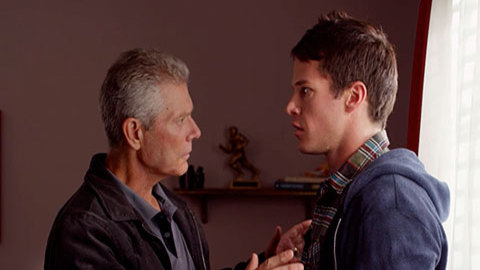
Stephen Lang is best known for playing the villain in “Avatar.” But in “23 Blast,” based on the real-life story of Travis Freeman, a high school football player who lost his vision but stayed on the team, Lang plays a good guy, the coach who encouraged and supported him. I talked to Lang about acting and what it is like to play a real-life character you know will be watching.Copyright 2014 Touchdown Productions

I’ve seen you play a lot of bad guys and a lot of guys from other eras and it was really nice to see you playing just a regular nice contemporary guy. What was that like for you?

I didn’t give it a whole lot of thought, being nice or not nice, you know when I was still making this film, but when I watched the film I was like, “ Huh, what is it about this that…oh yeah, I am actually sympathetic. Wow.” And I realized, gee it’s kind of a while since I played someone who is not doing things bad things to people, so it is really quite a pleasure to watch.

From the very first scene, when you’re coaching the little kids, we see how decent and honorable your character is.

I love that scene. This is one of my favourite scenes in the movie. You know if you recall in this they were really little kids, you know.  And the bench was kind of high and their feet didn’t even touch the ground; they all were in football uniforms. And we only had this one bench and it really was not a very long bench. And we had like eight or nine kids crammed down to the bench, right and I was kind of at the end of the bench. So if you were the kid furthest away from me you had to lean far out so we could see everybody. And there was a kid who leaned far back, he just tumbled off and fell on his head. Once we made sure he was okay, it was very funny, a kind of slow motion dance.  It was what we would have called precious.

I had the pleasure of interviewing Dylan Baker last week, so I got his take on what it was like to be a first time director, but tell me about what it was like to work with him.
I’ve known Dylan and have really a lot of respect for him as an actor – as an actor’s actor.  I was pleased to be asked to be part of his effort and I suspected that he would do a good job. I knew he would do a good job with the actors. And in fact, he did. And you know, he was well supported, I think from the technical side. I think he came into it knowing a certain amount but until you have actually directed, I mean so what. But he was really up to the task in that movie, it looks quite splendid.  And I enjoyed working with him very much. We worked to fine-tune it together. He was very open to what I brought to it, and it was always very clear about stepping in and saying, “How about if we tune this, try this and everything.”  I worked in concert with him. And I know that when I deal with him, I’m dealing with somebody who is intimately familiar with the whole process. So it was an altogether pleasurable experience.

When you take on a role like this, how much is what is on the page and how much is based on meeting the real person?

It really would depend on the project. If you were playing Bear Bryant for example, a coach who is nationally renowned,  it would be really a wise thing to study very, very hard, understanding that the audience already has an expectation of the character. But Coach Farris is a wonderful guy, he is physically quite different from me and I met him during the filming and enjoyed meeting him but I felt there was enough on the page for me to work with and to create my version of who this coach was and hopefully he is satisfied. There are no historical imperatives for me to be concerned about. When I played Stonewall Jackson, you want everything dead on accurate as you can be or if you are going to make an alteration, you want to know you are doing it because it is a choice, maybe because dramatically it may better than the truth. There is a tremendous amount written and said about Jackson so we know. The same cannot be said of Coach Farris. Although down in Portland I think he is quite well known and anyway, a nice guy.

Did you play high school football?

Yes, and I was a center, like Travis in the movie. I had a coach who was a really good man and a really good coach, for football and lacrosse.

You have done a lot of theater. Can you tell me a little bit as an actor about what it is that you can do in a film role that you can’t do on stage?

I would say in film very often it is a question of mastering mechanical skills, whether it be hitting your mark while you are riding a motorcycle or jumping off something. Not that that doesn’t occur on stage but theatre is that experience that you shared that you’re having and it is there and it is gone. Film is just this recorded out of sequence moments.

What’s the best advice you ever heard about acting?

Hit your mark and tell the truth. One actor did say to me years ago something which I have thought of over the years, because you know it is a tough business, right? In the best of careers there are disappointments, things that you think are going to turn out great don’t turn out great – and along with the moments of joy and the actor said to me right at the beginning, forty years ago, he looked at me, he says, “Hey, remember this; get angry but don’t ever turn bitter.” That’s pretty good advice in a way, you know. And keep getting better, keep learning all the time because if you are standing still then you’re petrified in this business. That is why I have to play a role like this. It was cool for me because I can be the authority thing, the bad guy thing, I can be that. It is nice to get an opportunity to work with little kids or to play a more sympathetic role now and again.

What are you most proud of with this film?

It is a true story. And I think the thing that is most outstanding about it is that it is a film that could have been done in a less sensitive, way it could have come very perilously close to a kind of a cloying sentimentality. And I think that was avoided totally, completely. It is told simply and at times it is charming, at times it is highly emotional, at times it is quite funny. And it is told literally with an authenticity and an honesty and a simplicity that is very, very moving, a real testament to the filmmaker, to Dylan and to his editors and the choices that they have made.

Related Tags:


Actors Interview Spiritual films
THE MOVIE MOM® is a registered trademark of Nell Minow. Use of the mark without express consent from Nell Minow constitutes trademark infringement and unfair competition in violation of federal and state laws. All material © Nell Minow 1995-2026, all rights reserved, and no use or republication is permitted without explicit permission. This site hosts Nell Minow’s Movie Mom® archive, with material that originally appeared on Yahoo! Movies, Beliefnet, and other sources. Much of her new material can be found at Rogerebert.com, Huffington Post, and WheretoWatch. Her books include The Movie Mom’s Guide to Family Movies and 101 Must-See Movie Moments, and she can be heard each week on radio stations across the country.

Website Designed by Max LaZebnik