The Washington Area Film Critics have announced their nominees for 2017
Best Film:
Call Me by Your Name
Dunkirk
Get Out
Lady Bird
Three Billboards Outside Ebbing, Missouri
Best Director:
Guillermo del Toro (The Shape of Water)
Greta Gerwig (Lady Bird)
Christopher Nolan (Dunkirk)
Jordan Peele (Get Out)
Dee Rees (Mudbound)
Best Actor:
Timothée Chalamet (Call Me by Your Name)
Daniel Day-Lewis (Phantom Thread)
James Franco (The Disaster Artist)
Daniel Kaluuya (Get Out)
Gary Oldman (Darkest Hour)
Best Actress:
Sally Hawkins (The Shape of Water)
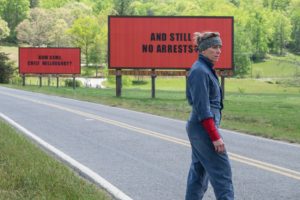
Frances McDormand (Three Billboards Outside Ebbing, Missouri)
Margot Robbie (I, Tonya)
Saoirse Ronan (Lady Bird)
Meryl Streep (The Post)
Best Supporting Actor:
Willem Dafoe (The Florida Project)
Armie Hammer (Call Me by Your Name)
Jason Mitchell (Mudbound)
Sam Rockwell (Three Billboards Outside Ebbing, Missouri)
Michael Stuhlbarg (Call Me by Your Name)
Best Supporting Actress:
Mary J. Blige (Mudbound)
Tiffany Haddish (Girls Trip)
Holly Hunter (The Big Sick)
Allison Janney (I, Tonya)
Laurie Metcalf (Lady Bird)
Best Acting Ensemble:
Dunkirk
It
Mudbound
The Post
Three Billboards Outside Ebbing, Missouri
Best Youth Performance:
Dafne Keen (Logan)
Sophia Lillis (It)
Brooklynn Prince (The Florida Project)
Millicent Simmonds (Wonderstruck)
Jacob Tremblay (Wonder)
Best Voice Performance:
Will Arnett (The LEGO Batman Movie)
Gael García Bernal (Coco)
Michael Cera (The LEGO Batman Movie)
Bradley Cooper (Guardians of the Galaxy Vol. 2)
Anthony Gonzalez (Coco)
Best Motion Capture Performance:
Andy Serkis (War for the Planet of the Apes)
Dan Stevens (Beauty and the Beast)
Steve Zahn (War for the Planet of the Apes)
Taika Waititi (Thor: Ragnarok)
Best Original Screenplay:
Emily V. Gordon & Kumail Nanjiani (The Big Sick)
Jordan Peele (Get Out)
Greta Gerwig (Lady Bird)
Martin McDonagh (Three Billboards Outside Ebbing, Missouri)
Guillermo del Toro & Vanessa Taylor (The Shape of Water)
Best Adapted Screenplay:
Hampton Fancher & Michael Green, Story by Hampton Fancher (Blade Runner 2049)
James Ivory (Call Me by Your Name)
Scott Neustadter & Michael H. Weber (The Disaster Artist)
Aaron Sorkin (Molly’s Game)
Virgil Williams and Dee Rees (Mudbound)
Best Animated Feature:
The Breadwinner
Coco
Despicable Me 3
The LEGO Batman Movie
Loving Vincent
Best Documentary:
City of Ghosts
Faces Places
An Inconvenient Sequel: Truth to Power
Jane
Step
Best Foreign Language Film:
BPM (Beats Per Minute)
First They Killed My Father
In the Fade
The Square
Thelma
Best Production Design:
Production Designer: Sarah Greenwood; Set Decorator: Katie Spencer (Beauty and the Beast)
Production Designer: Dennis Gassner; Set Decorator: Alessandra Querzola (Blade Runner 2049)
Production Designer: Nathan Crowley; Supervising Set Decorator: Gary Fettis (Dunkirk)
Production Designer: Paul Denham Austerberry; Set Decorators: Shane Vieau, Jeff Melvin (The Shape of Water)
Production Designer: Aline Bonetto; Set Decorator: Anna Lynch-Robinson (Wonder Woman)
Best Cinematography:
Roger A. Deakins, ASC, BSC (Blade Runner 2049)
Sayombhu Mukdeeprom (Call Me by Your Name)
Hoyte Van Hoytema, ASC, FSF, NSC (Dunkirk)
Rachel Morrison, ASC (Mudbound)
Dan Laustsen, ASC, DFF (The Shape of Water)
Best Editing:
Paul Machliss, ACE; Jonathan Amos, ACE (Baby Driver)
Joe Walker, ACE (Blade Runner 2049)
Lee Smith, ACE (Dunkirk)
Gregory Plotkin (Get Out)
Sidney Wolinsky, ACE (The Shape of Water)
Best Original Score:
Hans Zimmer and Benjamin Wallfisch (Blade Runner 2049)
Michael Giacchino (Coco)
Hans Zimmer (Dunkirk)
Alexandre Desplat (The Shape of Water)
Carter Burwell (Three Billboards Outside Ebbing, Missouri)
The Joe Barber Award for Best Portrayal of Washington, DC:
An Inconvenient Sequel: Truth to Power
Last Flag Flying
Mark Felt: The Man Who Brought Down the White House
Spider-Man: Homecoming
The Post
Critics Choice Awards Nominations for 2017 from the BFCA
Posted on December 6, 2017 at 4:28 pm
A+
Lowest Recommended Age:
Preschool
I am very proud to be a member of the Broadcast Film Critics Association, which today announced our nominees for the Critics Choice Awards. I’ll be there on January 11 when we announce them — please be sure to watch the show on the CW!
FILM NOMINATIONS FOR THE 23rd ANNUAL CRITICS’ CHOICE AWARDS
Copyright 2017 Amazon Studios/Lionsgate
BEST PICTURE
The Big Sick
Call Me by Your Name
Darkest Hour
Dunkirk
The Florida Project
Get Out
Lady Bird
The Post
The Shape of Water
Three Billboards Outside Ebbing, Missouri
Copyright 2017 Fox Searchlight
BEST ACTOR
Timothée Chalamet – Call Me by Your Name
James Franco – The Disaster Artist
Jake Gyllenhaal – Stronger
Tom Hanks – The Post
Daniel Kaluuya – Get Out
Daniel Day-Lewis – Phantom Thread
Gary Oldman – Darkest Hour
Copyright 2017 Focus
BEST ACTRESS
Jessica Chastain – Molly’s Game
Sally Hawkins – The Shape of Water
Frances McDormand – Three Billboards Outside Ebbing, Missouri
Margot Robbie – I, Tonya
Saoirse Ronan – Lady Bird
Meryl Streep – The Post
Copyright 2017 A24
BEST SUPPORTING ACTOR
Willem Dafoe – The Florida Project
Armie Hammer – Call Me By Your Name
Richard Jenkins – The Shape of Water
Sam Rockwell – Three Billboards Outside Ebbing, Missouri
Patrick Stewart – Logan
Michael Stuhlbarg – Call Me by Your Name
Copyright Fox Searchlight 2017
BEST SUPPORTING ACTRESS
Mary J. Blige – Mudbound
Hong Chau – Downsizing
Tiffany Haddish – Girls Trip
Holly Hunter – The Big Sick
Allison Janney – I, Tonya
Laurie Metcalf – Lady Bird
Octavia Spencer – The Shape of Water
BEST YOUNG ACTOR/ACTRESS
Mckenna Grace – Gifted
Dafne Keen – Logan
Brooklynn Prince – The Florida Project
Millicent Simmonds – Wonderstruck
Jacob Tremblay – Wonder
BEST ACTING ENSEMBLE
Dunkirk
Lady Bird
Mudbound
The Post
Three Billboards Outside Ebbing, Missouri
BEST DIRECTOR
Guillermo del Toro – The Shape of Water
Greta Gerwig – Lady Bird
Martin McDonagh – Three Billboards Outside Ebbing, Missouri
Christopher Nolan – Dunkirk
Luca Guadagnino – Call Me By Your Name
Jordan Peele – Get Out
Steven Spielberg – The Post
BEST ORIGINAL SCREENPLAY
Guillermo del Toro and Vanessa Taylor – The Shape of Water
Greta Gerwig – Lady Bird
Emily V. Gordon and Kumail Nanjiani – The Big Sick
Liz Hannah and Josh Singer – The Post
Martin McDonagh – Three Billboards Outside Ebbing, Missouri
Jordan Peele – Get Out
BEST ADAPTED SCREENPLAY
James Ivory – Call Me by Your Name
Scott Neustadter and Michael H. Weber – The Disaster Artist
Dee Rees and Virgil Williams – Mudbound
Aaron Sorkin – Molly’s Game
Jack Thorne, Steve Conrad, Stephen Chbosky – Wonder
BEST CINEMATOGRAPHY
Roger Deakins – Blade Runner 2049
Hoyte van Hoytema – Dunkirk
Dan Laustsen – The Shape of Water
Rachel Morrison – Mudbound
Sayombhu Mukdeeprom – Call Me By Your Name
BEST PRODUCTION DESIGN
Paul Denham Austerberry, Shane Vieau, Jeff Melvin – The Shape of Water
Jim Clay, Rebecca Alleway – Murder on the Orient Express
Nathan Crowley, Gary Fettis – Dunkirk
Dennis Gassner, Alessandra Querzola – Blade Runner 2049
Sarah Greenwood, Katie Spencer – Beauty and the Beast
Mark Tildesley, Véronique Melery – Phantom Thread
BEST EDITING
Michael Kahn, Sarah Broshar – The Post
Paul Machliss, Jonathan Amos – Baby Driver
Lee Smith – Dunkirk
Joe Walker – Blade Runner 2049
Sidney Wolinsky – The Shape of Water
BEST COSTUME DESIGN
Renée April – Blade Runner 2049
Mark Bridges – Phantom Thread
Jacqueline Durran – Beauty and the Beast
Lindy Hemming – Wonder Woman
Luis Sequeira – The Shape of Water
BEST HAIR AND MAKEUP
Beauty and the Beast
Darkest Hour
I, Tonya
The Shape of Water
Wonder
BEST VISUAL EFFECTS
Blade Runner 2049
Dunkirk
The Shape of Water
Thor: Ragnarok
War for the Planet of the Apes
Wonder Woman
BEST ANIMATED FEATURE
The Breadwinner
Coco
Despicable Me 3
The LEGO Batman Movie
Loving Vincent
BEST ACTION MOVIE
Baby Driver
Logan
Thor: Ragnarok
War for the Planet of the Apes
Wonder Woman
BEST COMEDY
The Big Sick
The Disaster Artist
Girls Trip
I, Tonya
Lady Bird
BEST ACTOR IN A COMEDY
Steve Carell – Battle of the Sexes
James Franco – The Disaster Artist
Chris Hemsworth – Thor: Ragnarok
Kumail Nanjiani – The Big Sick
Adam Sandler – The Meyerowitz Stories (New and Selected)
BEST ACTRESS IN A COMEDY
Tiffany Haddish – Girls Trip
Zoe Kazan – The Big Sick
Margot Robbie – I, Tonya
Saoirse Ronan – Lady Bird
Emma Stone – Battle of the Sexes
BEST SCI-FI OR HORROR MOVIE
Blade Runner 2049
Get Out
It
The Shape of Water
BEST FOREIGN LANGUAGE FILM
BPM (Beats Per Minute)
A Fantastic Woman
First They Killed My Father
In the Fade
The Square
Thelma
BEST SONG
Evermore – Beauty and the Beast
Mystery of Love – Call Me By Your Name
Remember Me – Coco
Stand Up for Something – Marshall
This Is Me – The Greatest Showman
BEST SCORE
Alexandre Desplat – The Shape of Water
Jonny Greenwood – Phantom Thread
Dario Marianelli – Darkest Hour
Benjamin Wallfisch and Hans Zimmer – Blade Runner 2049
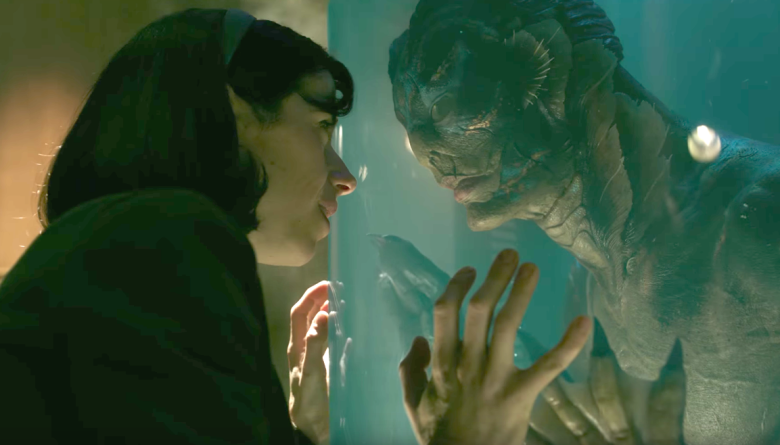
What a treat to see a tribute to Alice Faye’s classic “You’ll Never Know” in Guillermo del Toro’s new film, “The Shape of Water.”
The song was introduced by Faye in “Hello, Frisco, Hello.” The lyrics were based on a poem by a WWII war bride. It not only won the Oscar for best song and became a hit — it was such a hit that Faye sang it again a year later in another movie, “Four Jills in a Jeep.” It is now a standard, covered by Frank Sinatra, Rosemary Clooney, and many others, including Barbra Streisand, who chose it as her first-ever recorded song, made at a do-it-yourself booth when she was 13 as a gift for her mother.
Fictional depiction of suicide and violence, some scuffles
Diversity Issues:
None
Date Released to Theaters:
December 1, 2017
Let’s face it. Failure is more fascinating than success. There are innumerable movies based on true stories about real people who overcame seemingly insurmountable obstacles with determination, vision, and talent to accomplish extraordinary achievements in sports, the arts, and shaping public policy. Movies like “Schindler’s List” and “The Big Short” help us to understand huge, complicated tragic failures through the prism of small victories. But there are also movies like “Florence Foster Jenkins,” with Meryl Streep as the legendarily awful singer and “Ed Wood,” with Johnny Depp as the legendarily awful movie director, that explore with some affection the stories of terrible failures, and they do it with vastly more skill than the people they depict could have imagined.
In fact, that is part of what led to the failures in the first place — Florence Foster Jenkins and Ed Wood were exemplars of the Dunning-Kruger effect, which shows that the less competent people are, the more likely they are to be unable to evaluate their own competence. It isn’t the terrible end product that enthralls us as much as the buoyant optimism and imperishable self-regard that keeps these people going while the rest of us are consumed with doubt and insecurity.
“The Room,” from writer-director-star Tommy Wiseau, has been called “the ‘Citizen Kane’ of bad movies.” It is in that rare category of films that transcend “so bad it’s good” and “suitable for Mystery Science Theater commentary” into genuine hit, with well-attended midnight showings filled with fans who come to see it again and again. Like the midnight “Rocky Horror Show” screenings, fans come in costume and with props. An arty picture of a spoon in a frame that appears in many shots provokes a flurry of plastic spoons thrown at the screen. The crowd yells “focus” whenever someone should have reminded the cinematographer that the camera needed to produce a sharper image. And some people get happily tipsy taking a drink whenever any of the movie’s characters say “Hi.”
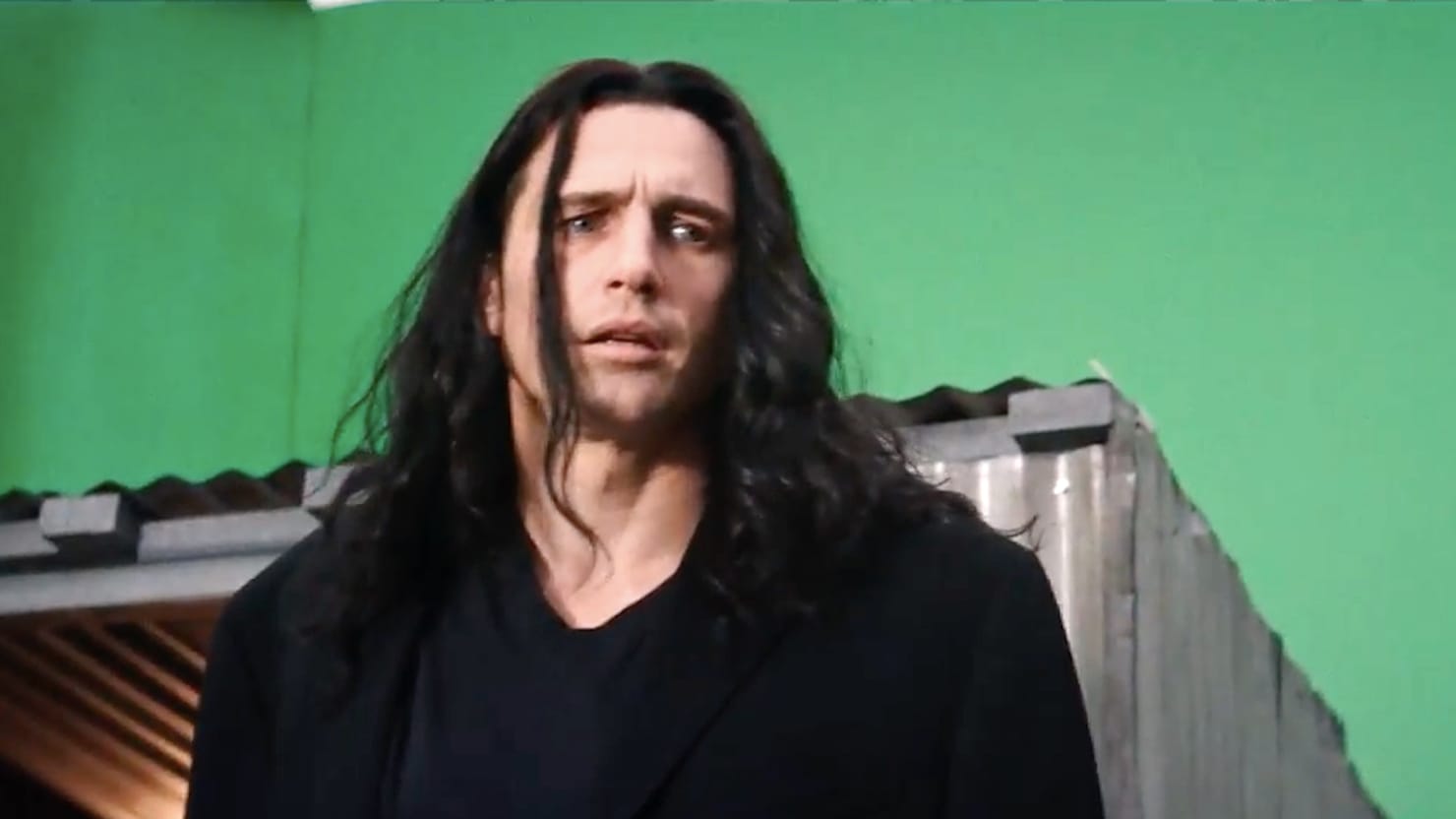
The film is based on a book co-written by Greg Sestero, who co-starred in “The Room.” For multi-degreed master of literary analysis James Franco, who directed and stars in the film, “Disaster Artist” is not an oxymoron. In his mind, Tommy Wiseau is an artist because he has a singular vision so urgent that he will realize it, no matter the cost, in the most literal terms. Wiseau is said to have spent six million dollars in making “The Room,” much of it as poorly decided as every other choice that went into making the film.
“The Room” tells the story (I use the term loosely, as the script is a mishmash of many unexplained developments and characters, with a plot even more out of focus than the camera) of Johnny (played by Wiseau, and Franco as Wiseau in this version), a successful banker who has a fiancee named Lisa (portrayed by Ari Graynor), a best friend named Mark (played by Dave Franco as Greg Sestero), and a teenage protegee of some kind named Danny (played by Josh Hutcherson). Lisa is bored with Johnny and begins an affair with Mark, though her mother pushes her to stay with Johnny because he is rich and treats her well. The film has extended soft-core-style sex scenes, a weird, inexplicable confrontation between Danny and a drug dealer, and another odd scene with guys in tuxedos tossing a football.
“The Disaster Artist” begins with Greg and Tommy meeting in acting class in Northern California, becoming friends in part because of their shared love for James Dean (coincidentally once played by Franco himself in a breakthrough performance) and dreams of being stars. They move to LA together, with Greg staying in Tommy’s apartment. Tommy is quite mysterious about his background (he has a strange eastern European accent), his age, and his source of income. He is supportive of Greg but also possessive. The decision to cast his own brother as Greg is Franco’s exploration of a mirrored duality in their relationship and there is more than a hint of some boundary issues that may reflect homoerotic feelings.
Frustrated by his lack of success in Hollywood and jealous that Greg is getting some work, Tommy decides to write and produce his own movie. And so we see how many bad decisions go into creating the “Citizen Kane” of terrible cinema. But we also see a very rare example of a film, usually the ultimate artistic reflection of teamwork, that is a genuinely singular vision. As muddled and incoherent as it is, it is exactly the movie he had in his head and exactly the movie he wanted to make. Franco clearly respects that, as Tim Burton did with “Ed Wood” (with Vincent D’Onofrio’s Orson Welles as his stand-in showing one director saluting another). The audiences in the midnight shows are there to jeer and feel superior. Franco, in his performance and direction, is sympathetic, giving Wiseau and his story the film he was not able to give himself.
NOTE: Be sure to stay through the credits for some uncanny side-by-side re-creations of scenes from “The Room” with the cast of this film.
Parents should know that this film includes nudity, sexual references and situations, depiction of suicide and violence, alcohol, and very strong language.
Family discussion: What does it mean that something is “so bad it’s good?” What does this movie tell us about the decisions that go into making a work of art?
If you like this, try: “The Room,” of course, and the book by Sestero, and the bonkers “Beaver Trilogy” documentary
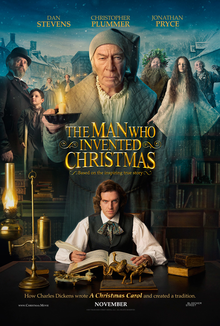
Dan Stevens and Bharat Nalluri on “The Man Who Invented Christmas”
Posted on November 29, 2017 at 4:06 pm
It was a great pleasure to interview actor Dan Stevens, who plays Charles Dickens in “The Man Who Invented Christmas” and the director, Bharat Nalluri.
It has a lot to say about those in positions of power and wealth and influence and how they wield that in the world around them and how much they’re prepared to overlook in the society around them. That has not changed, and neither has the possibility of redemption. In Dickens’ time, though, it was very unusual to have a character that time travels and went through his own life. It’s almost sci-fi in a way the way he travels back. But also he’s able to go from the archetype of a really not very pleasant character, overnight he’s transformed. And that goes back in the history of theater and literature. You have these archetypes and they pretty much stay bad. The fatal flaw is ultimately fatal. The bad guy comes on stage and we know who he is and he stays pretty bad; he might learn a lesson but here there is more because there is redemption. He has a second chance. He goes through this transformation. It’s so epic and so full of hope that somewhere inside there must be good in this man and that gives us hope about ourselves and the people around us and the possibility of change.
When he was writing A Christmas Carol, Christmas celebrations were pretty austere. He wrote a book that gave you a picture postcard idea of Christmas as a time for kindness and generosity. I think the reason it resonates over the decades upon decades and never been out of print is because it actually says something about the human condition. Personally he did invent Christmas for me. I was born in India and my parents brought me into the north of England and Christmas wasn’t a thing that was always huge in my family. I didn’t really know what Christmas but I was surrounded by people in the north of England on the Scottish border where Christmas was just huge and it was a really joyous time for people. I couldn’t quite get it because it just didn’t register with me and then when I was about 10 or 11 I read A Christmas Carol and it completely clicked. I completely got what it was. So in a weird sort of way Dickens really did invent Christmas for me. We all look back and we have this wonderful image of what Christmas should be, that combination of everything we want. We want family life, we want to be around a roaring fire, we want to be roasting chestnuts, we want to hear snow falling but we also want to be good to each other in the human spirit. It’s that combination which is combined so beautifully in Dickens’ book and which we pay tribute to in our film.





 Let’s face it. Failure is more fascinating than success. There are innumerable movies based on true stories about real people who overcame seemingly insurmountable obstacles with determination, vision, and talent to accomplish extraordinary achievements in sports, the arts, and shaping public policy. Movies like “Schindler’s List” and “The Big Short” help us to understand huge, complicated tragic failures through the prism of small victories. But there are also movies like “Florence Foster Jenkins,” with Meryl Streep as the legendarily awful singer and “Ed Wood,” with Johnny Depp as the legendarily awful movie director, that explore with some affection the stories of terrible failures, and they do it with vastly more skill than the people they depict could have imagined.