Marshall

Marshall

Posted on October 12, 2017 at 5:25 pm

B +
Lowest Recommended Age: Mature High Schooler
Profanity: Some strong language
Alcohol/ Drugs: Alcohol, smoking
Violence/ Scariness: Allegations of rape and attempted murder, fights and beatings, gun
Diversity Issues: A theme of the movie
Date Released to Theaters: October 13, 2017
Date Released to DVD: January 8, 2018
Copyright 2017 Open Road

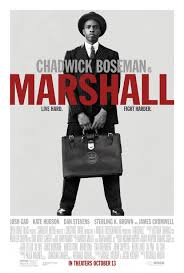
“It’s a real life Bigger Thomas,” says a character describing the new case assigned to a young lawyer named Thurgood Marshall (Chadwick Boseman). Bigger Thomas was the young black protagonist who could not escape the fundamental racism of American society in Richard Wright’s novel, Native Son, accused of rape and murder. In this real-life case, a black chauffeur named Joseph Spell (Sterling K. Brown of “This is Us”) was accused of rape and attempted murder of his employer, Eleanor Strubing (Kate Hudson), a wealthy Connecticut socialite. Marshall, then the entire legal staff of the NAACP, was going from town to town representing black defendants, many whom “confessed” after being beaten and starved, but, Marshall insists, only those who are innocent. They do not have time or resources to devote to those who did what they are accused of.

This case is unusual because it is in the North and because it is so high-profile. It has been a front page story in the newspapers and many white families are firing their domestic employees because they are so terrified.

Connecticut may not have the overt, explicit racism of the Jim Crow laws, but in some ways that makes fighting its version of bigotry more difficult. The judge (James Cromwell) refuses Marshall the normally automatic courtesy of allowing him to represent Spell in court without being a member of the state bar association. Instead, a local lawyer named Sam Friedman (Josh Gad) must argue the case, even though he has no experience in criminal trials and is very reluctant to get involved. “That must be difficult,” Marshall tells him wryly. “To have a reputation to think of.” Marshall may sit at the counsel’s table but may not address the judge or examine witnesses. He says that not being allowed to speak is the worst blow he has had as a lawyer, worse than having to enter the courthouse by the back door.

This is an absorbing drama on many levels, working purely as an “Anatomy of a Murder”-style courtroom mystery, as a historical depiction of the roots and mechanics of social change, and as the personal story of the two young lawyers facing enormous professional and personal challenges, developing a friendship, and becoming better at what they do.

The screenplay by father and son Michael and Joseph Koskoff is forthright in addressing the complicated ethics of preparing a defense for an individual client that many not always be consistent with the larger political imperatives. It also delicately if not always sucessfully skirts the complicated problem faced by contemporary films based on real-life events: if the white character teaches the black character, it’s condescending, but if the black character teaches the white character it’s “magical Negro.” In real life, Samuel Friedman was already active in civil rights cases before the Spell case, and he was slender and athletic. But for dramatic purposes, here he is played by Josh Gad and his character only takes insurance cases. We first see him winning for an insurance company on a technicality that leaves the disabled plaintiff without any damage payment. And Marshall’s character changes very little over the course of the film. He is sophisticated, tough, smart, and confident all the way through which is great as a tribute to one of the towering figures of the 20th century, but without some kind of character arc like the one given to Friedman, the risk is that he becomes a supporting character in the movie that has his name in the title. Fortunately Boseman is intensely charismatic and a gifted actor who is able to bring a great deal to the role, and he and Gad have a strong chemistry that benefits and is benefited by director Reginald Hudlin’s gift for understanding when comedy is needed to lessen the tension. Brown is also excellent in a role far removed from the high educated and successful characters on “This is Us” and “People v. O.J.” Indeed, the entire cast is outstanding, especially Hudson, Ahna O’Reilly as a juror, and Barrett Doss as Marshall’s host and friend.

The film balances the personal, the political, and the professional lives of its heroes and is frank about the opportunism — and the opportunity — of their choices. It places it in the context of its time, as Friedman’s family in Eastern Europe is captured by the Nazis and white thugs attack both lawyers. It makes its case as effectively as Friedman and Marshall make theirs — that courage and persistence bring change and that there are good people out there who will work, with all of our help, to make it happen.

Parent should know that this story concerns a real-life trial for rape and attempted murder with sexual references and situations, themes of racism including beatings and police brutality, some strong language, domestic violence, and some strong and racist language.

Family discussion: Why did Marshall represent only innocent clients? Did Spell have a fair trial? What has improved since that time? What has not?

If you like this, try: “Separate But Equal” and “Mr. Civil Rights: Thurgood Marshall and the NAACP”

NOTE: Read my interview with Boseman and director Reginald Hudlin at rogerebert.com

Related Tags:


Based on a true story Courtroom Drama DVD/Blu-Ray Pick of the Week movie review Movies -- format Race and Diversity Race and Diversity
HULU Brings Back TGIF Family Television #TGIHULU

HULU Brings Back TGIF Family Television #TGIHULU

Posted on October 4, 2017 at 9:04 pm

Put your hair in a scrunchy, grab your Lisa Frank stickers, and zoom back to the TGIF ‘90’s as Hulu brings back the whole line-up: more than 800 episodes of Full House, Family Matters, Step by Step, Perfect Strangers, and Hangin’ With Mr. Cooper. The kids who grew up with these shows can now watch them with their own children. You can try to explain what life was like before iPads and cell phones, when it took two Olsen twins to play one very precocious toddler, and when a character named Urkel who was just supposed to be in one episode could become an instant superstar. And yes, there were “very special episodes” with genuine moments, gently explored, to help families talk about some difficult subjects like loss, peer pressure, eating disorders, bullying, and guns.

How many catch phrases can you identify? “How rude!” “Did I do that?” “Oh, puh-LEEZE.” “Before you play, what do you say?” “America! Land of my dreams, home of the Whopper!”

Technology has been wonderful at giving us many choices but it has also meant fewer moments when families sit down at the same time to share a favorite series. What I love about Hulu bringing these shows back is that it makes it possible for the adorably silly and unabashedly heartwarming series to bring families together, making their best moments into that sweetest of family connections, the in-joke.

I have a #tgihulu prize pack to give away, including three months of Hulu! (See picture above)
Send me an email at moviemom@moviemom.com with TGIF in the subject line and tell me your family’s favorite TV show to watch together. Don’t forget your address! (U.S. addresses only). I’ll pick a winner at random on October 12, 2017. Good luck!

Related Tags:


Contests and Giveaways Television

Anatomy of a Scene: Battle of the Sexes

Posted on October 3, 2017 at 8:00 am

I love the “Anatomy of a Scene” series at the New York Times, where filmmakers explain what went into creating a moment in a movie. Here, Valerie Dayton and Jonathan Faris talk about something most filmgoers never consciously notice, the “soundscape” and how that affects our sense of what is happening. I was very intrigued to hear their reference to AMSR because I actually thought of that when I was watching the film.

Related Tags:


Behind the Scenes Directors

RT Interview with “American Made” Director Doug Liman

Posted on October 1, 2017 at 4:55 pm

I’m a fan of Doug Liman, director of four “Bourne” movies, “Mr. and Mrs. Smith,” and the neglected gem “Edge of Tomorrow.” I really enjoyed his list of five favorite movies for Rotten Tomatoes (I love “Guess Who’s Coming to Dinner?” too) and his fondness for flawed heroes. Here are his comments on making a feature film based on a true story.

A movie like this, there’s a lot of research that goes into it. It’s a true story, so we want to honor that. But we’re not making the movie because it’s a true story, we’re making the movie because it’s a great story and has great characters in it. But I’ve often found sticking to the truth makes for better movies, at least when I make them. I come up with better scenes when I’m hemmed in by the reality of the situation. Limiting the CIA’s power in Bourne Identity – what they really could do at the time versus, you know, other movies that came up with magical command centers, where the CIA has eyes in the sky that can see everything in real time, and not deal with the reality that a spy satellite that’s low enough to see people on the ground isn’t geo-stationary, but is travelling across the land at a very high rate of speed. And it can be over a site for maybe 30 seconds. I’m interested in those limitations. I think they make the scenes more exciting.

So, making a movie like American Made, I’m interested in the reality of the story, because in my career up to date, the reality of the situation has always made my scenes more entertaining and more dramatic. And here I can always go back to the well, so any time I felt like the screenwriter was taking a shortcut, I’d say, “Well, let’s look at how it really happened.” And inevitably, I’d find a more exciting scene.

Related Tags:


Directors

“Loving Vincent” — Interview With Directors Dorota Kobiela and Hugh Welchman

Posted on September 26, 2017 at 1:32 am

Copyright 2017 Altitude

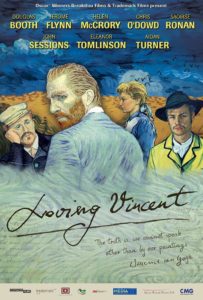
On Huffington Post, I interviewed the directors of a remarkable new animated film, “Loving Vincent,” a story about Vincent van Gogh and inspired by his paintings. Each frame is an oil painting. Directors Dorota Kobiela and Hugh Welchman described the process:

HW:We painted on canvas, seriously; I mean Vincent painted on canvas and we painted on canvas. When they were painting they were looking at the Vincent paintings and they were trying to get the same brush stroke. Piotr Dominiak, our head of painting animation, has been to all the museums taking photographs and we interviewed the experts at the Van Gogh Museum about which Vincent put the paint on, what type of equipment he was using, what exact color he was using so all of that research then went into us replicating and reimagining that on to our canvases.

DK: Our biggest problem that with animation was you have to obviously light the canvas and you need to light it evenly, while in a museum the lighting is directional, so you can see the shadows of the actual paint in them. It was a challenge to make sure the texture is visible on the screen and they were all sculptural.

HW: And once you’re committed to a big thick impasto stroke then they have to animate that. They have to scrub it out and leave it a little bit to the right, a little bit to the right, a little bit to the right. So for those big impasto shots they’re actually animating every brush stroke.

Related Tags:


Directors Directors Interview
THE MOVIE MOM® is a registered trademark of Nell Minow. Use of the mark without express consent from Nell Minow constitutes trademark infringement and unfair competition in violation of federal and state laws. All material © Nell Minow 1995-2026, all rights reserved, and no use or republication is permitted without explicit permission. This site hosts Nell Minow’s Movie Mom® archive, with material that originally appeared on Yahoo! Movies, Beliefnet, and other sources. Much of her new material can be found at Rogerebert.com, Huffington Post, and WheretoWatch. Her books include The Movie Mom’s Guide to Family Movies and 101 Must-See Movie Moments, and she can be heard each week on radio stations across the country.

Website Designed by Max LaZebnik