
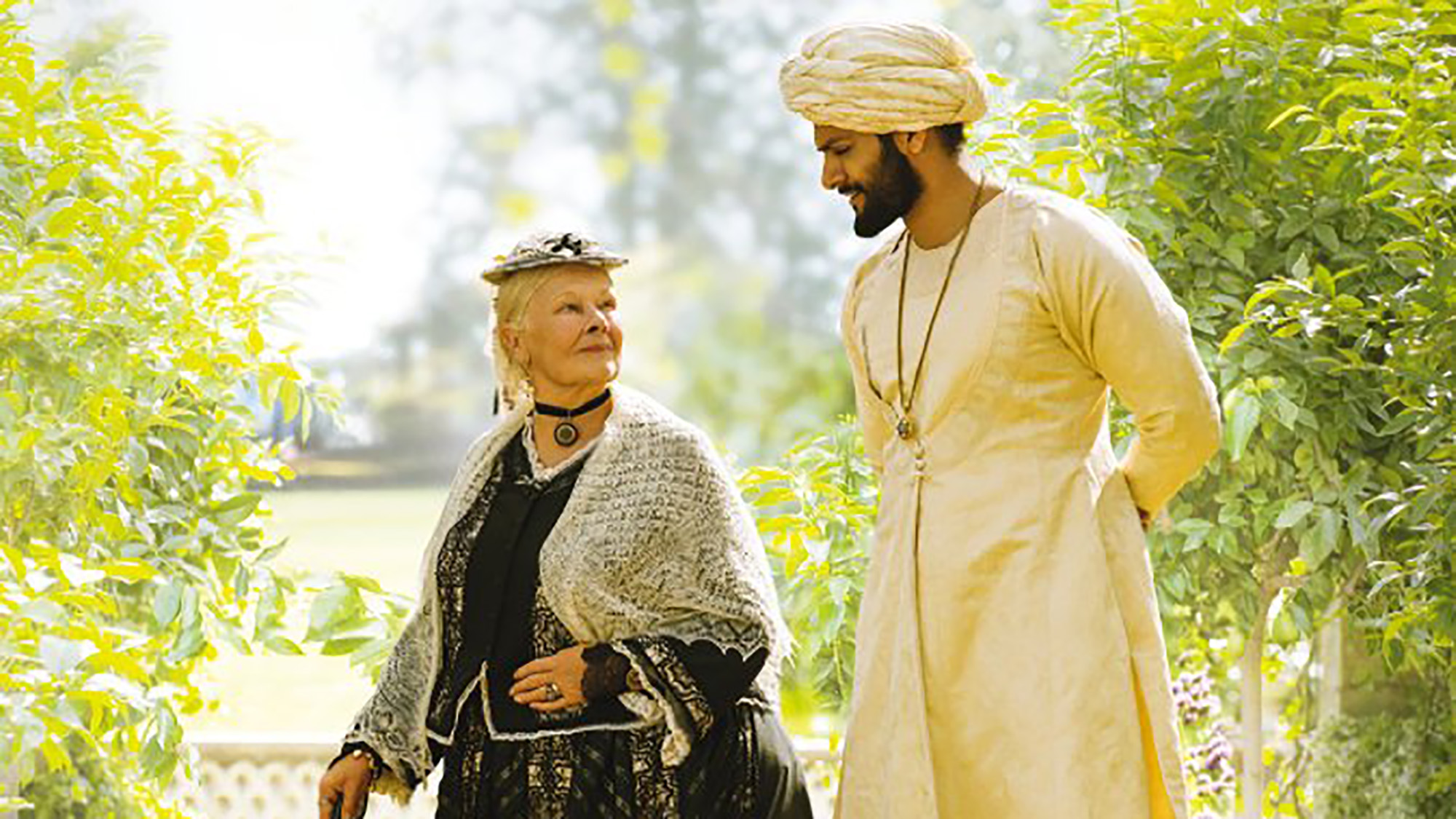
Stephen Frears and Ali Fazal on “Victoria and Abdul”

Stephen Frears and Ali Fazal on “Victoria and Abdul”

Posted on September 25, 2017 at 11:09 pm

I spoke to the director and co-star of the new film, “Victoria and Abul,” based on the real-life story of Queen Victoria’s last friendship, with the Indian man she called her “munshi” (teacher).

At rogerebert.com, Stephen Frears said there was one aspect of Victorian times he’d like to have now:

Confidence. In Britain we were very, very wealthy. We were very secure and very confident. Nowadays everyone is so neurotic; the country is so neurotic. We were robbers and thieves, though, so the confidence would have been nice but unfortunately it was all based on imperialism. Very, very tricky; never have an empire.

And he explained why he had to have a native of India to play the part of Abdul.

There are a lot of Indian actors in England, Asian actors in England but you couldn’t get that sort of wide-eyed quality. We hired an Indian casting director and I went to Bombay and a bunch of Indians came in to see me. When Ali came in, by the time he left the room I said, “Well, I can see why she’ll like him.” It was really as simple as that.

For the Motion Picture Association of America website Where to Watch, Ali Fazal talked to me about the magnificent costumes.

Oh God, I loved all of them. Every time I got into something, it was almost like what do we have on the menu today? That would be the sort of marvelous majestic-looking wardrobe and costume that I had. Consolata Boyle is truly a genius when it came to the authenticity of costumes that I wore, of course my particular favorite was the one he wears in Florence the scene where we’re dancing together. I give her a lot of credit for how I was able to flesh out the scenes. It’s the costumes that really tell the passage of time and the progression. So it was a really, really intimate journey that Consolata and I had over the costumes in this film. So yeah I’m very, very deeply attached to my costumes, every single thread and the buttons and the hooks and the Angrakhas and everything.

And what he hopes people will see in the film:

I think as clichéd as it sounds, it talks of love and hope and they’re the most abused words on the planet right now. We’ve tried war and politics and diplomacy and none of it really works. I really hope people see that, that in the middle of all that chaos there was something like that, this relationship that existed. It can happen today.
Related Tags:


Actors Directors Interview

Battle of the Sexes Composer Nicholas Britell

Posted on September 23, 2017 at 8:00 am

My interview with “Battle of the Sexes” composer Nicholas Britell is on the Huffington Post. Here’s an excerpt:

Musically it was a wonderful experience to work so closely with John and Valerie. We spent months together while they were editing the movie. I came up with a series of musical theme ideas and we mapped it out over the course of the film. There is a Bobby Riggs personal theme which is scored for a small jazz group with an upright piano and a double bass and a drum kit and then there are a few woodwinds here and there. And then there is a Billie Jean personal theme that reflects the changes she experiences. The colors of that theme change over the course of the film, so in the beginning it is more of an ambient soundscape and by the end it’s actually a full 79-piece orchestra. Her theme evolves until it finally reaches its full scope where there is a big cello in the match with her theme and then at the moment of her victory, there is a full orchestra taking it over. So it was exciting to see the way in which the geography of the musical ideas could live in parallel to the story.

And one of the things we really utilized throughout the film was the evolution of instrumentation. We thought a lot about the musical colors themselves. One of the first things we talked about was how this is a big story set in 1973, so what should the music actually sound like? We used some old-style equipment to try to have the music feel like it might have been recorded in the 1970s. One of our first ideas was: what if I were to write classical style music but written for 1970’s rock band instrumentation, electric guitars and electric bass and drums and an electric rock organ that is woven in through the whole movie. In the beginning, it’s very quiet in the background and in the tennis match you really hear it and it gets focused on. We started with the 70’s band instrumentation and as we explored the film and worked on it together, we started saying, “What if we had woodwinds here?” and “What if we have strings?” The movie responded so immediately to those experiments. The movie wanted the largest scope as the story unfolded.

My review of Battle of the Sexes.

My interview with Nicholas Britell about his score for “Moonlight

Related Tags:


Composers Interview
Battle of the Sexes

Battle of the Sexes

Posted on September 21, 2017 at 9:53 pm

B +
Lowest Recommended Age: Mature High Schooler
MPAA Rating: Rated PG-13 for some sexual content and partial nudity
Profanity: Some strong language
Alcohol/ Drugs: Drinking, cigarettes
Violence/ Scariness: None
Diversity Issues: A theme of the movie
Date Released to Theaters: September 22, 2017
Date Released to DVD: January 1, 2018
Copyright Fox Searchlight

“You’ve come a long way, baby!” was the 1970’s slogan for a cigarette for women. Virginia Slims were marketed as a badge of liberation and sophistication. They had a woman’s slightly naughty-sounding name and a word with a lot of appeal to female consumers (and a suggestion that they would aid in keeping weight down). They had a kicky advertising campaign. And they were the only commercial product willing to sponsor the brand new Women’s Tennis Association, founded by tennis champion Billie Jean King to protest the pay differential in professional tennis, with women making a fraction of the prize money awarded to the men. When they raised the issue, they were told that women’s tennis was not as interesting (even though they sold as many or more tickets at the same price as the tickets to see the men play) and because the men had families to support. It may now seem absurd, or at least off-brand to have a women’s athletic competition sponsored by a cigarette, but probably no more absurd than the argument that “the men’s tennis is more exciting to watch; it’s biology.”

One-time men’s tennis champ Bobby Riggs (Steve Carell) was a bit of a sexist and more than a bit of a showman, and much more than a bit of a gambler. And so he bragged that even in his 50’s he could beat the top-ranked women’s player. Margaret Court accepted the challenge, and he triumphed in a humiliating defeat. And so, Billie Jean King agreed to play him in something between a sporting event and a three ring circus, complete with marching band, scantily dressed cheerleaders in Sugar Daddy outfits, and the ceremonial presentation by King to Riggs of an actual pig.

So, not your usual night on ESPN, which, of course, had not been invented yet. This was front-page news in the midst of the fight for what people were still calling “women’s liberation.” This was consciousness raising whether you liked it or not.

It is especially suitable that this film was directed by a female/male team: Valerie Faris and Jonathan Dayton (“Little Miss Sunshine”). They found the human story, the vulnerability, the drive, the fear, the resolve behind the hoopla and hyperbole, and they have made a film about real people that is moving and, even though we know the outcome of the game, suspenseful.

Bobby Riggs would have been a public feminist if he could make a dollar at it. (A dollar, by the way, is what the original players in King’s Women’s Tennis Association were paid to sign up.) He would cheerfully admit, except possibly to his wealthy wife (Elisabeth Shue), that he was more of a showman and a huckster than an athlete. Billie Jean King was a determined, disciplined athlete at the forefront of the Gloria Steinem era of feminists. She was companionably married to Larry King (not the TV show host), but she was beginning to admit to herself that she was attracted to women. Her hairstylist, Marilyn (Andrea Reisborough), leans in and brushes her hand on Billie Jean’s cheek. The woman who never allowed herself any distractions has met a distraction she cannot ignore.

Faris and Dayton create the environment of the 70’s without any air quotes. The cinematography, the score, the deft use of Howard Cosell’s actual commentary during the match (at one point, he says approvingly that King moves like a man), evoke the era without exaggeration or snottiness. Every performance shines, including Sarah Silverman in the Eve Arden wry sidekick role. The film is generous to all of its characters, even the real and metaphorical pigs.

Parents should know that this film includes sexual references and an explicit situation with some nudity, issues of sexual orientation, some crude language, alcohol, cigarettes, sexism, and homophobia.

Family discussion: What is different today and what hasn’t changed? Why did Billie Jean King decide to play Bobby Riggs?

If you like this, try: Footage of the real King/Riggs game

Related Tags:


Based on a true story DVD/Blu-Ray Pick of the Week Gender and Diversity GLBTQ and Diversity movie review Movies -- format Sports

Interview: Writer/Director Danny Strong of “Rebel in the Rye”

Posted on September 19, 2017 at 2:48 pm

Danny Strong has appeared in “The Gilmore Girls” and “Buffy the Vampire Slayer,” wrote the “Mockingjay” films that finished the “Hunger Games” series, co-created “Empire.” He wrote and directed “Rebel in the Rye,” with Nicholas Hoult as J.D. Salinger, now in theaters. It is a touching, thoughtful story of a young man who is passionate about being a writer but only after the searing trauma of military service in WWII is he able to fully find his voice to write one of the most influential novels of all time, Catcher in the Rye. Salinger also wrote some acclaimed short stories and novellas, and then moved to New Hampshire, and made almost no other appearances in print. In an interview, Strong talked about why Catcher is his favorite of Salinger’s works and about telling the story of a man almost as famous for his decision to stop publishing as he is for what he wrote.

Do you have a favorite Salinger book?

Catcher in the Rye. I think it’s the best work but there’s sort of an intellectual bias against it. I reread it when I wrote the script and it was terrific. I loved it. It was so funny and insightful and Holden was just a terrific character. Certainly a scholarly point of view is that the later works are better, Seymour: An Introduction and Franny and Zooey. But for me Catcher is the richest as a story as opposed to just a philosophy. There are long religious passages on Franny and Zooey where we’re out of the story range and into the philosophizing range which some people enjoy in their literature. I read this letter of his that he said “sometimes I wonder if I’m propagandizing for the religious point of view” although he says it in a different phrasing, and then he says “but I just can’t help it when I just sit down and what’s inside of me comes out.”

Salinger was supported by and influenced by his professor Whit Burnett, who tells him that the story is everything. Is that right?

Yes, and there is something in the swami’s line about “Do you write to show off to your talent or to express what’s in your heart?” For me it’s the story and what happens and when I see a film that’s what I value most. The characters’ arc is the story. That’s the difference between plot and story. The plot is what happens and story is what this is all about, what you’re trying to say, what you take away from it. So the character journey is to me what’s ultimately the story. And then what makes a story good is when you have terrific characters in it that are dynamic and they’re entertaining, insightful or interesting; all of those things.

Salinger famously prohibited a film version of Catcher in the Rye, even though some of Hollywood’s top directors were interested. Could it be a movie?

People have asked me if I could make that would I? No. I don’t think it would be very good. What happens is he wanders around New York City and he encounters people and he’s antsy. I mean literally it’s the internal monologue and it’s the way he phrases things that makes it so engaging and entertaining and what happens is fine but it’s not cinematic to me.

For a man who was cynical and sarcastic, he was almost obsessed with innocence.

You can be sarcastic and still have “innocence,” right? I mean for me it was more of a loss of youth that was ripped away from him because of the war, because of trauma, because of seeing dead bodies in the Holocaust and nearly freezing to death, as he said, the smell of burning flesh that you can never get out of your nose. But you look at his writing before the war which wasn’t nearly as sophisticated, but nonetheless was very witty and had that sarcasm and was an exploration of Upper East Side life in a way that is quite fun to read. It just doesn’t have the depth that he hit after he experienced what he experienced.

It’s just a small body of work and it’s fascinating to me how obsessed people are with him over this the small body of work and how meaningful it is, people’s attachment to him and protectiveness of him over such a small body of work.

Why did he isolate himself?

He was part of the community in Cornish and he’d come back to New York from time to time and go to the same bookstore and vacation in Florida so he wasn’t a hermit, but he seemed to have an inability to really function socially and needed to be isolated. I view that as just another symptom of untreated PTSD and untreated trauma. I think when you look at someone who writes for forty to fifty years in a room by himself and never shows that work to anyone I view that as therapy, as someone who it’s therapeutic for them and it’s healing for them. In the case of the film and the story in the film t’s a triumph for him to a certain extent, that he’s become the ultimate writer, that he can just right for the sake of writing and he needs “nothing in return” and that’s the journey.

It is a Zen type journey which I believe is completely accurate for him. I think that that was him and that’s who he became. His writing became this meditation that was some sort of relationship with a higher being. I think maybe that’s intellectually how he talked about it, but for me I just see it as therapeutic; as someone who has a racing mind, a troubled soul who’s trying.

Related Tags:


Books Directors Interview Writers

New from Audible: Nick Offerman Reads Mark Twain’s “Connecticut Yankee in King Arthur’s Court”

Posted on September 19, 2017 at 6:00 am

Nick Offerman reads one of the most beloved books by one of America’s most beloved authors for Audible, available today.  A Connecticut Yankee in King Arthur’s Court pretty much invented the idea of time travel in fiction, and it has inspired dozens of adaptations.  As the title suggests, it is the story of a plainspoken American who finds himself back in the days of the knights of the round table.  I thought of it this summer because there is a very dramatic scene where the hero’s ability to predict a solar eclipse astonishes the courtiers.  There could not be a better choice for narration that Nick Offerman, whose rich tone and wry humor are perfectly suited to Twain’s prose.

Related Tags:


Books
THE MOVIE MOM® is a registered trademark of Nell Minow. Use of the mark without express consent from Nell Minow constitutes trademark infringement and unfair competition in violation of federal and state laws. All material © Nell Minow 1995-2026, all rights reserved, and no use or republication is permitted without explicit permission. This site hosts Nell Minow’s Movie Mom® archive, with material that originally appeared on Yahoo! Movies, Beliefnet, and other sources. Much of her new material can be found at Rogerebert.com, Huffington Post, and WheretoWatch. Her books include The Movie Mom’s Guide to Family Movies and 101 Must-See Movie Moments, and she can be heard each week on radio stations across the country.

Website Designed by Max LaZebnik