
WETA Around Town: Nell Minow on Band Aid
Posted on June 19, 2017 at 8:45 pm
It was a great pleasure to discuss “Band Aid” on WETA with my friends Robert Aubrey Davis and Travis Hopson.
Posted on June 19, 2017 at 10:00 am
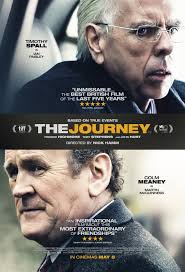 Nick Hamm directed “The Journey,” an imagined story about real events. Two bitter enemies, Protestant Ian Paisley (played by Timothy Spall) and Catholic Martin McGuinness (played by Colm Meaney), the bitterest of enemies, unwilling even to sit in the same room, managed to do what no one else had done for decades — to find a way to create peace in Northern Ireland after years of bloody battles. In real life, it took years. In the movie, time is compressed into one ride to the airport, shared by the two men and listened in on by a small group of very anxious government officials. But the spirit and even the language of the film accurately conveys the enormity of the situation and the statesmanship of the two men who discovered that no religion or political dispute could justify the terrible losses of The Troubles. In an interview, Hamm talked about the film’s relevance to today’s hyper-partisan conflicts around the world.
How do you find a balance between the familiar characteristics of these very well-known men and creating real characters?
We wanted to make it as accurate as possible. Both were well known but Paisley was a pretty iconic figure in English political life, known quite widely. The conflict ran for 34 years in Ireland. McGuinness in the later years of his career should we say was very public you know so people knew who they were. It was incumbent on us not to imitate but to get under the skin of them and I think that’s what Tim and Colm really do. Tim one of those extraordinary actors who melds into the character and he becomes and his kind of extremely fascinating process that we all went through. Tim is a 5 foot 8 inch Englishman playing this six foot massive Irish guy. But when we first showed it in Ireland, people thought he was completely bang on with Paisley. We had to make this people real because what you’re watching is the nuance of human behavior. You’ve taken away the normal activities that politicians deal with on a daily basis. You’ve removed the ability to speak to the media, to have an assistant, to deal with Congress, to be in a public situation, and you put them in a private situation. You strip from them all of that then is about how they deal with the domesticity of that situation, as though we are in the back of the car with them.
It all feels sadly timely with the way we see sharp and angry political divisions around the world.
Spot on. That is what we are talking about here. We are talking about two people in real life who came together and reached out beyond their base, beyond their own constituency and risked sacrificing their own political life for the betterment of other people. That really happened and their relationship opened the door into the Northern Island peace process which really stopped people killing each other. This was not a fictionalized event. This happened. It was real and the bombing stopped, and in that sense it is a great political story. It is a unique political story.
All over we see a climate of intransigence, tribal loyalties and politicians just appealing to their base. The left is as bad as the right. There’s no condemnation of either side. They both are as bad. Both sides looks for constant reaffirmation from social media, constantly feeling that only they know the way forward, and that is the way of madness. And it’s weird how it’s grown. So the argument of the movie is: now more than ever you need leaders who can take their base and can take their constituents and can move and reach out across that divide and actually do something. We need politicians who can do that now.
So yes, it is a message but we didn’t start like that. We just started by telling this story to celebrate what they’d actually achieved. And it was in the most extreme circumstances. It takes a huge amount of magnanimity to be able to to have your political beliefs and then just understanding that other people have different perspectives. There’s no such thing as political absolute truth. Your version of a blue sky is different from my version of blue sky. There’s no society in the history of the world, in the history of civilization, in which absolute truth has survived and existed and people ascribe to it.
I went to see McGuinness before we started shooting and talked to him for a couple of hours. He talked about his relationships with the IRA and the British government and he talked about one particular journey that they took, because politicians from Northern Ireland were travelling together for years and then denying the fact that they were on the same plane, even getting off the plane at separate times so that people wouldn’t see them laughing together, wouldn’t see them talking together. Did you know at the peace talks neither party sat in the same room? I find that the most extraordinary thing. You had flown to Scotland, the British government is putting you up, you’re staying in the same hotel, but you wouldn’t even eat in the same bloody restaurant and you won’t meet in the damn room together. So when Paisley actually said he was going to fly back the British government put him on a plane and and McGuinness went with them and that was the first time that they actually started to acknowledge each other. McGuinness said that Paisley had never even acknowledged his existence before that. Two days later I talked to Paisley’s son, and he was on the plane, and he even took some film of it, but his story was completely different. And that was when I knew that no one has the truth entirely.
This week, the British Embassy in Washington is putting on a screening at the institute for Peace
I think a lot of Congressmen and Senators are coming and senators. I think it will be fascinating to see. We actually had it in the House of Commons and here we are debating a film about the nature of terror a hundred feet from wher a week later all the flowers would be piled up for the death of the policeman being stabbed and here I am in two days time going to Washington to show the movie to members of Congress and you had that terrible atrocity just happen there. It seems like a lot to ask of a movie but I hope somehow we can be a reminder of what is possible if people find that what they have in common is more important than their differences.
Posted on June 18, 2017 at 4:51 pm
Happy Father’s Day! And extra Father’s Day love to the two great dads in my life, my father and my husband.
These are some of my favorite movie dads. Give the dad in your life an extra hug and ask who his favorite movie father is!
And don’t forget to get a FREE copy of my book, 50 Must-See Movies: Fathers
Posted on June 18, 2017 at 3:45 pm
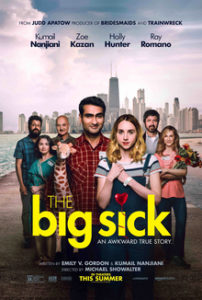 Emily V. Gordon wants you to know that her father did not cheat on her mother. You might think that he did because in the movie Gordon wrote with her husband, Kumail Nanjiani, about their romance, movie Emily’s father, played by Ray Romano, confesses that he had an affair. But Gordon and Nanjiani explained in an interview that the overall story is true, and Nanjiani plays himself, but some elements were compressed or heightened for dramatic purposes.
This part is true: Gordon met Nanjiani when she was in grad school studying psychology and he was a stand-up comic. Very early in their relationship, she suddenly became critically ill. This is probably the only romantic comedy in history to have its female lead spend half the movie in a medically induced coma. And that’s not even the couple’s biggest obstacle. Nanjiani’s Pakistani immigrant family wants him to marry a girl from their religion and culture. Gordon’s character, Emily Gardiner in the movie, is neither. He hasn’t told her about the parade of eligible girls his mother has “dropping by” the house when he is visiting his parents. Movie Emily, played by Zoe Kazan, breaks up with Nanjiani just before she gets sick, and then he meets her parents (Romano and Holly Hunter) for the first time at the hospital. The second half of the film is a different love story, between Nanjiani and Emily’s parents. “And then we get to really, really play and create these really fun people,” she said. “My parents are lovely but it would have been a more boring movie.”
“This is obviously very, very autobiographical,” Nanjiani continued. “I would say my character is probably closer to how I was then than Emily is.” “I would say your character is pretty clueless, and you’re not as clueless,” Gordon added. “We had a lot of fun arguments like: character Kumail is a lying asshole, but the real Kumail is just a liar.” “Yes, just a liar. And clueless. Judd would ask me what I thought was going to happen, what the plan was when I was dating Emily. And I was like, ‘I don’t know. I haven’t thought about it.’” Gordon, whose terrifically funny and wise book Super You: Release Your Inner Superhero reflects her training as a therapist and her insight as a writer, said, clearly not for the first time, “Not deciding is a decision. People don’t realize that not making a decision is a decision in itself.”
Nanjiani and Gordon worked on the script for three years, sending drafts to Apatow, who guided them on tempo and character. “We would write down the truth of things and then he would advise us: ‘You could really turn up the drama here, you can change the situation here and kind of make this resonate more.’ So we would show him what the truth was and then he would help us figure out ways to make it more cinematic, ways to make it more dramatic, more funny,” Nanjiani said. The biggest departure was in the portrayal of Gordon’s parents. Apatow was especially helpful in providing feedback on the story’s structure. “He was like: ‘this much will be Emily and Kumail, this much should be them separated, this much should be the hospital, this much should be the surgery.’ He just drew these lines separating each section and we took a picture of it. And then when Michael Showalter came on as director, he said, ‘Kumail in Emily’s room, that’s the center of the movie so everything has to come before come after it.’ So we moved everything around that point because that’s the point of no return. That’s when I realize that I’m in love with her and that I had made a huge mistake.”
Gordon described working with Showalter. “He’s all heart, that’s what’s great. And he wears all his emotions on his sleeve. That’s his strength in a way. He is so amazing to watch because he’s passionate and invested in the story. And he was always very open to collaboration. It wasn’t like he was ruling with an iron fist, ever. Everything felt like a collaboration. He had no ego about collaborating. That made me feel so safe and confident in giving him our story.” Nanjiani said that Showalter showed them how he was subtly using different color palettes for the different characters, even different camera movements. “And Mike is very good at guiding you between movements of the movie, with silence or just following a character for a little bit or whatever it, is he’s very, very adept at switching gears for the movie in a seamless way.” Showalter is especially gifted in casting even the smallest roles and because they shot in New York they were able to find superb performers from theater whose faces were not familiar to movie audiences.
Nanjiani said that writing the film helped him to appreciate and understand his parents’ reaction to his wanting to marry Gordon. “When people from a different culture come here you want to hold on to your own culture but you also want to be your own person. It’s a complicated thing and you do lose something going against the wishes of your parents and your culture. But ultimately it has to be a personal decision.”
Nanjiani is an experienced performer, including three seasons as Dinesh on “Silicon Valley.” But this role presented some new challenges for him, with some dramatic moments and with the difficulty of reliving some of his most painful experiences on camera.
“I hadn’t ever taken any acting classes so I started taking acting classes to sort of prepare for this. I just knew that there was this big thing coming up and it was going to be very difficult and challenging. I wanted to take some of the guesswork out of it because what I knew was comedy acting, where you can go on instinct and as long as it feels funny it works. I knew this was going to be different, especially separating the reality from the movie character and also dealing with some very painful memories. I wanted to get the tools to be able to go into different emotions because I knew that this was a very low budget movie and we had to learn work really fast. If I had to be sad in the scene knew I knew that I had to figure out how to do that like quickly.”
“And if may say,” added Gordon, “Old Kumail from the movie would not have done that. He just would have been like, ‘I’ll figure it out.’”

Posted on June 17, 2017 at 6:00 am
In honor of Father’s Day, my eBook, 50 Must-See Movies: Fathers
 What do “Wall Street” and the “Star Wars” saga and, seemingly, about half the movies ever made have in common? They are about fathers. In “Wall Street,” Charlie Sheen plays the ambitious Bud, who respects the integrity of his blue-collar father, played by his real-life father, Martin Sheen. But Bud is dazzled by the money and power and energy of Gordon Gekko (Michael Douglas). The movie will up the ante with Bud’s father’s heart attack as we see him struggle between the examples and guidance of these two male role models.
In “Star Wars,” Luke (Mark Hamill) does not know until halfway through the original trilogy that (spoiler alert) the evil Darth Vader is his father. He was raised by his aunt and uncle, who are killed very early in the first film, but the father figures who are most meaningful in his life are the Jedi masters Obi-Wan Kenobi and Yoda. Like Bud in “Wall Street,” Luke must choose between the good and bad father figures. Like Luke, Harry Potter is raised by an aunt and uncle, but he finds a true father figure later. For Harry, it is headmaster Albus Dumbledore. In opposition is He Who Must Not Be Named. Like Luke, Harry has the opportunity for great power on the dark side, but he lives up to the example set for him by Dumbledore.
The first stories ever recorded are about fathers. The central human struggle to reconcile the need for a father’s approval and the need to out-do him is reflected in the “hero of a thousand faces” myths that occur in every culture. In Greek mythology, Zeus is the son of a god who swallowed his children to prevent them from besting him. Zeus, hidden by his mother, grows up to defeat his father and become the king of the gods. Ancient Greece also produced the story of Oedipus, who killed his father and married his mother, and The Odyssey, whose narrator tells us “it is a wise man who knows his own father.”
These themes continue to be reflected in contemporary storytelling, including films that explore every aspect of the relationship between fathers and their children. There are kind, understanding fathers whose guidance and example is foundation for the way their children see the world. There are cruel, withholding fathers who leave scars and pain that their children spend the rest of their lives trying to heal. There are movies that reflect the off-screen real-life father-child relationships. Martin Sheen not only played his son’s father in “Wall Street;” he played the father of his other son, Emilio Estevez, in “The Way,” which was written and directed by Estevez, and which is about a father’s loss of his son. Will Smith has appeared with his son Jaden in “The Pursuit of Happyness” and “After Earth.” John Mills appeared with his daughter Hayley in “Tiger Bay,” “The Truth About Spring,” and “The Chalk Garden.” Ryan and Tatum O’Neill memorably appeared together in “Paper Moon.” Jane Fonda produced and starred in “On Golden Pond” and cast her father Henry as the estranged father of her character. Jon Voight played the father of his real-life daughter Angelina Jolie in “Tomb Raider.” And Mario Van Peebles, whose father cast him as the younger version of the character he played in “Sweet Sweetback’s Badasssss Song” made a movie about the making of that film when he grew up. It is called “Badasssss!” In the role of Melvin Van Peebles he cast himself.
Director John Huston deserves some sort of “Father’s Day” award. He directed both his father and his daughter in Oscar-winning performances, Walter Huston in “The Treasure of the Sierra Madre” and Anjelica Huston in “Prizzi’s Honor.”
Some actors known for very non-paternal roles have delivered very touching performances as fathers. Edward G. Robinson is best remembered for playing tough guys, but in “Our Vines Have Tender Grapes” he gave a beautiful performance as a farmer who loves his daughter (Margaret O’Brien) deeply. Cary Grant, known for sophisticated romance, played loving – if often frustrated — fathers in “Houseboat” and “Room for One More.” “Batman” and “Beetlejuice” star Michael Keaton was also “Mr. Mom.” Comedian Albert Brooks is a devoted father in “Finding Nemo.”
There are memorable movie fathers in comedies (“Austin Powers,” “A Christmas Story”) and dramas (“To Kill a Mockingbird,” “Boyz N the Hood”), in classics (“Gone With the Wind”), documentaries (“Chimpanzee,” “The Other F Word”), and animation (“The Lion King,” “The Incredibles”). There are great fathers (“Andy Hardy”) and terrible fathers (“The Shining”). There are fathers who take care of us (“John Q”) and fathers we have to take care of (“I Never Sang for My Father”). All of them are ways to try to understand, to reconcile, and to pay tribute to the men who, for better or worse, set our first example of how to decide who we are and what we will mean in the world.
https://www.youtube.com/watch?v=BadSZDpvq-s