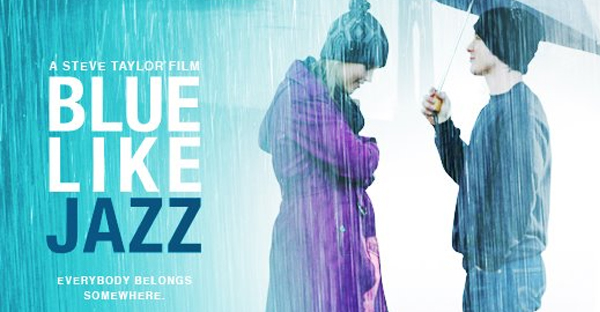
I love Steve Taylor’s new film, “Blue Like Jazz” and I loved talking to him about it. Based on the best-selling book of essays about faith, Blue Like Jazz: Nonreligious Thoughts on Christian Spirituality by Donald Miller, it is the story of a sheltered young man from an evangelical family in Texas who goes to the famously intellectually challenging and spiritually even more challenging campus of Reed College in Portland, Oregon. We talked about how how the film got 1600 associate producers and what it’s like to be on a the campus of a college where the student body annually elects a class “pope.”
How did you first come to the book and what made you think that a book of essays could make a movie?
I read it six years ago over Christmas and it’s not the sort of book you put down and say, “I see this movie in my head!” But it struck me as, this would make a great movie, particularly that part about that guy growing up as a suburban youth as a Southern Baptist, really conservative culture, and then ending up at Reed College. It would be hard to imagine a more opposite place. So I showed up for a reading, and they had a line wrapped around the block, and afterwards I pitched him the idea and from the beginning, told him, “Look, I think this’ll make a great movie, but I would love to end it with the confessional scene which is a really powerful scene in the book. The big change I’d like to propose is that in the book, he’s a thirty-year old writer who lives off campus and audits classes. I just think a more interesting movie story would be if you were a college student.” You know, usually authors understandably are very protective about their work and what they’ve written, and particularly if it’s memoir-ish, but he just immediately sparked to that. I think he would tell you it’s because he’s seen too many books, memoirs in particular, turned into movies where they tried to stick exactly to the book and it made for a bad movie. He recognized that it’s a different craft, and that the goal is to keep the truth but to make a compelling movie story. He was a quick learner, so I sent him to a screenwriting seminar, a famous one, Robert McKee, on story structure over three days, and he came back just fired up and he ended up being a great collaborator.
You made wonderful use of film vocabulary, and you don’t often see that in a film like this, which is telling a sort-of-true story. You’ve done music videos, right?
Yeah, I’ve done music videos, music as a recording artist and producer. I studied them both in college, music and film, my idea was to get into film-making, but I thought it’d be easier to be a rocker in my 20’s, then a film-maker in my 50’s instead of the reverse.
The movie has a bit of a jazzy structure to it. How did you pick the music for the movie?
Portland, Oregon is arguably the capital of indie rock in the U.S., so I really wanted a soundtrack that reflected Portland’s music scene. There was one band in particular called Menomena that were the musical muse for the movie, and their drummer Danny, was also credited with writing the original score. There’s also this jazz component, which is certainly not really about jazz, but there was one jazz piece in particular, John Coltrane’s “The Love Supreme,” I just thought that if there were a piece of music that summed up what we were trying to get across, that was it. So I worked for four years trying to get the rights to that piece of music. It was very complicated, but ultimately the estate of John Coltrane said yes, so I’m really grateful to them. It’s an iconic piece of music, but at the same time while a lot of people may have heard of it, they don’t really know it, but for people who know, the history of that piece of music and what it means, it’s like the perfect piece of music.
Tell me a little bit about the casting.
Marshall Allman has been in True Blood, and prior had been in that show, Prison Break. I think I first saw him in this Bruce Willis movie called “Hostage.” He actually grew up in Texas and moved to LA when he was eighteen, and became an actor out there. That was just a happy situation. He pitched in, somebody had his home e-mail address, I’m supposed to send people scripts, actor’s scripts to their home e-mail, and I did like two years prior to when we made it, and he just sparked through it immediately and wrote back the next morning and said, “I don’t know who you are, but I’m your man. I love this screenplay. You’ve got to let me play this role.” Claire Holt is actually Australian but she has a flawless American accent, and has since become well-known in “The Vampire Diaries” and another show called “Pretty Dirty Liars.” Tania Raymonde was in “Lost.” The role of the pope in many ways was the hardest role to pull off. I must’ve seen 150 actors for that, and Justin Welborn was not only fantastic, but—it was either him or nobody—because nobody else was getting that part right.
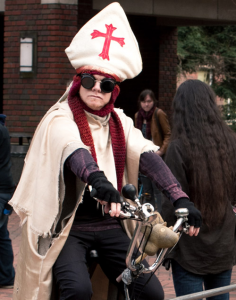 Is there really a “pope” at Reed College?
Not only is there a pope, but we met him last night! We were at Reed College and we were talking to some Reedies afterwards, and one of them said, ‘Hey, you know what, my boyfriend is the pope, he was elected pope in 2008, so, I guess he’s still sort of pope emeritus even though he graduated a couple years ago.’ So I have a shot of him posing with Justin’s pope, and the pope of Reed still had his mitre, so he put it on and it was pretty beautiful.
That’s part of the challenge in this movie. I’ve had people see it and push back, saying we kind of made like a caricature of a crazy college life, and I wanted to say, “You have no idea how much we toned it down.” When Don wrote the book, his experiences are ten years old, and the school has changed since then. Unfortunately, we didn’t have the money to make a movie that was set in 2002 and only have cars that were ten years old and things like that, so we’re presenting a modern version of Reed. Interestingly enough, since Don wrote the book, there are a number of students who have come to Reed that say Blue Like Jazz was the thing that first drew them into Reed. We did the movie because we loved Reed College, and spent a lot of time there, too, and Don rediscovered his Christian faith there after rejecting it. It’s an atmosphere where people really want to find truth and meaning, but you can’t bring your ego into discussion about truth, you have to be able to follow it where it leads.
I liked seeing some meaty classroom moments there.
We worked hard at that because it’s always tricky, you’re not telling a story about academics, but it’s a very strenuous academic environment. The annual Renn Fayre is in many ways a revolt from that strenuous academic environment. You’ve been through the ringer for nine months and people go blow off steam because it’s really tough. I think we got like three classroom scenes that are hopefully representational of the intellect there. I just hung out with a student last night, she had just gotten back from six hours of lab work, doing studies on microbes in a certain environment and I was having a really hard time just keeping up with her because she was so smart.
I have to ask you about Kickstarter. How many associate producers do you have in that sped-up crawl in the final credits?
I think they’re like 1600 associate producers.
And did you call them all?
I did! I didn’t think the Kickstarter campaign was going to work, so I said give us ten bucks or more and I will call you and thank-you personally. I ended up with a call-sheet of 3,500 names. Thankfully, in Tennessee we can talk on the cell-phone while we drive, which I’m not saying is a good idea, but it’s definitely easier for me to get all those calls made.
A lot of them were fans of the book, some of them were previous fans of my music career, but they all just wanted to see this movie made, and they felt like they were pitching in for something they really believed in and was worth while. We kept contact with them over the last eighteen months since it happened, pretty regular contact. I was even doing more calls because this weekend we’re going to do more calls up at my house, have a good call-center and check in with people again. And so many times when I call people they want me to know what this project has meant to them. It’s not just the movie itself, but also the bigger kind of community that folks have around it.
You say that it’s not a message movie but there is a message there about being true to yourself and being open to other people and being honest about who you are.
I think that that confession booth scene in the book was—it just hit me so strongly—because that image of a confession booth, there were just so many things, so many layers just to that—but I just thought, that was a really rich scene and a rich environment, and I was hoping we could get it right in the film, because in the book it’s really powerful.

 This Saturday, winged unicorn Princess Cadance and her handsome groom (bridal, not stable) Shining Armor will be married on “My Little Pony: Friendship is Magic,” shown on The Hub. Children and the adult fans known as bronies and pegasisters will enjoy the hour-long special with all of Equestria coming out to celebrate. Visit the website to download the royal wedding party package.