Interview: Jodie Foster, director and star of The Beaver

Interview: Jodie Foster, director and star of The Beaver

Posted on May 3, 2011 at 10:00 am

Jodie Foster directed and co-stars in “The Beaver,” a movie notorious already for two reasons.  First, its script by newcomer Kyle Killen was on top of the famous “black list” of outstanding unproduced screenplays.  Everyone knew how smart and distinctive it was and everyone know it would be very tough to film and very tough to find an audience for a story about a severely depressed man who finds that he is able to communicate through a beaver puppet he finds in a dumpster.  Second, the lead role of Walter is played by  Mel Gibson, whose behavior in the past few years has ranged from volatile to profoundly offensive.  But one of Foster’s many outstanding characteristics is her commitment to her work and to her friends.  It was a deeply rewarding pleasure to speak with her about the challenges of making this film and what she has learned from the movies and the people she has worked with in making them since she was a child.

Unlike ventriloquists (seen most recently in the documentary, Dumbstruck), Mel Gibson continues to act even when he is “speaking” through the beaver puppet on his hand.  Do you as a director intend the other characters on screen and the audience to look at him rather than the puppet?

I was surprised that people didn’t watch the puppet more.  I liked that about it.  I never wanted the audience to forget that there was a man behind the puppet.  It was a widescreen format.  We used an anamorphic lens, and that allows you to do two things.  First, it lets you keep two people in the frame almost all the time, even in close-up.  And with depth of field you can switch the focus very quickly from the front of the frame, where the puppet is, to where he is, so there’s a real distinction to the field that allows you to keep them in the same frame at all times in the beginning of the film and yet separate them emotionally.  We’re always, always following Walter’s path.  Then, as time goes on, we change that and allow the beaver to start taking over about halfway through the movie.

It seems to me that making a film is a little bit like having a puppet on your hand.  Instead of telling your story through one imaginary character, you’ve got many.

Yes, that’s pretty accurate.  It’s not just the director’s and the actor’s voice but the writer’s, the costume designer’s, the props, production design.  They’re all different languages and each one contributes to telling this one story.  There are other experts and you make decisions.

Tell me about how you worked with the costume designer to tell the story.

I’ve made many movies with Susan Lyall.  I love her stuff because it’s really real.  She spends a lot of time combing through vintage stores and looking through bins.  She didn’t come up through theater, so she doesn’t do draping and all that stuff.  She has a little bit of a different bent and I think it is more authentic.  The idea that there is this perfect icon, valedictorian and a cheerleader — that’s just a delusion.  Not only do they not exist, but when it appears they do, there’s a whole other side to them.  So for the character played by Jennifer Lawrence, at first she has a lot of make-up and that perfect WASP-y cheerleader outfit.  But as you get to know her — as Porter gets to know her, she changes and becomes a deeper and truer person and becomes more informal.

Your cast is one of the movie’s great strengths, including Jennifer Lawrence, nominated last year for an Oscar for her role in “Winter’s Bone” and soon to star in the big budget film of “The Hunger Games” and the brilliant theater actress Cherry Jones.  How did you select them?

I’m always trying to get Cherry in movies.  I love her.  Anton Yelchin is also amazing and really shares the screen with Mel.  Casting is a long process for me.  I take a lot of time.  Some people you know right away.  Anton I knew right away.  I met with some other actors but I was never serious about anyone but him.  I’d seen a lot of his work.  I knew that he could handle the wit, the lightness of the character but also had the dramatic side.  Plus, he looks like a combination of Mel and me so I was pleased about that!  I knew he could hold the screen with Mel even though they don’t have many scenes together, just one at the end of the movie.  The rest of the time they are fighting each other from opposite corners.  I spend a lot of time just making sure that it’s true.  There’s really nothing else you can ask.

Everybody reads for me.  I was never weird about that.  I never minded coming in and reading.  They should know if I’m the right person and I should know if I want to do a movie.  Some of it is just to hear it.  When I’m casting I’m still in the process of figuring out what the movie’s about, making decisions about locations, photography, and all that.  When I can hear it, either around a table or at an audition, then I can really see how things are going to work.  If I don’t get that process with the actors I’m walking into a mystery and I don’t want to do it.

You have quite a challenge in having a clinically depressed person as your main character. Even more than other illnesses, depression makes a person inaccessible and disturbing.

The world is littered with movies about people that are depressed that either did not come out or are not successful.  I read this article in the New York Times that I thought was so smart about obsessive ruminators.  It’s a real phenomenon.  I thought, “I do that!”  People who are good artists don’t just type it into the typewriter and win the Pulitzer Prize.  It takes a lot of rumination and thought, a lot of time thinking, “Why did that happen that way?” “How do those two things fit together?” and waking up at 3 in the morning to think about it.  It’s a very depressive process.  You go over and over and over drama and it can be depressing and isolating.  But you come out the other side.  And people who don’t, who just go to the beach and play volleyball to cope with their problems don’t get to the other side of their issues.  So I see it as a gift, and essential for being an excellent artist.  But it does make you alienated from the rest of the population.

There’s a very delicate structure to the film.  We start out inside Walter’s head.  He’s so lost at that point he’s not even speaking.  The beaver is speaking for him.  It’s a light, witty, but removed voice.  It’s remote.  And that gets you through the first part of the movie.  And then when he starts to want to live again, you get that burst of vitality.  It really isn’t until the second half when reality sets in and the drama begins.

Is the puppet’s accent another way for him to be separate from Walter?

Yes.  Walter wants the beaver to be everything that he’s not — charming, quick-witted, blue-collar, decisive.  The beaver is somebody who is a leader.

There’s a fairy tale quality to the movie — the narration and the quick turn-around in Walter’s business.

It’s a fable.  It’s a dark fable at times.  I don’t see anyone walking around with a puppet on his hand in real life.  Puppet therapy is very common for children.  It’s not something that adults take on.  It should be seen as a fable, carrying through to the ending as well.

It’s a fable in its facts but the underlying theme of finding a way to take a break from your negative elements is psychologically valid and dramatically compelling.

He adopts a survival tool.  People who go through tragic circumstances where they don’t have another option adopt a survival tool and any therapist will tell you it’s a good thing.  But you adopt and adapt these survival tools as a child — at a certain point, when you grow up, they can start to kill you.  You have to amputate them.  You have to get rid of your survival tool or it will take you over and destroy you.


Related Tags:


Actors Directors Interview
Five Inspiring Lines from Tina Fey’s Bossypants

Five Inspiring Lines from Tina Fey’s Bossypants

Posted on May 2, 2011 at 3:44 pm

I so enjoyed Tina Fey’s book, Bossypants.  It is rushed and uneven in places, understandable given her many full-time roles as producer, star, writer, mother, wife, and America’s sweetheart.  Still, the book is very funny and very, very smart.   Here are five of my favorite lines:

1.  Start with a YES and see where that takes you….The second rule of improvisation is not only to say yes, but YES, AND.  You are supposed to agree and add something of your own….It’s your responsibility to contribute.

2.  There are no mistakes, only opportunities.

3.  A wise friend once told me, “Don’t wear what fashion designers tell you to wear.  Wear what they wear.”

4.  : “The show doesn’t go on because it’s ready; it goes on because it’s 11:30.”  Fey adds, “You have to try your hardest to be at the top of your game and improve every joke until the last possible second, and then you have to let it go.”

5. I suggest you model your strategy after the old Sesame Street film piece “Over! Under! Around! Through!”


Related Tags:


Actors Behind the Scenes Books
Ralph Lauren Pretends His Catalog is a Book For Kids

Ralph Lauren Pretends His Catalog is a Book For Kids

Posted on May 1, 2011 at 9:07 pm

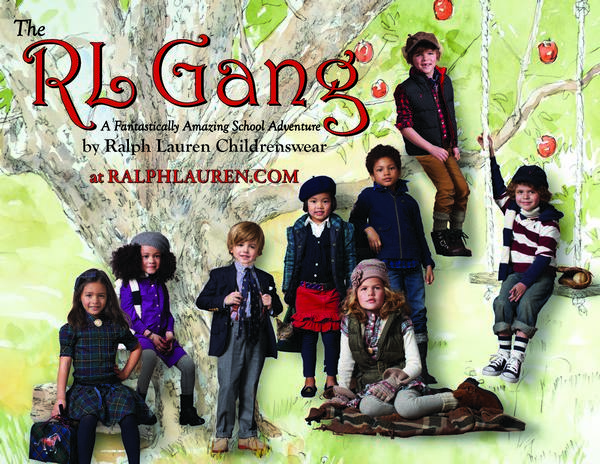
Renée Loth writes in the Boston Globe this weekend about Ralph Lauren’s new “book” for children — really a thinly disguised catalog.  They’re calling it “The first ever shoppable children’s storybook.’’

“The RL Gang: A Magically Magnificent School Adventure’’ is a 32-page volume, aimed at preschool-age children. Its slim plot involves a group of eight impossibly cute classmates, all dressed in Polo Ralph Lauren finery, with names like Willow, Oliver, Hudson, and River. The junior fashion icons use magical paintbrushes to draw themselves a garden party that comes alive, complete with ice cream and kittens.

Woozy yet? Reading along in the online video version — narrated by Uma Thurman — parents and kids can take a break to “look inside Oliver’s closet,’’ for example, and buy the twee outfits. “The RL Gang’’ is touted unblushingly as “an innovative way for parents and children to explore style, literature, and digital technology together.’”

It’s bad enough when product placement makes movies and television shows into infomercials and cross-promotions turn all kinds of products and almost-always unhealthy food into promotions for movies and television shows.  But this is essentially a catalog designed to sell very expensive clothes to children, who are not old enough to understand the fast-disappearing line between writing and pictures that are intended to tell a story based on imagination, experience, and heart and writing and pictures designed to make you think you want things you would otherwise never have thought about. 


To complain: CustomerAssistance@RalphLauren.com

Related Tags:


Advertising Books Commentary Elementary School Marketing to Kids Parenting Understanding Media and Pop Culture

Prom

Posted on April 28, 2011 at 6:31 pm

Less engrossing than a Clearasil commercial and more synthetic than a Rebecca Black video, “Prom” is Disney’s attempt to launch a new generation of tween idols with a wholesome confection about a high school dance. But the buoyant energy of “High School Musical”-style song and dance numbers is sorely missed and some sweet moments are not enough to make up for a thin storyline featuring too many inexperienced young performers. Anyone over the age of 12 will want to sit out this dance.

It begins three weeks before prom in a suburban high school.  The girls are excited about being asked.  The boys are terrified about asking them.  Apparently, even the ask itself is now a montage-worthy event, with high expectations for drama and creativity from the guys.  One romantic invitation features candles in the shed filled with party decorations, igniting a fire that destroys all of the “Starry Night” decorations.This is devastating for Nova (Aimee Teegarden), class president and all-around achiever who is determined that the prom will be “a perfect moment.” Jesse (Thomas McDonell), the school rebel (he has long hair, a motorcycle, and a bad attitude), points out that at the very worst, “the boys and girls of the school have been robbed of the opportunity to stand around and drink punch.  Lower the flags to half mast.”  The principal orders him to work with Nova to make new decorations, and inevitably, a less combustible set of sparks will fly.

The prom creates stress and drama for other seniors as well.  Two popular couples struggle with complications that go beyond the selection of limo and cummerbund.  The top candidates for prom queen and king are Jordan (Kylie Bunbury) and her boyfriend Tyler (DeVaughn Nixon), the lacrosse team captain and a playah off the field as well.  Mei (Yin Chang) does not know how to tell her devoted boyfriend since middle school that she wants to go to Parsons in New York to study design instead of to the University of Michigan with him.  The prom also gives shy, gawky Lloyd (Nicolas Braun) his last chance to ask a girl – any girl — out, with encouragement from his stepsister, Tess (a warm and engaging Raini Rodriguez).  And a pretty sophomore (Danielle Campbell) must choose between her awkward, music-mad lab partner and a smoother guy who may not be trustworthy.  And they squeeze in two characters from a Disney television series as underclassmen for cross-promotion and the already-announced sequel.

But never fear!  The over-packed plot still leaves time for the inevitable trying-on-dresses montage, a parent who has to learn to trust his daughter’s judgment, and a last-minute arrival of a back-lit dream date.

Parents will be relieved that everything stays reassuringly PG.  A character who would be a stoner in a PG-13 high school movie merely chomps on the candies that give him his nickname and talks about the girl he is bringing to the prom in a manner that sounds vaguely, well, vague.  And parents will appreciate the portrayal of supportive friends and moms and some nice lessons about self-respect, loyalty, and moving beyond shallow fantasies of “the perfect moment.” But with a dozen main characters it feels more like a series of Disney Channel sketches than stories.  Its effort to underplay the fantasy of the “perfect moment” prom is lost in its own focus on one magical evening.  A complaint from one girl about being required to read Ethan Frome is the only suggestion in the film that school is for any purpose other than college applications and finding prom dates.  Like a discount prom corsage, it looks pretty and wilts fast.

(more…)

Related Tags:


Comedy Family Issues High School Romance School Tweens
Interview: Carl Christman of ‘Selling God’

Interview: Carl Christman of ‘Selling God’

Posted on April 27, 2011 at 3:59 pm

Carl Christman, writer/director of the documentary Selling God, answered my questions about his film, an exploration of the way that fundamentalists market their religion.

How did you come to this project?

My films are a form of catharsis. I have many opinions about the major issues in life and feel the overwhelming desire to share my ideas. In past films I have dealt with War and Patriotism (Freedom Fries) as well as Terrorism and Fear (Culture of Fear.) The topic of religion seemed to be worthy of discussion.

How do evangelicals differ from other religious groups in spreading their religion?

Most religions movements work to spread their message. What sets the evangelical movement apart, and prompted me to focus on it in this film, is the skill with which they do it. They have very effectively used all forms of media and marketing to get their message out.

Are evangelicals successful in converting outsiders? In retaining those who grew up in the faith?

Judging by the continued growth and increased power of the evangelical movement I would say they are very effective at converting outsiders.

What do they consider the biggest threat to their way of belief?

There seems to be a feeling among many evangelicals that they are under attack from secularism. Since secularism is basically defined as being non-religious this means that religion is under attack from non-religion. Since three quarters of Americans identify themselves as Christian, however, I do not see Christianity as being in any danger.

Are they a political force?

The evangelical movement is definitely a political force. Evangelicals make up roughly a quarter of all Americans. This is a highly prized demographic for politicians and has tipped the balance in many elections.

How are some evangelicals like people who market books or music or other consumer goods?

My point in this film is to show how the marketing of religion is very similar to the marketing of anything else. The same techniques are used whether one is selling clothing or cars, soda or salvation.

Who do you think is the audience for this film?

Selling God has different audiences that watch the film for different reasons. Those that are not religious are likely to view it from the outside as a critique on the evangelical movement. Evangelicals are likely to watch the film and relate to the examples I offer, often on a personal level. In talking to people that grew up in the various denominations I dealt with in the film I found that they were amused by my unique take on the religious customs they had often taken for granted.

Did the evangelical community respond?

Most of my evangelical friends thought this was a thought-provoking critique. They did not necessarily agree with all of my conclusions, but they certainly enjoyed the process of exploration.

Do you see hypocrisy in the way that Christianity is marketed?

I do not see the marketing of Christianity as hypocritical. There is nothing that I am aware of in the tenets of Christianity that opposes marketing. Many people will not like talking about Christianity in terms of marketing, because they view it as being above such earthly techniques. I, however, have enjoyed applying the well-known consumer paradigm to the world’s largest religion. Hopefully this film offers a unique perspective on religion.

What good works do the members of this community support (other than trying to make converts)?

The Christian community has established many important institutions that improve all of our lives. I went to Christian schools from pre-school through college and I now teach at a Christian university.

What was the biggest challenge you faced in making the movie? What surprised you?

The biggest challenge in making this movie was trying to get access. Much of the footage I wanted to use was not easily available and many of the people I wanted to interview were not willing to speak with me. When I did have people welcome me with open arms it really stood out. I remember being outside the local Unitarian Church getting some shots from the street. When some of the parishioners saw my camera operator and myself outside, they invited us into their church, allowed us to film inside and spoke with us about their faith. I found their openness very refreshing.

Related Tags:


Directors Documentary Interview
THE MOVIE MOM® is a registered trademark of Nell Minow. Use of the mark without express consent from Nell Minow constitutes trademark infringement and unfair competition in violation of federal and state laws. All material © Nell Minow 1995-2026, all rights reserved, and no use or republication is permitted without explicit permission. This site hosts Nell Minow’s Movie Mom® archive, with material that originally appeared on Yahoo! Movies, Beliefnet, and other sources. Much of her new material can be found at Rogerebert.com, Huffington Post, and WheretoWatch. Her books include The Movie Mom’s Guide to Family Movies and 101 Must-See Movie Moments, and she can be heard each week on radio stations across the country.

Website Designed by Max LaZebnik