
Behind the Scenes with Melinda Doolittle
Posted on April 13, 2011 at 1:33 pm
The fabulous Melinda Doolittle guest stars as Cassie Cassava in the Veggie Tales’ ‘Twas the Night Before Easter!
Posted on April 13, 2011 at 1:33 pm
The fabulous Melinda Doolittle guest stars as Cassie Cassava in the Veggie Tales’ ‘Twas the Night Before Easter!

Posted on April 13, 2011 at 8:00 am
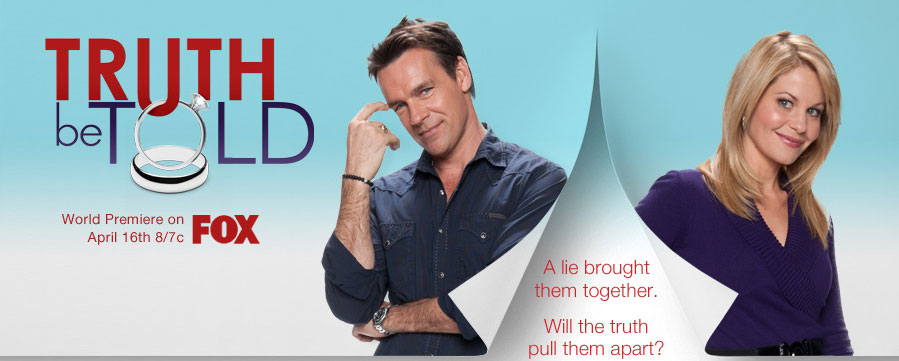
“Family Movie Night,” sponsored by Proctor & Gamble and Walmart, has produced another fine film for all ages. Candace Cameron Bure (“Full House,” “Make It or Break It”) stars in “Truth Be Told,” the story of a marriage counselor who is not married. When she has a job opportunity that requires a husband, she tells a lie, and enlists an old friend and his children to pretend to be her family.
I spoke to Candace about the role and about her work and her ministry, speaking about her faith and giving back to the community.
Tell me about “Truth Be Told.”
I couldn’t have been more excited when I was sent this script. I had seen some of the Family Movie Night shows and said to myself, “I want to do one of those!” When I read the script, it was absolutely perfect. I fell in love with Annie Morgan, the character I play. She’s a family and marriage counselor. It was something I can totally relate to, and family and marriage are so important to me. I do a lot of speaking at conferences and churches about family and marriage, so it was a topic I am passionate about. The premise is that one little lie snowballs into this huge mess and honesty is always the best policy.
That’s what I love about this series. These are not kids’ films that adults can tolerate or movies directed at adults without offensive content but true family movies with characters and situations that everyone in the family can understand and will want to talk about later.
I appreciate it as a mom. I have 12, 11, and 9 year-olds. I loved the fact that Proctor & Gamble and Walmart teamed up to give us this time on a Friday night when we can sit down with our families and watch a movie that we don’t have to worry about. It gives us things to think about and to open up some conversations with the family. “What happens if you tell a lie?” Depending on the age of your kids it can be a very simple conversation but you can turn it to a situation you and your family have recently experienced. I can open the door for something else your child has been struggling with. You use it as a platform for whatever dialogue needs to be exposed in your family at this time.
What happens in the film?
My character is offered a job at a radio station and because she is a marriage counselor, they assume she is married. And family is very important to the man who owns the company. She is probably not going to get the job unless she has a husband. She runs into an old college friend who is a widower and convinces him and his children to pretend to be her family for the weekend. The relationship develops — it is definitely a romantic comedy.
What is your experience like as you speak to groups about your faith?
I’ve been speaking and sharing my Christian faith for seven or eight years, and now I am speaking to the bigger groups like Extraordinary Women and Women of Joy. I actually just got back from a conference with Extraordinary Women. Sometimes there’s anywhere from 1500-15,000 ladies I will speak to. It is an amazing opportunity for me to share my faith and what is important to me and ultimately the gospel of Jesus Christ. I think I am as encouraged or maybe even more to see that God allows me to be used in that sense. These ladies will tell me they are encouraged by hearing my story and yet I am in awe that I am just a person getting this opportunity so I feel very privileged. It’s a very different thing from being on television. Most people would think that you would automatically be comfortable if you’re an actress to go up on stage to speak but it is actually very different. It’s not the number of people that scares me. The more there are, the easier it is for me. But it is a very different thing to open your heart and share your heart and be exposed in that way, not reading a memorized script or acting a different character. I get much more nervous speaking live at an event. You throw a camera on me and I am comfortable!
You have written about your faith as a way to manage food issues.
I had an emotional attachment to food. I ran to food for comfort, to fill a void instead of realizing I had to run to God for those things. I learned to honor my body by eating healthily and exercising but really by putting my faith into the forefront of my relationship with food by honoring my body as a temple God gave me and learning to run to Him for those needs and not to turn to food for it. I don’t enjoy getting up at 5 am some mornings but I see it as a necessity to take care of my body. To eat healthy, that’s all about the choices I make whether in a restaurant or the grocery story. The food’s not making it for me. There are so many tools out there to get us on the right track and help us make better choices. We don’t value those choices as much as we should. One choice a day, one choice an hour. If you look at it this way, it’s not so overwhelming.
Do you have a favorite Bible passage?
I don’t like that question because there are so many good ones! But the one that’s been on my computer desktop recently is Philippians 1, Verse 6. I just go, “God’s good work is in all of us and He will carry that on.” I don’t need to worry about it, I don’t need to stress over it. I know God has a plan set before me and I need to obediently just follow the footsteps that he’s laid out and keep my eyes focused on Him and He will carry out that good work to completion. And whatever that is, it might not be my own expectation but He knows what that is.
It’s everything. We read the Bible together and we talk about verses that can help us focus for that day. If we have a need or a worry for that day we find verses where it talks about it. We go to church. My kids are involved in Awana and youth group. My daughter has started leading worship and singing at her chapel. They go to a Christian school. So it is in every aspect of our lives but most important, my husband and I try to be that example, to show them that it is not just words but by our own actions and what we do.

Posted on April 12, 2011 at 3:47 pm
As we observe the 150th anniversary of the Civil War, a defining moment for good and bad in American history, it is a good time to watch some of these great films that show how we continue to try to make sense of its causes and its consequences.
1. Glory Denzel Washington won his first Oscar in this story of the doomed 54th Massachusetts Volunteer Infantry, one of the first black units to be made up of black soldiers. Writer-director Edward Zwick is sensitive to the many levels of the story but above all it is a compelling and heart-rending drama of honor and courage under the most devastating circumstances.
2. The Red Badge of Courage A young soldier learns courage does not mean lack of fear; it means not letting the fear stop him from doing what needs to be done in this movie based on the classic book by Stephen Crane. It stars two real-life WWII heroes, tthe most decorated soldier, Audie Murphy and Bill Mauldin, who won a Pulitzer prize for his Stars and Stripes cartoons about the men on the front.
3. The Civil War – A Film by Ken Burns
4. Friendly Persuasion Gary Cooper and Anthony Perkins star as a Quaker father and son, farmers who must decide how their faith guides them in the midst of a war that literally comes to their doorstep. This is a beautiful film, and a rare portrayal of faith that is respectful and sincere.
http://www.youtube.com/watch?v=YCn-HuYRM0g5. Shenandoah James Stewart plays the father of sons he insists have no reason to get involved in the war, until his youngest is taken prisoner.
http://www.youtube.com/watch?v=Ec-lmjqBOw06. Gods and Generals It is a bit stuffy, but its sincere respect for its subject and diligence about historical accuracy makes this story of Stonewell Jackson worth watching.
7. The Andersonville Trial

8. The General
9. Gone With the Wind Still the biggest box office champion of all time, this is a movie about love and war and power but mostly about survival.
http://www.youtube.com/watch?v=K9ftIzRAgAk10. Sherman’s March
There are dozens more, featuring everyone from Clint Eastwood and John Wayne to Nicole Kidman, Elvis Presley, and Shirley Temple. Each is as much a reflection of its time as of the era it depicts. But together they form a mosaic to help us understand and, we hope, to preserve the union.

Posted on April 11, 2011 at 3:53 pm
 It was so much fun to talk with some of the people behind “Born to Be Wild 3D” following its Washington DC premiere at the Smithsonian’s Museum of Natural History. Writer/producer Drew Fellman, cinematographer David Douglas, and Dame Daphne Sheldrick of the baby elephant rescue in Kenya spoke with me about making the movie.
3D and Imax requires some pretty extensive equipment — and yet you were able to get some amazing shots of the animals and the scenery. What was your biggest challenge?
Douglas: We had two camera systems. One of them weighs 300 pounds. It’s basically a massive fridge, and it sounds like a sewing machine and it has three minutes of film. So, that camera is used for certain scenes. But to get up in the canopy, to get an orangutan’s view of the world, we basically had to invent a new camera system for IMAX. And so we worked with IMAX to create their first camera that weighs less than 100 pounds, to get up on a 60-foot crane arm, and we build scaffolding in the middle of the jungle. Piece by piece, we trekked it up the river in small boats.
It sounds like “Fitzcarraldo!”
Fellman: I was actually reading Herzog’s book, Conquest of the Useless, his diary of the making of “Fitzcarraldo,” and it was really interesting because you’d read that book and think, “Okay, we’ve got it pretty good.”
Douglas: The shoot was really not just two animal but two challenges. The elephants were almost like a dream in a sense, we could be at ground level, we could get around them and we could use the big camera. But the orangutans, a big camera like that in the jungle is just too unwieldy. That small camera ended up being massively useful.
Fellman: One of the biggest surprises for us was how the animals ended up accepting our presence and the cameras. That was our biggest concern going in. One thing we had in our favor is that if it was between the camera and a bottle of milk, the milk was much more interesting than the camera.
Dame Daphne: They were a little bit suspicious at first, curious about these strange people around them all day who weren’t a part of their human family. But within a couple of days, it just became the norm and they were happy to ignore them and concentrate on what they were doing.
In the movie it says that it took you 24 years to develop infant formula for elephants that made it possible for the first time to raise them without a mother. What did you have to do to get it right?
Dame Daphne: Newborn elephants didn’t come in every day. But whenever they came in very small we tried different formulas. We knew elephant milk was very rich so we tried adding butter, cream, and then no fat at all. We didn’t have access to sophisticated baby formula in those days. We only had access to cow’s milk. I tried skim milk and the calves lasted a lot longer but they just wasted away. So I knew it was a fat problem. I went scouring the shops in Nairobi and all the zoos and asked, “What can we feed an elephant that has no cow’s milk fat?” Eventually, we settled on a base of SMA Goldcap. It’s not ideal. We still get stomach problems. But elephants need milk for the first three years of life. They cannot live without it. When they first come in we have a lot of problems with dehydration, lots of them are wounded or psychologically disturbed and in a mess. Stabilizing the stomach is the main challenge when they come in, getting them onto the new formula and calming them down.
Do you have to teach them about their natural predators so they can protect themselves when they return to the wild?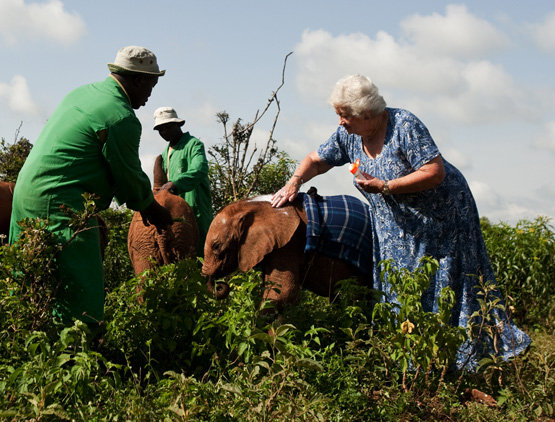
Dame Daphne: Fortunately for us, unlike the primates, elephants are born with a genetic memory, but in order to hone that, you have to expose them to a wild situation. We’ve learned that the younger we can get them there, the easier the transition is. We can keep them for as long as ten years. Generally, the ones that came to us older, that have the memory of being wild elephants, leave us sooner.
Fellman: There are lions all over that place. It’s part of Nairobi National Park, and the lions were walking around eating the warthogs. These elephants see lions and react to them.
Dame Daphne: The elephants are very fearful animals. They know the lions are there before the keepers do and they will run back to the keepers for protection. They are getting bolder, too.
Fellman: We were on a scouting trip in Tsavo and we were walking with the elephants with their keepers in the bush, and suddenly they stopped. This was a young group, maybe three or four years old. There were maybe three buffalo We didn’t know what to do. We had been told that the buffalo can be quite dangerous. We look at the elephants; the elephants look at us. We look at the buffalo; the buffalo look at us. And the elephants ran to go behind us! We got tossed aside like nothing.
Douglas: We were told to get behind the elephants, that they would protect us. But they had their own idea.
Dame Daphne: In the nursery, the keepers are very much a mother figure for the elephants. But once they get to rehab there’s a gradual change.
Do they ever come back after they go to the wild?
Dame Daphne: Some of the bulls come back, even after eight years One came back with a snare on his leg. He stood very still while we removed it.
Fellman: One scene we could not squeeze into the movie had two that came back. A whole group, maybe twelve, big elephants, brought them back. One had an arrow in his nose and another had an arrow in her rump. The mobile unit came by and treated them and then they went back.
Dame Daphne: One came back with a broken leg, escorted by another “ex-orphan.” The “ex-orphans” come and visit him, just like he’s in hospital. He’s made big friends with the small ones as well; they all have a hero worship on the big guy. They want to be close to him.
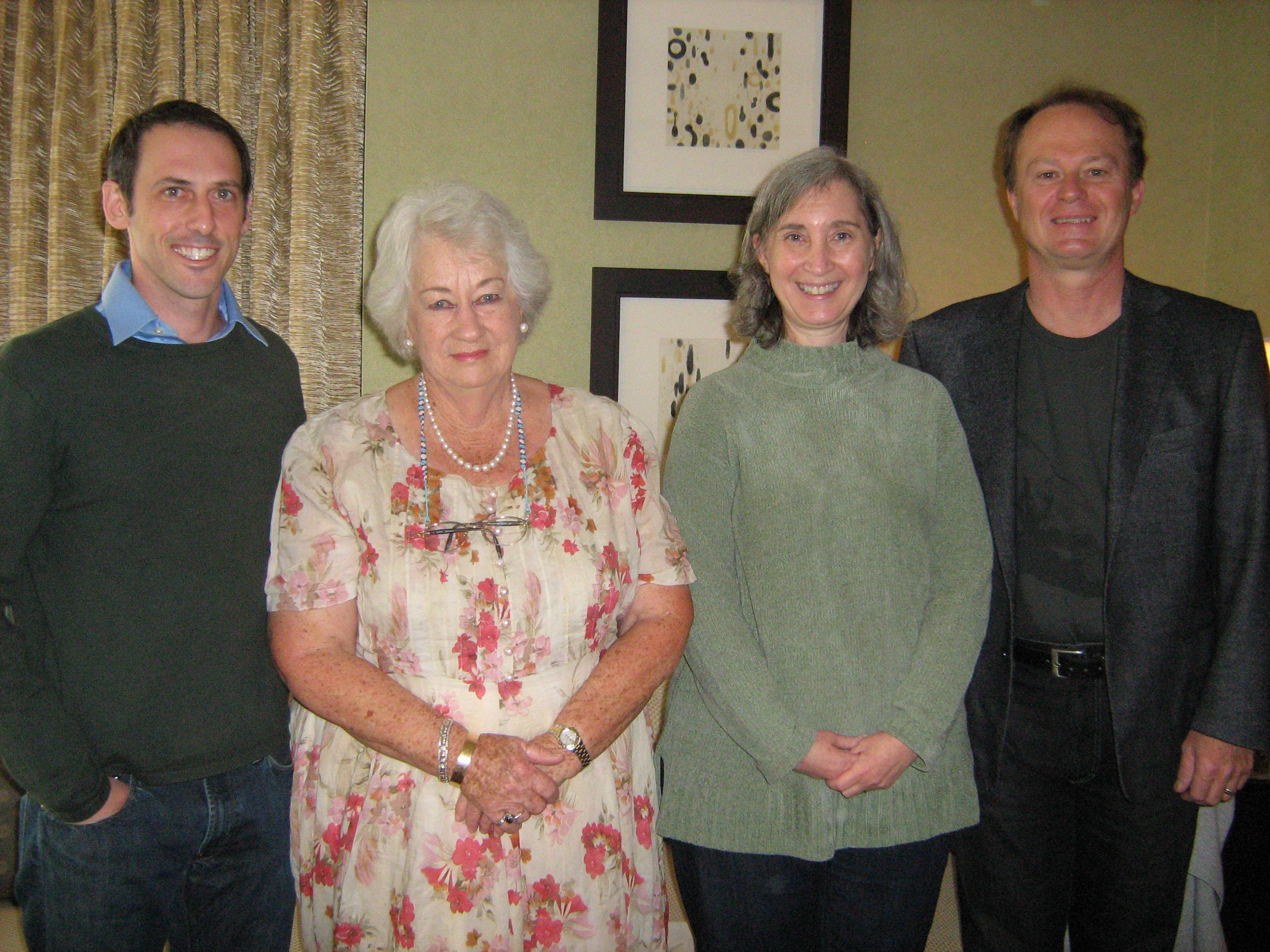 I admire the way you made it clear in the film that these are not pets or domesticated animals but respected fellow creatures.
Douglas: They weren’t patients, they weren’t study animals; they were friends.
Fellman: The thing that struck me when we started looking at his project is this idea that there’s an enterprise happening between people and animals as equals for a common goal.
Dame Daphne: The elephants are teaching the keepers. There’ve been occasions when one or two of the orphans have been left behind with the wild herds. The keepers are worried. They open up the gates and Yetta, the herd matriarch, sends two young bulls off and off they go to bring back the truants. The scientific community have had this huge block about not attributing human emotion to animals — that is anthropomorphizing. But I just came in as a lay person who loves animals. I could see very early on that all animals indeed have the same sort of emotions. We’re part of the animal kingdom and we’re not nearly as sophisticated as the elephants.
I have one adorable little stuffed orangutan to give to the first person who sends me an email at moviemom@moviemom.com with “Born to Be Wild” in the subject line. Tell me your favorite animal and don’t forget your address!
Posted on April 11, 2011 at 12:41 pm
I was thrilled that my first appearance on Ebert Presents At the Movies was a discussion of corporate villains on screen from 1909 to the present — why they are so popular and how the portrayals have evolved to reflect changing times. It was inspired by the piece I wrote for Bnet at the end of last year about the corporate villain in the movies of 2010. Thanks to all who wrote to say they watched and especially those who said I inspired them to track down some of these films so they can see them. Enjoy!
