Reading Rockets: Where the Wild Things Are Family Kit

Posted on October 11, 2009 at 8:00 am

Get ready for the release of “Where the Wild Things Are” by reading the book! Reading Rockets has a great site with resources including an interview with author Maurice Sendak. Did you know he originally wrote it as a story about horses?

And here’s a short animated version of the book:

Related Tags:


Behind the Scenes Books Early Readers Elementary School Movie Mom’s Top Picks for Families

Wait, Archie Will Marry Betty?

Posted on October 8, 2009 at 8:47 am

Now that Archie has not just proposed to Veronica (issue 600), but actually married her, gone on a honeymoon, and is going to be a father (issue 601), the comic is hitting rewind and sending Archie down the literal road not taken, so he gets to propose to Betty. In issue 603, Archie returns to the “Memory Lane” road that took him from high school graduation into adulthood and takes the other path, one apparently endorsed by the fans as the New York Times reports 80 percent favor the blond girl next door over the glamorous brunette.
The series is written by Michael E. Uslan, a lifetime Archie fan, who told the Times that this idea was inspired by Robert Frost’s famous poem, “The Road Not Taken” as well as the Gwyneth Paltrow movie “Sliding Doors” and the song “Both Sides Now.” This dual storyline allows the characters to explore the way choices large and small affect the future. But Uslan promises that all will be resolved.

“I have written his final fate in one of these two futures,” Mr. Uslan said. “Now, back in high school, it’s up to the three of them. Everything they say, don’t say, every action they take and fail to take, is going to add up to determine which of these two roads are taken. And one of them will be.”

Related Tags:


Comic book/Comic Strip/Graphic Novel Tweens Understanding Media and Pop Culture

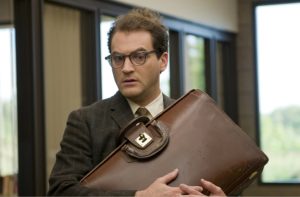
Interview: Michael Stuhlbarg of ‘A Serious Man’

Posted on October 8, 2009 at 8:00 am

Michael Stuhlbarg stars in the Coen brothers’ “A Serious Man,” as a professor in  1960’s Minneapolis who struggles with professional and family problems.

NM: You conveyed so much in your body language when you get hugged by the Sy character. How did you create that physicality?

MS: You know what? It just happens. It just naturally happened that way. We did it once and everyone laughed and it was like the blessing for the whole movie. You do as much preparation as you can and then when you get yourself into the space and you’re asked to just do it you leave yourself open to what happens.

NM: In a conventional movie, we would have had some sort of explanation, probably very simplistic, about what led to the strained relationship between your character Larry and his wife Judith. But in the Coen brothers movies, we seldom get that kind of clarity. Did you and the actress who played your wife come to some kind of understanding about the history of your characters’ relationship?

MS: Absolutely. Sari Lennick and I got together and talked about what those things were for us. Since they didn’t explore it in front of the camera we felt like we needed to bring something to ground us in what we were going to do so we discussed that thoroughly.

NM: You said that the director of photography, Roger Deakins, is almost like a third director because the Coens wait until he thinks the light is perfect before shooting. How do you, as someone trained in theater, where there is prolonged concentration, stay ready so that you can jump into the scene the moment the sunlight is what Deakins has been waiting for?

MS: It’s just one of those things that comes with doing film work. The light is all important in terms of capturing a particular moment and part of the challenge of the job for me is to be ready. I did my work before hand and hoped that when I got in front of the camera the work would pay off.

NM: One of the movie’s greatest strengths is the specificity of the production design which does a lot to tell us who these characters are. How was your performance helped by the make-up, hair, and clothing that seem so perfect for a middle-class suburb in 1967?

MS: Fríða Aradóttir helped me with the hair and Jean Black helped me with the make-up. We did a “haggard chart” to keep track of the various stages of misery that my character was experiencing. Jean and Fríða have been working with the Coens forever. Fríða is very tall and Icelandic and Jean is short and from Texas, so they are really quite a pair, kind of opposites but they work so beautifully together. So I just threw myself at their mercy and we just played. Jean and I sat down with the script together and marked out what Larry might be like physically and how haggard he might be on an given day.
Costume designer Mary Zophres gave me the shell for my character by finding those clothes.

NM: I was very impressed with your physical and verbal fluency with the very complex physics material your character has to lecture on. How did you manage that?

MS: Just a lot of practice! I sat in my hotel room in Minneapolis and just wrote it out over and over and over until I didn’t have to think about it so much any more, until it was just part of my natural instinct.

NM: Was there one scene that was especially challenging for you?

MS: There were a couple of moments that I just couldn’t stop laughing. I just find the story so funny. My first scene with Adam Arkin, in his law office, we were both just laughing our heads off. I would start and then he would start and it took us over half an hour just to calm down. And then with Richard Kind, the scene where he is on the sofa and I am on a cot in the living room, and he says “Boy, you should have worn a hat,” that just made me giggle. And then there was the constant challenge to try to monitor the emotional emotional journey that Larry was on and I had to trust that Joel would tell me if I went too far. He did on one occasion when I gave him the option of getting a little teary, but he said that is probably what is going on with him, but put a lid on it.

NM: What do you think the response will be to this movie, especially from non-Jews, who will find much of it unfamiliar?

MS: I hope that people will just come and have a good time. There may be a word here or there that they may not understand but so much of it is universal of someone who goes these troubles and tries to find an answer to his questions and has trouble trying to get them.

NM: What inspires you?

MS: I love a sense of humor, I love intelligence, I love specificity, I love surprises. I’m inspired to get out of bed in the morning and fill my day with good things.

Related Tags:


Actors Interview

Two Great Posts on Idol Chatter

Posted on October 8, 2009 at 8:00 am

I am honored to share coverage of popular culture with the thoughtful posters over at Idol Chatter. Two posts I have especially liked this week are Ellen Leventry’s commentary on the new homeless American Girl doll and the Mont Blanc $25,000 pen commemorating Mohandas Gandhi, a concept so stunning that at first I assumed it was a parody. She says:

Sure, American Girl has been working with HomeAid America, a leading national nonprofit provider of housing for the homeless, since 2006, and they have successfully addressed important social issues with other dolls, including Addy Walker, an escaped slave who is trying to reunite her family, and the Depression-era, penny-pinching Kit Ketteridge. But, American Girl is taking a problem that is less safely historical and merchandising it in the same way. In this recession, with more and more individuals and families becoming homeless, surely the Mattel-owned company could give a generous percentage of the sales of the even-in-economically-good-times-exorbitantly priced doll to charity?

That would certainly reinforce the learning experience of this doll. And I agree, too, that while Mont Blanc is giving some of the profits from this pen to charity, including one approved by Gandhi’s great-grandson, there is something fundamentally inconsistent in the idea of honoring a man whose possessions could be contained in a shoebox with a pen that costs as much as a car.
I also loved Esther Kustanowitz’s post on “The Family Goy,” about an episode of “The Family Guy” that explores Lois’ Jewish identity. There’s a link to the episode, too, so take a look.

Related Tags:


Understanding Media and Pop Culture

‘Henry Poole’ — Now Family-Friendly

Posted on October 7, 2009 at 3:59 pm

A lovely film that was neglected on its release last year will now be available in a slightly edited version that is suitable for family viewing. It is called “Henry Poole is Here,” and it is the story of a man (Luke Wilson) who thinks he has lost everything. When Henry moves into a small house he just wants to be left alone, and he does his best to obliterate himself. But a stain on his stucco looks to at least one neighbor like it could be an apparition of Jesus. And then, when it seems that the people who come to see it get special blessings, Henry finds that being left alone is getting harder and harder. And then what happens does begin to feel like a miracle, even to Henry.
The film has a lot of heart and a lot of inspiration for both believers and seekers. It is well worth a place on the family’s movie night schedule.
Thanks to commenter Michele for letting me know about the re-release of this film.

Related Tags:


Neglected gem Spiritual films
THE MOVIE MOM® is a registered trademark of Nell Minow. Use of the mark without express consent from Nell Minow constitutes trademark infringement and unfair competition in violation of federal and state laws. All material © Nell Minow 1995-2026, all rights reserved, and no use or republication is permitted without explicit permission. This site hosts Nell Minow’s Movie Mom® archive, with material that originally appeared on Yahoo! Movies, Beliefnet, and other sources. Much of her new material can be found at Rogerebert.com, Huffington Post, and WheretoWatch. Her books include The Movie Mom’s Guide to Family Movies and 101 Must-See Movie Moments, and she can be heard each week on radio stations across the country.

Website Designed by Max LaZebnik