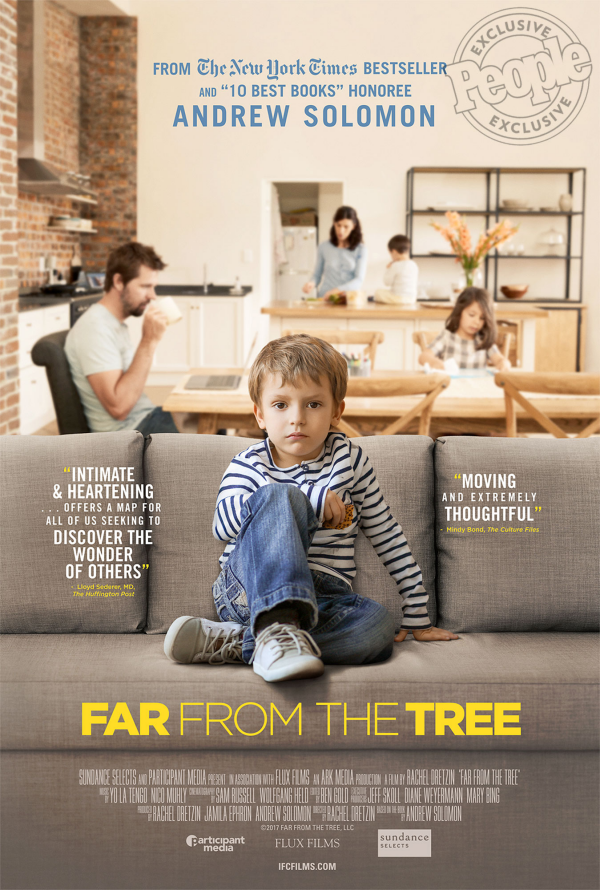
Interview: Rachel Dretzin and Andrew Solomon on “Far from the Tree”
Posted on August 2, 2018 at 8:00 am
In an interview, Solomon and director Rachel Dretzin talked about the lines between nature and nurture and between helping and accepting people who are different.
I remember in the 1960’s and 70’s, the authorities were still blaming “refrigerator mothers” for autism. Now we see it as entirely a matter of physical causes. Where are we in the attribution of our abilities and personalities between nature and nurture?
Solomon: Well, I think both nature and nurture can occur, and we look at a range of conditions in the film. I mean Down syndrome was not caused by nurture, but how well someone with Down syndrome is able to function in the world may have something to do with nurture. Different people with Down syndrome have different capacities, just as different people without Down syndrome have different capacities, but there’s no question that really good parents are able to bring their child to a higher level of functioning. So, certainly refrigerator mothers don’t cause autism, but mothers who are warm and engaged and supportive are able to help their children through autism. The family you see in the film devoted themselves one hundred percent to their autistic child, and ultimately were able to help them quite a lot.
So that’s what parenting is, is figuring out what their nature is and then nurturing whatever their nature is?
Solomon: Well, nurturing whatever their strengths are and helping them to realize their full potential. I mean parenting involves loving your children, it involves accepting your children, and what it shouldn’t involve is trying to transform their children because you are uncomfortable with the way that they’re different. You don’t want to have families to say “I have a child with Down syndrome and I’m going todo all of these things because I hate having a child with Down syndrome and I want to make it disappear and go away.” You recognize that it can create a lot of difficulties in life and so here is the way that we’re going to help him to be independent or self-reliant or give him as much education as we can and so on and so forth.
We all as parents have a responsibility for changing our children. We have to educate them, to give them moral compass, teach them some manners, and we also all have to accept and celebrate our children for who they are. Some things clearly need to be accepted and celebrated and some things clearly need to be changed and a great deal falls in a very funky middle. The film is really about how people navigate through that foggy middle
While we know different in theory, do we still somehow expect that our children will be Xerox copies of ourselves?
Dretzin: I think we all have some fantasy when we have children. Andrew says it in the book, I think it’s the first line, “There’s no such thing as reproduction.” Having children is an act of production. It is always a leap into the unknown and we all know it’s a leap into the unknown, so I think imagining that our children are gonna be just like us is a sort of comforting way of padding the jump.
The families in the movie have very little overlap with the book. How did you select them?
Dretzin: The first decision that we made, which we made very, very early on, was not to for the most part not to use the same stories that are in the book. Jason Kingsley is the one character in the film who’s also in the book, but his life has kind of moved into a new phase and a whole set of new experiences that were not part of the book, so that’s part of the reason we decided to include him.
Once we decided we were going to find new characters it was about really narrowing down the scope of what we were going to look at. There are twelve chapters in the book, ten of which are devoted to different identities. We knew we couldn’t do them all, so we thought about it thematically in terms of stories that would address some of the most important ideas in the book, and not necessarily repeating them.
So for example, there’s a lot of overlap between the themes of the Deaf chapter in the book and the themes of the dwarf chapter in the film. Both are about communities that have wrestled mightily with the question of whether cure is something they want, both are communities that have an organized empowered community that is very positive, if not celebratory, of their condition. So we decided we would do dwarfism because deafness is something that’s been looked at a lot and is further along.
Then we went out and met people. My producer, Jamila Ephron, and I spent about a year meeting dozens and dozens and dozens of families. Whether it was conferences or conventions or through different groups, then narrowing it down, then meeting them in their homes multiple times before we ever brought cameras in.
You were dealing with very intimate, often painful topics. How did you make them comfortable with you and with being so public on screen?
Dretzin: We’ve built a lot of trust. I mean, again, the film was made over a couple of years and we spent many, many, many hours with these families, multiple visits. So, in some cases the trust was there right away. Emily Kingsley and Jason, partly because they had been in the book and they knew Andrew and partly because they were just further along, they’ve done quite a bit of media before, they were comfortable almost immediately. But other families took time. It’s a funny thing that happens. You spend enough time with people and you like them enough and they like you enough, and eventually everything else just kind of goes away and people really do just relax and there are times where nobody is thinking about the cameras because we’ve been there for so long. I hope those are reflected in the film. That’s the magic moment.
There is a moment in the film at the Little People convention where they discuss a possible “cure” for dwarfism and some people are reluctant. As one of them says, “I don’t think I need to be fixed.” How do we decide and who decides whether something needs to be fixed?
Solomon: The question is whether it’s addressing short stature because it’s uncomfortable to be in the world with short stature, or whether it’s addressing short stature and these other health complications and proposing ways to avoid all of the complications that are involved. Every condition that we looked at has elements of social deficit and elements of inherent deficit. So if you’re a dwarf and you need spinal decompression, that is a biological reality, that is something that no degree of adjusting our social attitudes can address and it needs a biological response, but if you said the problem with dwarfism is that everyone stares at you and people take pictures without permission, and you can’t reach things in grocery shelves, those are all things that can be shifted and fixed, and they should be shifted and fixed and there should not be reasons for eliminating dwarfism from the spectrum of human experience.
The question is to try to tease apart the inherent problems of the conditions, and the social problems of the conditions, and to ensure that more medicine is focused on the biological issues, and that social reform is focused on the social issues.
If I had a deaf child, if one of my children was born deaf, I would get him cochlear implants because I think communication between parents and children is paramount and I’m not good at languages and I would not have become fluent in sign in three weeks, it would have taken many, many years. But I would also bring that child up around other Deaf people and learning to sign as the surest way to leave the child later on with the option. You can keep the implant on and function mostly in the hearing world, and you could move back and forth between those two worlds in a fluid and easy fashion.
Dretzin: I would just add to that that I think there’s been a kind of misconception about the inclusion of a crime story in the film that we’re trying to equate what Trevor did with being deaf or being a dwarf or any of these other sorts of conditions. It’s really in the film to show the enduring nature of parental love, and that story challenges parental love in ways that none of the other stories in the film actually can. It’s not there to suggest that we should fully accept what Trevor did or that he doesn’t meet to be fixed or anything of that nature.
I loved the music in the film. Tell me about it.
Dretzin: Well, we have two composers actually, Nico Muhly was one of the prodigies featured in Andrew’s book, so that was kind of a no-brainer. His music is beautiful particularly what he does with the autism section with Jack. You hear those voices and the buzzing and it mimics some of what is going on in Jack’s brain. Yo La Tengo was an absolute delight to work with. They came into the project a bit late because there was a song of theirs that I wanted to use and I approached them about using it. We got into a conversation about the film and they expressed so much interest in getting involved. One of the most interesting moments was actually when I screened the film for Yo La Tengo for the first time. It was a rough cut and they loved it but they thought there was too much of their music in and actually encouraged me to pull back, which was the smartest call I think that they could have made. We really had to be careful with this film not to get sentimental or manipulative emotionally because it’s such an emotional film and the music has a lot to do with that. So we really tried to pull back with the music and not overdo it, and in the end I think that that helps make the film not feel sappy.
The movie is about family members, who are often very different from one another and still find ways to support each other. But it is also about the importance of being with other people who are like you, about finding your tribe, whether you are born into it or not.
Solomon: We live in the era of the internet, I think a lot of these families find other families going through similar experiences. If you know only people who are like you you become a caricature of yourself but if you don’t know anyone who’s like you it’s hard to figure out who you are.

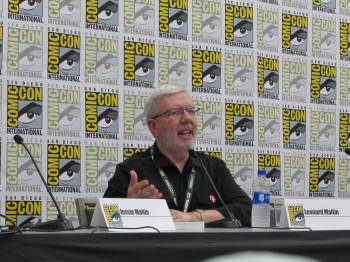
 The name of the panel was “You’re Wrong, Leonard Maltin,” and the audience was invited to argue with one of America’s most respected and beloved film critics. Disagreement there was, but all presented with affection and good humor, delightful moderated by