
Why ‘The Last Airbender’ Will Be Considered a Classic in 30 Years
Posted on July 12, 2010 at 6:53 pm
Related Tags:
Posted on July 12, 2010 at 6:53 pm
Related Tags:
Posted on July 7, 2010 at 3:54 pm
It sounded promising, with Sam Mendes (“American Beauty”) as director and Peter Morgan (“Frost/Nixon” and “The Queen”) as writer, with Daniel Craig returning and, perhaps most intriguingly, Oscar-winner Rachel Weisz as the villain. But the status of the next James Bond movie has been shifted from on hold to canceled entirely. Has Jason Bourne done what all those bad guys could not? Has he wiped out James Bond? Have modern, shaky camera, gritty spy movies and mundane real-life spy stories like the recent arrests of deep cover Russian spies in the suburbs made it impossible for us to enjoy the glossy elegance of the Bond series after 22 films? Or can he be re-booted again, even re-Bourne?
The Guardian’s film blog has a good discussion about Bond’s future prospects. On one hand, James Bond is one of the world’s great brands, with all-but-guaranteed box office sales. On the other hand, the recent entries in the series, arguably everything since Sean Connery, have been infomercials stuffed with product placement and mired in retro notions of glamor that are uncomfortably outdated.
I don’t doubt that Bond will be back. The franchise still has value. But this stumble should be an opportunity to refocus on story, not stunts, and entertainment, not product sales.

Posted on June 27, 2010 at 3:58 pm
Eight years ago, I wrote an article for the Chicago Tribune about magazines for teen girls.
Like Cosmo Girl, Twist, Teen and other magazines aimed at teenage girls, Seventeen strikes an uneasy balance between being empowering and being trashy. This is the result of another uneasy balance between their two constituencies, readers and advertisers. Girls want to attract boys. Advertisers want to avoid controversy.
The magazines are filled with tips on dating, fashion, makeup, managing stress, decorating and hair. After all, those of us with two X chromosomes love tips. Women secretly believe that all problems can be solved, usually with the female equivalent of duct tape: twist-ties, scrunchies, nail polish remover and cucumber slices. We love tips that make us feel like we are improving anything.
The magazines have tips on more than good grooming and accessorizing. Cosmo Girl’s internship survival guide has first-class information and lots of good advice about finding a job, acing the interview and demonstrating professionalism and commitment in the office.
An eighteen-year-old named Jamie Keiles has undertaken something she calls The Seventeen Project. She is living her life by the magazine’s tips for one month and documenting the results online. This will be good practice for college; the site notes that she will be studying economics and gender studies at the University of Chicago in the fall of 2010.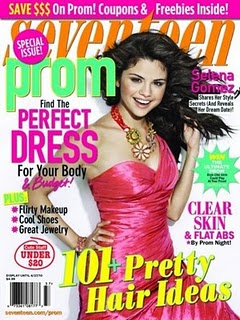
Keiles is sharp and funny about herself as well as the magazine. She is pleased with the results of a hairstyle she tries from the magazine until she looks at it again and finds that it was voted “not” by the magazine’s readers. I loved her comment on some of the dresses in the special prom issue: “Seventeen calls this trend ‘High-Low’ but I think ‘Mullet Dress would be a more fitting name.” She has some very thoughtful comments on the glossy magazine’s portrayal of race, gender, sexual orientation, and sex. “Teen mags often do better in the race department than their adult counterparts, including women of a variety of races and even offering some pretty level-headed advice on interracial dating. Still, out of curiosity, I wondered exactly how the racial content of Seventeen broke down. So I counted!” Keiles was pleased to find that the races of the models in the magazine were proportionate to the races in the US census, with the significant exception of Hispanics. But she astutely noted that there was more racial variety in the females than the males. “It seems like Seventeen’s idea of female beauty is more varied, while the races that are considered attractive for males are extremely more limited.” What could have been a stunt is an engaging, impressive, and nuanced assessment of the magazine, its advertisers, and its readers. We worry so much about media messages and the way they influence children and teenagers. It is a pleasure to see this kind of objectivity and analysis from a young woman. I hope she gets a lot of readers and I look forward to her next project.
Posted on June 18, 2010 at 3:56 pm
Children should be exposed to music as early and as often as possible and there is nothing wrong with pregnant women doing the best they can to surround themselves with soothing and beautiful sounds for their own benefit and the baby’s. But this new product, Sound Beginnings and its competitors are simply idiotic. They are belts for a pregnant woman to strap to her belly so that she can pipe music and other sounds directly to the baby from her own MP3 player.
Research does show that babies hear in utero. But that does not mean that they need some contraption to provide more benefit more than they get from what is going on around their mothers as they conduct their lives. If you want the baby to hear music, play some. If you want the baby to hear voices, talk. There is no data to show that the baby, surrounded by amniotic fluid inside the uterus, can hear any better via a belly strap than via the ambient environment as conducted through the mother’s skeletal system. There is no evidence to support any benefit whatsoever from this product other than for the companies prying more money away from expectant parents and their families and giving them even more anxiety and homework.
Additional stupidities: “The speakers are made to keep the total sound output at a low level for babies with the loudest it can go at 85 decibels. Furthermore, the speakers are encased in padded vinyl which almost eliminates the vibrations making it even safer for little ears.” Again, no data whatever to support this claim of what is or is not safe “for little ears” or at what stage of development the ears are functional. And it comes in three colors, black, white, and a pinkish they call “nude” — an offensive use of this term in a world where pregnant women and their babies have many different skin tones.
The people who sell this junk should be ashamed of themselves, as should the bogus organizations that have given it “awards:” Disney’s Iparenting media award, Mom’s Best Award, and the Parent Tested Parent Approved Media Award. All three of these “organizations” are money-making semi-scams that charge fees from products submitted for “awards.” Note that there are no awards from any educational, obstetric, or pediatric associations.
I remember a visit to my obstetrician when I was pregnant with our first child. The doctor said that the baby would recognize our voices when he was born from hearing them so frequently in utero. “Well,” my husband said, “the baby will probably recognize Cary Grant’s voice, too. She watches a lot of movies!” To this day, our son will tease me when he hears Cary Grant’s voice by saying, “Why does that sound so familiar?” And just think, even without a belly strap that protected his little ears.
Posted on June 16, 2010 at 3:59 pm
One of the many unpleasant elements of The Killers was the light-hearted portrayal of one of the main characters as a substance abuser. Catherine O’Hara plays the mother of Katherine Heigl’s character. Her role is one drunk joke after another. And there is never a suggestion that anyone in the family has any concerns or resentment or sadness about the fact that she is perpetually drinking, tipsy, or both.
A few decades ago, the funny drunk was a comic staple. Dean Martin and Foster Brooks created entire personas based on an “I’ll drink to that” approach to just about everything. (In real life, both drank very little.) Lee Marvin, best known for playing tough guys in war films and westerns, won an Oscar for a funny drunk role as a broken-down gunslinger (and his identical twin brother) in “Cat Ballou.” Another character introduces himself by saying that he is drunk and a sight gag shows a horse that has had too much to drink.
Lucille Ball had comic drunk scenes (after inadvertently imbibing) in both her television series (the “Vitameatavegamin” episode) and the movie “Yours, Mine, and Ours.” Many serious actors had comedy intoxication scenes on their resumes, from James Stewart (another Oscar-winner, for “The Philadelphia Story”) to Charles Laughton (directed by David Lean in “Hobson’s Choice”). Perhaps most surprising, these kinds of scenes and characters were even found in children’s movies like “Dumbo” and “Aristocats.”
But these days, with heightened awareness of the consequences of drunk driving and the visibility of celebrities who participate in 12 step programs or stay in rehab facilities like the Betty Ford Center, drunkenness, alcoholism, and other substance abuse problems are hard to make funny. In the case of “The Killers, it’s just evidence of the same laziness and bad judgment that makes the rest of the film so painful to watch. But even the deftest 21st century comedies may not be able to find a way to make comedy based on drinking too much work. I am pretty sure that’s progress.