Google Pays Tribute to Winsor McCay

Posted on October 15, 2012 at 12:38 pm

I am so happy that Google is paying tribute to one of my favorite artists, Winsor McCay, creator of Little Nemo in Slumberland and Dreams of the Rarebit Fiend.

McCay also invented animation.

He was the one who figured out that if movies were just a series of still pictures, he could draw a series of still pictures and make a movie out of them.  He personally drew thousands of pictures for his first animated movie, about Gertie the Dinosaur.

http://www.youtube.com/watch?v=UY40DHs9vc4

I was enchanted by the short films inspired by McCay Roger Ebert showed us at Ebertfest this year.  This one is by Thomas Edison, circa 1904.

And I am proud to be a Kickstarter supporter of animator Bill Plympton’s new film about McCay.


Related Tags:


Animation Directors Internet, Gaming, Podcasts, and Apps

Frankenweenie

Posted on October 4, 2012 at 6:00 pm

B+
Lowest Recommended Age: 4th - 6th Grades
MPAA Rating: Rated PG for thematic elements, scary images, and action
Profanity: Schoolyard language
Alcohol/ Drugs: None
Violence/ Scariness: Ghoulish horror images and some peril
Diversity Issues: Diverse characters
Date Released to Theaters: October 5, 2012
Date Released to DVD: January 6, 2013
Amazon.com ASIN: B005LAIIA8

Mary Shelley’s Victor Frankenstein was a scientist who wanted to create life.  Tim Burton’s Victor Frankenstein is a kid who just wants his dog back.

Writer/director and master of the macabre Burton first developed this idea in a 1984 live action short film that got him fired by Disney because it was too scary for children.  Times have changed, and Disney came to Burton to ask him to develop a feature length remake in 3D stop-motion — and in black and white.  Burton, who had worked in black and white (“Ed Wood”) and stop-motion animation (“The Corpse Bride,” “The Nightmare Before Christmas”) tells a deliciously ghoulish story with visual wit, panache and a lot of heart.

It is, after all, the story of a boy and his dog.  Victor (Charlie Tahan) is a bit of a loner and his dog Sparky is his best friend.  When Sparky is killed by a car, Victor decides to harness the power of lightning to try to bring him back to life.  At first, it does not seem to work, but then Sparky’s tail starts wagging.  And then it wags itself off.  “I can fix that!” the happy Victor reassures his re-animated pet.  It’s just a matter of a few quick stitches.

One of Victor’s classmates is Edgar “E” Gore (“The Middle’s” Atticus Shaffer), a mishappen but cheerful kid fascinated with creepy things.  (His name is “E” Gore, get it?)  He pressures Victor to tell him what happened and soon all the kids are trying their own experiments.  And then, perhaps because their hearts are not as pure as Victor’s (they want to win the science fair), because they are not as careful and knowledgeable, or just old-fashioned hubris, that is when things begin to go terribly wrong.

This first-ever black and white stop-action animated film is a visual treat with dozens of witty details.  I loved it when Sparky’s poodle doggie crush next door (they have a Pyramus and Thisbe-style fence between them) gets enough of an electronic jolt to give her fur white streaks in tribute to Elsa Lanchester’s iconic Bride of Frankenstein.  Martin Landau, who won an Oscar in Burton’s “Ed Wood,” gives a delicious performance as Victor’s teacher.  Burton’s own pleasure in the twisted and demented is evident in the comic grotesquery of the characters.  One creepy little girl insists on seeing omens in her cat’s poop, and when Victor’s classmates try to appropriate his methods, things go bizarrely off-kilter.  It does not reach the poetry of “A Nightmare Before Christmas,” but there are plenty of tricks and treats.

Parents should know that this film has ghoulish and macabre themes inspired by classic monster stories, children and adult characters in peril, a sad death of beloved pet, some potty humor, some violence and disturbing graphic images, and some schoolyard language.

Family discussion:  How is this story most like the original “Frankenstein?”  How is it most different?  Which monster is the scariest and why?  Why was it hard for Victor to make friends?

If you like this, try: “ParaNorman,” “Monster House,” “Beetlejuice,” and “The Nightmare Before Christmas”


Related Tags:


3D Animation DVD/Blu-Ray Pick of the Week Fantasy Horror Remake Stories About Kids

Disney’s Cinderella — New Diamond Edition

Posted on October 3, 2012 at 3:57 pm

This week, Disney’s animated classic Cinderella is being released with a glorious new Three-Disc Diamond Edition: Blu-ray/DVD + Digital Copy, and that glass slipper really sparkles!

The classic fairy tale by Charles Perrault is lovingly and imaginatively brought to life in this animated Disney version, also a classic. Cinderella, a sweet, docile, and beautiful girl forced to act as a servant for her mean stepmother and stepsisters, goes to the ball with the help of her fairy godmother. But her godmother warns that the beautiful coach and gown will only last until midnight. Cinderella meets the Prince at the ball, and they share a romantic dance. But when the clock begins to strike midnight, she runs away, leaving behind one of her glass slippers. The Prince declares he will marry the girl whose foot fits that slipper. He finds her, and they live happily ever after.

Disney expanded the simple story with vivid and endearing characters and memorable songs. The animation is gorgeously detailed and inventive. In one musical number, as the stepsisters squawk their way through their singing lesson in another room, Cinderella sings sweetly as she scrubs the floor, reflected in dozens of soap bubbles.

When Cinderella asks if she can go to the ball, her stepmother tells her she can, if she can make an appropriate dress. She then keeps Cinderella much too busy to have time to make the dress. But Cinderella’s friends, the mice and birds, make one for her in another delightful musical number. As the fairy godmother sings “Bibbidi Bobbidi Boo,” she transforms a pumpkin into a coach, the mice into horses, the horse into a coachman, and finally, Cinderella’s rags into a magnificent ball gown. The scene when the Duke comes looking for the girl whose foot will fit the glass slipper is very suspenseful and highly satisfying.

While the story has enduring appeal, many people are troubled by the passive heroine, who meekly accepts her abusive situation and waits to be rescued, first by her godmother and then by the Prince. It is worth discussing, with both boys and girls, what some of her alternatives could have been (“If you were Cinderella, would you do what that mean lady told you?”), and making sure that they have some exposure to stories with heroines who save themselves. A Ella Enchanted, based on the book by Gail Carson Levine, and Ever After, starring Drew Barrymore, have ingenious explanations for the heroine’s obedience and spirited heroines who can rescue themselves.

In today’s world of blended families, it might also be worth discussing that not all step-parents and siblings are mean. Even children who are living with intact families of origin may need to hear this so that they will not worry about their friends.

Families who see this movie should talk about these questions: Why does Cinderella do what her stepmother says? What could she have done instead? Why is the King so worried about whether the Prince will get married? If you had a fairy godmother, what would you like her to do for you? Or would you like to be a fairy godmother? Whose wish would you grant?

This story has been told many times, and families might enjoy seeing some of the other versions, including Cinderfella, with Jerry Lewis as the title character and Ed Wynn as his fairy godfather. The made-for- television musical version Rodgers & Hammerstein’s Cinderella, starring Leslie Ann Warren and the remake with Brandi and Whitney Houston are well worth watching.

Children might be amused to hear the rumor that Cinderella’s most famous accessory is the result of a mistake. It is often reported that in the original French story, her slipper was made of fur. But a mistranslation in the first English version described it as glass, and it has stayed that way ever since. But in reality, while there have been many versions of the story over the years, the best-known early written version, by Charles Perrault, did describe her slippers as glass. Other versions have her wearing gold slippers or a ring that fits only the true Cinderella.

Related Tags:


Animation Based on a book Classic Date movie Family Issues Fantasy For the Whole Family Musical Remake

Hotel Transylvania

Posted on September 27, 2012 at 6:00 pm

B
Lowest Recommended Age: 4th - 6th Grades
MPAA Rating: Rated PG for some rude humor, action, and scary images
Profanity: Some schoolyard language
Alcohol/ Drugs: None
Violence/ Scariness: Funny-scary monsters
Diversity Issues: A theme of the movie
Date Released to Theaters: September 28, 2012
Amazon.com ASIN: B0034G4OYA

What scared me most about “Hotel Transylvania” was the prospect of another film starring Adam Sandler and Andy Samberg.  Their last collaboration was “That’s My Boy,” by far the most excruciatingly painful experience I’ve had at a theater this year. Thankfully, just providing voices for this PG animated horror comedy written by five other people, Sandler and Samberg are charming.  It is a sweet, funny story about monsters who want to enjoy a peaceful life far from humans and the human who finds them anyway.

Sandler plays Count Dracula, a doting if over-protective vampire father who builds the hotel as a refuge so he and his daughter Mavis (Selena Gomez) can be safe from scary people with their pitchforks and torches.   Dracula croons a tender lullaby: “Hush little baby, don’t say a word, papa’s going to bite the head off a bird.”  Next to the changing table is a coffin-shaped diaper pail.

Mavis gets a little older, with cute little baby tooth fangs, and her caped father makes sure she’s wearing a helmet before he teaches her how to transform into a bat and fly.  The hotel is a castle surrounded by a haunted forest and a graveyard populated by the undead. “Human-free since 1898,” the hotel proudly proclaims.  And so things stay for over a century.

This Dracula has no need for human blood (“it’s so fatty and you don’t know where it’s been”).  He relies on synthetic.  All he wants is to take care of his guests, give his daughter a wonderful 118th birthday party, make sure she never leaves home, and never, ever see a human.   But then, just as all of the monsters have arrived for the party, an easy-going bro with an enormous back-pack walks in.  His name is Jonathan (Samberg), he thinks the monsters are cool, and he likes Mavis’ goth-girl vibe.  This is worse than torches and pitchforks.  A human who wants to get rid of monsters is one thing but a daughter who might fall in love with one is even scarier.  And yes, there a wink at “Twilight.”

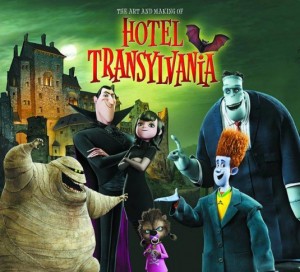
Of the three animated horror 3D comedies this fall, “Hotel Transylvania” is the least aesthetically ambitious, the most accessible for younger children, and the closest to the comfortingly silly scares of “Scooby-Doo.”   Like this film, “ParaNorman” (now in theaters) and “Frankenweenie” (opening next week), the focus is on showing us that what we think is scary really is not very frightening after all.  Of the three, this one has more all-out comedy, much of it coming from the monster-fied setting and the ghoul-ification of ordinary life.  At Hotel Transylvania, the Do Not Disturb signs hanging from the doorknobs are shrunken heads — very outspoken ones.  Mavis likes to eat “scream” cheese, which amusingly rises up from the cracker to let out a squeal as she takes a bite.  Guests are greeted by zombie bellman, a Jack Pumpkinhead doorman, and a skeleton mariachi band with hats and sarapes.  When the Invisible Man (David Spade) attempts to play charades, it is a hoot.

First-time director Genndy Tartakovsky was a storyboard artist on films like “Iron Man 2,” so he has an exceptional understanding of the mechanics and timing of the action sequences, and 3D adds a vertiginous thrill to a chase on flying tables and a touch of claustrophobia to a maze of underground corridors.  It is telling that both of those highlights involve the most vivid vampire/human relationship at the heart of the story — Dracula and Jonathan. Despite a lot of talk about romantic “zing,” the bromance is much more real than the love story.  And when they leave the castle for that most overused of climax cliches, the race to the airport, the story sags.

Top voice talent includes Kevin James as a sweet-natured Frankenstein and Fran Drescher as his bride, Steve Buscemi and Molly Shannon as the Wolf couple with innumerable cubs, and Ceelo Green as the outgoing Mummy.  But the real stars are character designers Carter Goodrich (“Despicable Me”), Greg Kellman (“Madagascar”), and Carlos Grangel (“King Fu Panda”), whose monsters pay affectionate homage to their origins but are so endearing that families may want to pay a visit to have room service deliver an order of scream cheese.


Parents should know that the monsters in this movie are intended to be more funny than scary but there are some grotesque and macabre images that may be frightening to young or sensitive children as well as some potty humor and peril.

Family discussion: Why was Dracula so afraid to let Mavis leave home?  How can parents know when their children are ready for more responsibility?  Which monster was your favorite?

If you like this, try: “ParaNorman,” “Monster House,” “Monsters vs. Aliens,” and “Scooby-Doo”

 

Related Tags:


3D Animation Comedy Fantasy Movies -- format Romance

Happy 50th Birthday to “The Jetsons!”

Posted on September 24, 2012 at 3:59 pm

Fifty years ago this week, The Jetsons first appeared on television, a sort of spin-off/bookend to The Flintstones.  While “The Jetsons” did not have any characters to match the bombastic and iconic Fred Flintstone and lasted only 24 episodes in its original run, its stories of a family living in 2062 with push-button conveniences (and a robot maid to operate them) is still fondly remembered after five decades.

The Smithsonian’s Paleofuture blog has a thoughtful and entertaining tribute to the Jetsons by Matt Novak, who calls the show “the single most important piece of 20th century futurism.”

Thanks to my Google Alerts for words and phrases like Jetsons, Minority Report, utopia, dystopia, Blade RunnerStar Trek, apocalypse and a host of others, I’ve been monitoring the way that we talk about the future for years. And no point of reference has been more popular and varied as a symbol of tomorrowism than “The Jetsons.”

“The Jetsons” was the distillation of every Space Age promise Americans could muster. People point to “The Jetsons” as the golden age of American futurism because (technologically, at least) it had everything our hearts could desire: jetpacksflying carsrobot maidsmoving sidewalks. But the creators of “The Jetsons” weren’t the first to dream up these futuristic inventions. Virtually nothing presented in the show was a new idea in 1962, but what “The Jetsons” did do successfully was condense and package those inventions into entertaining 25-minute blocks for impressionable, media-hungry kids to consume.

And though it was “just a cartoon” with all the sight gags and parody you’d expect, it was based on very real expectations for the future. As author Danny Graydon notes in The Jetsons: The Official Cartoon Guide, the artists drew inspiration from futurist books of the time, including the 1962 book 1975: And the Changes to Come, by Arnold B. Barach (who envisioned such breakthroughs as ultrasonic dishwashers and instant language translators). The designers also drew heavily from the Googie aesthetic of southern California (where the Hanna-Barbera studios were located)—a style that perhaps best represented postwar consumer culture promises of freedom and modernity.

He interviewed Danny Graydon, the London-based author of The Jetsons: The Official Guide to the Cartoon Classic.

Graydon explained why he believed the show resonated with so many Americans in 1962: “It coincided with this period of American history when there was a renewed hope — the beginning of the ’60s, sort of pre-Vietnam , when Kennedy was in power. So there was something very attractive about the nuclear family with good honest values thriving well into the future. I think that chimed with the zeitgeist of the American culture of the time.”

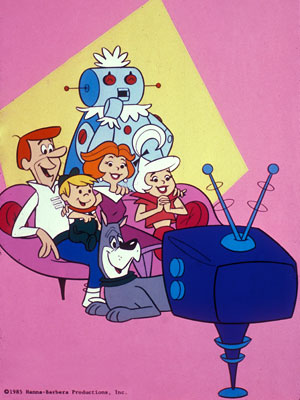
Here the Jetsons are doing something that today seems almost as sweetly retro as the Flintstones — gathered together to watch a small television with antennae.


Related Tags:


Animation Television
THE MOVIE MOM® is a registered trademark of Nell Minow. Use of the mark without express consent from Nell Minow constitutes trademark infringement and unfair competition in violation of federal and state laws. All material © Nell Minow 1995-2026, all rights reserved, and no use or republication is permitted without explicit permission. This site hosts Nell Minow’s Movie Mom® archive, with material that originally appeared on Yahoo! Movies, Beliefnet, and other sources. Much of her new material can be found at Rogerebert.com, Huffington Post, and WheretoWatch. Her books include The Movie Mom’s Guide to Family Movies and 101 Must-See Movie Moments, and she can be heard each week on radio stations across the country.

Website Designed by Max LaZebnik