Greyhound

Greyhound

Posted on July 9, 2020 at 5:10 pm

B +
Lowest Recommended Age: High School
MPAA Rating: Rated PG-13 for war-related action/violence and brief strong language
Profanity: Brief strong language
Alcohol/ Drugs: None
Violence/ Scariness: Extended wartime peril and violence, weapons, explosions, some disturbing images, characters injured and killed
Diversity Issues: Historical issues, segregated all-male military
Date Released to Theaters: July 10, 2020

Copyright 2020 Apple
People always remember the wrong part of “The Caine Mutiny.” It’s understandable because Humphrey Bogart is mesmerizing as Captain Queeg, a career officer held in contempt by the junior officer draftees who think he failed so unforgivably in his command that, in this fictional story, there is a mutiny. (In reality, there has never been a mutiny on a US military ship.) One of the most iconic scenes in movie history is when Bogart as Queeg becomes so defensive on the witness stand he undermines his own credibility. Like Jack Nicholson as Colonel Jessup being cross-examined by Tom Cruise in “A Few Good Men,” the short-term smart alecks show up the men who give their lives to the service. But do they? After Queeg decompensates on the witness stand, the mutineers feel vindicated. But the lawyer who argued the case tells them they are wrong. He could have given Nicholson’s speech about those who are smug in the luxury of their principles without having to test them in war. (Of course, SPOILER ALERT Jessup’s actions went far beyond Queeg’s paranoia and poor judgment; there is no possible justification for assaulting a soldier to force him to improve or quit.)

The WWII story “Greyhound,” written by and starring Tom Hanks, is something of a counterweight to those stories. It is based on a book called The Good Shepherd by Horatio Hornblower author C.S. Forester, whose specialty was thrilling naval stories. Hanks plays Captain Ernest Krause, commander of the USS Keeling, known by its callsign Greyhound. Like Queeg and Jessup, Krause was in the Navy before the war. We get a sense that he has been disappointed by not being promoted and perhaps, now that America’s entry into the war has prompted a promotion at last, he may have some doubts about whether he is ready. In a brief and probably unnecessary flashback, we see him propose to his lovely girlfriend, played by the lovelier-than-ever Elisabeth Shue. But she wants to wait. (In Forester’s book, Krause is divorced because his wife could not handle his by-the-book-ishness.). But unlike Jessup and Queeg, Krause is the very model of a decent, honorable, careful, officer. His first thought is for his mission; his second thought is for his men. He never loses sight of the consequences of his actions. As his men rejoice in the sinking of the U-Boat attacking them — “50 less Krauts!” — he says to himself as much as to anyone else, “50 souls.”

Other than that flashback, the quick 90-minute runtime is entirely devoted to a few days as Krause’s destroyer brings cargo ships across the Atlantic so they can deliver critically needed supplies and troops to England. Air cover at the time could not stretch all the way across the ocean, so there was a space in the middle known as the Black Pit. As the movie begins we hear the stirring voice of Winston Churchill describing the “hard unrelenting struggle” of the Atlantic fleet and Franklin Roosevelt, a former Secretary of the Navy, extolling the American spirit: “Damn the torpedoes! Full speed ahead!” “The price of the war has fallen on our sailor men,” we hear. And then we see what that means on Krause’s first crossing.

In addition to the vulnerability of lack of air cover, the equipment they have to work with is endearingly, and horrifyingly basic, analog, almost prehistoric. Their communication with their base is inadequate, even when it works, a critical message arriving two hours too late. The tracking system stops working. On board, Krause gets his intel by voice relay. A sailor has the job of just repeating everything coming from below so he can hear it. A sneeze at the wrong moment can be disastrous. The crew uses grease pencils and protractors. Krause uses binoculars. He uses a pencil-sharpener. They run low on ammo.

As admirable as the movie’s devotion to accuracy is, the tech talk is overwhelming. There’s a lot of “five minutes to course change” and language that is much harder to parse. Much less time is devoted to developing characters other than Krause; he may care a lot about the men but the movie does not seem to. An exception is Rob Morgan, in his third indelible performance of the year so far after “Bull” and “The Photograph.” As a loyal steward in the still-segregated military, he manages to convey infinite dignity and a movie’s worth of back story.

All of the tech talk and even some of the action are a distraction from what the movie is about: risk assessment under the direst circumstances, the responsibility for other people’s lives, both those on board and those they are fighting to protect at home, the wear on the spirit, the resolve to go on. At its foundation, beyond all of the tension and action, this movie is is a continuation of those same issues explored in Hanks’ recent films, especially “Captain Phillips,” “Sully,” and “Bridge of Spies.” Hanks, who often seems to play the role of America’s dad in real life, explores the existential questions that underly all of our choices.

Parents should know that this film includes extended wartime peril and violence, disturbing images, guns, torpedos, explosions, characters injured and killed, and brief strong language. Reflecting the reality of the era, the military is segregated and all-male.

Family discussion: What are some of the biggest differences between the military technology of WWII and today? Which was the most difficult decision Commander Krause had to make? If he had to do it again, what would he do differently?

If you like this, try: “Midway,” “Mr. Roberts,” “Destination Tokyo,” and “Band of Brothers”

Related Tags:


Based on a book Drama Epic/Historical movie review Movies -- format Movies -- Reviews War
The Babysitters Club

The Babysitters Club

Posted on July 9, 2020 at 9:11 am

A-
Lowest Recommended Age: 4th - 6th Grade
Profanity: None
Alcohol/ Drugs: None
Violence/ Scariness: Various health-related issues including diabetes and stroke
Diversity Issues: Diverse characters
Date Released to Theaters: July 7, 2020

Copyright Netflix 2020
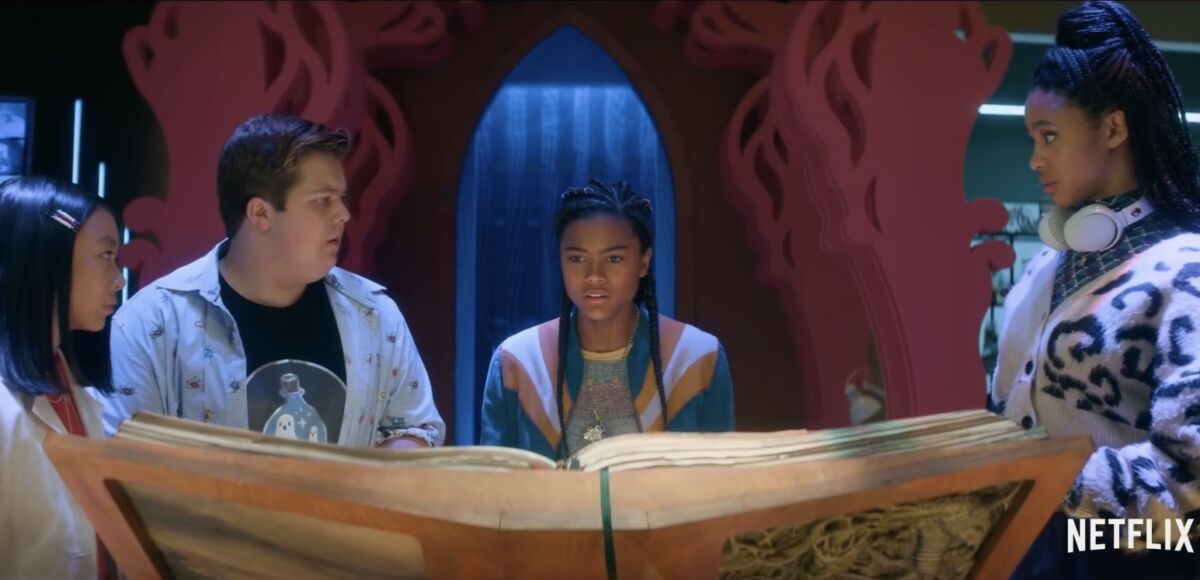
You will not see a show for any age this year that is better than this latest version of “The Babysitters Club,” Netflix’s gently updated series inspired by the Ann M. Martin. Delightfully natural performances from an outstanding group of newcomers, backed by adults like Marc Evan Jackson (“The Good Place’s” Shawn) and Alicia Silverstone (“Clueless”), deal with problems from the universal (growing up, learning to make the most of strengths and adapt to or overcome weaknesses) including crushes and puberty) to family upheavals like divorce, remarriage, illness, and loss to resolving differences with friends, family and adults, all handled with sensitivity and maturity. If that maturity is in some cases aspirational (many adults struggle to do as well), it never seems so far out of reach that it is unobtainable. The good humor and loyalty the girls show each other in resolving their conflicts is genuinely heartwarming and instructive for all ages.

The series cleverly maintains some of the books’ beloved traditions, including the landline in the colorful bedroom of one of the girls, Claudia Kishi (adorable Momona Tamada, rocking a high-fashion look that would be a challenge for a less confident performer of any age). And no one girl controls the narrative. We see the stories from different perspectives in each chapter, narratively illuminating and a good way to spark some conversations about empathy and points of view.

7th grader Kristy (Sophie Grace) comes up with the idea for the Babysitters Club, a one-stop or one-call service that provides sitters for local families after her mother (Silverstone) complains about how hard it is to find someone. The first girls to join are her shy best friend Mary Ann (Malia Baker), who lives with her very strict father, a widower (Jackson), a new girl just arrived from New York named Stacy (Shay Rudolph), who is great at math and who is concealing her Type 1 diabetes, and Claudia, a gifted artist who struggles with schoolwork and with her demanding parents and chilly sister but is very close to her grandmother (Takayo Fischer), who loves her the way she is. Later on they are joined by another new girl, the warm-hearted, justice-seeking Dawn (Xochitl Gomez), who arrives with her newly divorced mother.

Various clashes occur about the business, both internally and externally, when some older girls start their own babysitting service to compete. And various clashes occur with parents (and sadness over parents who are not there). But the girls are always committed to finding a way through, even if that sometimes takes a little while. And it is a pleasure to see each of them learn to speak up, especially Mary Ann, who discovers that her father is more vulnerable than she thought, that she can find her voice if it is on behalf of someone else, and that theater gives her an opportunity to be her best. There are also some nifty lessons about running a business, including what to do when your success leads to competition.

It is truly a delight to see these characters brought to life with such care and understanding and I cannot wait for the next season.

Parents should know that this series addresses in an age-appropriate way issues of puberty, trans children, sexual orientation, illness and disability, parental abandonment, death of a parent, bullying, blended families, and class/economic issues.

Family discussion: Can you think of a time when you were upset about something other than what it seemed you were upset about? Who was right, Dawn or Meanie? How did the girls learn to talk about their conflicts? Which one is most like you?

If you like this, try: the 1995 movie and the books, now published as graphic novels

Related Tags:


Based on a book Coming of age Family Issues For the Whole Family Movies -- format Movies -- Reviews Stories About Kids VOD and Streaming
The Outpost

The Outpost

Posted on July 2, 2020 at 5:50 pm

A-
Lowest Recommended Age: Mature High Schooler
MPAA Rating: Rated R for war violence and grisly images, pervasive language, and sexual references
Profanity: Constant very strong and crude language
Alcohol/ Drugs: Substance abuse, smoking
Violence/ Scariness: Intense wartime peril and violence, very graphic and disturbing images, many characters injured and killed, possible suicide attempt
Diversity Issues: None
Date Released to Theaters: July 3, 2020

Copyright ScreenMedia 2020
There are war stories that are about strategy and courage and triumph over evil that let us channel the heroism of the characters on screen. And then there are war stories that are all of that but also engage in the most visceral terms with questions of purpose and meaning that touch us all. “The Outpost,” based on the book by news correspondent Jake Tapper, is that rare film in the second category, an intimate, immersive drama from director Rod Lurie, a West Point graduate and Army veteran who knows this world inside out and brings us from the outside in.

The script by Eric Johnson and Paul Tamasy wisely avoids the usual expository dialogue as a newcomer is introduced to the group. Instead, we get a crisp, military briefing-style scene-setting with on-screen text informing us that the military has set up outposts in areas that are impossible to defend and given the 53 soldiers there the impossible task of both befriending the locals and fighting off the Taliban. This one is Combat Outpost Keating, located in a near-indefensible mountain-enclosed area in Afghanistan 14 miles from the Pakistani border.

Lurie and his cast, including Orlando Bloom, Scott Eastwood, and breakout star Caleb Landry Jones, understand the small revelatory moments, the trash-talk and taunting that is the way people away from home and coping with unendurable uncertainty connect to each other. Then there are the brief calls home when they pretend to be normal and maintain those connections. As a sign nearby reminds them to keep the calls to 10 minutes, one soldier puffs away while assuring his wife that he stopped smoking. A series of new commanding officers each bring his own ideas and style of communication. Over the course of the movie, we see how much we expect from the military, from 21st century warfare to diplomacy. Over the closing credits, we get a devastating reminder of how heartbreakingly young these soldiers are.

There are telling moments in the interactions with the locals. The soldiers do their best to implement the policies they are there to carry out, which means “soft power” like paying them for their people who have been killed as collateral damage or even as enemy or possibly those who are dead by other means but maybe a way to get more money from the Americans. “I will lose my honor with my elders,” one explains via a translator. “I can regain my honor one of two ways. One way is for all of you to lay down your arms and watch as your communities flourish with the help of the US and Allah.” That support comes in the form of “money, contracts, projects.” The other way does not need to be explained to the Afghanis or to us. The outpost also has to develop sources of intelligence in a place where there is no reason for anyone to trust them and they do not speak the language. There is a local version of the boy who cried wolf, constantly warning of an attack but with no useful details. And then there are the attacks, always expected yet always unexpected because they never know when.

Impeccable camerawork from Lorenzo Senatore and editing by Michael J. Duthie give the film a documentary feel matched by understated, natural performances from the cast. We feel their exhaustion. And we feel their dedication, more important even than their training or their courage. Their loyalty to each other in the face of risk so dire the outpost is known as Camp Custer is itself the answer to the question the story raises about purpose, meaning, and why we are here. The question of why we are there it is wise enough not to try to resolve.

Parents should know that this is a war movie with constant, intense, and graphic military and terrorist violence, disturbing images, characters injured and killed, constant very strong and crude language, sexual humor, smoking and substance abuse.

Family discussion: Which was the best commanding officer of the outpost? How do the soldiers manage their stress?

If you like this, try: “Beaufort” and “1917”

Related Tags:


Based on a book Based on a true story Drama movie review Movies -- format Movies -- Reviews War
Four Kids and It

Four Kids and It

Posted on June 29, 2020 at 5:37 pm

B
Lowest Recommended Age: 4th - 6th Grade
MPAA Rating: Rated PG for thematic elements, some rude/suggestive comment, fantasy violence, and language
Profanity: Some schoolyard language
Alcohol/ Drugs: None
Violence/ Scariness: Fantasy peril and some violence, guns, explosion
Diversity Issues: None
Date Released to Theaters: June 30, 2020
Copyright 2020 Kindle Entertainment

Let’s get one thing clear before we talk about “Four Kids and It.” We’re going to set aside our deep affection for E. Nesbit’s book Five Children and It for a moment. That classic has at best a homeopathic relationship to this film, which is based on a sort of inspired by, sort of sequel, touch of rip-off called, without much imagination, Four Kids and It. In both cases, the story is about children who discover a magical sand-dwelling creature called a Psammead who can talk and grant wishes. And in both cases, the wishes do not exactly turn out the way the wishers hope, creating a learning experience for the wishers and some fun for the readers/audience. I’ll take a moment to warmly recommend the truly classic original, preferably read aloud and with the Paul O. Zelinsky illustrations, and get on to this far lesser but still pleasantly entertaining version.

A single dad (Matthew Goode as David) and a single mom (Paula Patten as Alice) decide for no reason whatsoever other than being idiot adults in a movie about kids, that what they should do is not tell their children that they have been dating, it is serious, and both sets of children will be staying in the same remote house along the Cornwall coast.

The children do not consider this a good surprise, especially David’s bookish daughter Ros (Teddie-Rose Malleson-Allen), who has brought a copy of Five Children and It along with her, and Alice’s daughter Smash (Ashley Aufderheide), a sk8r grrl with a massive attitude problem. Both girls miss the parents who abandoned them. Ros hopes her mother will come back and Smash hopes her father will let her come live with him. The two younger children are David’s son Robbie (Billy Jenkins), who spends all day on his gaming device and five-year-old Maudie (Ellie-Mae Siame), who just wants everyone to get along.

On the beach, the children discover the Psammead, delightfully voiced by a perfectly grumpy Michael Caine. He agrees to grant one wish a day, but each one will expire at sundown.

The house they are staying in is owned by a wealthy and eccentric man named Tristan Trent III (Russell Brand with a beard). He seems very interested in Ros and puts a tracking device on her shoe. While the children are making their wishes and the parents remain clueless, he is trying to find the Psammead.

The fantasy elements and fending off Trent are fun. What matters, though, is the way that Ros and Smash begin to understand how acknowledging they cannot have what they really want makes it possible for them to begin to move forward, starting with developing a friendship. That’s the real magic.

Parents should know that this movie has fantasy peril and some violence, including guns, falls, and an explosion, though no one is badly hurt. There are family issues and confrontations, including two parents who walk out on their families, causing a lot of distress. Characters use some schoolyard language and are rude to parents. There are some mild sexual situations involving adults and there is some potty humor.

Family discussion: If you saw a Psammead, what would you wish for? If you could go back in time, when would you pick?

If you like this, try: Five Children and It and its sequels by E. Nesbit

Related Tags:


Based on a book Fantasy movie review Movies -- format Movies -- Reviews Stories About Kids
Artemis Fowl

Artemis Fowl

Posted on June 11, 2020 at 5:16 pm

B +
Lowest Recommended Age: 4th - 6th Grade
Profanity: Some schoolyard language
Alcohol/ Drugs: None
Violence/ Scariness: Extended fantasy-action style violence and peril, reference to death of a parent
Diversity Issues: Diverse characters
Date Released to Theaters: June 12, 2020
Copyright 2020 Disney

The twelve-year-old criminal mastermind of the Artemis Fowl series of books by Eoin Colfer is, as one might suspect, slightly nice-ified in this Disney version originally intended for the big screen but now coming to DisneyPlus. One might also suspect that Disney would call on the most spectacularly talented visual artists they could find to make this a family-friendly, gorgeously designed action fantasy.

Fans of the book will need to keep an open mind, as the storyline and characters have been re-aligned. As in the original, Artemis Fowl (Ferdia Shaw) is a prodigy. He defeats a chess master in five moves and spots his therapist’s treasured family heirloom as a fake. He is alone most of the time because his adored father (Colin Farrell) travels a lot on urgent but mysterious business trips. When they are together, Artemis loves listening to his father’s stories of Irish myths, filled with magical creatures and enchanted objects.

And then Artemis senior is kidnapped by the mysterious Opal Koboi, who gives Artemis three days to retrieve a powerful artifact, or his father will be killed. Artemis learns that the stories his father told him were not just fairy tales. And that the Irish blessing poem he recited was a clue in case of just exactly the kind of emergency that he now faces.

Copyright 2020 Disney

The shift to give Artemis a less criminal motive makes sense, especially since the character’s personality is cool and adult-ish at all times. At one point, he is asked if he is scared since, as through the entire movie, he is hyper-rational and shows very little emotion. His calm response is that he is, but it is better to be scared than dead. Knowing that he is doing everything to get his father back and, not incidentally, save the world, keeps us on his side.

As in the book, the film also balances out his quiet demeanor by surrounding him with colorful characters whose skills come in handy in searching for the mysterious weapon. Josh Gad is nearly unrecognizable and a lot of fun as a giant dwarf with exceptional skills at digging and hair that can pick a lock. Dame Judi Dench is a hoot as Commander Root, who is kind of the CEO of the land of magical creatures, barking out orders when it is necessary to stop time or wipe the memories of some humans who have had an unexpected encounter with magic. Basically, she is M with Spock ears. Loyal elf Holly Short (Lara McDonnell with the requisite spark and sparkle) is one of Commander Root’s must trusted aides.

Production designer Jim Clay had a dream job and got a dream result. Who wouldn’t want to dream up a fabulous mansion on the coast of Ireland, filled with Victorian furnishings and wonderful curios, not to mention an entire magical land? And who would not want to spend 90 minutes luxuriating in all of the fabulous details? The world of the film is truly magical, and the adventure looming ahead is deliciously enticing.

Parents should know that this film includes extended fantasy/action peril and violence with weapons including guns. Characters use some schoolyard language. There are references to the death of a parent and another parent is threatened.

Family discussion: Would you rather be a goblin, a fairy, or a troll? How did Artemis get Holly to trust him?

If you like this, try: the Artemis Fowl books and the book and movie series about Percy Jackson and Harry Potter

Related Tags:


Based on a book Fantasy movie review Movies -- format Movies -- Reviews Stories About Kids
THE MOVIE MOM® is a registered trademark of Nell Minow. Use of the mark without express consent from Nell Minow constitutes trademark infringement and unfair competition in violation of federal and state laws. All material © Nell Minow 1995-2025, all rights reserved, and no use or republication is permitted without explicit permission. This site hosts Nell Minow’s Movie Mom® archive, with material that originally appeared on Yahoo! Movies, Beliefnet, and other sources. Much of her new material can be found at Rogerebert.com, Huffington Post, and WheretoWatch. Her books include The Movie Mom’s Guide to Family Movies and 101 Must-See Movie Moments, and she can be heard each week on radio stations across the country.

Website Designed by Max LaZebnik