Leave No Trace

Leave No Trace

Posted on June 28, 2018 at 5:20 pm

B +
Lowest Recommended Age: Middle School
MPAA Rating: Rated PG for thematic material throughout
Profanity: Mild language
Alcohol/ Drugs: Pharmaceuticals
Violence/ Scariness: Peril, injury, some disturbing images, family issues, military-related PTSD
Diversity Issues: None
Date Released to Theaters: June 29, 2018
Date Released to DVD: October 1, 2018
Copyright 2018 Bleeker Street

Author Peter Rock’s novel My Abandonment was inspired by a news story reporting that a father and daughter were living off the grid but in plain sight, camping out in a Portland, Oregon public park. Writer/director Debra Granik (“Winter’s Bone”) has now adapted the story in a quiet wonder of a film called “Leave No Trace,” starring Ben Foster and newcomer Thomasin Harcourt McKenzie.

Foster, who spent weeks learning survival skills, has said in interviews that with Granik’s permission he removed 40 percent of the words in the script, which wisely lets the images tell the story. We first see Will (Foster) and Tom (McKenzie) companionably doing their daily chores, completely at home with each other and the woods. They do not need to speak. Each knows exactly what to do and each motion is as familiar as a morning stretch but as precise and synchronized as an intricately choreographed tango. When Will calls a drill, Tom knows how to hide. Their world may be Edenic, just two human creatures in tune with nature, but they are also constantly on the alert. If they are spotted, they will have to leave and go to places where there are rules and walls and jobs and school.

They make regular trips to the world outside to get provisions. “Need or want?” Will asks when Tom hopeful shows him a candy bar. “Want,” she admits. But he gets it for her anyway. Their devotion to one another is deep and palpable. She trusts him completely. She is everything to him.

And then they are spotted. They are suddenly in the system. Social services does its best to respect their wish to be isolated, using the diplomatic term “unhoused” instead of “homeless,” and finding a place for them to live and a job that is as unobtrusive on their freedom as possible. But Will, who is a veteran and may have PTSD, chafes at being told what to do. Tom, on the other hand, finds that the world outside the park has some intriguing possibilities. Will engages in that most fatherly of tasks, teaching Tom to ride a bicycle. Tom gets a chance to talk to other people. There’s a boy who raises rabbits and tells her about the activities at 4H.

Will tells Tom they have to leave. In their efforts to find a new home, they encounter some obstacles, but also some people who respect the need for privacy and living off the grid.

Debra Granik has a great gift for finding extraordinary young actresses (she picked Jennifer Lawrence for “Winter’s Bone”) and guiding them through stories of subtle complexity and humanity. “Without a Trace” is on its surface a story of a father and daughter living off the grid, on the fringe of society. In reality, it is a heightened version of the relationship every parent has with a child, the irrational efforts we make to protect them from what we see as threats, and the bittersweetness of seeing them become their own people, with their own lives, destinies, and decisions. We see Thomasin Harcourt McKenzie’s character first as living entirely in the world her father has created for her, looking to him for everything she has to know. And then we see the small moments and realizations that lead her to believe in her own voice about her future. “Want or need?” is still the question, but they may have different answers.

Beautiful performances by McKenzie and Ben Foster, a compassionate screenplay co-written by Granik, and an intimate, naturalistic style of storytelling make this a thoughtful meditation on parents and children, on damage and courage, on communities we create, and on what we mean by home.

Parents should know that this movie’s themes include PTSD, family issues, loss of a parent, and some peril and off-screen violence.

Family discussion: What was Will trying to protect Tom from? If they had not been discovered, would Tom have made a different decision?

If you like this, try: “Winter’s Bone” and “Captain Fantastic”

Related Tags:


Based on a book Drama DVD/Blu-Ray Family Issues movie review Movies -- format Not specified
How to Talk to Girls at Parties

How to Talk to Girls at Parties

Posted on May 31, 2018 at 4:02 pm

B +
Lowest Recommended Age: Mature High Schooler
MPAA Rating: Rated R for language throughout, sexual content, some drug use and nudity
Profanity: Very strong language
Alcohol/ Drugs: Alcohol, drugs
Violence/ Scariness: Sci-fi peril and some violence
Diversity Issues: None
Date Released to Theaters: June 1, 2018
Date Released to DVD: August 13, 2018
Copyright 2018 A24

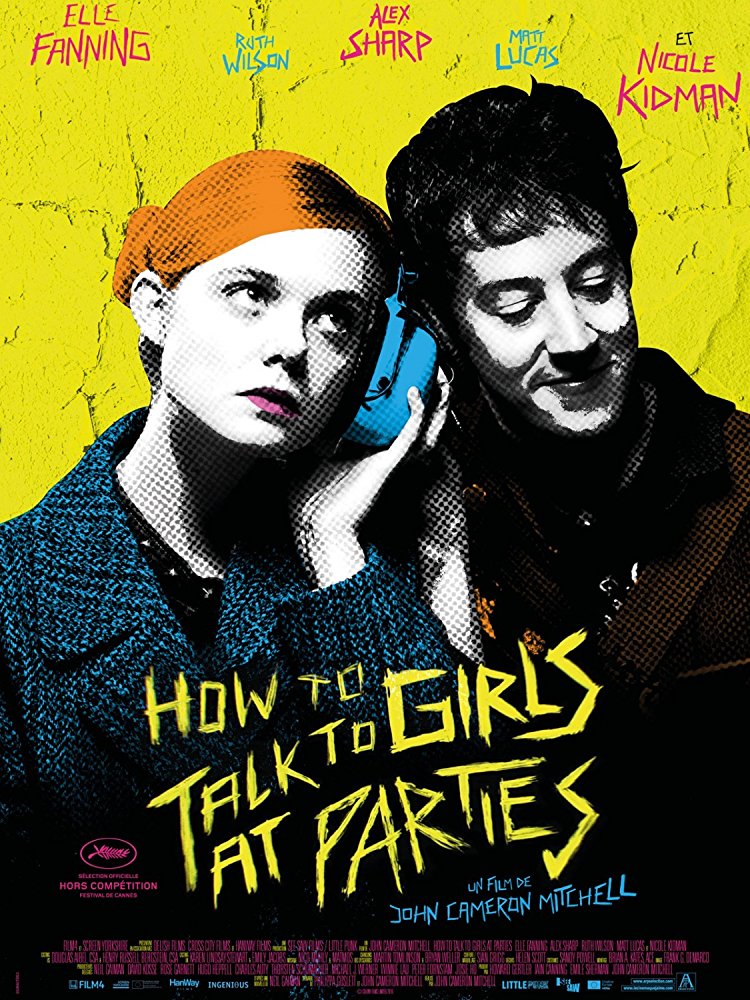
Three suburban British schoolboys in the 1990’s are big fans of punk because it seems thrilling to challenge authority and pretty much everything.  But they are not very knowledgeable about anything outside of their own experience, and so when they accidentally wander into a strange party that happens to be a bunch of aliens, they just assume that they must be American girls. In How to Talk to Girls at Parties, Americans, girls, and aliens — they’re all equally unknown, and so, for these boys anyway, easy to confuse.

Neil Gaiman’s sly short story has been lovingly adapted by John Cameron Mitchell (“Hedwig and the Angry Inch,” “Rabbit Hole”), with a breakout performance by Tony-winner Alex Sharp as Enn (short for Henry), a sweet-natured kid who, like his two best friends, loves punk and really, really, really wants to learn how to talk to girls.  Somehow, though, at parties he’s the one who ends up in the kitchen talking to someone’s mum. One night, after a punk concert, they go in search of a party they heard about but end up knocking on the wrong door.  Inside, each room has a different gathering or ritual or happening going on, all exceptionally attractive people (though one has made a mistake in manifesting and has a weird forked finger).

We know what it will take Enn the whole movie to figure out.  These are not American girls. They are aliens, on some sort of galactic tour.  And one of them, named Zan (Elle Fanning, looking far too perfect to be a human) is an alien version of punk, open-minded, curious, and inclined to break the rules. She and Enn go out exploring the world together, and they explore each other a bit, too.

The fun of all fish out of water films is seeing our world, in this case our former world, through fresh eyes. We may laugh as Zan discovers what happens when a human body processes food or speaks whatever comes into her head without understanding social norms like privacy or embarrassment. But we also appreciate her wonder at the gritty, harsh British suburb and the very things that punk is rebelling against. Her encounter with a punk queen (Nicole Kidman with gusto and evident enjoyment) is surprisingly endearing. And when Zan’s alien leaders want to interfere, well, let’s just say that it can be a real advantage to have punks on your side. A magical musical number brings everything together in quite literal terms.

Sharp is the real deal. I was struck by his performance on Broadway and really happy to see him in this film. He is able to convey innocence that comes from being true-hearted, not from a slapstick kind of awkwardness. Fanning continues to be one of the most appealing young performers in films today, always thoughtful and heartfelt. Their Romeo and Juliet romance is sweet and touching, with the adventures of Enn’s friends providing some counterpoint. Punk in this film is not angry so much as revolutionary, fueled by ideas and optimism. That may seem like an alien idea today, but Mitchell makes it seem right on time.

Parents should know that this film includes very strong language, sexual references and situations, teen partying, drinking, drugs, nudity, and some peril and violence.

Family discussion: What does punk mean to you? What is punk today? Why didn’t Zan want to follow the rules?

If you like this, try: “Stardust” and “Coraline,” also based on books by Neil Gaiman

Related Tags:


Based on a book Date movie DVD/Blu-Ray Fantasy Features & Top 10s movie review Romance Science-Fiction
Adrift

Adrift

Posted on May 31, 2018 at 3:36 pm

C
Lowest Recommended Age: Mature High Schooler
MPAA Rating: Rated PG-13 for injury images, peril, language, brief drug use, partial nudity and thematic elements
Profanity: Some strong language
Alcohol/ Drugs: Alcohol, brief drug use
Diversity Issues: None
Date Released to Theaters: June 1, 2018
Date Released to DVD: September 3, 2018
Copyright 2018 STX Films

If I ever decide to pursue a PhD, I think I will go for a combined film/economics degree and study the correlation between the quality of a film and the star also being the producer. There will be plenty of data.

Shailene Woodley produces and stars in “Adrift,” based on the true story of a young couple sailing across the Pacific Ocean in the early 1980’s, who were caught in a deadly hurricane. There is obviously a lot of appeal for an actress in a story of the struggle to survive with the opportunity to show courage, resilience, and determination. But the back-and-forth flashbacks weaken the intensity of that struggle and a weak script with a Gothika Rule-worthy twist ending make even a story of survival more disappointing than inspiring.

Tami (Woodley) is a free spirit as we see when the immigration official in Tahiti asks her what her profession is and she replies, “Whatever job pays me enough to get me to the next place.” She has been traveling full-time since she graduated from high school five years earlier, most recently as chef on a schooner. She meets Richard (Sam Claflin), a British Naval Academy drop-out who worked in a boatyard so that he could build his own sailboat and has been on the water pretty much full-time ever since. Though he tells her that being at sea alone is mostly being “sunburnt, sleep-deprived, seasick, or all three at once. And after a few days, there’s the hallucinations.” But there is something both of them find irresistible in sailing into the horizon, and both have an unquenchable desire to see what the world has to offer. In one of the movie’s best scenes, she says a sunset at sea is red (as in “Red sky at night, sailor’s delight”), and he makes her see all the different shades and colors within the red. While she teases him about it later, she loves seeing the world through his eyes. And he loves her spirit of adventure.

When a wealthy friend offers Richard $10,000 and two first-class plane tickets to sail his yacht to San Diego, it seems like a perfect way for them to begin their life of adventure. But we know from the movie’s first shot that they are sailing into terrible trouble. We first see Tami submerged, and then we see her come to, disoriented, in the wrecked and waterlogged hull of the yacht, with Richard gone. Later we will see their tiny ship buffeted about by waves (the special effects are fine but nothing we didn’t see in “The Perfect Storm”) interspersed with scenes of their early romance and scenes of the 41 days adrift, with no way to get help or let anyone know where they were.

I don’t want to spoil the movie’s twist here, but per the Gothika Rule will be happy to share it to anyone who writes to me at moviemom@moviemom.com. I’ll just saw that while I am sure it was a deeply spiritual and sustaining experience for Tami, it comes across poorly on screen, leaving the audience, yes, adrift.

Parents should know that this film includes intense mortal peril with severe and graphic injuries, some strong language, sexual references, nudity, brief drug use, alcohol, reference to suicide and teen pregnancy, and a sad death.

Family discussion: How many ways can you think of to describe red? Why was the frangipani so meaningful? Why did Tami say she wouldn’t trade the experience for anything? What problem-solving skills helped her the most?

If you like this, try: “Touching the Void” and “The Life of Pi”

Related Tags:


“Gothika Rule” Action/Adventure Based on a book Based on a true story DVD/Blu-Ray movie review
Ready Player One

Ready Player One

Posted on March 28, 2018 at 4:00 pm

A-
Lowest Recommended Age: Middle School
MPAA Rating: Rated PG-13 for sequences of sci-fi action violence, bloody images, some suggestive material, partial nudity and language
Profanity: Brief strong language, one f-word
Alcohol/ Drugs: None
Violence/ Scariness: Extended sci-fi/fantasy peril and violence, real and virtual weapons, chases, and explosions, arson, characters injured and killed
Diversity Issues: None
Date Released to Theaters: March 30, 2018
Date Released to DVD: July 23, 2018
Copyright Warner Brothers 2018

You know that one perfect high note in the A-Ha song, “Take on Me?” The goosebumpy bliss of it? “Ready Player One,” with endless callbacks to the era of A-Ha, is that note as a movie, set in the future, in love with the past, and uncannily right of this exact moment. There could be no better director than Steven Spielberg to take on this movie about a virtual game filled with the cultural touchstones of the 1980’s, a decade he helped define for the generation who will now be taking their children to this film and re-entering their own childhoods. We are all Marty McFly, now, going back to the future in a Delorean.

Spielberg is as good as anyone has ever been at the craft of cinematic storytelling, and there has never been a story more suited to that craft than this one, based on the book by first-time author Ernest Cline, who co-scripted and co-produced, and who admits that his world view was in large part formed by the Spielberg movies he watched as a kid in the 1980’s. There is a lot of nostalgia in the film, but also themes that could have come from today’s news: the role of technology as a distraction and as an invasion of privacy and underminer of democracy and the idea of teenagers saving the world.

It is Columbus, Ohio, 2045, when “people have stopped trying to fix problems and are just trying to outlive them.” The world is a bleak and broken place and most people spend most of their time escaping reality via a massive, enthralling online world called The Oasis, invented by James Halliday (Mark Rylance) a shy, obsessive genius who is a combination of Steve Jobs, Bill Gates, Mark Zuckerberg, Walt Disney, and Willy Wonka. “They come for all the things they can do,” we hear, “but stay for all the things they can be.” Players can design their own avatar personas any way they want — with antlers or wings, beautiful or ugly, super-powerful, purple, any age, gender, or species.

Five years before this story begins, Halliday died, leaving his half-trillion dollar empire and sole control of The Oasis to whomever was the first to discover the “Easter egg”* hidden in the game, which required agility, puzzle-solving, and a comprehensive knowledge of Halliday’s life and the popular culture he immersed himself in as a child in the 1980’s.

In five years, no one has even found the first of the three keys that lead to the egg. Many people have given up. Those still seeking it are called “gunters” (egg hunters). Wade Watts (“Mud’s” Tye Sheridan) is a teenage orphan living with his aunt and her latest in a series of abusive boyfriends in what is essentially a vertical trailer park called The Stacks. The film’s opening scene is brilliantly designed, as the camera pans down a dingy, jerrybuilt column of shabby capsules, showing each occupant caught up in a different virtual reality scenario, from boxing to pole dancing, with just one woman growing real-life flowers, the only person who even notices that Wade is there.

Wade signs into The Oasis, using haptic** gloves and a virtual reality eyepiece, for yet another try at crossing a virtual version of a Manhattan bridge guarded by King Kong. His avatar is Parzival***, who drives a Delorean, and he has an online friend, an enormous, mechanically-gifted man named Aech (I won’t reveal the voice performer to avoid spoilers). And he is intrigued by a female avatar named Art3mis (again, no spoilers) who rides the red motorcycle from the Akira video game. While Parzival and Art3mis both insist they will not “clan up” (team up with other players, they end up forming an alliance that includes two other avatars, Sho and Daito.

The Nolan Sorrento (Ben Mendelsohn) is head of the rival online company, Innovative Online Industries, and he wants to be the one to find the egg so he can make a lot of money selling ads (he has determined the exact number of ads that can bombard users “before inducing seizures,” he crisply informs his staff) and charging for access. IOI has hundreds of researchers and gamers trying to find the egg. And it operates “Loyalty Centers,” essentially debtors prisons, where those who owe the company money have to work it off under brutal and impossibly Sissiphusian conditions.

Wade has to locate three keys and solve clues involving not just logic and intense research but empathy, clues that turn out to be wisely selected by Halliday, Willie Wonka-style, to find the right person to take over the Oasis. Spielberg himself has to locate three keys as a filmmaker and does so with as much grace, heart, and integrity as Wade, his own avatar through the story. The copper key is the game level, the action scenes and the next-level special effects, including the chase across the Manhattan bridge and a stunning set piece inside the Stanley Kubrick movie, The Shining, repurposed here with bravura wit and skill. The jade key is the nostalgia, with dozens, perhaps hundreds of 80’s references, from the iconic and enduring to the obscure and forgotten. It is not, as is too often the case, shortcuts to play into the audience’s emotions, but deployed, again, with consummate wit and skill as commentary, as surprise, and as a reminder of our connections to the pop culture that first excited and engaged us. And the crystal key, well, it has been said often that the theme of all Spielberg movies is finding your way home. Wade is a 21st century Dorothy in Oz or Alice in Wonderland — or David in “WarGames,” exploring a land of infinite magic and wonder — and danger — but learning that there’s no place like home.

*The use of the term “Easter egg” to describe secret features originates from the 1979 video game Adventure for the Atari 2600 game console, programmed by employee Warren Robinett.

**They make it possible for the wearer to “feel” or “touch” virtual characters and objects.

***Named for one of King Arthur’s knights, who devoted his life to the search for the Holy Grail.

Parents should know that this film includes extended real world and virtual peril and violence including chases, explosions, weapons, murder, brief crude humor, some sexual references, brief strong language

Family discussion: What would your avatar be in the Oasis and why? Why would people stop trying to fix problems? What would Sorrento do with the Oasis and how would users respond?

If you like this, try: The book by Ernest Cline and movies that this one refers to, including “The Shining,” “The Iron Giant,” and “Back to the Future”

Related Tags:


Action/Adventure Based on a book DVD/Blu-Ray Fantasy Fantasy movie review Science-Fiction Stories about Teens
Love, Simon

Love, Simon

Posted on March 15, 2018 at 5:15 pm

B +
Lowest Recommended Age: Middle School
MPAA Rating: Rated PG-13 for thematic elements, sexual references, language and teen partying
Profanity: Brief strong language
Alcohol/ Drugs: Teen drinking
Violence/ Scariness: Tense family situations
Diversity Issues: A theme of the movie
Date Released to Theaters: March 16, 2018
Date Released to DVD: June 11, 2018
Copyright 20th Century Fox 2018

If you are scrolling through Netflix you may run across movies like 2000’s The Truth About Jane, where family or friends discover that someone is gay, get upset, try to deny it or force the gay person into therapy, and then learn in time for a big happy ending at a Pride parade that love is what matters, no matter who the person they love loves. A lot has happened in 18 years, and thankfully we are pretty much past the point where a story about a family freak-out over the discovery that someone is gay is worth making a movie about. Yet there are two elements that are notable about “Love, Simon.” It is the first major studio romantic comedy about a gay teenager. And, much more notable, the real issue is not about his being gay; it is just about his being a teenager.

Love, Simon” is based on the award-winning book by psychologist Becky Albertalli. It is indeed a comedy. There are many very funny lines, and gems of comic performances by two of the adults in the film. The always-great Tony Hale (“Veep”) plays a high-spirited vice-principal who likes to confiscate cell phones and act like a princi-PAL, and Natasha Rothwell (“Insecure”) is absolutely hilarious as a put-upon drama teacher forced to direct a production of “Cabaret” that is required to include every student who wants to be in the cast. Making the adults in the story the comic relief is a very nice touch.

And it is definitely a romance. I can’t remember when I’ve heard an audience respond with cheers and applause as joyous as they did when the big kiss moment finally arrived. But what makes this film really special is that is about feelings everyone has — the feeling of being alone, outside some sort of magic circle everyone else seems to know how to get inside, the worry about letting people down, the soul-shrinking experience of actually letting them down even more than you feared, the terror of allowing yourself to be vulnerable, the joy of being seen and understood.

Nick Robinson (“The Kings of Summer”) plays Simon, a high school senior who has everything — loving, generous parents (who also happen to be gorgeous — Josh Duhamel and Jennifer Garner), a cute kid sister, and great friends with whom he shares “way too many iced coffees, bad 90’s movies, and gorge on carbs at the Waffle House.” His life is just about perfect except that he has not been able to find a way to tell anyone that he is gay.

The school has a gossipy website where a student who calls himself Blue says that he is gay but cannot come out. So Simon writes him as “Jacques” and the two of them instantly fall into a close, supportive friendship with perhaps a little bit of flirting. What makes this really great in the film is that it allows/requires Simon (whose full name, as he points out, means “he who hears” and “he who sees”) to look at every male student in the school differently, as he wonders which one is Blue and even pictures different students in the situations Blue describes. That experience, as much as the correspondence itself, widens his world and makes him more empathetic, similar to the different perspectives in last year’s “Wonder.”

An obnoxious student discovers the correspondence and threatens to publish it unless Simon helps him get close to Abby, a transfer student who has become a part of Simon’s group of friends.

A brief fantasy sequence about what being gay might be like in college is a lot of fun, and a scene where Simon imagines that heterosexual teens should have to come out to their parents is sharply funny. But what makes this movie special is its tender heart. It is wise about friendships, about those first tentative steps toward intimacy, about being honest, not just about what you are but who you are, and about the unforgettable tenderness of that first kiss.

Parents should know that the theme of this film is a gay high schooler struggling to come out and it includes kisses, a brief crude sexual reference, teen drinking, and brief strong language.

Family discussion: Why could Simon tell Blue and Abby before Leah and his family? Would you like to have a “Secrets” website for your school?

If you like this, try: “G.B.F.,” “Never Been Kissed,” and “Easy A”

Related Tags:


Based on a book Coming of age DVD/Blu-Ray Pick of the Week GLBTQ and Diversity High School movie review Romance Stories about Teens
THE MOVIE MOM® is a registered trademark of Nell Minow. Use of the mark without express consent from Nell Minow constitutes trademark infringement and unfair competition in violation of federal and state laws. All material © Nell Minow 1995-2025, all rights reserved, and no use or republication is permitted without explicit permission. This site hosts Nell Minow’s Movie Mom® archive, with material that originally appeared on Yahoo! Movies, Beliefnet, and other sources. Much of her new material can be found at Rogerebert.com, Huffington Post, and WheretoWatch. Her books include The Movie Mom’s Guide to Family Movies and 101 Must-See Movie Moments, and she can be heard each week on radio stations across the country.

Website Designed by Max LaZebnik