
Jack Reacher

Posted on December 22, 2012 at 1:02 pm

Jack Reacher, the hero of a series of books by Lee Child, is as much an idealized fantasy figure as any adorkable chick-lit single girl rocking her Jimmy Choos and self-deprecating quips until Mr. Perfect puts a ring on it.  The testosterone version has the observational and analytic skills of Sherlock Holmes, the “who was that masked man” righting-wrongs-and-leaving-town career path of the Lone Ranger, and the single-minded devotion to righteous indignation firepower of Rambo, and he will never, ever, ever put a ring on anyone.

Reacher is ex-military, and ex-pretty much everything else.  He has no strings, no relationships, no commitments — also, no id, no phone, no home, and no baggage, in both the literal and metaphorical sense.  When he needs to change clothes, he picks up something at Goodwill and throws away whatever he was wearing before.  When he needs a car, he has a very effective way of persuading people to let him drive theirs.  Or, he just takes one.  And he keeps moving.

http://www.youtube.com/watch?v=kK7y8Ou0VvM

In the books, Reacher is 6’5″ and 250 pounds and blond.  But that did not stop Tom Cruise, who is none of those things, from taking the role.  He more than makes up for the lack of physical stature with pure movie star charisma, a fair trade.

The movie is based on Child’s One Shot, written and directed by “The Usual Suspects” screenwriter Christopher McQuarrie. It opens with a scene of a sniper shooting random passers-by, and it is especially jarring when we see him aiming at a child.  I would say that it might have made sense to delay the release of the film because it is unfortunate to have it open a week after the shooting of children and teachers in Newtown, Connecticut, but it may be that after that horrible tragedy there will never be a good time for a movie that turns carnage into entertainment.  Within the world of the movie, a world people willingly enter because they want to see some guilt-free fights, chases, and shoot-outs, it is reasonably effective.  But if it is harder to enter that world these days, perhaps that is not a bad thing.

Law enforcement tracks down the sniper, a military vet, and the case seems open and shut.  But before he is beaten into a coma by other prisoners, he scrawls “Get Jack Reacher.”  Reacher can’t be contacted, but somehow he knows where he is needed, and he shows up.  The sniper’s lawyer Helen (Rosamund Pike) believes her client is guilty, but wants to do her best to represent him.  It turns out Reacher knew the sniper in Iraq.  He has reason to believe the sniper is guilty.  And, as Reacher tells us, he is not a hero.

Oh, who is he kidding, of course he is.  Surprise!  The case is not as open and shut as we thought.  There are some dreary detours into Helen’s relationship with her father, who happens to be the DA, and to a hideous torture scene with a bad guy known as “The Zec” (Werner Herzog, better known as a director), and a five-on-one bar fight, and than, thankfully, we meet up with Robert Duvall as a ex-Marine shooting range owner.  He is the only one who seems to understand what kind of movie this is, bringing a delicious zest to his scenes that almost make us forget that this is a movie in which a man is asked to bite off his own fingers and everyone seems to speak Russian.

It delivers what it intends to and what fans of the series are looking for.  But I’d say it’s too soon, and maybe it’s never going to be the right time for a mindless shoot-em-up again.

Parents should know that this film includes extensive, brutal and graphic violence including a sniper who kills innocent people and executions, many fights, many guns, car chases and smashes, torture, some disturbing images, characters injured and killed, some strong language (one f-word, crude epithets), drinking, and references to drug use and drug dealing.

Family discussion:  Why does Jack stay on the move?  Did Emerson have a choice?

If you like this, try: the Jack Reacher books by Lee Child
Related Tags:


Action/Adventure Based on a book Crime Thriller

My Favorite Versions of “A Christmas Carol”

Posted on December 19, 2012 at 8:00 am

My favorite Christmas story is “A Christmas Carol” by Charles Dickens and I enjoy as many versions as possible every year.  I love it in just about any of its movie incarnations. “Bah, humbugs” have been muttered by Scrooges played by top-notch dramatic actors like George C. Scott and Albert Finney, former Miss America Vanessa Williams, former Fonzie Henry Winkler, former Ace Ventura Jim Carrey, and former “Saturday Night Live” star Bill Murray. I love them all. I’ve already listened to the Tim Curry and Jim Dale audio versions available on Audible.com, both delightful.  And I have the book, of course, with wonderful illustrations by Ronald Searle.

Here are my very favorite versions on film and I try to watch each of them every year.

5. “Mickey’s Christmas Carol” Who better to play Scrooge than his namesake Scrooge McDuck? And who better for the part of the unquenchable Bob Cratchit than Mickey Mouse? This compilation DVD includes other Christmas goodies “The Small One” and “Pluto’s Christmas Tree.”

4. “The Muppet Christmas Carol” has the distinguished actor Michael Caine as Scrooge and the equally distinguished Kermit the Frog as Bob Cratchit. Special mention of A Sesame Street Christmas Carol as well.

3. “Mr. Magoo’s Christmas Carol” The voice talent is outstanding, with Broadway star Jack Cassidy (father of teen idols David and Shaun) as Bob Cratchit and of course Jim Backus as Mr. Magoo, in this version an actor playing the part of Scrooge. The tuneful songs were written by Bob Merrill and Jule Styne, who later went on to write “Funny Girl.” (The legend is that their song “People” was originally written for this movie.)

2. “A Christmas Carol” This MGM classic features the top stars of the 1930’s. Watch for future “Lassie” star June Lockhart as one of the Cratchit children — her real-life father Gene Lockhart played Bob. (He also appears in another Christmas classic, as the judge inMiracle on 34th Street.)  Reginald Owen plays Scrooge and this one has my favorite Fred, Barry MacKay.  I love Dickens’ description of Fred’s laugh:  “If you should happen, by any unlikely chance, to know a man more blest in a laugh than Scrooge’s nephew, all I can say is, I should like to know him too. Introduce him to me, and I’ll cultivate his acquaintance.”

1. “A Christmas Carol” This is the all-time best, with the inimitable Alistair Sim as Scrooge. There has never been a more embittered miser or a more jubilent Christmas morning rebirth. When he orders that turkey for the Cratchits and walks into his nephew’s celebration at the end, everything Dickens hoped for from his story is brought to life.

https://www.youtube.com/watch?v=zWdJ1EXf5zo
Related Tags:


Based on a book Classic For the Whole Family Holidays Lists Movie Mom’s Top Picks for Families Remake

The Hobbit: An Unexpected Journey

Posted on December 13, 2012 at 6:00 pm

B
Lowest Recommended Age: Middle School
MPAA Rating: Rated PG-13 for extended sequences of intense fantasy action violence, and frightening images
Profanity: Some strong language
Alcohol/ Drugs: Drinking, smoking
Violence/ Scariness: Extended fantasy violence and peril with swords and arrows, characters injured and killed, scary monsters
Diversity Issues: Diverse characters
Date Released to Theaters: December 14, 2012
Date Released to DVD: November 4, 2013
Amazon.com ASIN: B00E8S2JZ4

As the second in the Hobbit trilogy is about to be released, The Hobbit: An Unexpected Journey (Extended Edition).  Director Peter Jackson returns to J.R.R. Tolkien’s Middle Earth for this “Lord of the Rings” prequel, the adventure of young Bilbo Baggins, the hobbit we meet in the LoTR trilogy as the middle-aged uncle of the heroic Frodo.  We see many familiar faces, especially Ian McKellan as the wizard Gandalf, the sepulchral Christopher Lee as Saruman, Cate Blanchett as the ethereal Galandriel, Hugo Weaving as the regally gracious Elrond, and Andy Serkis plus CGI as Gollum, and the now-familiar but still marvelously eye-filling New Zealand locations.What is most different here is that Jackson has doubled the frames-per-second for a new hyper-clarity.  The 24 frames per second standard that has been in effect since the beginning of the sound era has been upped to 48, giving the film a depth of detail that is so fresh it can be a little unsettling.  We subconsciously associate the quality of light and focus with the video used for news programs and lower-budget sitcoms (think of the difference between the indoor and outdoor scenes in the old “Monty Python” episodes), so it can take a while to get used to it in a richly imagined fantasy, especially when close-ups reveal the pores of a character’s skin like a magnifying mirror at a department store makeup counter and the quality of light seems chillier and more sterile.  We get so much visual information that it takes a while to re-calibrate our ability to separate the meaningful from the superfluous.
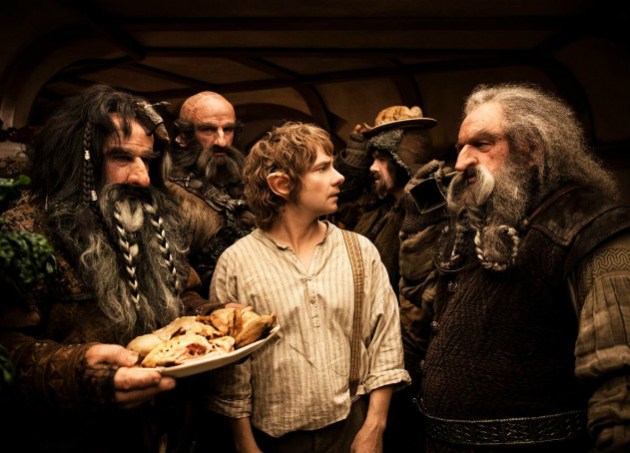
It does not help that Jackson himself seems to miss the forest of the story for the literal trees.  Blowing out the shortest and most accessible of the books to a projected trilogy of nearly nine hours suggests that Jackson has fallen so in love with the project that he has lost touch with what it feels like not to be completely obsessed with it.  Of course, he is enabled by the intensity of the fans, who are famously dedicated to every leaf, twig, and Elvish declension.  But he seems to have lost track of the thread of the story and dulled his sense of how to communicate with those who are not as deeply involved with the story as he is. He glosses over the important discussion of Bilbo’s two competing heritages, one open to adventure, one devoted to home and hearth, which makes it hard to understand why he changes his mind about accepting Gandalf’s challenge.  Since it is a prequel, we are all familiar with the destructive power of the One Ring to Rule Them All, which makes it confusing when we see it 60 years earlier as a simple and benign invisibility ring.  Meanwhile, it takes all of 40 minutes before Bilbo leaves his house as what should have been a 10-minute scene about the unexpected arrival of a bunch of rowdy dwarves is expanded to include two different musical numbers.  And yet, it still does not give us enough of a sense of who the individual dwarves are.

The action scenes are filled with vitality and dynamically staged, but the film assumes a commitment and understanding on our part that it has not earned.  In a story about a quest of honor, that is an unexpected disappointment.

Parents should know that this film includes many battle sequences and scenes of peril, scary monsters, characters injured and killed, some disturbing images, smoking, drinking, and some potty humor.

Family discussion:  Why did Bilbo decide to join the adventure?  Why did Gandalf pick him?  Why didn’t Gandalf use his powers to help the dwarves sooner?

If you like this, try:  The book by J.R.R. Tolkien and the “Lord of the Rings” films

Related Tags:


3D Action/Adventure Based on a book DVD/Blu-Ray Pick of the Week Epic/Historical Fantasy Remake Series/Sequel

Life of Pi

Posted on November 20, 2012 at 6:00 pm

B+
Lowest Recommended Age: Middle School
MPAA Rating: Rated PG for emotional thematic content throughout and some scary action scenes and peril
Profanity: Mild language
Alcohol/ Drugs: Wine
Violence/ Scariness: Scary shipwreck, frequent peril, deaths of characters and animals, some scary images including dismembered animals
Diversity Issues: Diverse characters
Date Released to Theaters: November 22, 2012
Date Released to DVD: March 11, 2013
Amazon.com ASIN: B005LAIIHG

“Oh God, thy sea is so great and my boat is so small.”

This classic Breton fisherman’s prayer describes “Life of Pi,” Ang Lee’s exquisitely beautiful fairy tale story of an Indian boy shipwrecked with a Bengal tiger, and their journey home.

The book by Yann Martel is an award-winning national best-seller, filled with meditations on life, faith, and zoos.  Pi, played as an adult by Irrfan Kahn and as a teenager by newcomer Suraj Sharma, was named Piscine Molitor after a swimming pool in France.  He insisted on shortening it to Pi after the kids at school teased him, and showed off by memorizing pi to the hundreds of places.  Pi’s family owned a zoo in Pondicherry, India, or, rather, the community owned the zoo and his family owned the animals.  When they must leave India, his parents sell most of the animals and pack up the rest  with Pi and his older brother to travel to Canada by ship.  On a stormy night, the ship sinks and, according to the story the adult Pi tells to a visitor, the only survivors are Pi, a zebra with a broken leg, a hyena, an orangutang named Orange Juice, and a Bengal tiger improbably named Richard Parker thanks to a clerical error and always referred to by his full name.  Soon, it is just Pi and the tiger.

Pi is an unusually thoughtful boy who considers himself at the same time a Hindu, a Moslem, and a Christian.  (This is described in much more detail in the book, including an amusing encounter between two of his teachers.)  His parents are not religious and his father jokes that if he picks up a few more faiths every day will be a holiday.  He is a thoughtful, observant boy who considers matters deeply and wants to understand.  In the lifeboat, he considers his options carefully, making an inventory of the food and equipment and lashing together a small raft to protect himself from the hungry tiger.  As it becomes clear that they will have to sustain themselves for an indefinite time, Pi uses what he knows about animals to establish his territory and earn the tiger’s trust.  In a sense, his life has been simplified to its essence, as everything — home, family, plans, community, food, water, — is taken from him.  In another sense, these losses open him up to a depth and spiritual richness that would not be possible in a busy world of connections and obligations.

Pi and Richard Parker weather storms.  They share unexpected riches when flying fish literally jump into their laps, and soul-expanding beauty, especially a great luminous leap by a whale the size of a motor home.

When he was a young boy, Pi tried to feed a tiger.  His father arrived just in time to prevent him from being the tiger’s lunch and gave him an unforgettable lesson by making him watch as the tiger attacked a live goat.  Pi insists that he can see the tiger’s soul in his eyes.  His father insists that there is nothing behind his eyes but the law of the jungle.  Pi has a great heart and the gift of faith.  Both are tested.  And it is only when everything he thought he could not live without is taken from him that he realizes how much he has gained, and how it is the troubles he has faced that have kept him alive.

The rapturous visual beauty of the film is itself a spirit-expanding experience.  The lyrical poetry of the images and the skillfully immersive effects surround us with a powerful sense of connection to the divine.

Parents should know that the plot concerns a boy lost at sea with a Bengal tiger and it includes sad deaths of family members and animals, some graphic and disturbing images, and extended danger and peril.

Family discussion:  Why does a character say the story will make you believe in God?  Which story do you prefer?  How did Richard Parker keep Pi alive?  What do we learn about Pi from his questions about the dance?  From his reaction to the island?

If you like this, try: the book by Yann Martel

Related Tags:


3D Action/Adventure Based on a book Drama DVD/Blu-Ray Pick of the Week Spiritual films

Silver Linings Playbook

Posted on November 15, 2012 at 6:01 pm

B+
Lowest Recommended Age: Mature High Schooler
MPAA Rating: Rated R for language and some sexual content/nudity
Profanity: Constant very strong language
Alcohol/ Drugs: Drinking
Violence/ Scariness: Assaults and fighting
Diversity Issues: Respectful treatment of mental illness
Date Released to Theaters: November 16, 2012
Date Released to DVD: April 29, 2013
Amazon.com ASIN: B00A81NFAS

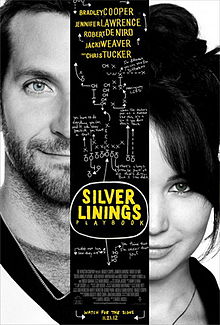
When Bradley Cooper appeared on “Inside the Actors Studio,” the first graduate of the program to be featured, they showed a clip from Robert DeNiro’s appearance on the show, with then-student Cooper asking him a question about his performance in “Awakenings.”  DeNiro was clearly impressed with the perception and sincerity of his young questioner.  It was only a few years later that Cooper was acting opposite DeNiro in “Limitless.” Now they are together again as father and son, Pat Sr. and Pat Jr., in “Silver Linings Playbook,” based on the novel by Matthew Quick.

Pat Jr. has been in a mental hospital being treated for bipolar disorder, the result of a plea bargain following “the incident,” we will only learn the details of later.  His mother brings him home though it is not at all clear that he is or will ever be ready.  Pat has impulse control problems, especially when he hears a particular Stevie Wonder song or does not like the ending of a Hemingway novel.  But he is absolutely determined to get his life back.  And his wife back.  This involves a lot of physical conditioning and finding away around the restraining order that forbids him from contacting her.

He meets a troubled young widow named Tiffany (Jennifer Lawrence of “Hunger Games”), the sister-in-law of his best friend.  Pat is fighting so hard to be “normal” again that he is disturbed, annoyed, and a little scared by her outspoken, socially inappropriate behavior.  But she offers the same directness and shared experience he had with his fellow patients.  He struggles with the competing impulses to reject and accept her overtures of friendship.  Their exchange about the effects of various mood and anti-psychotic meds is a gem, the mental illness equivalent of Romeo and Juliet speaking to each other in alternate lines of a sonnet on their first meeting.  And Lawrence is sublime in her summation-to-the-court-style argument with Pat Sr. about the factors that go into an Eagles win.

They agree to help each other, and this gives Pat purpose, discipline, and direction.  And we learn more about “the incident” and about Pat’s relationship with Pat Sr., a professional gambler and bookie whose passion for the Eagles provides some context for his influence on his son.

Director David O. Russell, who adapted the novel, and his cast fill the story with engaging, believable characters, especially Jackie Weaver as Pat’s mother, John Ortiz as his stressed-out best friend, and Anupam Kuhr as his therapist.  It is a great pleasure to see Chris Tucker, who is outstanding as a mental patient, though I wish they had found him more to do than the usual “black it up” (that’s a direct quote) pep talk.  Pat is so upset by the end of Farewell to Arms (on his wife’s assigned reading list for the high school class she teaches) that he has to wake his parents in the middle of the night to tell them why stories need happy endings.  The ending here is abrupt and a bit cheesy.  But these damaged and vulnerable and anxious characters love and want to be loved and we want it for them.

Parents should know that this film includes a lot of very strong and profane language, sexual references (some explicit), family dysfunction and mental illness, drinking

Family discussion: How are Pat and his father alike? How do Tiffany, Ronnie, and Cliff help him? What makes Pat change his mind?

If you like this, try: “Inside Moves” and “Garden State”

Related Tags:


Based on a book Drama DVD/Blu-Ray Pick of the Week Family Issues Romance
THE MOVIE MOM® is a registered trademark of Nell Minow. Use of the mark without express consent from Nell Minow constitutes trademark infringement and unfair competition in violation of federal and state laws. All material © Nell Minow 1995-2026, all rights reserved, and no use or republication is permitted without explicit permission. This site hosts Nell Minow’s Movie Mom® archive, with material that originally appeared on Yahoo! Movies, Beliefnet, and other sources. Much of her new material can be found at Rogerebert.com, Huffington Post, and WheretoWatch. Her books include The Movie Mom’s Guide to Family Movies and 101 Must-See Movie Moments, and she can be heard each week on radio stations across the country.

Website Designed by Max LaZebnik