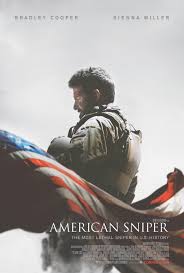
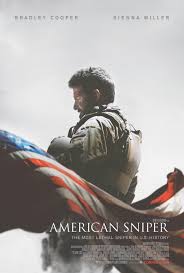
American Sniper

American Sniper

Posted on May 18, 2015 at 8:00 am

B+
Lowest Recommended Age: Mature High Schooler
MPAA Rating: R for strong and disturbing war violence, and language throughout including some sexual references
Profanity: Very strong language
Alcohol/ Drugs: Drinking and drunkenness
Violence/ Scariness: Wartime violence including battles and snipers, characters injured and killed, disturbing images
Diversity Issues: A theme of the movie
Date Released to Theaters: January 16, 2015
Date Released to DVD: May 18, 2015
Amazon.com ASIN: B00RGZ915C
Copyright 2015 Warner Brothers

The highest-grossing movie of 2014 is also one of the most controversial. Director Clint Eastwood and producer-star Bradley Cooper have made a more subtle and nuanced film than either the people who loved it or the people who hated it give him credit for. Extremists on both sides found validation for their views, whether for or against the wars in Iraq and Afghanistan or for or against the actions of the military there. That may be the most significant proof of the evenhandedness of Eastwood, a man who made two separate films about Iwo Jima to tell the stories of both the Japanese and American military.

We see Chris Kyle as a young boy, hunting with his father (Ben Reed). We learn two key facts. First, even at that age, Kyle is a very good shot. Second, we hear his father explain that there are sheep, wolves, and sheepdogs, and he expects his boys to grow up to be protectors of sheep, not wolves or their victims.

Nevertheless, Chris grows up (now played by a bulked-up Cooper) without much direction until he decides to enlist. In the movie, it is a response to news reports about Americans being killed by terrorists, following time spent as a ranch hand and finding his girlfriend in bed with another man. In fact, Kyle had always planned to join the military and he does not mention the girlfriend in his book.

This is the kind of diversion from the truth that has caused some viewers to argue that the portrayal is slanted. Later on, as he becomes the deadliest sniper in US military history, the film again unnecessarily ramps up the drama as though Eastwood does not trust the audience to appreciate the intensity, moral quandaries, and psychological impact of war or the courage and skill required of the military. They really did not have to inflate the story of the bounty being put on his head or make it seem as though he was the only one.

The movie and Kyle’s book both begin with a real-life story of Kyle’s first day, where he shoots a woman with a grenade (in the movie, he shoots the child she hands it to as well). This parallels a later moment where he has to decide whether to shoot. Kyle says in both book and movie that he has no regrets. Whether the viewer concludes that is the reason or the result of combat is left to us.

Parents should know that this movie concerns the real-life experiences of a military sniper in combat, with many characters injured and killed and disturbing images. Characters use strong language and there are sexual references and situations and drinking and drunkenness.

Family discussion: Who are the sheep/wolves/sheepdogs in your life?

If you like this, try: “The Hurt Locker” and “The War Tapes”

Related Tags:


Based on a book Based on a true story DVD/Blu-Ray Pick of the Week Romance War

Trailer: Queen Latifah Plays Bessie Smith on HBO

Posted on May 14, 2015 at 8:00 am

Queen Latifah plays blues singer Bessie Smith in a new movie premiering on HBO May 16, 2015.  Monique co-stars as Ma Rainey.

Here is the real Bessie Smith.

Related Tags:


Based on a true story Biography Music Television Trailers, Previews, and Clips
Noble

Noble

Posted on May 7, 2015 at 5:57 pm

B
Lowest Recommended Age: Middle School
MPAA Rating: Rated PG-13 for mature thematic material, including some violent and sexual situations
Profanity: Some strong language
Alcohol/ Drugs: Drinking, smoking
Violence/ Scariness: Gang rape, child abuse and child homelessness, war scenes
Diversity Issues: A theme of the movie
Date Released to Theaters: May 8, 2015

Christina Noble is an Irish woman known as “Mama Tina” to thousands of Vietnamese children and their families. Her own childhood was one of poverty, abandonment, loss, and hardship, but her resilience and determination led her to give children half a world away the help she never had herself. This film tells her improbable story and conveys her endless charm, her engaging spirit, and the extraordinary difference that one person can make in the world.

Noble is played by three different actresses to show us her life as a child, a teenager and young mother, and as a woman in her 40’s, her children grown, who follows a dream to go to Vietnam and help the homeless children of Vietnam. We first see her skipping school at age 10 to sing Doris Day songs in a bar (played by Gloria Cramer Curtis), and running from the truant officer. Her mother dies and her father all but abandons the children who are eventually split up. Christina ends up at a convent school. As a teenager, she is played by the radiant Sarah Greene (“Penny Dreadful”), and undergoes a second cruel abandonment by her father, a gang rape, a pregnancy, and then is forced to give up her child through the same kind of forced adoption program documented in “Philomena.” She finally falls in love, gets married, and has more children, but her husband is cruel and abusive.

The story moves back and forth in time to give us a greater understanding of Christina’s courage and of her faith in God, in her purpose, and in her ability to make something better out of what she has. Irish star and stand-up comedian Deirdre O’Kane (“Moone Boy”) gives a smashing performance as the grown-up Christina, fearless and always frank, whether confronting a child molester, getting a smile from a dour desk clerk, asking for money from every corporate representative trying to do business in Vietnam or challenging God to do a better job or at least get out of her way and let her get on with it. And her indomitable spirit and merry heart make this remarkable story vivid, true, and touching.

Parents should know that this film includes themes of deprivation and abuse, including the loss of a parent, abandonment, gang rape, child molestation, child homelessness, and a character being forced to give up her child. There is some strong language, drinking, and smoking.

Family discussion: Why was helping the homeless and orphaned children of Vietnam so important to Christina Noble? What made it possible for her to survive the loss, abandonment, and abuse of her early years? How can you learn to be more resilient?

If you like this, try: Noble’s book, Bridge Across My Sorrows, and another real-life-inspired story, “Mary and Martha”

Related Tags:


Based on a true story Movies -- format

True Story

Posted on April 16, 2015 at 3:20 pm

Copyright 20th Century Fox 2015

A reporter in disgrace for fabricating details of a story sits across the table from an orange-jumpsuited prisoner, accused of murdering his wife and three children. They have more in common than either of them expected. They are both outcasts. They are both unable or unwilling to explain their actions.

And they both used the name Michael Finkel. The reporter was given that name at birth and it appeared on the byline of his stories in the New York Times Magazine, including the one that cost him his job and his reputation. The man who murdered his family used that name when he fled to Mexico to escape capture. The real Michael Finkel, in seclusion at his home in Montana following his humiliating dismissal, got a phone call when the murderer was arrested, asking him for comment. With nothing else to do, and with the thought that this might be the kind of big story that get him back to a job in journalism, the real Michael Finkel, or as real as sometime just fired for lying can be (Jonah Hill), drove to Oregon to visit the man who was accused of killing his family. His real name, by the way, was Chris Longo (James Franco).

Co-writer/director Rupert Goold has a lot of ideas to explore in this film, and some work much better than others. The focus should be on the parallels between the two men, what links them, the ways they tried to use each other, and the resentments and differences that separate them.  But Goold wastes Felicity Jones (“The Theory of Everything”) as Finkel’s girlfriend, with distracting diversions like an ominous shot of her running (for exercise) through the woods. She does as well as possible with a scene where her character confronts Longo, but it is artificial and stagey.

Franco perfectly captures the superficial charm that occasionally slips to reveal fierce underlying anger and self-justification. Hill is a bit out of his depth, or more likely the Finkel character is underwritten. We should be able to see his anger and self-justification, too. And he is lost in the scene where he is grappling with a moral dilemma or trying to consider the rights of anyone but himself.  He is better at showing us Finkel’s arrogance and his need for approval. When Longo says he took Finkel’s name because he was a fan, Finkel is unabashedly complimented. After his humiliating dismissal, he gravitates toward approval like a moth toward a flame. And we know how that turns out.

The ironic title reminds us that we can never really know the true story; there are always too many conflicting versions, too much that is just unknowable. And yet the difference between Finkel, who violated the most fundamental principles of journalism by combining the details of the Africans he met to tell it as a story about one individual, and the movie of his own story is that fiction is supposed to convey larger truths. It is not at all clear that this one does.

Parents should know that this film concerns the murder of a wife and children. There are some disturbing and grisly images, as well as child slavery and discussion of beatings, deception, some strong language, and drinking.

Family discussion: Why did Jill visit Chris? How did Chris and Mike try to con one another and who was most successful?

If you like this, try: “Capote” and “The Jinx” and Finkel’s book, Murder, Memoir, Mea Culpa

Related Tags:


Based on a book Based on a true story Crime Drama
THE MOVIE MOM® is a registered trademark of Nell Minow. Use of the mark without express consent from Nell Minow constitutes trademark infringement and unfair competition in violation of federal and state laws. All material © Nell Minow 1995-2025, all rights reserved, and no use or republication is permitted without explicit permission. This site hosts Nell Minow’s Movie Mom® archive, with material that originally appeared on Yahoo! Movies, Beliefnet, and other sources. Much of her new material can be found at Rogerebert.com, Huffington Post, and WheretoWatch. Her books include The Movie Mom’s Guide to Family Movies and 101 Must-See Movie Moments, and she can be heard each week on radio stations across the country.

Website Designed by Max LaZebnik