Jobs

Posted on August 15, 2013 at 6:00 pm

Lowest Recommended Age: High School
MPAA Rating: Rated PG-13 for some drug content and brief strong language
Profanity: Some strong language
Alcohol/ Drugs: Drinking, smoking, drug use including hallucinogens
Violence/ Scariness: Tense and angry confrontations
Diversity Issues: None
Date Released to Theaters: August 16, 2013
Date Released to DVD: November 26, 2013
Amazon.com ASIN: B00BEIYLAW

ashton-kutcher-as-steve-jobs

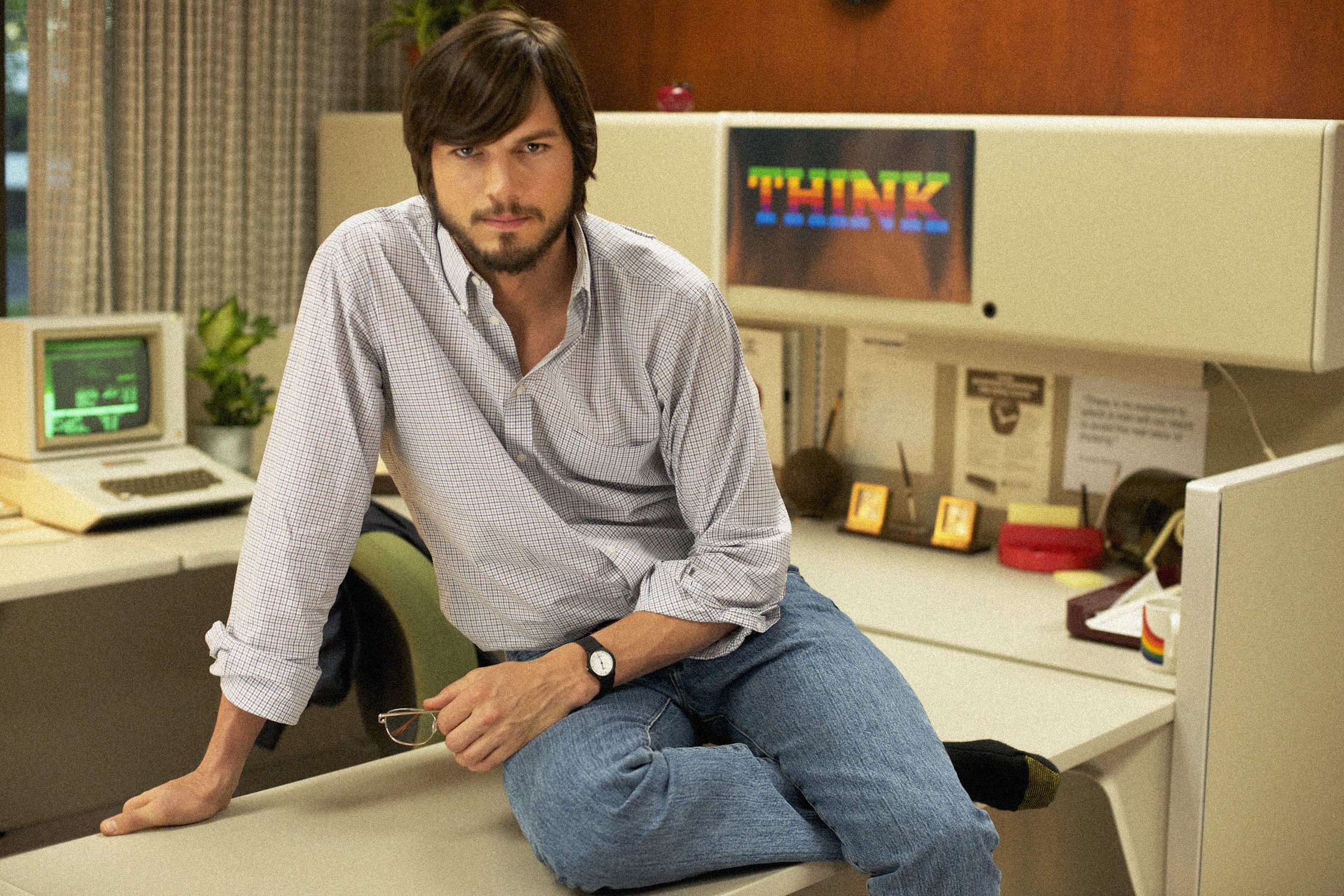
Even the most fascinating character, a true visionary with a transformative impact on the world and a story with one of the most wallopingly vindicating comebacks in business history, cannot always translate into a great movie.  A straight-on biopic cannot help but feel formulaic and clichéd, with the inevitable cinematic ports of call: our hero meets his then-unknown, now-legendary posse, there is a start-up montage of hard work with no resources, and when things get going our hero is accused by the people around him of neglecting them and/or abandoning the principles he once stood for. Everyone will tell him he is wrong.  He will be proven to be right.  Everyone will tell him he is arrogant.  He is, but he is also right.  There are setbacks.  There is triumph.  There are “Stars: They’re Just Like Us”-style peeks into his messy private life.  There is hero worship.  As we learned from “The Social Network,” these stories work better when they do not try to show us why someone was great or how he or she became great but instead tell us a story about a limited set of incidents that illuminate not only the life of this real person but tell us something about our own.

The good news is that just that movie about Steve Jobs is in the works, from “The Social Network’s” Aaron Sorkin. It will show us just three different moments in Jobs’ life, as three products are about to be launched.  And it will have lots of very smart dialog.  I can’t wait to see it.  In the meantime, we have this version, with Ashton Kutcher giving a very respectable performance as Steve Jobs, from his days as a college dropout still attending courses at Reed, in between sleeping around and dropping acid, to his triumphant return to Apple, eleven years after he was thrown out by the board of directors and the CEO he hired. Is it ironic or at least inconsistent that a movie about a man who insisted on “insanely great” innovation and joyfully disruptive, even seismic product development would be the subject of such an old-fashioned, traditionally structured storytelling?  Sure.  It’s like the problem of the computers and other equipment in the movie.  Though it is crucial to the storyline that we see how innovative they are; a couple of decades later they all look as old-fashioned as the rotary phones.  It is not a great or even a very good movie.  It is reporting rather than illuminating.  But it is watchable and modestly entertaining.

We learn very quickly, if clumsily, that (1) Jobs is so brilliant that a benign professor played by James Woods says he is welcome to keep going to class even though he has dropped out, (2) he is something of a user (he picks up a girl, sleeps with her, and then, when she offers him a tab of acid, tells her he is taking a second one for his girlfriend), (3) he is sad and rootless (as he and his friend and girlfriend are tripping as they lie on a blanket in the Oregon countryside, a tear slips out of his eye when he talks about being abandoned by his birth parents).  And while we’re on the subject of tears, there are a lot of damp eyes in this movie.  There may be no crying in baseball, but apparently there are a lot of tears in computers.  And (4) he does not play well with others.  He goes to work as a programmer for Atari, where he alienates everyone by being arrogant and smelling bad.

And then one day his pal Steve Wozniak (Josh Gad, in full nerd mode but with heart) shows him something cool.  He has hooked up his processor to a TV screen so that he can see the code.  Big time light bulb moment for the other Steve.  After an awkward and unimpressive demo for the Home Brew computer club, which led to his first business opportunity.  Jobs realized that there was a market for personal computers beyond the hobbyists and gearheads.  The fact that this seems stunningly obvious now is a tribute in part to his vision.  The clunkiness of the landline phones throughout the movie is another one.  Soon he created Apple with Wozniak and some friends.  Jobs set up a production facility in his parents’ garage and everyone got out their soldering irons and whatever the 1980’s equivalent of Red Bull was and went to work.

We see him rise and fall and rise again, with boardroom battles as vicious and bloodlessly violent as any scene to hit theaters this year.  Jobs is portrayed as a callous but visionary leader who tells his staff that “when you can touch the human heart, it’s limitless,” but parks in the handicapped space and tells his pregnant girlfriend, “I’m sorry you have a problem, but it’s not happening to me.”  He ferociously insists on loyalty from those around him but shows them none in return.

All of the performances are solid, despite the considerable handicap of 70’s hair.  As one of the early Apple employees he cuts out of the IPO gains, Lukas Haas is still making good use of those puppy dog eyes that go way back to “Witness.” Matthew Modine and J.K. Simmons are nicely slick as corporate bad guys.  But so much of both the personal and business story is left out that it feels empty.  The Jobs we see seems more focused on the details of the financing than the details of the product.  The man who felt abandoned by his birth parents (and later refused to see his birth father, even as Jobs was dying) disputed paternity and refused to see his daughter Lisa, but nevertheless named his biggest project after her?  He ran up huge development costs but refused to raise the price of the products to cover them and this made the shareholders the bad guy?  Why was he so ruthless in refusing stock options for the guys who were there at the beginning?  And why doesn’t the movie show that Wozniak gave them a piece of his own share?  Most important, why doesn’t the movie give us more than platitudes in showing us how Jobs got to “insanely great?”

Parents should know that this film includes smoking, drinking, marijuana and hallucinogens, strong language, a paternity dispute, and many tense confrontations.

Family discussion: What were Steve Jobs’ greatest strengths and faults? How can you work toward something that is “insanely great?”  What does it mean to say that “the system can only produce the system” and how can we transcend that?

If you like this, try: Steve Jobs by Walter Isaacson and Steve Wozniak’s iWoz: Computer Geek to Cult Icon: How I Invented the Personal Computer, Co-Founded Apple, and Had Fun Doing It

Related Tags:


Based on a true story Biography Drama DVD/Blu-Ray Pick of the Week

Behind the Candelabra: The Real Story of Liberace and Scott Thorson

Posted on May 24, 2013 at 3:50 pm

Behind the Candelabra premieres this weekend on HBO.  It is based on the hard to believe but true story of one of the most popular and flamboyant stars of the 1950’s and 60’s, who went by just one name: Liberace.

Wladziu Valentino Liberace was an American of Polish/Italian heritage, a gifted classical pianist, a masterful showman, and a pioneer in the art of celebrity branding and marketing.  He was multi-platform before the term was invented For decades he was the highest-paid entertainer in the world.  He had record albums, endorsements, and movie and television appearances and his own series, but it was his live stage show that was what people loved most.  He never tried for a career as a serious classical musician, performing with orchestras in concert halls.  He liked to play what he called “classical music with the boring parts left out.”  And the show was as important as the music, from the flashy pianos to costumes Lady Gaga would envy.  Ermine capes.  Crystal-encrusted tuxes.  Feather boas.  Chandeliers and of course candelabras.  Excess was not enough.

It was a different era.  Liberace was not openly gay.  On the contrary, when a British newspaper called him “a deadly, winking, sniggering, snuggling, chromium-plated, scent-impregnated, luminous, quivering, giggling, fruit-flavoured, mincing, ice-covered heap of mother love,” he sued under their notoriously strict libel laws. testified under oath that he was not a homosexual, and won.

liberace THORSENIn the late 70’s, Liberace met a handsome teenager named Scott Thorson.  They were together for five years, and after they broke up (and Thorson was “fired” as Liberace’s chauffeur), Thorson sued him for “palimony.”  It was settled out of court.  Thorson is now in jail, charged with identity theft.  He has had removed the plastic surgery prosthetic Liberace paid for so that Thorson would look more like an idealized version of himself when young.  Thorson’s book, Behind the Candelabra: My Life With Liberace, tells the story of their love affair and the unimaginable excesses of their life together and is the inspiration for this film.  It is in competition at Cannes and will be released theatrically overseas, but in the US no studio would back it, so it is on HBO.
Steven Soderbergh (“Oceans 11,” “Traffic,” “Erin Brockovich”) directed and it stars Michael Douglas as Liberace, Matt Damon as Thorson, and Debbie Reynolds, who knew Liberace, as his mother.

http://www.youtube.com/watch?v=QqAC1yiIROw

Related Tags:


Based on a true story Biography Television The Real Story

42

Posted on April 11, 2013 at 12:08 pm

B+
Lowest Recommended Age: Middle School
MPAA Rating: Rated PG-13 for thematic elements including language
Profanity: Racist epithets, crude and ugly insults, some additional strong language (s-words)
Alcohol/ Drugs: Drinking, smoking
Violence/ Scariness: Threats of violence, some scuffles, some injuries
Diversity Issues: A theme of the movie, brief homophobic humor
Date Released to Theaters: April 12, 2013
Date Released to DVD: July 15, 2013
Amazon.com ASIN: B009NNM9OA

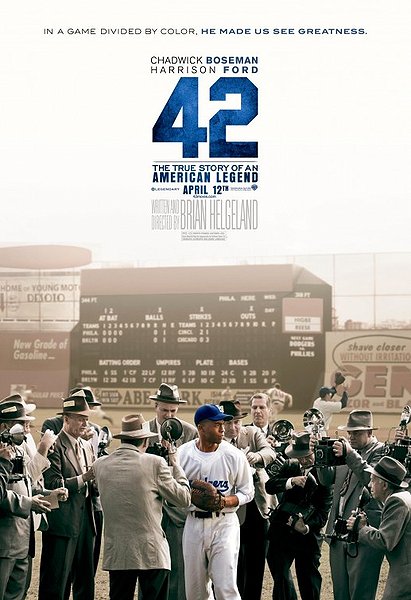
Jackie Robinson was the first black man to play major league baseball. His number, 42, is worn by every player once a year to commemorate his achievements as a baseball player and as a man.  This version of the story of the year the Brooklyn Dodgers broke the color barrier in baseball from writer/director Brian Helgeland is a little superficial, it still packs a lot of power, thanks to an evocative sense of its period and star-making performances by Chadwick Boseman as Robinson and Nichole Beharie as his wife.  If what we see is a small part of the courage and integrity of this extraordinary man in taking on the virulent racism of his era, it is still enough to make this movie deeply moving.

It is just after the end of WWII.  Black soliders returned home from fighting for freedom on behalf of a country that was still segregated, from the separate fighting divisions in the military to the “Whites Only” laws of the Jim Crow South.  Brooklyn Dodgers manager Branch Rickey (a cigar-chomping Harrison Ford, in full growl) decides it is time to integrate baseball.  He needs to find a player who is not only an athlete of unquestionable ability but someone who has the temperament to stay cool despite the constant attacks he will face from his own team, opposing teams, and the fans.  Rickey decides that Roy Campanella was too sweet and Satchel Paige was too old (both would follow Robinson into the major leagues).

Rickey picked Robinson.  He had the skill, he has played with white teammates in college, and he is tough.  He was courtmartialed  for refusing to go to the back of a military bus — and won.  Rickey asks Robinson, “Can you control your temper?” “You want a player that doesn’t have the guts to fight back.” “I want a player who has the guts not to fight back.”  Rickey knows that no matter what the provocation, any show of temper from Robinson will only give ammunition to the bigots.  What would be called “spirit” in a white player will be called something different coming from him.

It is solidly entertaining, delivering all of the expected notes, and if it seems heavy-handed to anyone old enough to remember a time before the Montgomery bus boycott and the passage of the Civil Rights Act, it is perhaps understandable that Hollywood does not take for granted that younger audience members remember there was once a time when segregation was not only legal; it was the law.  It harks back to the Sidney Poitier era of saintly black characters, which is understandable.  But it is a movie about tolerance that cannot resist a homophobic joke about teammates showering together, which is not.

Parents should know that this movie features frank portrayals of bigoted behavior including a stream of racist invective, with crude insults.  There are some sexual references, including adultery.  Characters drink and smoke, and there are some scuffles and injuries.

Family discussion:  Why was Jackie the best choice to be the first?  How did he challenge the beliefs of his teammates?   Read more about Jackie Robinson.


If you like this, try: “The Bingo Long Traveling All-Stars & Motor Kings,” Ken Burns’ “Baseball” series, “Brian’s Song,” and “A League of Their Own”

Related Tags:


Based on a true story Biography Drama DVD/Blu-Ray Pick of the Week Spiritual films Sports

The Sapphires

Posted on March 28, 2013 at 6:00 pm

B+
Lowest Recommended Age: High School
MPAA Rating: Rated PG-13 for sexuality, a scene of war violence, some language, thematic elements, and smoking
Profanity: Strong language
Alcohol/ Drugs: Drinking, smoking
Violence/ Scariness: War violence
Diversity Issues: A theme of the movie
Date Released to Theaters: March 22, 2013
Date Released to DVD: August 15, 2013
Amazon.com ASIN: B00D2UMHQ0

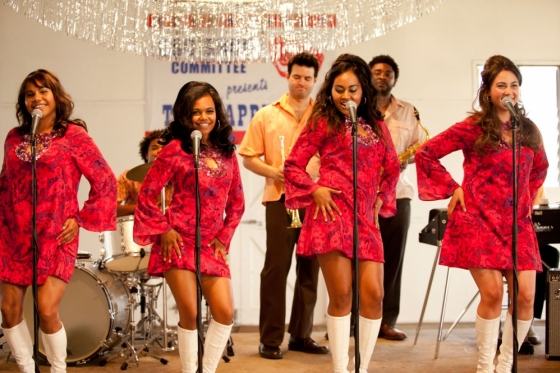
A very conventional story of a 60’s Australian girl group gains extra power from its context and setting in this fact-based story set to the beat of Motown soul.  Co-written by the son of one of the real-life singers and directed by Wayne Blair, who starred in the play based on their story, “The Sapphires” is clearly a labor of love for all involved and a touching tribute to four women for whom success as performers was just the beginning.

Before it begins, we learn two stark, devastating facts.  Until 1967, the native Australians dubbed “Aborigines” by the British settlers were not classified as humans by the Australian government.  They were considered “flora or fauna.”  And the government had the authority to remove light-skinned native children from their families as part of the program depicted in “Rabbit-Proof Fence” to make them part of the white community.

We meet the future singers as children, three sisters and their cousin, performing at a family celebration in 1958.  The light-skinned cousin is taken to become part of what is now known as the “Stolen Generation,” with no contact with her family.

A decade later, as young women, the sisters still sing together.  Gail, the feisty oldest (Deborah Mailman of “Rabbit-Proof Fence”), the ambitious Julie (pop singer Jessica Mauboy), and the flirty Cynthia (Miranda Tapsell) enter a local competition singing American country and western.  Braving the bigotry of the audience, they sing a Merle Haggard song.

The accompanist/master of ceremonies is Dave (“Bridesmaids'” Chris O’Dowd) is a broken-down mess who seems to have burned every possible bridge that once linked him to music, a job, his home in Ireland, or any semblance of self-respect.  But he still knows the real deal when he hears it.  As amateurish as they are, Dave sees what the sisters can become.  They ask him to come with them to try out for a chance to perform for American GIs in Viet Nam for $30 a week.  Soon they have reconnected with their cousin Kay (Shari Sebbens), switched from country to Motown, and passed the audition under their new name, inspired by a ring — The Sapphires. O’Dowd’s shambling charm plays well against Mailman’s protective ferocity and the wartime background and struggles against bigotry add some heft what might otherwise seem like a lightweight jukebox musical.

A girl group with four members under high-stress touring conditions far from home means many opportunities for romance, adventure, and power struggles, plus the inevitable rehearsal montages. “Can you make it sound blacker?” Dave asks.  He switches lead singers, guides them on stage presence, and suggests some different songs.  Both country and soul music are about loss, he tells them, but in country music the singer has given up.  “With soul, they’re still struggling.”  Dave’s passion for the music and his belief in the girls are scary but exhilarating.  So is being away from home for the first time.

The girls learn that performing is about more than great songs and tight harmonies as they are touched by the valor of the American soldiers.  It is not just that the GIs expect a show; they deserve one.  So, The Sapphires add spangles, go-go boots, rump-shaking and a lot of attitude.

That gives them the freedom to open themselves up to new experiences and new ways of looking at themselves.  And it means that we get to enjoy quite a show as well.  When the storyline starts to feel too close to the familiar “VH1 Behind the Music” soapy sagas of backstage tensions and heartache, those fabulous classic soul songs of the 60’s ring out, thoughtfully matched to what is happening off-stage.  “I Heard It Through the Grapevine,” “What a Man,” “I’ll Take You There,” “Hold On!  I’m Coming,” and many more add tremendous energy and spirit.  They are every bit as entertaining as they were nearly half a century ago.  Equally entrancing is a touching moment when they sing a native song called “Ngarra Burra Ferra.”

The credit sequence updates us on what happened after The Sapphires came home, with an extraordinary record of achievement, photos of the beautiful women who inspired the film, and a concluding line of piercing sweetness.  It would be great to have a sequel, but they deserve a documentary.

Parents should know that this movie includes strong language, sexual references, smoking, drinking, and wartime violence.

Family discussion: How do the racial conflicts portrayed in this film compare to those of the same era in the United States?  What makes them different?  Are you surprised by what the Sapphires did after their tour?

If you like this, try: “Rabbit-Proof Fence” and “Dreamgirls”

Related Tags:


Based on a play Based on a true story Biography Drama DVD/Blu-Ray Pick of the Week Family Issues Music Musical Romance War
THE MOVIE MOM® is a registered trademark of Nell Minow. Use of the mark without express consent from Nell Minow constitutes trademark infringement and unfair competition in violation of federal and state laws. All material © Nell Minow 1995-2026, all rights reserved, and no use or republication is permitted without explicit permission. This site hosts Nell Minow’s Movie Mom® archive, with material that originally appeared on Yahoo! Movies, Beliefnet, and other sources. Much of her new material can be found at Rogerebert.com, Huffington Post, and WheretoWatch. Her books include The Movie Mom’s Guide to Family Movies and 101 Must-See Movie Moments, and she can be heard each week on radio stations across the country.

Website Designed by Max LaZebnik