Dolores Huerta and Peter Bratt on the New Documentary “Dolores”

Dolores Huerta and Peter Bratt on the New Documentary “Dolores”

Posted on September 12, 2017 at 8:00 am

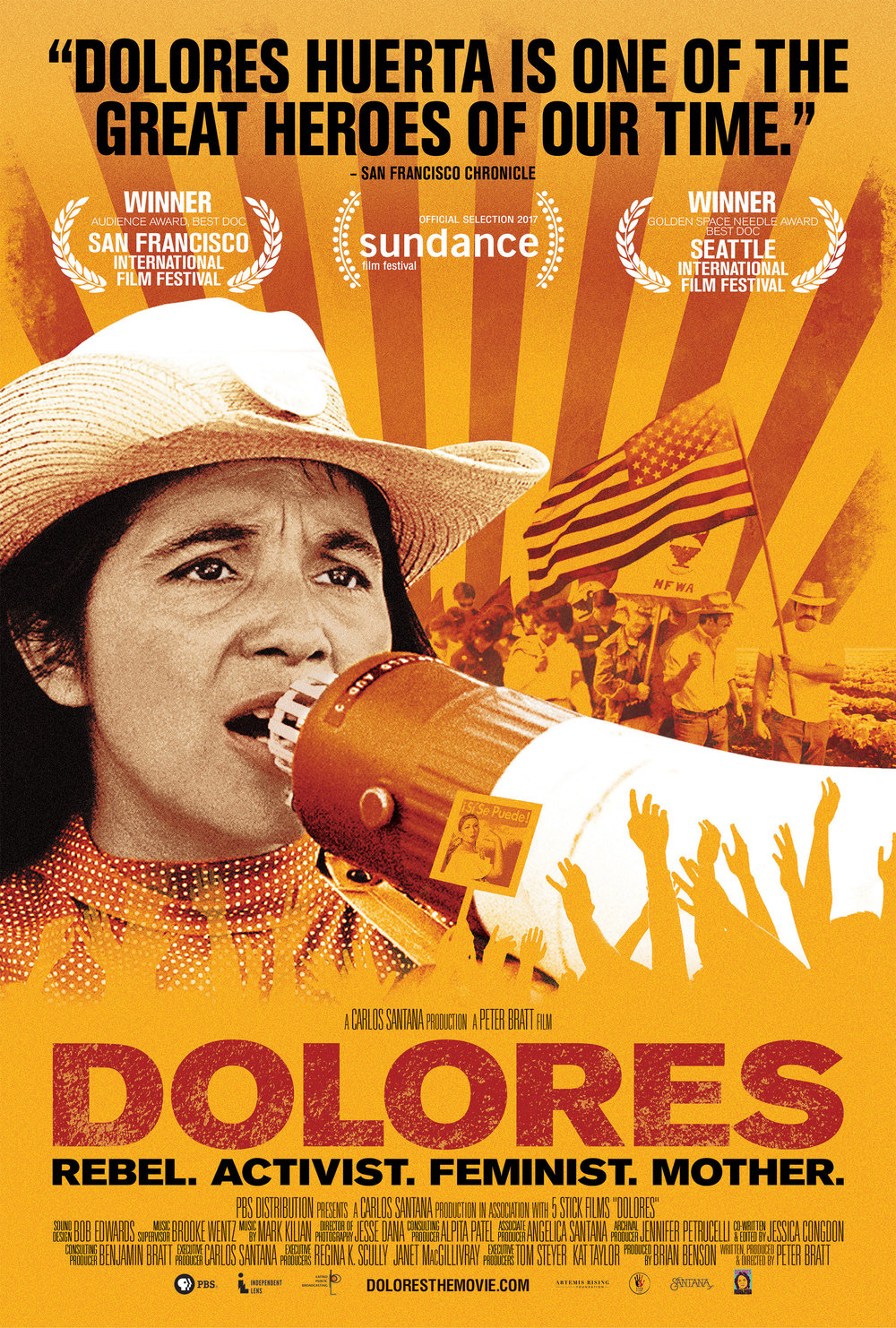
Dolores” is a new documentary that tells the story of activist icon Dolores C. Huerta, president and founder of the Dolores Huerta Foundation, co-founder of the United Farm Workers of America. If Ginger Rogers is known for matching Fred Astaire’s steps backwards and in high heels, Huerta was as responsible as the better-recognized Cesar Chavez for bringing the attention of the world to the rights of immigrants, women, and farm workers while raising eleven children as a single mother and constantly being marginalized and underrated because of her race and gender. I spoke to Huerta, who was awarded the nation’s highest civilian honor by President Barack Obama, along with the director of the documentary, Peter Bratt.

In the film, we see you begin by sitting down in living rooms or talking to farm workers in the fields to encourage them to insist on fair treatment. What did you say to them?

Dolores Huerta: When you are organizing a group of people, the first thing that we do is we talk about the history of what other people have been able to accomplish; people that look like them, workers like them, ordinary people, working people, and we give them the list. These are people like yourself, this is what they were able to do in their community. And then we talked about the issues that they’re facing in their own community and then we would say to them, “Well, just like these other people did, they were able to accomplish all these great things. You can do the same thing. But the thing is that you got to do it because if you don’t nobody else is going to do it for you; nobody else is going to come into your community and solve your problems. So you have to take on the issues yourself. You’re the ones who have to volunteer to make the work happen.”

So we do a whole series of these little house meetings and you probably get a hundred and fifty people together and out of that group then you have a cadre of them that will come up and they’ll volunteer to do the work that needs to be done and that’s how the leaders are developed. When you go into a community you’ll never know ahead of time who the leaders are going to be. The leaders come up from the volunteers that do the work and it’s amazing because then they do these incredible things in their community that they never thought they had the power to make that happen. Basically, the message is: you have power, the power is in your person and you can make this happen but you can’t do it alone; you’ve got to work with other people to make it happen, you have to make a plan and you have to volunteer. And it works; it’s like magic.

You go out there and you find those people that have this burning passion that they want to change things and you basically are just giving them the tools. This is the way that you do it: you come together with a group of people, you pass petitions, you go to the city council, you go to the board of supervisors and you can make it happen.

Peter Bratt: She actually was telling me a story that she hopped on a Greyhound to northern central California, throughout the bus ride was expecting sixty to seventy people at a house meeting which had only one person, and she said she gave it her all because one person can be the most incredible leader that can change thousands of lives. That was a great lesson.

Why was it important to you to tell this story?

Peter Bratt: Dolores in my view challenges the three pillars of society. She’s challenging patriarchy and yes, that’s part of gender discrimination but it’s also racial. She’s also a Chicana; she’s a woman of color. The third one is as a labor activist she’s challenging the institution of capitalism, and I think those are the three great threats and that made her dangerous. I think those complexities combined to keep her in the margins.

The people who appear in the film are very candid and sometimes very emotional. How do you as a filmmaker develop a sense of trust so that they will share those memories and feelings?

Peter Bratt: I have some history with Dolores. I’ve known her for a little while and I think there was initially a great amount of trust between her and myself and Carlos Santana whose idea this was, and I also knew a few of her daughters from years back. So I think initially there was trust but you still have to prove yourself and earn even more trust. The most important thing as a director is you have to create a safe environment where you make the person feel safe enough to open their heart and reveal the soul; that’s ultimately where you’re trying to get. We interviewed probably about fifty people and the ones that we selected for the film were the ones who we felt truly opened their hearts and spoke their truth.

What has surprised you in terms of how far we’ve come and what has been the most persistently frustrating?

Dolores Huerta: Women are now 50 percent of the law schools and medical schools, so we can look at all the progress that we’ve made, but we can see all the progress that we still need to make and now with the voter suppression going on and with the racism rearing its ugly head we know that we’ve got to really step up our game on the progressive side and get people to vote because a lot of people aren’t voting. They’ve taken civics out of our high schools. People were asleep but I think they’re waking up now. Trump has given everybody a good kick and people are waking up and realizing they’ve got to get involved. That’s the message that we want to send with the film; for people to get involved at the local level, at the community level, at the state level and international level because we can’t afford to let the right wing take over our country. My son Emilio is running for Congress to continue the fight for social justice.

Peter Bratt: Sometimes I just want to put the covers over my head and stay in bed and I feel like no matter what I do it’s ineffectual and I get depressed. So for me having spent these last few years with Dolores, to see her not just doing the work but impassioned about doing the work and getting out there at the grassroots level and she still goes out into the fields in 100 degrees to organize this farm operation, she’s still doing it in the school boards, on water boards, she’s been getting people involved and to see her so engaged and relentless. The fortitude is awe inspiring and yet there is this joy and this passion while continuing to do the work, It encourages me to like quit feeling sorry for myself and get back out there. To me as a filmmaker that’s the biggest reward, to see people lift themselves up and recommit themselves.

A briefer version of this interview originally appeared on the Huffington Post.
Related Tags:


Biography Directors Directors Documentary Gender and Diversity Race and Diversity

Trailer: Professor Marson & the Wonder Women!

Posted on July 21, 2017 at 8:00 am

Luke Evans (recently Gaston in “Beauty and the Beast”) plays the remarkable William Marston, psychiatrist, lawyer, inventor of the lie detector, and creator of Wonder Woman.

For more background, read my interview with Noah Berlatsky and Jill Lepore’s terrific book about Marston.

Related Tags:


Based on a true story Biography Trailers, Previews, and Clips
A United Kingdom

A United Kingdom

Posted on February 9, 2017 at 5:12 pm

B +
Lowest Recommended Age: Preschool
MPAA Rating: Rated PG-13 for some language including racial epithets and a scene of sensuality
Profanity: Some strong language including racist epithets
Alcohol/ Drugs: Social drinking
Violence/ Scariness: Peril, threats, violence including street fight
Diversity Issues: A theme of the movie
Date Released to Theaters: February 10, 2017
Copyright Harbinger Pictures 2016

In Shakespeare’s “A Midsummer Night’s Dream,” Lysander says, “aught that I could ever read/Could ever hear by tale or history/The course of true love never did run smooth.” It may just seem that way because the most enduring loves are those where challenges bring the couples together instead of tearing them apart. To quote Shakespeare again, this is the love that “looks on tempests, and is never shaken.” “A United Kingdom” tells the true story of a love that triumphed over the most intense opposition from both families and at least three countries.

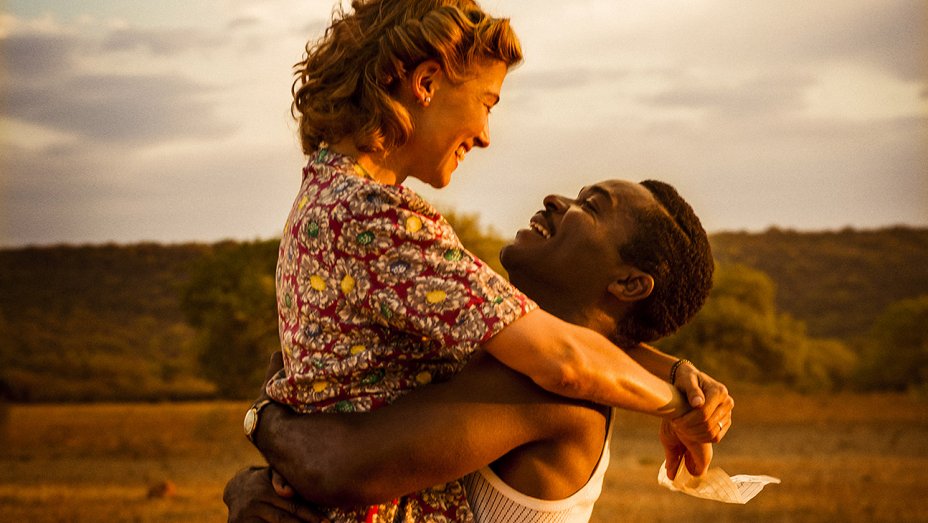
Seretse Khama (David Oyelowo of “Selma” and “Queen of Katwe”) is studying law in post-WWII London when he meets Ruth (Rosamund Pike of “Gone Girl”) and they are instantly drawn to each other. They share a love of jazz music and a passionate commitment to the public good. Before they realize what is happening, they are deeply in love. Seretse explains that he is not just another law student; he is heir to the throne of his country, and his uncle is acting as Regent until he returns. He asks Ruth to take time to think about marrying him but she does not need time to think.

Even though they have already experienced some unpleasant, even threatening responses to their relationship, they believe that their good intentions and mutual devotion can overcome any obstacles. They will see that post-war optimism about a new era of tolerance and mutual commitment to continuing the progress toward freedom tested more intensively than they could have imagined.

Ruth’s sister is sympathetic, but she correctly predicts that their father “will hate him on sight. He is cleverer than him and he is black.” And indeed, he says, “You may deserve a life of insults and shame, but what about us? I can’t see you again.”

And then they go to Botswana, where his uncle and the community see his marrying a foreigner and a commoner as a betrayal, calling into question his loyalty and his ability to understand them. Has his time in London caused him to abandon the ways of his people?

And might his uncle have other reasons for wanting to stay in power?

The British government, in the form of the wonderfully condescending Jack Davenport (“Pirates of the Caribbean”), is even more disturbed. They have important business and political interests in the region, particularly in the adjoining country of South Africa, which is in the middle of adopting the 20th century’s most viciously racist laws, known as Apartheid.

Director Amma Asante (“Belle”), the British-born child of Ghanaian parents, has a sure sense of the worlds she is depicting. The Botswanans and their land are portrayed as respectfully and “normally” as the Londoners, with no sense of quaint or lesser “otherness.” And while the culture is not entirely equal (apparently only men vote), the female characters, including Seretse’s sister, have dignity and agency. This is a true love story, not just between Seretse and Ruth, but between the filmmakers telling this story and the people and the country where it is set.

Parents should know that the theme of the movie concerns an interracial marriage that was objected to by both families and their governments. There are some scenes of peril including racist street thugs, some strong language including racial epithets, and a sexual situation.

Family discussion: How did Ruth prove her sincerity to the Botswanans? Why did the British government intervene?

If you like this, try; “Loving” and the BBC program about Seretse and Ruth Khama.

Related Tags:


Based on a true story Biography Drama Movies -- format Race and Diversity Romance

PBS: John Lewis — Get In the Way

Posted on February 7, 2017 at 3:16 pm

Congressman John Lewis was the youngest person to speak at the March on Washington organized by the Reverend Dr. Martin Luther King, Jr. This week, PBS will show a documentary about Lewis, a key figure in the civil rights movement of the 1960s and a genuine statesman and hero. Despite more than 40 arrests, physical attacks, and serious injuries, John Lewis remained a devoted advocate of the philosophy of nonviolence. He was one of the leaders of the SNCC and a Freedom Rider and his three-volume memoir March is a best-seller and the first graphic book to be given a National Book Award.

A film by Kathleen Dowdey, “John Lewis – Get in the Way” is the first biographical documentary about John Lewis, an inspiring portrait of one man cast into extraordinary times and his unhesitating dedication to seeking justice for the marginalized and ignored. The film spans more than half a century, tracing Lewis’ journey of courage, confrontations and hard-won triumphs.

At the age of 15, John Lewis’ life changed forever when he heard Dr. Martin Luther King, Jr. on the radio. It was 1955, during the Montgomery Bus Boycott, and Lewis listened with rapt attention as the young preacher called for resistance to the harsh injustice of segregation. Notably, Dr. King exhorted those listening to fight not with weapons but with proven tools of nonviolence.

Lewis embraced Dr. King’s spiritual call with a fervor that would determine the course of the rest of his life. A student activist in the vanguard of the Civil Rights Movement, Lewis was arrested and jailed for the first time during the Nashville lunch counter sit-ins in 1960. A front-line general during the 1961 Freedom Rides, he was repeatedly assaulted by angry, unrestrained mobs.

Related Tags:


Biography Race and Diversity Television
The Founder

The Founder

Posted on January 19, 2017 at 5:40 pm

Copyright 2016 TWC

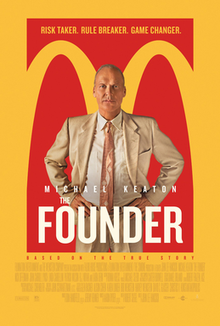
McDonald’s began as a hamburger stand in San Bernardino, California, the idea of two brothers, Dick and Mac McDonald, who brought to food what Henry Ford brought to cars: ultra-efficient assembly-line production: consistent, reliable, and scalable. But McDonald’s, the worldwide “billions and billions served” fast food franchise phenomenon with the iconic golden arches was the creation of the man who put “founder” on his business cards, Ray Kroc.

Balzac famously said that behind every great fortune there is a crime, and this story of one of the great disruptive forces in 20th century business shows us the vision, the passion, the triumph and the heartbreak behind it. Michael Keaton is well cast as Kroc, a struggling salesman who listens to motivational tapes about the importance of persistence — a more significant factor, according to the lectures, than ability or resources.

Kroc is on the road trying to sell milkshake machines to restaurants. He calls his secretary for messages. A prospect says no. A bill collector wants to be paid. And some hamburger stand in California wants to buy six. Kroc is sure that is a mistake. No one has ever wanted more than one. He calls and speaks to one of the McDonald brothers. He can hear the activity in the background. And the order gets upped to eight. Kroc has to go see it for himself.

The McDonald brothers (John Carroll Lynch and Nick Offerman) welcome Kroc warmly, proud to tell their story and show off their innovations. In one of the movie’s highlights, they explain the trial and error and meticulous planning that led to their operational and conceptual innovation. They had three brilliant insights. First, they got rid of the inessentials: no wait staff, no plates to wash or break, and they limited the menu offerings to the items that were most often ordered. You want chicken — go somewhere else. They got rid of the cigarette machine and jukebox and thus got rid of the undesirable customers, teenagers and others who come to hang around instead of those who eat and leave. That left busy families, who appreciated the wholesome atmosphere and utter consistency and reliability. Second, they streamlined production, again reinforcing consistency and reliability and attracting families. One more difference to appeal to families: no waiting. Food was delivered almost instantly. Indeed, when on his first visit Kroc received his food neatly packed in a bag seconds after placing the order, he looked at it confused and asked, “What’s that?” The McDonald brothers realized they were not just providing customers with food; they were providing them with something even more precious: time.

The third brilliant insight created some conflict with their new partner after Kroc persuaded them to put him in charge of franchising. For the McDonald’s, money was not the top priority. They valued, well, values.

It is instructive that there are several points throughout the film where someone explains that McDonald’s is not about hamburgers. All of the other answers are right in their own way, along with many others. This is a rare film that looks at what it takes to create a globally dominant business, and what it costs as well.

Parents should know that this film includes one f-word, some predatory business behavior, illness, and marital strain and divorces.

Family discussion: How many things other than hamburgers did people say the business of McDonald’s really was? Why did Kroc call himself “founder?” Who was right, the brothers or Kroc, and why?

If you like this, try: “Tucker: The Man and his Dream” and “Joy”

Related Tags:


Based on a true story Biography Drama
THE MOVIE MOM® is a registered trademark of Nell Minow. Use of the mark without express consent from Nell Minow constitutes trademark infringement and unfair competition in violation of federal and state laws. All material © Nell Minow 1995-2026, all rights reserved, and no use or republication is permitted without explicit permission. This site hosts Nell Minow’s Movie Mom® archive, with material that originally appeared on Yahoo! Movies, Beliefnet, and other sources. Much of her new material can be found at Rogerebert.com, Huffington Post, and WheretoWatch. Her books include The Movie Mom’s Guide to Family Movies and 101 Must-See Movie Moments, and she can be heard each week on radio stations across the country.

Website Designed by Max LaZebnik