
The Great Race

Posted on May 26, 2008 at 8:00 am

B+
Lowest Recommended Age: All Ages
Profanity: None
Alcohol/ Drugs: Social drinking, smoking
Violence/ Scariness: Comic peril and violence, no one hurt
Diversity Issues: A theme of the movie
Date Released to Theaters: July 1, 1965

Dedicated to “Mr. Laurel and Mr. Hardy,” this movie is both a spoof and a loving tribute to the silent classics, with good guys, bad guys, romance, adventure, slapstick, music, wonderful antique cars, and the biggest pie fight in history. The opening credits are on a series of slides like those in the earliest movies, complete with cheers for the hero and boos for the villain, and a flickering old-fashioned projector that at one point appears to break down. Always dressed in impeccable white, the Great Leslie (Tony Curtis) is a good guy so good that his eyes and teeth literally twinkle. His capable mechanic and assistant is Hezekiah (Keenan Wynn). The bad guy is Professor Fate (Jack Lemmon), assisted by Max (Peter Falk). Like Wile E. Coyote, Fate’s cartoonishly hilarious stunts to stop Leslie inevitably backfire.

After a brief prologue, in which Fate tries to beat Leslie in breaking various speed records, literally trying to torpedo him at one point, they both enter an automobile race from New York to Paris. So does a beautiful reporter (Natalie Wood as Maggie DuBois) trying to prove she can get the story — dressed in an endless series of exquisite ensembles designed by Hollywood legend Edith Head. Great%20Race2.jpg

The race takes them across America, through the Wild West, to a rapidly melting ice floe in the Pacific, and into a European setting that is a cross between a Victor Herbert operetta and “The Prisoner of Zenda,” where a spoiled prince happens to look exactly like Professor Fate and it takes all of the stars to foil an evil Baron (Ross Martin) who wants to use Fate to take over the throne.

This is a perfect family movie, just plain fun from beginning to end.  It may also provide an opportunity for a discussion of competition and sportsmanship.  At the end, Leslie deliberately loses as a gesture of devotion to Maggie DuBois.  Professor Fate, after all, shows some sense of honor — apparently it is all right for him to cheat to win, but not all right to win by having Leslie refuse to compete.  “You cheated — I refuse to accept!”  Modern adults may wince a bit at Dubois’ notion of how to attain equal opportunity — she ultimately succeeds by showing her leg to the editor, who becomes too dazed to argue further.  But like “Mary Poppins,” it provides a chance to remind children that when their great-grandparents were children, women did not even have the right to vote.

Questions for Kids:

  • Should Leslie have let Fate win?
  • Why wasn’t Fate happy when he beat Leslie?
  • Why was Fate so jealous of Leslie?
  • Why did DuBois want to be a reporter so badly?


Connections:  Curtis and Lemmon also appeared together in one of the greatest comedies of all time, “Some Like it Hot.”   Children who enjoy this movie might like to see some of the silent classics it saluted, like “Two Tars,” in which Laurel and Hardy create chaos in the middle of an enormous traffic jam.  They might also enjoy “Those Magnificent Men in Their Flying Machines” or “Those Daring Young Men in Their Jaunty Jalopies.”  Children who have enjoyed Ed Wynn as Uncle Albert (who “loves to laugh”) in “Mary Poppins” may like to know that his son, Keenan Wynn, plays Leslie’s assistant Hezekiah.
 

Related Tags:


Comedy DVD/Blu-Ray Pick of the Week For all ages For Your Netflix Queue Movie Mom’s Top Picks for Families Rediscovered Classic

Mad Money

Posted on May 12, 2008 at 4:00 pm

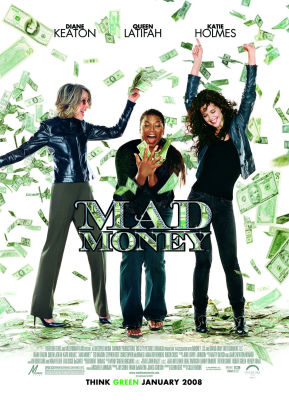
What force on earth is strong enough to unite an upper middle class suburban housewife, a poor African-American single mother and a young, spaced-out rock n’ roll fan living in a trailer? Why, the opportunity to steal from the government, of course.
“Mad Money” is a conventional heist comedy about a plot to steal money from the Bureau of Printing and Engraving. Diane Keaton, Queen Latifah and Katie Holmes star as low-level employees of the Bureau who come up with a complicated plan to get around the elaborate security procedures. Working together beneath the notice of government officials, the three women combine their roles to walk off with bags of used money that has been returned to the Bureau to be destroyed. Each of them has a different justification for their decision to steal — a special need or a past injustice that the money will cure. mad_money.jpg

(more…)

Related Tags:


Comedy Crime

Harold and Kumar Escape from Guantanamo Bay

Posted on April 24, 2008 at 6:00 pm

B-
Lowest Recommended Age: Adult
MPAA Rating: Rated R for strong crude and sexual content, graphic nudity, pervasive language and drug use.
Profanity: Extremely strong, graphic, and crude language
Alcohol/ Drugs: Frequent drug use, positively portrayed
Violence/ Scariness: Comic peril and violence including guns, character murdered
Diversity Issues: A theme of the movie
Date Released to Theaters: April 25, 2008

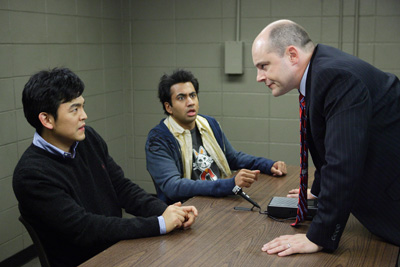
harold%20and%20kumar.jpgLike the effects of the marijuana laced with cocaine smoked by a world leader near the end of this movie, the sequel to Harold & Kumar Go to White Castle combines a literally dopey stoner comedy buzz with an electric sting of sharp satire. The first film was surprisingly popular with audiences and even more surprisingly popular with critics, who found that making the main characters minorities in an otherwise unambitious druggie comedy gave the interactions as the two stoned college students stumbled toward the fabled little square burgers a new freshness, even an edgy, satiric quality.
Plus, it had Neil Patrick Harris in a deliciously demonic role as “himself,” a ‘shroomed-out former child star.

Harold (John Cho) and Kumar (Kal Penn) depart for Amsterdam, where Harold hopes to see the girl of his dreams (even though he does not know her last name or where she is staying) and Kumar hopes to enjoy legal marijuana. But on the plane, Kumar lights up, using a smokeless bong he invented for the occasion, and a passenger assumes he is a terrorist. “Bong” sounds like “bomb” and he has brown skin. Before you can say “I just wanted to join the other mile high club,” they are cuffed by air marshals and carted off to face a racist, power-mad, pea-brained US government official (Rob Corddry), who orders them put into orange jump suits and shipped to the prison at Cuba’s Guantanamo Bay. This ain’t “Law and Order.” No right to a phone call, no lawyer, no passing Go and no collecting $200.

After some ugly encounters with real terrorists in the adjacent cell and sexually predatory guards, Harold and Kumar escape, get back to the US, and take off for Texas, where they hope to get help from a classmate who is conveniently both connected to the top levels of the Department of Defense and about to marry Kumar’s former girlfriend, the one he still loves.

The racial and political barbs are even more pointed this time as just about everyone’s bigotry is exposed. In one of the highlights, Harold and Kumar are taken in by a redneck who looks like an extra from “Deliverance.” He brings them to his broken-down shack and they go inside to find it decorated like a Manhattan co-op apartment, the redneck’s elegant wife at the computer complaining that the DSL line is not working properly. Just as they readjust their expectations, there is another twist. They also have a run-in with the KKK, who think they are Mexicans. No one seems to know or care what their ethnic backgrounds really are. The government interrogator insists on speaking Chinese to Harold’s parents — and insists that they are speaking some strange dialect he cannot understand, despite the fact that they are (1) Korean, (2) are speaking English, and (3) have lived in New Jersey for 40 years.

Cheerfully offensive, cheekily raunchy, happily outrageous, and often just plain disgusting, the movie avoids the usual sophomore slump by ramping up the political jabs while keeping it all unpretentious and moving quickly. We get a bit of a glimpse of Kumar’s backstory — his first girlfriend and his first joint. It is not for everyone; some audiences will consider it so morally bankrupt that they will not be able to enjoy it. But for its audience what makes this one appealing is that like its heroes, this series is growing up.

Related Tags:


Comedy Movies -- format Series/Sequel

Juno

Posted on April 15, 2008 at 8:00 am

B+
Lowest Recommended Age: Mature High Schooler
MPAA Rating: Rated PG-13 for mature thematic material, sexual content and language.
Profanity: Strong language
Alcohol/ Drugs: None
Violence/ Scariness: Sad and tense confrontations
Diversity Issues: None
Date Released to Theaters: December 5, 2007
Date Released to DVD: April 15, 2008
Amazon.com ASIN: B000YABYLA

Juno%20poster.jpg
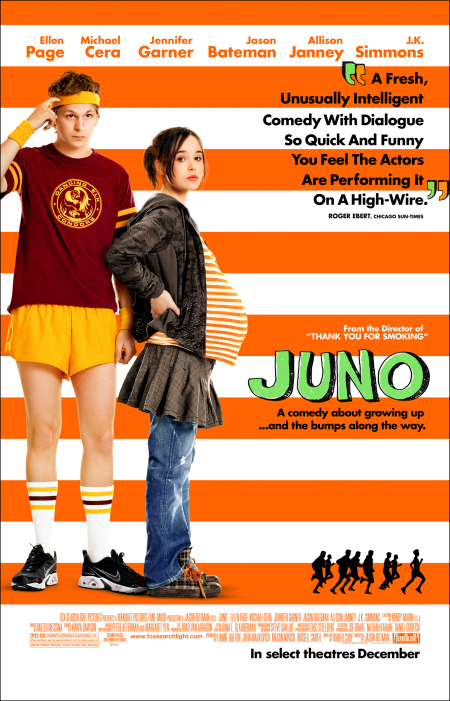
It’s time for the q-word again. Every year, it seems, there is some audience-favorite-quirky-little-indy — that category is now a genre of its own, like thriller and romantic comedy. 2006’s Little Miss Sunshine was called “this year’s Napoleon Dynamite. And in 2007, ever since it premiered at the Toronto International Film Festival, “Juno” has been called this year’s Little Miss Sunshine. All three films are modest little independent films, though the two most recent have, if not A-list superstars, certainly established A-list actors. All three are small stories about people who are not glossy, air-brushed, homogenized, safe, and stories that are not formulaic or easily classified. The movies are filled with telling details and some intriguing messiness in character and plot. Hollywood’s word for this is “quirky.” When it’s done right, it is endearing, engaging, and unforgettable, filled with people we want in our lives.
(more…)

Related Tags:


Comedy Drama Genre , Themes, and Features Movies -- format Reviews

Alvin and the Chipmunks

Posted on April 1, 2008 at 8:00 am

alvinandthechipmunks.jpg

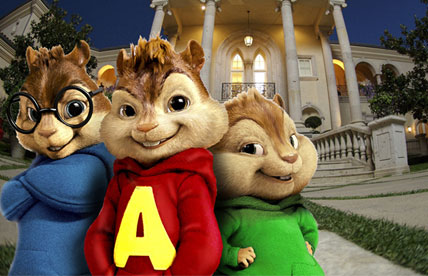
Novelty songwriter Ross Bagdasarian noticed that speeding up the audio recordings creatd a high-pitched sound in 1958, and used that technique in his song “The Witch Doctor.” It was a hit. And so, he created the singing chipmunks, Simon, Theodore, and AAAAAlvin. Their record-breaking Christmas song sold four and a half million records in seven weeks — a record not broken until the Beatles — and won two Grammy awards. The high pitch of the voices was the novelty, but what made the record a hit was the relationship between Bagdasarian, who chose the stage name Dave Seville after the Spanish town he had been stationed in during the second World War, and the chipmunks, scholarly Simon, cheery Theodore, and especially mischievous Alvin. It became a franchise, with more records, an animated television series, product endorsements, and “appearances” with real-life rock stars. What was left? A feature-length movie, inspired by the origin story. But any charm in the original idea has been diluted and all that remains is packaging. It is 9/10 product placement, 1/10 filler.

Related Tags:


Animation Comedy Family Issues Fantasy Genre , Themes, and Features Musical Reviews
THE MOVIE MOM® is a registered trademark of Nell Minow. Use of the mark without express consent from Nell Minow constitutes trademark infringement and unfair competition in violation of federal and state laws. All material © Nell Minow 1995-2026, all rights reserved, and no use or republication is permitted without explicit permission. This site hosts Nell Minow’s Movie Mom® archive, with material that originally appeared on Yahoo! Movies, Beliefnet, and other sources. Much of her new material can be found at Rogerebert.com, Huffington Post, and WheretoWatch. Her books include The Movie Mom’s Guide to Family Movies and 101 Must-See Movie Moments, and she can be heard each week on radio stations across the country.

Website Designed by Max LaZebnik