
Bruce Almighty

Posted on May 21, 2003 at 5:28 am

You could not ask for a better showcase for what Jim Carrey does best than this comedy about a man who is given all of God’s powers and has no compunction about using them for cheap thrills and petty payback. Director Tom Shadyac, who worked with Carrey on his biggest hits, “Ace Ventura” and “Liar, Liar,” once again gives us Carrey in a role designed to get the most out of his talent for wildly elastic physical comedy.

There’s a strong sense of art imitating life here, at least the life of Carrey the performer, if not Carrey the person. Carrey the performer has not had the success he hoped for in more serious roles, particularly in “The Majestic” and “The Man in the Moon.” So when his character is told throughout this movie that there is nothing wrong with being funny (and when God, played by Morgan Freeman, says “All-righty then!” Ace Ventura’s favorite catch phrase), and when he plays a character with God’s powers (which must feel pretty close to the omnipotent power our society gives to celebrities) and yet he ends up being satisfied with what makes people laugh, it is hard not to think that there is something more than resonance here for Carrey. It is almost as though he is saying “All-righty then! If this is what you want to see, here it is!” to the audience.

Carrey plays Bruce Nolan, a television news reporter who resents being assigned to silly stories like the world’s biggest cookie and the anniversary of the Niagara Falls boat tour. He wants to do serious stories and he thinks he should be the anchor. He lives with his girlfriend, Grace (Jennifer Aniston), whose name is an indication of the script’s idea of a theological reference.

Despite his love for Grace, Bruce is shallow and self-centered. When he loses the anchor job to a rival (Comedy Central “Daily Report’s” Steve Carell), he furiously explodes on the air and is fired. He tries to help a homeless man, and is beat up by thugs. Bruce thinks that life is very unfair, so he complains to God. God challenges him to try out His powers, as long as he does not tell anyone or interfere with free will.

Bruce spends the first week using the powers for cheap thrills. He parts the red soup instead of the Red Sea and makes the cars blocking him in a traffic jam move out of the way. And he enjoys petty payback. This part of the movie is fun — who would not like to be able to do anything without any guilt or accountability — and it is very funny, especially when Bruce makes his rival mess up on camera. The best physical comedians, like Carrey, perfectly enact the id out of control, the mean little imp that lives in each of our hot little hearts. That is ideal for embodying Bruce’s juvenile uses of his new power.

But then Bruce has to realize that power and responsibility go together and that he cannot be happy until he understands that other people’s happiness has to come first. That part of the movie does not work because it is pretty clear that Bruce never cares about anyone but himself. There is a hollow, hypocritical, and faintly creepy sense that the people behind the movie don’t really understand the message themselves.

Bruce’s carelessness in lassoing the moon (a reference to “It’s a Wonderful Life” that is hammered home later on when we get a glimpse of that scene on television), unleashing an asteroid, and making hundreds of lottery winners, is portrayed as humorous. Even though we get glimpses of the disasters he causes, Bruce never does and never has to clean up the mess.

When Bruce tells God that he wants to solve the problems of world hunger and peace, God tells him that is a “Miss America answer” and His goal seems to be to get Bruce to think about what would make him happy with no regard for anyone but himself and the woman he loves. And life and art come together as it becomes clear that Carrey the performer is no more generous than Bruce the anchorman; Bruce’s failure to appreciate the sweet and ever-forgiving Grace is less of a, well, sin, than Carrey’s failure to make use of the considerable comic talents of the woman who plays her. It’s a shame to see Aniston in essentially an arm candy role. The result is a movie that, despite some very funny moments, makes the same mistake as its main character without learning any lessons about maturity or responsibility. It teeters between deranged comedy and sentimental fable, and is unsatisfying in both categories. What Bruce should have used his powers for was a better script.

Parents should know that the movie has very mature material for a PG-13, including very strong language and crude humor after a thug makes a rhetorical reference to a monkey coming out of his butt. Bruce gives “pleasure” to Grace as they prepare for a sexual encounter. There is an extended joke about a dog who is not house-trained. Characters drink alcohol and Bruce uses his powers to plant bags of marijuana on rival broadcasters.

Families who see this movie should talk about what they would do if they had God’s powers. How would they decide the best way to respond to prayers? Most of the prayers in this movie are “petitionary,” meaning that they are asking for something, usually love, money, or status-related. What other kinds of prayers are there? Some families will want to discuss their own ideas about God and prayer.

Families who enjoy this movie will also enjoy “Oh God,” with George Burns and John Denver. They might like to see a different portrayal of God that also discusses the importance of free will in the wonderfully imaginative “Time Bandits.” And every family should watch and discuss “It’s a Wonderful Life” with Jimmy Stewart and Donna Reed.
Related Tags:


Comedy Fantasy Romance

Muppets From Space

Posted on December 13, 2002 at 10:52 am

Like all Muppet movies, this latest entry has plenty of jokes to keep the parents happy while the kids are enjoying the story. This time, the story focuses on a question that has intrigued Muppet fans for years: exactly what IS Gonzo? Gonzo feels alone and outcast, even in the midst of the busy Muppet group house. He dreams that Noah refuses to let him on the ark because there is only one of him, and Noah wants only pairs. But then he begins receiving messages and learns that he is an alien, and that his alien family is coming to meet him.

There is a problem, though. Edgar Singer (Jeffrey Tambor of television’s “Larry Sanders Show”), who works at a mysterious government office that tracks aliens, captures Gonzo and orders a scientist to remove his brain for study. Gonzo’s pal Rizzo the Rat is put in a cage with lab rats. Kermit, Miss Piggy, Animal, and the others set out to rescue them.

The movie has sly references to just about every space movie classic, from “The Day the Earth Stood Still” to “Independence Day” and “Men in Black” (plus “The Shawshank Redemption”), cameos from stars including Andie MacDowell, Ray Liotta, and David Arquette, and a bouncy score of rock classics. While the score draws from performers like James Brown, The Commodores and Sly and the Family Stone, the human performers are overwhelmingly white, a mistake also too often committed by the sci-fi movies so lovingly parodied. With that caveat, and with the further warning that this may not be the Muppets’ all-time best, it is a very pleasant way to spend a quick 90 minutes, and the best movie of the summer for families with younger children.

Related Tags:


Animation Based on a television show Comedy For all ages For the Whole Family Talking animals

American Pie

Posted on December 13, 2002 at 10:34 am

This is a movie about teenagers who promise each other that they will have sex before the night of the prom, and then do whatever they can to make it happen. It is one of the raunchiest and most explicit movies ever released by a major studio. The title, for example, refers to an apple pie that the main character masturbates in. A girl explains that she used her flute to masturbate. A boy ejaculates into a glass of beer. Boys hide a camera so they can broadcast pictures of a girl changing her clothes over the internet. A little boy hides in a closet so he can see teens have sex.

Parents whose kids see this movie may want to see it themselves, so they can give kids their own ideas about the appropriate ways to make responsible choices about sex, showing respect for themselves and their partners.

Related Tags:


Comedy Series/Sequel

Mary Poppins

Posted on December 13, 2002 at 5:18 am

A+
Lowest Recommended Age: Kindergarten - 3rd Grade
MPAA Rating: G
Profanity: None
Alcohol/ Drugs: None
Violence/ Scariness: None
Diversity Issues: The cause of votes for women is presented as unimportant, even daffy; subtext that parents should spend time with their children in
Date Released to Theaters: 1964
Date Released to DVD: December 09, 2013
Amazon.com ASIN: B00E9ZAT4Y

marypoppins5In honor of the upcoming “Saving Mr. Banks” and the 50th anniversary of the original film, Disney is releasing a superclifragilisticexplialidocious new edition of Mary Poppins.

Based on books by P.L. Travers (whose reluctance to allow a film to be made is the subject of “Saving Mr. Banks,” the film switches the 1930’s-era setting to the more picturesque London of 1910, where the Banks family has a loving, if rather chaotic, household. A nanny has just stormed out, fed up with the “incorrigible” children, Jane and Michael. Mr. Banks (David Tomlinson) writes an ad for a new nanny and the children compose their own, which he tears up and throws into the fireplace. The pieces fly up the chimney, where they reassemble for Mary Poppins (Julie Andrews), who is sitting on a cloud. The next day, a great wind blows away all of the nannies waiting to be interviewed, as Mary floats down.

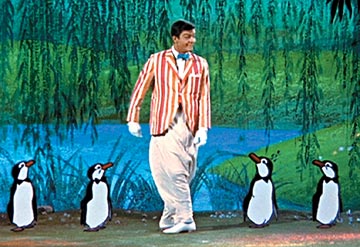
Somehow, she has a mended copy of the qualifications written by the children that Mr. Banks tore up and threw into the fireplace.  To the children’s astonishment, she slides up the banister.Out of her magically capacious carpetbag she takes out a tape measure to determine the measure of the children (“stubborn and suspicious” and “prone to giggling and not tidying up”) and her own (“practically perfect in every way”).  She directs them to clean up the nursery, and shows them how to make it into a game (“A Spoonful of Sugar Helps the Medicine Go Down”). Once it is clean, they go out for a walk, and they meet Mary Poppins’ friend Bert (Dick Van Dyke) drawing chalk pictures on the sidewalk. They hop into the picture and have a lovely time, or, rather, a “Jolly Holiday” in a mixture of live-action and animation that has Bert dancing with carousel horses and penguins.

Mary-Poppins-RooftopMary takes the children ato see her Uncle Arthur (Ed Wynn), who floats up to the ceiling when he laughs, and they find this delightfully buoyant condition is catching. Later, Mr. Banks takes the children to the bank where he works, and Michael embarasses him by refusing to deposit his tuppence because he wants to use it to buy crumbs to feed the birds. There is a misunderstanding, and this starts a run on the bank, with everyone taking out their money. Mr. Banks is fired.

Mr. Banks realizes that he has been too rigid and demanding. He invites the children to fly a kite with him. Mrs. Banks realizes that in working for the vote for women, she had neglected the children. Her work done, Mary Poppins says goodbye, and floats away.

This sumptuous production deserved its many awards (including Oscars for Andrews and for “Chim Chimeree” as best song) and its enormous box office. It is fresh and imaginative, and the performances are outstanding. (Watch the credits carefully to see that Van Dyke also plays the rubber-limbed Mr. Dawes.) The “jolly holiday” sequence, featuring the live-action characters interacting with animated ones, is superb, especially Van Dyke’s dance with the penguin waiters.

The resolution may grate a bit for today’s families with two working parents, but the real lesson is that parents should take time to enjoy their children, not that they should forego all other interests and responsibilities to spend all of their time with them.

Family discussion:  If you were writing a job notice for a nanny, what would it include?  Which of the children’s adventures did you most enjoy and why?

If you like this, try: books by P.L. Travers and the documentary about this film’s Oscar-winning song-writers, The Boys: The Sherman Brothers’ Story. And go fly a kite!

Related Tags:


Based on a book Classic Comedy DVD/Blu-Ray Pick of the Week Family Issues Fantasy For the Whole Family Musical Stories About Kids

Holiday

Posted on December 13, 2002 at 5:17 am

After a whirlwind romance at a ski resort, Johnny Case (Cary Grant) is on his way to meet his new fiancée, Julia Seton (Doris Nolan). Overwhelmed by the mansion at the address she gave him, he assumes she must be on the staff, and goes to the back door to ask about her. But she is the daughter of the wealthy and distinguished family that occupies the house. He is surprised and amused, and enjoys meeting Julia’s sister Linda (Katherine Hepburn) and brother Ned (Lew Ayres). They promise to help him win over their father, who is likely to object to the engagement, because Johnny is not from an upper-class wealthy family.

Johnny is a poor boy who has worked hard and done very well. Julia likes him because she sees a similarity to her grandfather, who made a fortune. She wants him to do the same, and tells him, “There’s nothing more exciting than making money.” But Johnny, who has just taken the first vacation of his life, only wants to make enough so that he can take a “holiday,” to “find out why I’ve been working.” As the movie begins, he is about to achieve that goal.

Linda thinks this is a great idea. She is something of an outsider in the family, forsaking the huge formal rooms of the mansion for one cozy place upstairs, which she calls “the only home I’ve got.” She tries to persuade Julia and their father that Johnny is right. Even though he completes the deal that gives him enough for his holiday, Johnny gives in and promises Julia to try it her way, and go to work for her father for a while. As her father presents them with a honeymoon itinerary and explains he is arranging for a house and servants for them, Johnny balks. He knows that if he accepts all of this, he will never be able to walk away from it. Julia breaks the engagement, and Linda joins Johnny on his holiday.

Kids should talk about why it was so important to Linda that she be allowed to give the engagement party. Why did Johnny change his mind about trying it Julia’s way? If you were going to take a holiday, what would you do? Remember, this is more than a vacation, it is more like a journey of discovery. Where would you go? What would you hope to find? How do you think people decide what jobs they want to have? Ask your parents what they thought about in choosing their jobs, and whether they ever took (or wanted to take) a “holiday.” What do you think Johhny will do at the end of his holiday? If Linda thought making money was exciting, why didn’t she want to do it herself?

Many kids will identify with the feeling of wanting to take a holiday, to step back from daily life and study the larger picture. The idea that other things are more important than making money and living according to traditional standards of success may also have some appeal. This is a good opportunity to talk with them about what success really means, and about finding the definition within yourself instead of putting too much weight on the definitions of others. There is nothing inherently wrong with making a fortune, of course, just as there is nothing inherently wrThis movie has two exceptionally appealing characters in Johnny’s friends the Potters, played by Jean Dixon and Edward Everett Horton. Their kindness and wisdom contrasts with the superficial values of the Seton family.

Cary Grant began in show business as an acrobat, and you can see him show off some of that prowess in this movie. The same stars, director, author and scriptwriter worked on another classic, “The Philadelphia Story.”


Related Tags:


Based on a play Classic Comedy Date movie For Your Netflix Queue Movie Mom’s Top Picks for Families Romance
THE MOVIE MOM® is a registered trademark of Nell Minow. Use of the mark without express consent from Nell Minow constitutes trademark infringement and unfair competition in violation of federal and state laws. All material © Nell Minow 1995-2026, all rights reserved, and no use or republication is permitted without explicit permission. This site hosts Nell Minow’s Movie Mom® archive, with material that originally appeared on Yahoo! Movies, Beliefnet, and other sources. Much of her new material can be found at Rogerebert.com, Huffington Post, and WheretoWatch. Her books include The Movie Mom’s Guide to Family Movies and 101 Must-See Movie Moments, and she can be heard each week on radio stations across the country.

Website Designed by Max LaZebnik